In-person classroom training is back, and discounts are available! Details are in the February 2023 newsletter, along with the latest online learning content—including certification prep, a fresh podcast, and new videos. Make sure to subscribe to the newsletter!

Hi Guys,
How to create a user that can have access to only one specific Zen page of an application?
Thanks
Any ideas on how this can be solved?
I need to use it with some Unicode text, in Docker image. And get this error. And documentation says nothing about it.
USER>do $zf(-100, "/SHELL", "echo", "test")
test

USER>do $zf(-100, "/SHELL", "echo", "test тест")

DO $ZF(-100, "/SHELL", "echo", "test тест")
^
<TRANSLATE>
I know that it works in some Linux environments without Docker, but no idea where is the difference.
Morning all,
I got access to the new Bing this morning and thought I would try out some things on it. Below are a series of screenshots of what I searched and the results.
Please share your experiences here too.
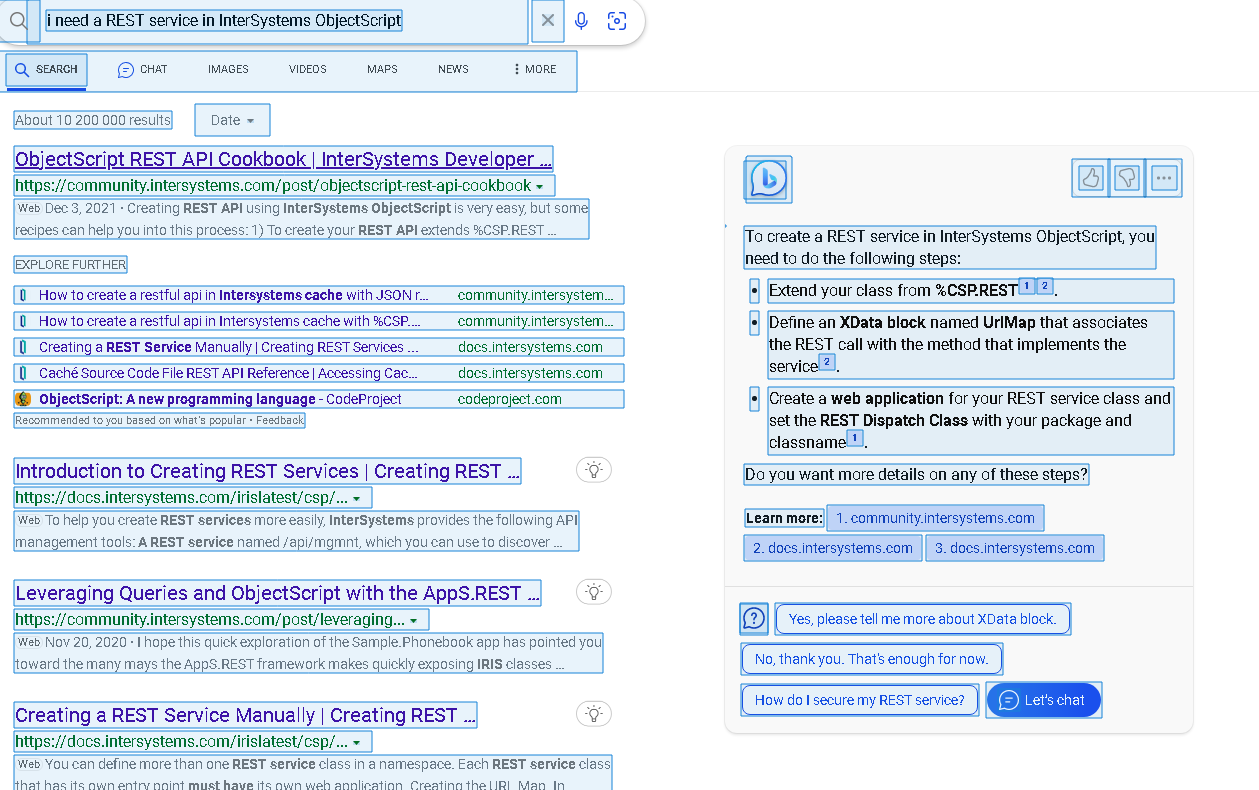
Searching for help with arrays:
A search for a Python related topic:
We have a remote opportunity for a Interface Engineer.
If you have a strong background working with InterSystems 2021.2 Let's connect.
Netsmart is one of the nation's leading EMR developers for the Post-Acute / Human Services / Senior Living Care Market.
If you would have an interest in learning more then please reach out to Gary Brown at gbrown@ntst.com
Hi Guys,
I'm looking for an easy to allow certain user to only have access to one CSP or Zen page from my application, my thoughts is to create a role to only access that specific page then allocate that role to my user, but can find the Zen page so I can allocate it to a role?
Thanks
Hi Guys,
How can I restrict access to a webpage to a specific user only?
Thanks
Has anyone had experience using IRIS as an SFTP endpoint. We want to use SFTP to receive files from a bank.
Hi, I am facing below error while sending the data from one namespace to another namespace.
ERROR <Ens>ErrFailureTimeout: FailureTimeout of 15 seconds exceeded in EnsLib.TCP.PassthroughOperation; status from last attempt was ERROR <Ens>ErrOutConnectionLost: Lost TCP Counted Read connection to xx.xxxx.xxs- detected via ERROR <Ens>ErrException: <READ>zReadCountedStream+10 ^EnsLib.TCP.CountedCommon.1|Block Count -- logged as '-'
number - @'
Else { Read tLenStr#4:pStartTimeout Set tTimedOut = '$Test }'
Sender Version is Ensemble 2017.1
Receiver version: HealthConnect:3.5.
Dear community members!
A very common problem of our users is to use an external database as data source in an IRIS production. As many of you already know, we have two ways to connect directly to an external database, the first one is using an ODBC connection, the second is using JDBC.
In our example we are going to create a connection using JDBC, and we are going to build a simple Docker's project, in this way you will be able to modify the example as you wish.
The code is available from this URL: https://github.com/intersystems-ib/workshop-sql-jgw
In our docker-compose.
Hi Community,
We've launched a nice competition on Global Masters under the "Season of Giving" campaign, which I hope will bring inspiration to all of you!
We inviting you to share your task ideas for new applications that could be developed on InterSystems Technology. Let's enrich our Open Exchange apps gallery with great applications in 2021!

is it possible to export a specific data lookup table (Ens_Util.LookupTable) directly into Recordmap or Request message class or just a list of strings for me to loop through them?
Trying to find an optimal solution for a high volume interface.
Following up on the topic of making sure that referenced instances are deleted when the referrer is deleted –
I have a compactJWE that I want to decrypt using a key. I read the key from a .pem file and create a JWK with "RSA-OAEP" algorithm. I have the code below in a routine (.mac) file.
decryptJWE
    #include %msqls
When I run it in the terminal, the previous status checks return "1" and I can also see the Objects, until the jwe.Decrypt part (jweDecryptStatus), where it returns "0" with the error message "ERROR #9723: Unsupported JOSE algorithm: A256GCM". The encrypted JWT comes from the other source, and I have no choice but to use the A256GCM algorithm.
Hi:
I don't understand how to use this open exchange item for auto creating deleting items. I think it assumes knowledge in the steps of how to use it which i don't get.
Added the code into dev on SRFT.Utility.DeleteHelper.OnDeleteSuper and SRFT.Utility.DeleteHelper.AddHelper
current class is
Class Messages.XML.GenericWif.fileparameters Extends (%Persistent, %XML.Adaptor)
{
Property revisionnumber As %String;
Property primarylink As Messages.XML.GenericWif.primarylink;
Property additionalindexes As Messages.XML.GenericWif.
Hi
I am upgrading our application from dotNet Framework to dotNet Core.
Prior to the upgrade I was able to connect to both my Cache & IRIS instances using the IRIS ADO.NET driver.
However, in dotNet Core, whilst I can connect to IRIS, I get the following error connecting to Cache.
InterSystems IRIS Provider is not compatible with Cache xDBC server
I am using the IRIS driver from the Windows (x86-64) 2022.1 distribution (the one in dev\dotnet\bin\net5.0).
The cache version is Cache for Windows (x86-64) 2018.1.2
Thanks
Hi we have started to get rid of orphaned data and would like to soon compact and truncate the database as will have about 40gb free to return to filesystem after the few weeks of running the new task.
The idea would be to do this on the shadow server first of mirror rather than primary.
Is there any reason this is a bad idea? Considering this needs done on both servers of mirrored db? As idea would be to do this on shadow server before we failover to the server a few days afterwards. And do the same for the month afterwards.
Hi Team,
Here we have requirement to send json data from on-premises iris to business service in cloud iris namespace. we have firewalls opened.
Could you please suggest any other ways with out using WEB Service (soap or rest) solution?
Thanks,
Prashanth
So I have a base string that I want to sign using RSA-SHA256. I have a .p12 file and passphrase to get the RSA Private key using NodeJS (pem.readPkcs12 library), which I don't know how to do that in intersystems as well. (would appreciate if you can include a solution for that too)
The main problem here is I am trying to sign a string and print the result to terminal, using the code below in a routine (.mac file).
We are looking for Innovators!
We invite early stage startups to join Caelestinus digital health and FHIR startup incubator for the season 2023!
Hi,
I'd like to try out irissqlcli.
My server, that has IRIS installed on it, is SUSE (SUSE Linux Enterprise Server 15 SP1).
How do install this product from GitHub? Detailed instructions would be great!
It would be best if I can download the software from GitHub and then get pip to install from that downloaded file repo.
Is there an easy way to open classes in VS Code?
In studio you go open and just type the class name and it opens up the class.
In VS Code need to know the full path, is there a quick way? It is probably the one thing preventing from using VSCode full time (apart from not seeing the .luts or csp files)
I built a dashboard to show hourly instrument capacities based on a term list. The term list consists of the TestInstrumentID and the number of tests that instrument can perform in 1 hour. The calculation works correctly and the data is accurate but periodically if you go to check the dashboard the percentages all get changed to 100% across every hour. If you check it later or add an additional site to the filter then the percentages correct themselves. I don't know what's causing this or how to troubleshoot it because it does calculate correctly but is not consistent.
Hello, I am writing some cache code that will pick up a PDF file, Base64 encode the contents and then send on to a third party system within a Long String (via their API). I have been testing this and discovered that the PDFs do not open within the supplier system (I get an error saying that it hasn't been decoded correctly). I wanted to prove that the issue does not lie with the way that I have Base64 encoded it within Ensemble, and therefore as a test wanted to Encode the PDF stream, then decode the stream and write out to a new file.
With InterSystems IRIS 2022.2, we introduced Columnar Storage as a new option for persisting your IRIS SQL tables that can boost your analytical queries by an order of magnitude. The capability is marked as experimental in 2022.2 and 2022.3, but will "graduate" to a fully supported production capability in the upcoming 2023.1 release.
The product documentation and this introductory video, already describe the differences between row storage, still the default on IRIS and used throughout our customer base, and columnar table storage and provide high-level guidance on choosing the appropriate storage layout for your use case. In this article, we'll elaborate on this subject and share some recommendations based on industry-practice modelling principles, internal testing, and feedback from Early Access Program participants.
It's time to announce the winners of the InterSystems Developer Tools Contest!
But first, we'd like to say Thank you to all our amazing participants who submitted 21 applications 🔥
We are thrilled to know that you think this subject is important! Now, without further ado, the winners are...
.jpg)
Can someone confirm that HealthShare Health Connect 2022.2 is the correct latest release that is available via the Online Distribution? I tried looking at the HealthShare Health Connect on WRC and now do not see a 2022.2 or 2022.3 version. Is this correct? So I shouldn't be running 2022.2? Did Health Connect get renamed? A couple of months ago I downloaded HealthConnect-2022.2.0.368.0-lnxrh8x64 but not seeing it now on the WRC site.
.png)
GREAT NEWS!!
Starting in April the InterSystems classroom course schedule will once again include public in-person classroom training in Cambridge.
InterSystems periodically updates our software release policies and practices to adjust to customer needs.
We're now changing our maintenance release cadence in order to be more predictable for customers and partners, and tweaking a few other areas.
This article summarizes the release cadence for our Data Platforms products and recent changes to it, and announces a few new updates.
Why change?
- Our customers are taking our new releases more quickly.
- Our customers are adopting new platforms versions (operating systems and orchestrators) more quickly.