#Best Practices

37 Followers · 307 Posts

Best Practices recommendations on how to develop, test, deploy and manage solutions on InterSystems Data Platforms better. 

InterSystems staff + admins Hide everywhere
Hidden post for admin
Article sween · Nov 7, 2019 5m read

Loading your IRIS Data to your Google Cloud Big Query Data Warehouse and keeping it current can be a hassle with bulky Commercial Third Party Off The Shelf ETL platforms, but made dead simple using the iris2bq utility.

Let's say IRIS is contributing to workload for a Hospital system, routing DICOM images, ingesting HL7 messages,  posting FHIR resources, or pushing CCDA's to next provider in a transition of care.  Natively, IRIS persists these objects in various stages of the pipeline via the nature of the business processes and anything you included along the way.  Lets send that up to Google Big Query to augment and compliment the rest of our Data Warehouse data and ETL (Extract Transform Load) or ELT (Extract Load Transform) to our hearts desire.

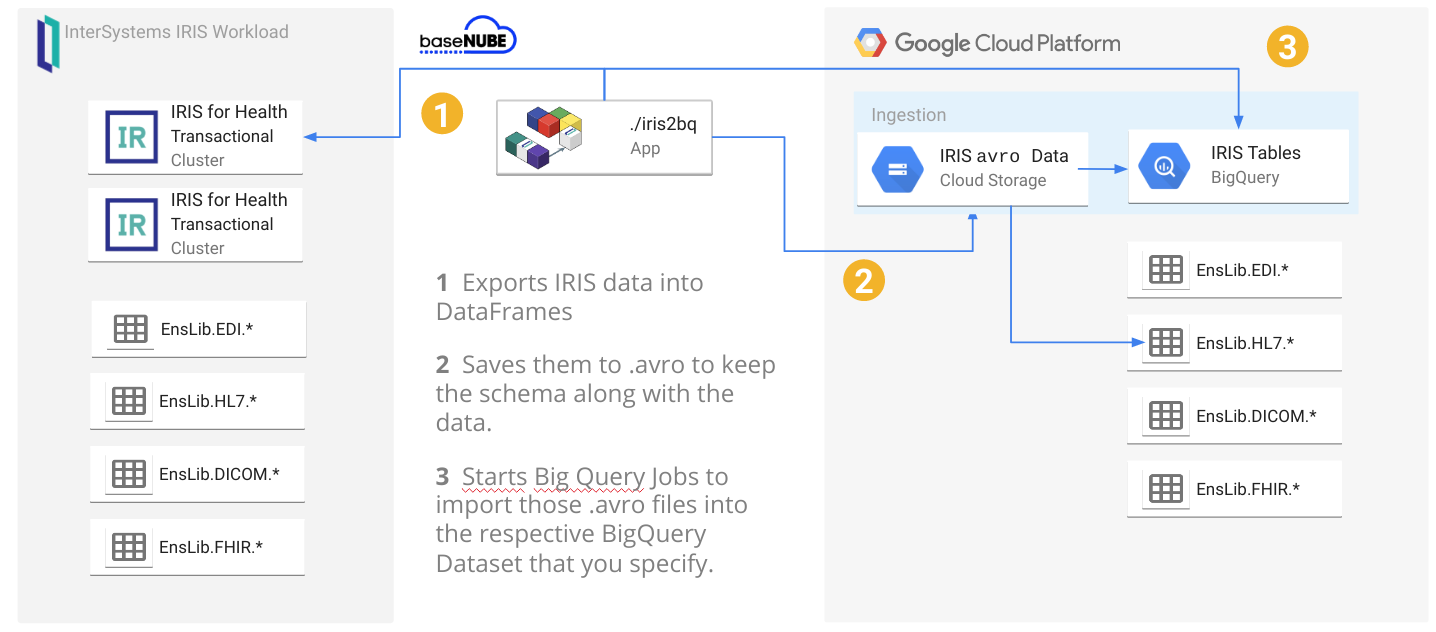
A reference architecture diagram may be worth a thousand words, but 3 bullet points may work out a little bit better:

  • It exports the data from IRIS into DataFrames
  • It saves them into GCS as .avro to keep the schema along the data: this will avoid to specify/create the BigQuery table schema beforehands.
  • It starts BigQuery jobs to import those .avro into the respective BigQuery tables you specify.
 

3
0 1325
Article Mikhail Khomenko · Aug 16, 2017 20m read

Hello! This article continues the article "Making Prometheus Monitoring for InterSystems Caché". We will take a look at one way of visualizing the results of the work of the ^mgstat tool. This tool provides the statistics of Caché performance, and specifically the number of calls for globals and routines (local and over ECP), the length of the write daemon’s queue, the number of blocks saved to the disk and read from it, amount of ECP traffic and more. ^mgstat can be launched separately (interactively or by a job), and in parallel with another performance measurement tool, ^pButtons.

10
4 3279
Article Peter Steiwer · Feb 25, 2019 1m read

AnalyzeThis is a tool for getting a personalized preview of your own data inside of InterSystems BI. This allows you to get first hand experience with InterSystems BI and understand the power and value it can bring to your organization. In addition to getting a personalized preview of InterSystems BI through an import of a CSV file with your data, Classes and SQL Queries are now supported as Data Sources in v1.1.0!

4
0 679
Article Peter Steiwer · Dec 12, 2019 2m read

DeepSeeButtons is available on Open Exchange! This tool will generate a diagnostic report of your DeepSee environment.

The report consists of multiple sections. These sections range from System Details to Caché/InterSystems IRIS logs to Cube information. In addition to simply providing information about the environment, some common recommended configurations are checked. If a recommended configuration is not used, an alert is displayed highlighting that the environment configuration does not match the recommended configuration.

1
0 552
Article Eduard Lebedyuk · Mar 14, 2018 10m read

Intro

For many in today's interoperability landscape, REST reigns supreme. With the overabundance of tools and approaches to REST API development, what tools do you choose and what do you need to plan for before writing any code? This article focuses on design patterns and considerations that allow you to build highly robust, adaptive, and consistent REST APIs. Viable approaches to challenges of CORS support and authentication management will be discussed, along with various tips and tricks and best tools for all stages of REST API development. Learn about the open-source REST APIs available for InterSystems IRIS Data Platform and how they tackle the challenge of ever-increasing API complexity. The article is a write-up for a recent webinar on the same topic.

5
6 3105
Article Patrick Jamieson · Apr 22, 2019 8m read

Launching IRIS Using Docker

This brief document will walk through the steps to launch IRIS community edition using Docker on the MAC. For those new to Docker, the first two pages explain how to install Docker, and run some basic commands that will be needed to get the IRIS community edition running. Experienced Docker users can skip directly to page three.

3
4 2521
Article Sean Connelly · Apr 12, 2017 5m read

Does anyone NOT use a debugger? I can't remember the last time I did. It's not because I don't dislike them, I just don't need to use them. The main reason for this is because I have a certain development methodology that either produces less bugs, catches them at a unit test level, or makes tracking them down much easier.

Here are my tips...

1. Write your own COS cheat-sheet.

17
6 1697
Article Pravin Barton · Mar 28, 2019 2m read

ObjectScript has at least three ways of handling errors (status codes, exceptions, SQLCODE, etc.). Most of the system code uses statuses but exceptions are easier to handle for a number of reasons. Working with legacy code you spend some time translating between the different techniques. I use these snippets a lot for reference. Hopefully they're useful to others as well.

5
23 3954
Article Peter Cooper · Mar 13, 2018 3m read

Index to Articles

Hi All

I am an avid user of ZEN for over 10 years now and it works for me.
But it seems that Intersystems are no longer actively developing it (or ZEN Mojo), the only published reference to this  is here

As an aside, Intersystems makes fine products (I have been using the technology for 35 years) and has great support BUT they are not good at being open with their product road map/retirement plans.  This is very embarrassing  to me when talking with my end user clients.

10
1 2077
Article Mark Bolinsky · Mar 21, 2017 4m read

Database systems have very specific backup requirements that in enterprise deployments require forethought and planning. For database systems, the operational goal of a backup solution is to create a copy of the data in a state that is equivalent to when application is shut down gracefully.  Application consistent backups meet these requirements and Caché provides a set of APIs that facilitate the integration with external solutions to achieve this level of backup consistency.

7
2 2947
Article Joel Solon · Oct 30, 2019 4m read

A few years ago, I was teaching the basics of our %UnitTest framework during Caché Foundations class (now called Developing Using InterSystems Objects and SQL). A student asked if it was possible to collect performance statistics while running unit tests. A few weeks later, I added some additional code to the %UnitTest examples to answer this question. I’m finally sharing it on the Community.

2
2 738
Article Murray Oldfield · Mar 25, 2016 14m read

This week I am going to look at CPU, one of the primary hardware food groups :) A customer asked me to advise on the following scenario; Their production servers are approaching end of life and its time for a hardware refresh. They are also thinking of consolidating servers by virtualising and want to right-size capacity either bare-metal or virtualized. Today we will look at CPU, in later posts I will explain the approach for right-sizing other key food groups - memory and IO.

So the questions are:

10
2 5351
Article Mikhail Khomenko · Feb 13, 2017 14m read

This post is dedicated to the task of monitoring a Caché instance using SNMP. Some users of Caché are probably doing it already in some way or another. Monitoring via SNMP has been supported by the standard Caché package for a long time now, but not all the necessary parameters are available “out of the box”. For example, it would be nice to monitor the number of CSP sessions, get detailed information about the use of the license, particular KPI’s of the system being used and such. After reading this article, you will know how to add your parameters to Caché monitoring using SNMP.

14
3 11830
Article Lexi Hayden · Jul 18, 2017 2m read

The newer dynamic SQL classes (%SQL.Statement and %StatementResult) perform better than %ResultSet, but I did not adopt them for some time because I had learned how to use %ResultSet. Finally, I made a cheat sheet, which I find useful when writing new code or rewriting old code. I thought other people might find it useful.

First, here is a somewhat more verbose adaptation of my cheat sheet:

35
4 2530
Article Henry Pereira · Apr 11, 2019 10m read


Hello everyone,

I was first introduced to TDD almost 9 year ago, and I immediately fell in love with it. 
Nowadays it's become very popular but, unfortunately, I see that many companies don't use it. Moreover, many developers don't even know what it is exactly or how to use it, mainly beginners.

Overview

My goal with this article is to show how to use TDD with %UnitTest. I will show my workflow and explain how to use cosFaker, one of my first projects, which I created using Caché and recently uploaded to OpenExchange.

So buckle up and let's go.

What is TDD?

7
10 1685
Article Alexander Koblov · Jul 29, 2016 10m read

In this article we are going to compare $Increment and $Sequence functions.

First of all, a note for readers who have never heard of $Increment. $Increment is a Caché ObjectScript function which performs an atomic operation to increment its argument by 1 and return the resulting value. You can only pass a global or local variable node as a parameter to $Increment, not an arbitrary expression. $Increment is heavily used when assigning sequential IDs. In such cases parameter of $Increment is usually a global node. $Increment guarantees that each process using it gets a unique ID.

11
5 1965
Article Sean Klingensmith · Nov 18, 2016 10m read

As a developer, you have probably spent at least some time writing repetetive code. You may have even found yourself wishing you could generate the code programmatically. If this sounds familiar, this article is for you!

We'll start with an example. Note: the following examples use the %DynamicObject interface, which requires Caché 2016.2 or later. If you are unfamiliar with this class, check out the documentation here: Using JSON in Caché. It's really cool!

##Example

2
3 3581
Article Eduard Lebedyuk · Apr 12, 2019 1m read

This series of articles would cover Python Gateway for InterSystems Data Platforms. Leverage modern AI/ML tools and execute Python code and more from InterSystems IRIS. This project brings you the power of Python right into your InterSystems IRIS environment:

  • Execute arbitrary Python code
  • Seamlessly transfer data from InterSystems IRIS into Python
  • Build intelligent Interoperability business processes with Python Interoperability Adapter
  • Save, examine, modify and restore Python context from InterSystems IRIS

Index

The plan for the series so far (subject to change).

11
9 3164
Article Michael Broesdorf · Jul 22, 2016 16m read

1.About this article

Just like Caché pattern matching, Regular Expressions can be used in Caché to identify patterns in text data – only with a much higher expressive power. This article provides a brief introduction into Regular Expressions and what you can do with it in Caché. The information provided herein is based on various sources, most notably the book “Mastering Regular Expressions” by Jeffrey Friedl and of course the Caché online documentation. The article is not intended to discuss all the possibilities and details of regular expressions. Please refer to the information sources listed in chapter 5 if you would like to learn more. If you prefer to read off-line you can also download the PDF version of this article.

11
8 6106
Article Andreas Schneider · Feb 22, 2017 2m read

I' have done some tests with Caché and Apache Zeppelin. I want to share my experince to use both systems together. I'll try to describe all steps that are required to config Zeppelin to connect to Caché.
 

What is  Apache Zeppelin?

For all who think: What the heck is Apache Zeppelin?, here some details what the project site (http://zeppelin.apache.org) says:

6
0 1517
Article Niyaz Khafizov · Jul 27, 2018 4m read

Hi all. Today we are going to upload a ML model into IRIS Manager and test it.

Note: I have done the following on Ubuntu 18.04, Apache Zeppelin 0.8.0, Python 3.6.5.

Introduction

These days many available different tools for Data Mining enable you to develop predictive models and analyze the data you have with unprecedented ease. InterSystems IRIS Data Platform provide a stable foundation for your big data and fast data applications, providing interoperability with modern DataMining tools. 

2
2 1541
Article David E Nelson · Apr 26, 2019 13m read

The last time that I created a playground for experimenting with machine learning using Apache Spark and an InterSystems data platform,  see Machine Learning with Spark and Caché, I installed and configured everything directly on my laptop: Caché, Python, Apache Spark, Java, some Hadoop libraries, to name a few. It required some effort, but eventually it worked. Paradise. But, I worried. Would I ever be able to reproduce all those steps? Maybe. Would it be possible for a random Windows or Java update to wreck the whole thing in an instant? Almost certainly.

3
7 1112
Article Kyle Baxter · Sep 9, 2016 5m read

Have some free text fields in your application that you wish you could search efficiently?  Tried using some methods before but found out that they just cannot match the performance needs of your customers?  Do I have one weird trick that will solve all your problems?  Don’t you already know!?  All I do is bring great solutions to your performance pitfalls!

As usual, if you want the TL;DR (too long; didn’t read) version, skip to the end.  Just know you are hurting my feelings.

11
2 2826
Article Eduard Lebedyuk · Feb 20, 2018 1m read

I needed to know programmatically if last ran failed or not.

After some exploring, here's the code:

ClassMethod isLastTestOk() As %Boolean{  set in = ##class(%UnitTest.Result.TestInstance).%OpenId(^UnitTest.Result)  for i=1:1:in.TestSuites.Count() {    #dim suite As %UnitTest.Result.TestSuite    set suite = in.TestSuites.GetAt(i)    return:suite.Status=0 $$$NO  }  quit $$$YES}
4
1 695
Article Murray Oldfield · Mar 15, 2018 14m read

InterSystems Data Platform includes utilities and tools for system monitoring and alerting, however System Administrators new to solutions built on the InterSystems Data Platform (a.k.a Caché) need to know where to start and what to configure.

This guide shows the path to a minimum monitoring and alerting solution using references from online documentation and developer community posts to show you how to enable and configure the following;

  1. Caché Monitor: Scans the console log and sends emails alerts.

  2. System Monitor: Monitors system status and resources, generating notifications (alerts and warnings) based on fixed parameters and also tracks overall system health.

  3. Health Monitor: Samples key system and user-defined metrics and compares them to user-configurable parameters and established normal values, generating notifications when samples exceed applicable or learned thresholds.

  4. History Monitor: Maintains a historical database of performance and system usage metrics.

  5. pButtons: Operating system and Caché metrics collection scheduled daily.

Remember this guide is a minimum configuration, the included tools are flexible and extensible so more functionality is available when needed. This guide skips through the documentation to get you up and going. You will need to dive deeper into the documentation to get the most out of the monitoring tools, in the meantime, think of this as a set of cheat sheets to get up and running.

1
8 2443
Article Eduard Lebedyuk · Mar 7, 2018 7m read

In this series of articles, I'd like to present and discuss several possible approaches toward software development with InterSystems technologies and GitLab. I will cover such topics as:

  • Git 101
  • Git flow (development process)
  • GitLab installation
  • GitLab Workflow
  • Continuous Delivery
  • GitLab installation and configuration
  • GitLab CI/CD

In the previous article, we covered Git basics, why a high-level understanding of Git concepts is important for modern software development, and how Git can be used to develop software. Still, our focus was on the implementation part of software development, but this part presents:

  • GitLab Workflow - a complete software life cycle process - from idea to user feedback
  • Continuous Delivery - software engineering approach in which teams produce software in short cycles, ensuring that the software can be reliably released at any time. It aims at building, testing, and releasing software faster and more frequently.
1
3 3471