#Tips & Tricks

12 Followers · 325 Posts

Pieces of experience in InterSystems Technology which solve some particular problem in elegant or unusual way.

Article Tani Frankel · Dec 8, 2022 1m read

When creating a PRA (Privileged Routine Application; which by the way is not relevant just for Routines but also for Classes/Methods), it is important to make sure you include a new $ROLES, before calling AddRoles(). For example:

new$ROLESset status=$System.Security.AddRoles("MyPrivilegedRoutineApplication")

This way you ensure that indeed the added (elevated) roles "evaporate" for the User running this code, once the User is out of the scope of that routine/method.

[Thank you @Andreas Dieckow for validating this]

3
0 340
Article Suriya Narayanan Suriya Narayanan Vadivel Murugan · Nov 12, 2016 5m read

In this article, we will discuss about Orphaned Messages.

What is an Orphaned Message

Every message body is associated with a message Header which holds the metadata. The Header holds information like source configuration name, target configuration name, time created, time processed, associated message body reference, session information, message body class name, message status. When there are message body records that do not have their corresponding Header records those are called Orphan message bodies. We will discuss possible causes which could end up with orphan message bodies.

Purging only

5
8 4767
Article Timothy Leavitt · May 12, 2016 6m read

The topic of for/while loop performance in Caché ObjectScript came up in discussion recently, and I'd like to share some thoughts/best practices with the rest of the community. While this is a basic topic in itself, it's easy to overlook the performance implications of otherwise-reasonable approaches. In short, loops iterating over $ListBuild lists with $ListNext or over a local array with $Order are the fastest options.

As a motivating example, we will consider looping over the pieces of a comma-delimited string.

A natural way to write such a loop, in minimal code, is:

For
21
5 10117
Discussion Jose-Tomas Salvador · Oct 21, 2022

Good morning, evening, night,... wink

A small reflection/question for today... it's true that new IRIS for Health (I4H) releases are more and more powerful each time regarding FHIR capabilities. Nowadays it allows us to consume FHIR resources with extrem easiness, we can connect with end-points in external FHIR servers very easily and make I4H act as passthrough or consume their resources... or, even more, we can define, configure and run a FHIR repository in, literally, less than 5 minutes.

3
0 426
Article Kurro Lopez · Mar 1, 2022 5m read

Good men don’t need rules.

The Doctor.

It's not an easy task to be a master of dates and times, it is always a problem and sometimes confusing in any programming language, we are going to clarify and put a few tips to make this task as simple as possible.

Get on the TARDIS and I'm going to turn you into a Time lord

Tardis

3
1 864
Article Steve Wilson · Oct 13, 2022 3m read

I have recently come across a problem saving TrakCare reports as PDF files while using the MS Edge browser on a Windows 10 PC. Whenever a user selected the Save to PDF option the window Tab would crash and reset. The event was trapped and viewable in the Windows Events Viewer and showed a Fault in the AcroPDFImpl64.dll. Even a little research on the Internet showed me that this has been an issue for many and for quite some time – not just in TrakCare, but many other non-InterSystems applications.

The root cause seems to be with a security update that Adobe applied to all their document

0
0 2209
Article Katherine Reid · Aug 26, 2016 2m read

Question:

What version of Caché supports TLS v1.2? 

Answer:

Caché 2015.2 announced support for TLS v1.1 and v1.2.  In this version, the SSL/TLS configuration page provides checkboxes for TLS v1.1 and v1.2, which allows the versions to be configured individually.  This allows sites to, for example, require TLS v1.2 only.

Additionally, some earlier versions of Caché provide undocumented support for TLS v1.1 and v1.2, specifically Caché 2014.1.3 and above and 2015.1, on Windows, Linux and Unix.

Here’s why:  Caché uses the openssl library for SSL/TLS.

1
0 2453
Article Yuri Marx · Aug 9, 2021 3m read

Hi Community,

The InterSystems Learning Website has many important iterative courses. So if you want to learn about InterSystems and start to work with InterSystems this is the path:

Overview:

Fundamentals:

21
8 2329
Article Sylvain Guilbaud · Apr 19, 2022 2m read

Kong provides an open source configuration management tool (written in Go), called decK (which stands for declarative Kong)

  • Check that decK recognizes your Kong Gateway installation via deck ping
deck ping   
Successfully connected to Kong!
Kong version:  2.3.3.2-enterprise-edition
  • Export Kong Gateway configuration to a file named "kong.yaml" via deck dump
deck dump
  • After modifying the kong.yaml, show the differences via deck diff
deck diff
updating service alerts  {
   "connect_timeout": 60000,
-  "host": "172.24.156.176",
+  "host": "192.10.10.18",
   "id":
0
0 816
Article Kurro Lopez · Mar 4, 2022 4m read

Time travel is like visiting Paris. You can't just read the guide, you have to throw yourself into it. Eat the food, use the wrong verbs, get double the charges, and end up kissing complete strangers.

The Doctor

We are now going to travel through time, that is, we are going to see future and past dates and how to calculate them in different formats. The TARDIS doesn't wait, take the controls and hold on tight.

Travel in TARDIS

5
0 624
Article Peter Steiwer · Nov 26, 2019 3m read

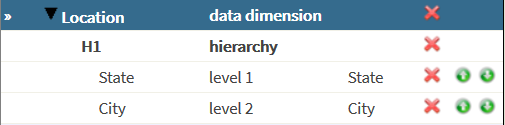
When designing a hierarchy in DeepSee, a child member must have only one parent member. In the case where a child corresponds to two parents, the results can become unreliable. In the case where two similar members exist, their keys must be changed so that they are unique. We will take a look at two examples to see when this happens and how to prevent it.

Example 1

There are a handful of states with a city named Boston. In my sample data, I have records from both Boston, MA and Boston, NY. My dimension is defined as:

City and State are simply strings in my case.

1
1 946
Article Evgeny Shvarov · Feb 19, 2022 2m read

Hi developers!

As you probably noticed in IRIS 2021 the names of globals are random.

And if you create IRIS classes with DDL and want to be sure what global was created you probably would want to provide a name.

And indeed you can do it. 

Use WITH %CLASSPARAMETER DEFAULTGLOBAL='^GLobalName' in CREATE Table to make it work. Documentation. See the example below:

11
0 707
Article Evgeny Shvarov · Feb 19, 2022 2m read

Hey developers!

Sometimes we need to insert or refer to the data of classes directly in globals.

And maybe a lot of you expect that data structure of global with records is:

^Sample.Person(Id)=$listbuild("",col1,col2,...,coln).

And this article is a heads up, that this is not always true, don't expect it as granted!

1
0 482
Article Muhammad Waseem · Jan 11, 2022 2m read

In this article I will explain the usage of %SQL_Diag.Result and %SQL_Diag.Message table along with all-new LOAD DATA functionality.

It is recommended to go through LOAD DATA documentation first. 

After successful operation LOAD DATA insert one record in %SQL_Diag.Result table and details are inserted in %SQL_Diag.Message table


Below is the basic command when table is already created and source file does not contain header row. 

LOAD DATA FROM FILE 'C://TEMP/mydata.txt' 
INTO MyTable

The file name must include a .txt or .csv (comma-separated values) suffix and both source and target have the same sequence of data columns.

Loading from File Source: Header

1
0 358
Article Jose-Tomas Salvador · Nov 9, 2021 3m read

For some years I missed being able to offer, to everybody interested in ObjectScript, a tutorial more or less complete, to start with ObjectScript. Something that could help more and make things easier to those new developers that come to our technology... something intermediate, halfway between the common "Hello World!", that doesn't really get you further, and the "Advanced Training", that is unaffordable because of lack of time,etc.

If there were something truly helpful not only as an introduction to the ecosystem, but as a starting point, as a boost, to really start to walk into ObjectScript and move forward by yourself... wouldn't that be awesome?

7
1 875
Article Oliver Wilms · Jan 16, 2022 2m read

I participate in InterSystems Datasets Contest. I created dataset-finance and analyze-dataset-finance apps along with Online Demo.

The username is _SYSTEM and password is SYS. I created an online demo with a pretty dashboard here:

 https://finance.demo.community.intersystems.com/dsw/index.html#/login?from=%2FUSER%2FGenerated%2FSamples%20for%20finance.dashboard

 I wanted to create my own pivot table and went to regular management portal:

 https://finance.demo.community.intersystems.com/csp/sys/UtilHome.csp

 We can access Analyzer in USER namespace directly: 

https://finance.demo.community.intersystem

0
0 228
Article Evgeny Shvarov · Jan 9, 2022 2m read

Hi folks!

Sometimes we need the docker image of the InterSystems IRIS solution we build to be published on some docker registry. The cases could be:

  1. Deploy it then in Kubernetes cluster
  2. Let your pal run the image of your public repo without building it locally.

You can push the image to Docker Hub Registry or Github Registry.

In this very short article, I provide a way how to do it automatically on every push to your GitHub repository.

0
2 373
Article Sylvain Guilbaud · Oct 6, 2016 3m read

to dismount/mount a database, use Dismount() and Mount() methods in SYS.Database class available in %SYS namespace.
NB: the database ID is its Directory

You'll find  some examples of how to dismount/mount and check if a database is mounted (Mounted=1) or not (Mounted=0), and quickly see all the attributes of a database (via zwrite)


%SYS>set db="/opt/irisapp/data" 

%SYS>w ##class(SYS.Database).%OpenId(db).Mounted                     
1
%SYS>w ##class(SYS.Database).%OpenId(db).Dismount()
1
%SYS>w ##class(SYS.Database).%OpenId(db).Mounted   
0
%SYS>w
2
1 2905
Article David Hockenbroch · Nov 12, 2021 7m read

Pouring The Coffee: Creating and scheduling a task

Don't you wish a fresh, hot cup of coffee could be waiting for you right when you get into the office? Let's automate that!

Cache and IRIS come with a built-in Task Manager, which should have a familiar feel to those used to using the Windows task scheduler or using cron on Linux. Your user account will need access to the %Admin_Task resource to use it, and you can access it in the management portal under System Operation -> Task Manager. When first installed, there are roughly 20 types of task that you can schedule.

If you want to add your own

7
6 1823
Article Jean Millette · Nov 5, 2021 2m read

One of our apps uses a class query to support a ZEN Report and works just fine in that report, producing the expected results every time. We’ve since migrated to InterSystems Reports and noticed that, for a report using the same class query, 100s of extra rows with the same column values appear at its bottom.

We eliminated InterSystems Reports as the source of the problem by recreating the same “extra rows” issue with an Excel spreadsheet calling the same class query as a stored procedure.

What was the issue?

0
1 374
Article Evgeny Shvarov · Aug 5, 2021 1m read

Hi folks!

Want to share a lifehack with you on ObjectScript highlighiting withing VSCode for script files.

Script files are just files with lines of ObjectScript that we feed anywhere, e.g. into IRIS during Docker baking procedure.

Typical usecase - here is the Scriptfile

here is the Dockerfile where we feed it.

And here is how it looks like usually in VSCode:

Screenshot 2021-08-05 at 09 51 06

Coudl be more beautiful, right?

0
0 568
Article Jose-Tomas Salvador · Apr 8, 2020 6m read

This time I want to talk about something not specific to InterSystems IRIS, but that I think is important if you want to work with Docker and your server at work is a PC or laptop with Windows 10 Pro or Enterprise.

As you likely know, containers technology comes basically from Linux world and, nowadays, is on Linux hosts were it shows maximum potential. Those who use Windows on a normal basis see that both, Microsoft and Docker, have done important efforts during these last years that allow us to run containers based on Linux images on our Windows system in a really easy way... but it's something not supported for production systems and, this is the big problem, is not reliable if we want to keep persistent data outside of containers, in the host system,... mostly due to the big differences between Windows and Linux file systems. In the end, Docker for Windows itself uses a small linux virtual machine (MobiLinux) to run the containers... it does it transparently for the windows user... and it works perfectly well if, as I said, you don't require that your databases survive longer than the container...

Well,...let's get to the point,... the point is that many times, to avoid issues and simplify, we need a full Linux system and, if our server is based on Windows, the only way of having it is through a virtual machine. At least till WSL2 in Windows is released, but that will be another story and sure it'll take a bit of time to become robust enough.

In this article, I'll tell you, step by step, how to install an environment where you'll be able to work, if you need it, with Docker containers on an Ubuntu system in your Windows server. Let's go...

11
3 29872