#Monitoring

5 Followers · 179 Posts

Monitoring is a process of controlling and management of performance and availability of software applications.

Article Sean McKenna · Aug 26, 2016 8m read

Enterprise Monitor is a component of Ensemble and can help organizations monitor multiple productions running on different namespaces within the same instance or namespaces running on multiple instances.

Documentation can be found at:

http://docs.intersystems.com/ens20161/csp/docbook/DocBook.UI.Page.cls?KEY=EMONITOR_all#EMONITOR_enterprise

In Ensemble 2016.1 there were changes made to make this utility work with HealthShare environments.

This article will:

  • Show how to set up Enterprise Monitor for HealthShare sites
  • Show some features of Enterprise Monitor
  • Show some features of Enterprise Message Viewer

For this article, I used the following version of HealthShare:

Cache for Windows (x86-64) 2016.1 (Build 656U) Fri Mar 11 2016 17:42:42 EST [HealthShare Modules:Core:14.02.2415 + Linkage Engine:14.02.2415 + Patient Index:14.02.2415 + Clinical Viewer:14.02.2415 + Active Analytics:14.02.2415]

2
0 1610
Article Oliver Wilms · May 30, 2022 1m read

InterSystems Production Monitor is a page in Management Portal to display monitoring information for the current running production. I like the page as it comes, but one size does not fit all.

On May 13, 2022 I read this post on Developer Community:

https://community.intersystems.com/post/creating-custom-monitoring-page

I agree with Mark that Production Monitor is complex. I liked the idea to create a nice clean clear monitor page.

I began to work on a Cache Server Page utilizing class methods to provide the production data.

I shared my first attempt with Mark.

2
1 520
Article Murray Oldfield · Nov 14, 2019 6m read

Released with no formal announcement in IRIS preview release 2019.4 is the /api/monitor service exposing IRIS metrics in Prometheus format. Big news for anyone wanting to use IRIS metrics as part of their monitoring and alerting solution. The API is a component of the new IRIS System Alerting and Monitoring (SAM) solution that will be released in an upcoming version of IRIS.

However, you do not have to wait for SAM to start planning and trialling this API to monitor your IRIS instances.

2
7 2278
Article Yubo Mao · Feb 3, 2023 3m read

Overview

With the gradual improvement of hospital information construction, there are more and more business interfaces in hospitals. Due to the influence of various factors (network, consumer system, etc.), the data processing of business interface may cause excessive message accumulation and even the situation of interface card congestion, which affects the normal business development in the hospital. Therefore, the monitoring of the queue of business interface components becomes more and more important.

2
0 658
Article Yubo Mao · Feb 7, 2023 3m read

1. Overview

With more and more hospital applications built, business interface data processing may be affected by a variety of factors (network, consumer systems, etc.), there is an excessive accumulation of messages or even cause interface lag, affecting the routine performance of hospital IT systems , so the monitoring of the business interface components queue is increasingly important.

While current Intersystems IRIS platform's built-in queue monitoring  only displays real-time queue information for interface components, which is limited in providing the queue data information needed by hospitals. The queue monitoring component program is based on the Intersystems IRIS platform and can monitor all interface components and display component queue information within 24h of the component, as well as query component historical queue data by setting a time period to better meet the needs of current in-hospital applications.

1
0 420
Article Alex Woodhead · Jan 28, 2023 3m read

Some Usage cases

1. A deployment may consist of two high availability instances and two disaster recovery instances in a different data center.

The corresponding UAT environment could replicate this giving a total of 8 instances. How do you confirm CPF and Scheduled task alignment across ALL instances.

2. Another team (possibly in anther organization) makes changes to an IRIS instance to correct a problem, improve security, or modify shared system task configuration. Capture the CPF before and after to see what was done across instances.

2
0 564
Question Mark Charlton · Jan 20, 2023

I've been trying for a while to come up with a set of tools to monitor the health of a mirror set and email a report nightly on the status of the mirror, or flag issues in real time.
Making sure that all the databases are caught up, that all the mirror members are online. 

I've tried a number of methods I've found to try to access the state of the mirror and mostly found they're internal or unsupported routes, (that when questioning WRC have swiftly been removed from the online documentation.).

2
0 556
Question Rob Schoenmakers · Dec 21, 2022

Hello everybody,

In the documentation I read the following:

Alerts are messages generated by production components. InterSystems IRIS automatically writes the alerts to a log file and sends then to the production component named Ens.Alert. If your production does not have a component named Ens.Alert, then InterSystems IRIS writes alerts to the log file but does not send them to any component. The component named Ens.Alert can be of any class. The most frequently used classes for Ens.Alert are:

I am not able to find the log file where the alerts are stored.

3
1 394
Article Murray Oldfield · Nov 18, 2019 8m read

The following steps show you how to display a sample list of metrics available from the /api/monitor service.

In the last post, I gave an overview of the service that exposes IRIS metrics in Prometheus format. The post shows how to set up and run IRIS preview release 2019.4 in a container and then list the metrics.


This post assumes you have Docker installed. If not, go and do that now for your platform :)


Step 1. Download and run the IRIS preview in docker

Follow the download instructions at Preview Distributions to download the Preview Licence Key and an IRIS Docker image

10
6 1697
Article Suriya Narayanan Suriya Narayanan Vadivel Murugan · Nov 12, 2016 5m read

In this article, we will discuss about Orphaned Messages.

What is an Orphaned Message

Every message body is associated with a message Header which holds the metadata. The Header holds information like source configuration name, target configuration name, time created, time processed, associated message body reference, session information, message body class name, message status. When there are message body records that do not have their corresponding Header records those are called Orphan message bodies. We will discuss possible causes which could end up with orphan message bodies.

5
8 4831
Article David Loveluck · Feb 25, 2019 4m read

There have been some very helpful articles in the community that show how to use Grafana with IRIS (or Cache/Ensemble) by using an intermediate database.

But I wanted to get at IRIS structures directly. In particular, i wanted to access the Cache History monitor data that is accessible by SQL as described here

https://community.intersystems.com/post/apm-using-cach%C3%A9-history-mo…

and didn't want anything between me and the data.

I already had class queries that returned the data i wanted, so i just needed to embed them in a REST class that returned JSON. I haven't included my class Grafana.

5
4 1789
InterSystems Official Bob Kuszewski · Nov 9, 2022

InterSystems is pleased to announce the release of System Alerting & Monitoring (SAM) version 2.0.

What is SAM?

SAM marries IRIS’s standards-based Monitoring API and Log Monitor with familiar industry standard tools like Grafana and Prometheus to create a basic monitoring and alerting solution for IRIS clusters.

For more on SAM, see the System Alerting and Monitoring Guide.

What’s new in SAM 2.0?

The industry standard tools that SAM relies on have all been upgraded. 

Configuration Export & Import – You can now export your SAM configuration and re-import it into another SAM instance.

0
1 573
Question Piotr Stefańczyk · Oct 26, 2022

Hello

I have a problem on enabling SNMP monitoring on Cache.

I installed on HP UX NET SNMP 5.7.2 package from HP Software Center and enabled agentX protocol in snmpd.cfg. 

When I enabled full debugging on Cache and NET SNMP I discovered that sent and received packets on both sides are not the same. Some bytes are different. I think the problem is in default charset for TCP/IP connection which is on our system set to CP1250 instead of default RAW. So result is that Cache notifies are not visibile from snmpwalk etc.

Is there a solution for this issue? 

Peter

4
0 299
Question Alfredo Neto · Oct 13, 2022

Hello,

I am currently having the experience activating prometheus for iris db.

This environment that I speak uses IKO as a base.

I need to put 3 notes in the iris service area.

Are they:

annotations:
   prometheus.io/path: "/monitor/metrics"
   prometheus.io/port: "52772"
   prometheus.io/scrape: "true"

I'm not finding this possibility in the IKO documentation.

Has anyone had this experience and can help us with this challenge?

 Below is the current configuration we made, however, it did not create the annotations we need

apiVersion: intersystems.com/v1alpha1
kind: IrisCluster
metadata:
  name: iris-db-teste
  annotations:
    prometheus.io/scrape: "true"
    prometheus.io/path: "/api/monitor/metrics"
    prometheus.io/port: "52773"
spec:
  licenseKeySecret:
    name: licenca-iris
  configSource:
    name: iris-cpf
  topology:
    data:
      shards: 2
      mirrored: true
      image: CONTAINER_IMAGE
      podTemplate:
        spec:
          args:
            - --check-caps
            - "false"
      storageDB:
        resources:
          requests:
            storage: 10Gi
        storageClassName: iris-ssd-storageclass
  serviceTemplate:
    spec:
      type: ClusterIP
4
0 309
Article David Underhill · Jul 12, 2019 2m read

This is a self contained class that can be run from the Intersystems Task Scheduler which records peak usage details for databases and licenses built up throughout the day and retaining 30 days history.

To schedule the task to run every hour:  

d ##class(Metrics.Task).Schedule()

You can also specify your own start time, stop time, and run interval:

d ##class(Metrics.Task).Schedule(startTime, stopTime, intervalMins)

Metrics are stored in ^Metrics in the namespace that the class resides in/is run from.

3
3 653
Article Paul Hurley · Aug 17, 2022 1m read
IrisStat options
a All
b bits
c counters
d dump processes
e error log
f global module flags
g ^GLOSTAT info
h irisstat usage
j journal
k prefetch daemons
l LRU global buffers
m GFILETAB
n network
o clear irisstat
p processes
q hibernation semaphores
s irisstat exe directory
t run irisstat in loop
u locks
v Check versions
w write daemon queues
B Blocks in GBFSPECQ
C inter-job comms
D sample block collisions
E cluster status
G
0
0 485
Article Murray Oldfield · Apr 27, 2016 11m read

InterSystems Data Platforms and performance - Part 5 Monitoring with SNMP

In previous posts I have shown how it is possible to collect historical performance metrics using pButtons. I go to pButtons first because I know it is installed with every Data Platforms instance (Ensemble, Caché, …). However there are other ways to collect, process and display Caché performance metrics in real time either for simple monitoring or more importantly for much more sophisticated operational analytics and capacity planning.

8
2 4672
Announcement Anastasia Dyubaylo · May 15, 2020

Hey Developers,

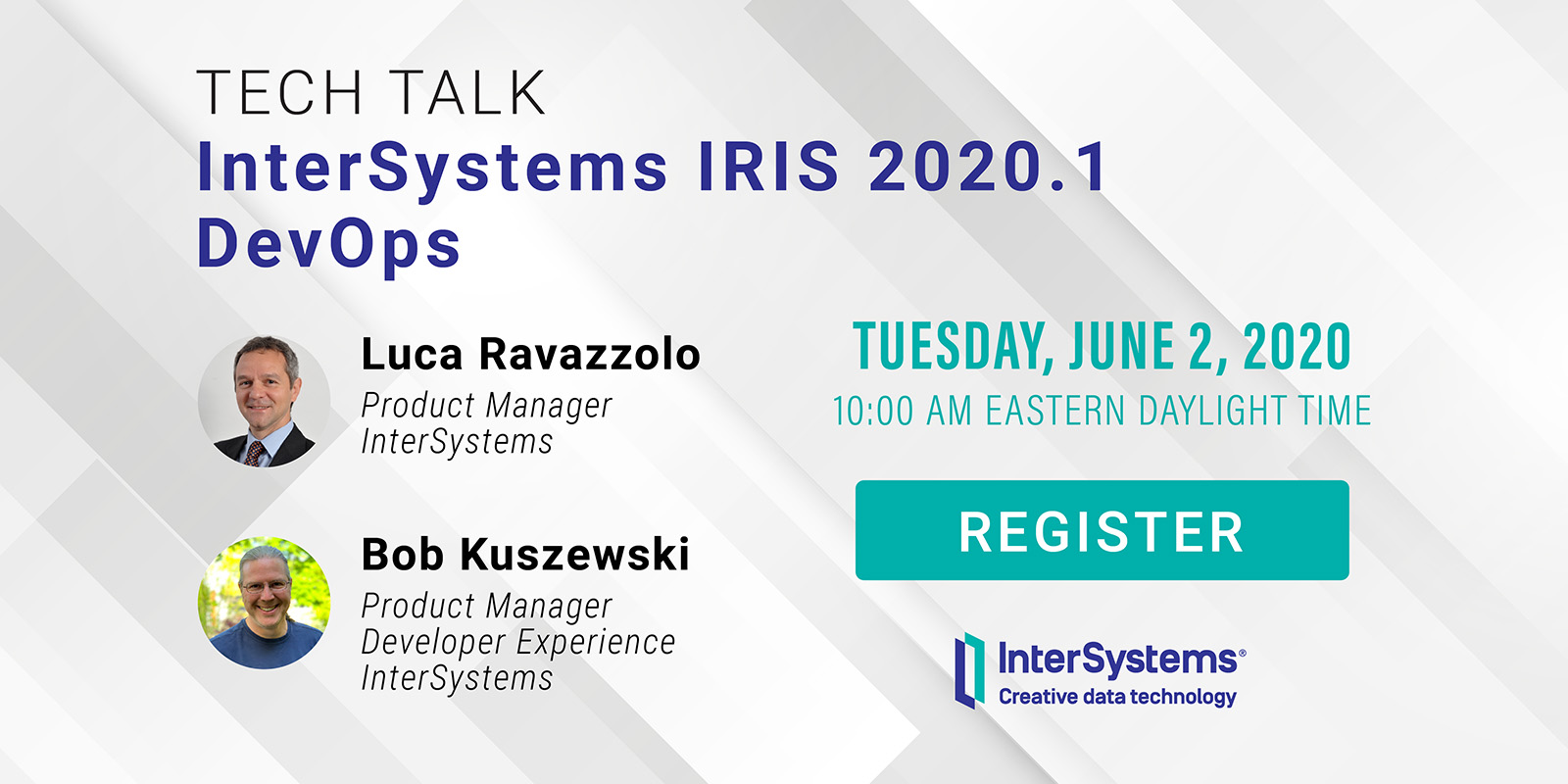
We're pleased to invite you to join the nextInterSystems IRIS 2020.1 Tech Talk: DevOpson June 2nd  at 10:00 AM EDT!

In this InterSystems IRIS 2020.1 Tech Talk, we focus on DevOps. We'll talk about InterSystems System Alerting and Monitoring, which offers unified cluster monitoring in a single pane for all your InterSystems IRIS instances. It is built on Prometheus and Grafana, two of the most respected open source offerings available.

Next, we'll dive into the InterSystems Kubernetes Operator, a special controller for Kubernetes that streamlines InterSystems IRIS deployments and management. It's the easiest way to deploy an InterSystems IRIS cluster on-prem or in the Cloud, and we'll show how you can configure mirroring, ECP, sharding and compute nodes, and automate it all.

Finally, we'll discuss how to speed test InterSystems IRIS using the open source Ingestion Speed Test. This tool is available on InterSystems Open Exchange for your own testing and benchmarking. 


6
1 666
Question Mark OReilly · May 13, 2022

Hi:

Currently we are using an older Healthshare instance but I am not opposed to using IRIS as we will upgrade eventually. 

Currently for monitoring productions we have a Montior screen. We have both the Queues page and a Deepsee dashboard which has current status of our services. The issue with the Deepsee method we currently have with traffic lights is 1) the page is a bit slow to load the metrics 2) any new services from the team  a new widget needs created and although this is easy enough to do it just is time consuming.

5
0 532
Announcement Shane Nowack · May 23, 2022

Hello IRIS Community,

InterSystems Certification is developing a certification exam for IRIS system administrators and, if you match the exam candidate description given below, we would like you to beta test the exam. The exam will be available for beta testing on June 20-23, 2022 at InterSystems Global Summit 2022, but only for Summit registrants (visit this page to learn more about Certification at GS22) . Beta testing will open for all other interested beta testers on July 18, 2022. However, interested beta testers should sign up now by emailing certification@intersystems.com

0
4 1520
InterSystems Official Bob Kuszewski · Apr 30, 2022

InterSystems is pleased to announce the release System Alerting & Monitoring (SAM) version 1.1.

What is SAM?

SAM marries IRIS’s standards-based Monitoring API and Log Monitor with familiar industry standard tools like Grafana and Prometheus to create a basic monitoring and alerting solution for IRIS clusters.

For more on SAM, see the System Alerting and Monitoring Guide.

What’s new in SAM 1.1?

You’ll notice performance improvements for the Grafana dashboard graphs, especially when working with large data sets.  If you’re upgrading from SAM 1.

3
0 501
Article Mario Sanchez Macias · Apr 27, 2022 3m read

From time to time, we get the previous question in support, something or someone is using more licenses than expected, and we need to find what. 

We have two scenarios. The first scenario is when we realize that the licenses are exhausted when the application does not work or when we try to connect through the terminal and get the "lovely"

<LICENSE LIMIT EXCEEDED> message: 

The second scenario is when the end-user complains they could not use the application at some time, and we are late to see the problem when it is happening.

1
0 1021
Article David Loveluck · Aug 27, 2019 28m read

Since Caché 2017 the SQL engine has included new set of statistics. These record the number of times a query is executed and the time it takes to run.

This is a gold mine for anyone monitoring and trying to optimize the performance of an application that includes many SQL statements but it isn’t as easy to access the data as some people want.

This article and the associated sample code explains how to use this information and how to routinely extract a summary of daily statistics and keep a historic record of the SQL performance of your application.

What is recorded?

7
6 1778
Question Michael Jobe · Jan 26, 2021

The current version of SAM creates Prometheus metric endpoints which appear to be handled correctly by the current prometheus scraper, however the metrics do not confirm to the current prometheus standard.  The standard states: 

  • Prometheus' text-based format is line oriented. Lines are separated by a line feed character (\n). The last line must end with a line feed character. Empty lines are ignored.

Link is here: Prometheus format

In the current output on the

<hostname>:8080/api/monitor/metrics

endpoint the last metric does not contain a newline causing parsers to fail.

9
0 515
Article Jon Sue-Ho · Nov 17, 2016 2m read

The MONITOR process (also called the Caché Monitor) scans the messages in your cconsole.log file and sends you emails based on the severity of those messages.  The MONITOR is configured using the ^MONMGR utility in terminal.

The MONITOR should not be confused with the similarly named System Monitor, which checks a variety of system health and performance metrics and can log messages regarding them to the cconsole.log, where they can then be scanned by the MONITOR.

The process begins automatically at Caché startup and scans your cconsole.

6
2 1575
Question Lucas Galdino · Jan 18, 2022

Hi everyone,

Im trying configure the Caché Monitor Manager (^MONMGR) utility for send alert e-mails.
Following the steps I have doubs to configure the options in "Set Server" to send e-mails for hotmail or outlook (smtp-mail.outlook.com).
I dont know how can I configure Mail server SSLConfiguration for hotmail or outlook.
Could you give me help?
Thank you! wink

Mail server? mail.outlook.com (Enter '-' to reset) =>
Mail server port? 587 =>
Mail server SSLConfiguration?
Mail server UseSTARTTLS? 0 =>

2
0 565