#Development Environment

5 Followers · 381 Posts

An integrated development environment (IDE) is a software application that provides comprehensive facilities to computer programmers for software development.

The official IDE for InterSystems Data Platform products is Atelier.

Article Dmitry Maslennikov · Sep 25, 2024 1m read

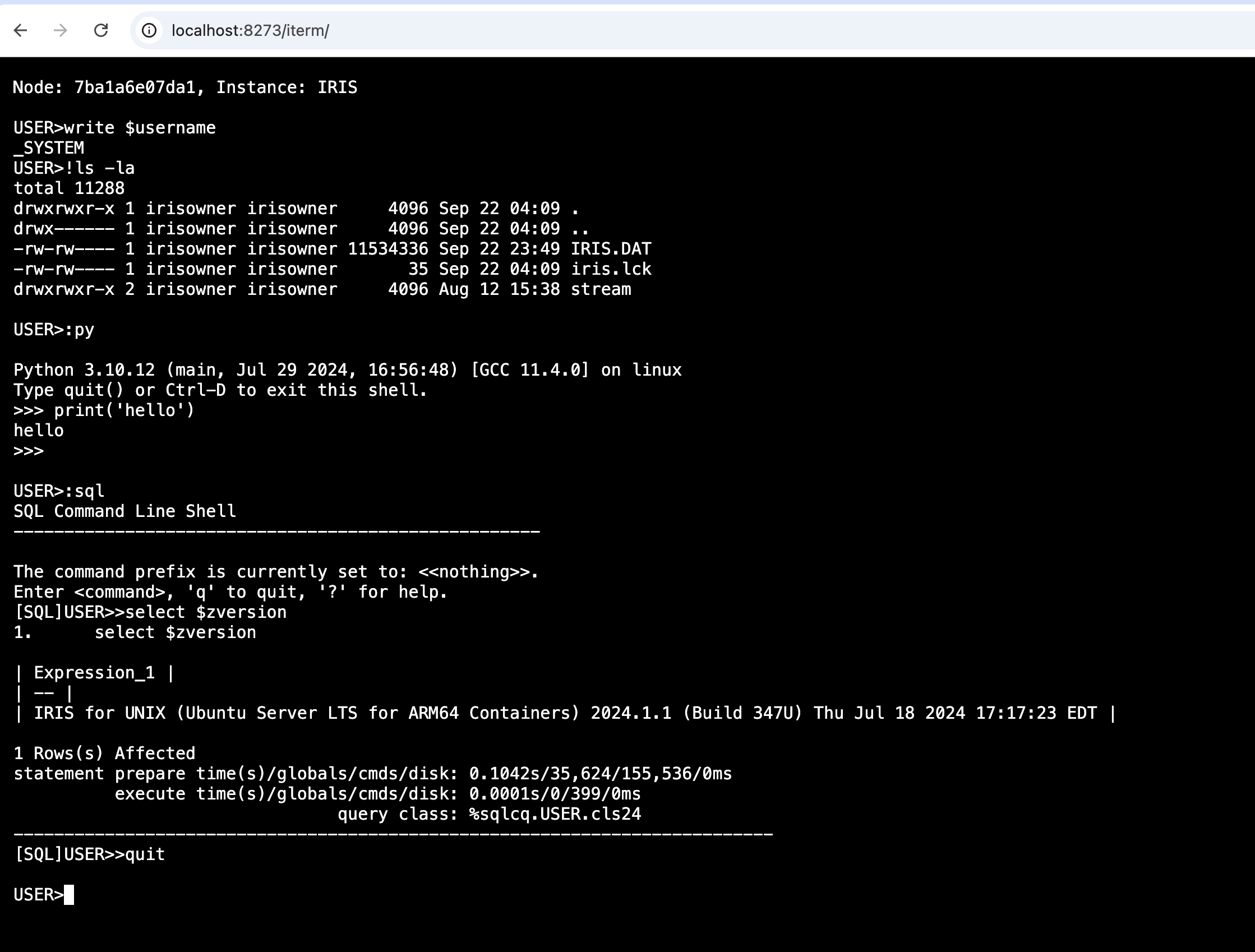
We have Webterminal around for quite a while, but it was limited, not all features worked there. There was no shell support or the latest feature as embedded Python support. There are some issues with tools that require programmer mode. Basic Authorization, not as handy as simple login page, where you could have options to add own login page, in case if you would wish to change the way how to login to the application, such as using SSO.

With the original iris terminal, wrapped into a web form, using most used in the web world xterm.js, used in tools like VSCode as well, with some magic from Python, which helped with interprocess tty. We can get the the terminal in the web, in the full capacity.

iTerm

38
6 805
Article Robert Cemper · Apr 26, 2021 3m read

Why SSH ?

If you do not have direct access to the server that runs your IRIS Docker container
you still may require access to the container outside "iris session" or "WebTerminal".
With an SSH terminal (PuTTY, KiTTY,.. ) you get access inside Docker, and then, depending
on your needs you run "iris session iris" or display/manipulate files directly.

Note: 
This is not meant to be the default access for the average application user
but the emergency backdoor for System Management, Support, and Development.
34
0 1354
Article Dmitry Maslennikov · Oct 5, 2025 5m read

Introduction

The InterSystems IRIS Data Platform has long been known for its performance, interoperability, and flexibility across programming languages. For years, developers could use IRIS with Python, Java, JavaScript, and .NET — but Go (or Golang) developers were left waiting.

Golang Logo

That wait is finally over.

The new go-irisnative driver brings GoLang support to InterSystems IRIS, implementing the standard database/sql API. This means Go developers can now use familiar database tooling, connection pooling, and query interfaces to build applications powered by IRIS.


Why GoLang Support Matters

GoLang is a language designed for simplicity, concurrency, and performance — ideal for cloud-native and microservices-based architectures. It powers some of the world’s most scalable systems, including Kubernetes, Docker, and Terraform.

Bringing IRIS into the Go ecosystem enables:

  • Lightweight, high-performance services using IRIS as the backend.
  • Native concurrency for parallel query execution or background processing.
  • Seamless integration with containerized and distributed systems.
  • Idiomatic database access through Go’s database/sql interface.

This integration makes IRIS a perfect fit for modern, cloud-ready Go applications.

25
0 396
Article Bill McCormick · Dec 4, 2015 3m read

A few people wrote to me asking about the infrastructure behind the Atelier Server implementation. Its neat and a worthwhile story to share so I am writing it up here as a post on the community. I want to go in to a little detail on why it was needed and then I will outline in detail how we went about implementing this.

So why did we need to give people a “server in the cloud”? Atelier is the new IDE for InterSystems products. It is Eclipse based and implemented in Java so it is cross platform. The communication between the Atelier client and the server is REST based over http.

24
0 1190
Article Evgeny Shvarov · Feb 24, 2020 9m read

Hi Developers!

Many of you publish your InterSystems ObjectScript libraries on Open Exchange and Github.

But what do you do to ease the usage and collaboration to your project for developers?

In this article, I want to introduce the way how to introduce an easy way to launch and contribute to any ObjectScript project just by copying a standard set of files to your repository.

Let's go!

21
6 2514
Article Joyce Zhang · Jun 6, 2017 2m read

It's been 6 months since InterSystems released Atelier 1.0 and we continue to roll out enhancements and new features through the beta channel (please see the Atelier Download page for details). In the meantime, we have received a lot of messages from the Developer Community with ideas for further improvements. Based on your feedback, we created a roadmap for Atelier 1.1 so you can conveniently track when specific features are going to be integrated.

Below is a list of the major improvements planned for 1.1, which we are expecting to demo at the Global Summit.

1.

15
0 1582
Article Luca Ravazzolo · Jan 27, 2016 1m read

InterSystems is delighted to announce the support of Docker container technology as a platform from the moment 2016.1 will be released.


Docker is a disruptive system technology that has many benefits and offers many advantages for those investing in infrastructure-as-code or immutable-infrastructure provisioning & deployment scenarios.
Like any new technology that appears, there is a learning curve, and many considerations need to occur when using it. However, Docker container technology has already proven to be successful by a huge follow-up with many companies already using it in production.

14
0 2232
Article Evgeny Shvarov · Dec 14, 2015 1m read

Hi ISC Community!

I'm pleased to announce new release of Caché Web Terminal 3.1.4.

What's new:

1. Drag'n'drop to Studio installation: just import xml in any namespace.

2. After import and comilation access your web terminal app on URL  server:port/terminal/.

F.e. localhost:57772/terminal/       

Slash is mandatory.

3. No need to use %CACHELIB anymore - please feel free to update your Caché and continue using CWT.

Download release here.

Source code for view and contribute here.

Post your issues here.  Want to add your own features - fork it!

Featured screencast   (previos version).

Enjoy!

13
1 1233
Article Bill McCormick · Dec 7, 2015 4m read

So another topic that has been of interest to a number of people since the beta was put up last week is in regard to Studio Hooks and Atelier. This requires a bit of background and then some discussion of how the architecture of Atelier necessitates some changes and then what our current thinking on the subject is.

Studio hooks were added to Cache over 10 years ago. They have two primary usages. The first is that on an appropriate action such as creating a new document, or compiling a document a callback is executed whose job is to interact with external source control systems.

12
0 1440
Article Kyle Baxter · Oct 10, 2019 2m read

Are you all ready for something you wish you knew ages ago (or, in my case, a DECADE ago)?  Open up a portal in your favorite instance and go to:

System Administration->Configuration->Additional Settings->Startup

Scroll down to "Terminal Prompt" and click 'Edit'.  This allows you to edit what you see on your terminal prompt.  You can change that to my current setting: 8,3,2

What does this do?  It adds your instance name for your prompt.

12
2 1363
Article Evgeny Shvarov · Jan 25, 2024 2m read

Hi Devs!

Recently I was impressed by @Dan Pasco's article where he shares also how he uses terminal aliases. 

Terminal aliases is a very powerful tool for developers and sys admins if you often need to call some cumbersome terminal expressions and make it shorter and cleaner. Here is the documentation.
Yes! 

But what about Docker environments? What if you are fan of Docker dev environments but also want to keep using your favorite aliases with Docker as well?

Turned out it is very possible.

12
0 401
Article Jose-Tomas Salvador · Apr 8, 2020 6m read

This time I want to talk about something not specific to InterSystems IRIS, but that I think is important if you want to work with Docker and your server at work is a PC or laptop with Windows 10 Pro or Enterprise.

As you likely know, containers technology comes basically from Linux world and, nowadays, is on Linux hosts were it shows maximum potential. Those who use Windows on a normal basis see that both, Microsoft and Docker, have done important efforts during these last years that allow us to run containers based on Linux images on our Windows system in a really easy way... but it's something not supported for production systems and, this is the big problem, is not reliable if we want to keep persistent data outside of containers, in the host system,... mostly due to the big differences between Windows and Linux file systems. In the end, Docker for Windows itself uses a small linux virtual machine (MobiLinux) to run the containers... it does it transparently for the windows user... and it works perfectly well if, as I said, you don't require that your databases survive longer than the container...

Well,...let's get to the point,... the point is that many times, to avoid issues and simplify, we need a full Linux system and, if our server is based on Windows, the only way of having it is through a virtual machine. At least till WSL2 in Windows is released, but that will be another story and sure it'll take a bit of time to become robust enough.

In this article, I'll tell you, step by step, how to install an environment where you'll be able to work, if you need it, with Docker containers on an Ubuntu system in your Windows server. Let's go...

11
3 29888
Article Evgeny Shvarov · Mar 14, 2019 5m read

Hi Community!

I think everyone keeps the source code of the project in the repository nowadays: Github, GitLab, bitbucket, etc. Same for InterSystems IRIS projects  check any on Open Exchange.

What do we do every time when start or continue working with a certain repository with InterSystems Data Platform?

We need a local InterSystems IRIS machine, have the environment for the project set up and the source code imported.

So every developer performs the following:

  1. Check out the code from repo
  2. Install/Run local IRIS installation
  3. Create a new namespace/database for a project
  4. Import the code into this new namespace
  5. Setup all the rest environment
  6. Start/continue coding the project 

If you dockerize your repository this steps line could be shortened to this 3 steps:

  1. Check out the code from repo
  2. Run docker-compose build 
  3. Start/continue coding the project 

Profit - no any hands-on for 3-4-5 steps which could take minutes and bring head ache sometime.

You can dockerize (almost) any your InterSystems repo with a few following steps. Let’s go!

10
9 1989
Article Pietro Di Leo · Sep 24, 2025 23m read

Table of Contents

  1. Purpose of the article
  2. What containers are and why they make sense with IRIS
     2.1 Containers and images in a nutshell
     2.2 Why containers are useful for developers
     2.3 Why IRIS works well with Docker
  3. Prerequisites
  4. Installing the InterSystems IRIS image
     4.1 Using Docker Hub
     4.2 Pulling the image
  5. Running the InterSystems IRIS image
     5.1 Starting an IRIS container
     5.2 Checking container status
     5.3 Executing code in the container terminal
     5.4 Accessing the IRIS Management Portal
     5.5 Connecting the container to VS Code
     5.6 Stopping or removing the container
     5.7 Setting a specific password with a bind mount
     5.8 Using durable %SYS volumes
      5.8.1 What gets stored with durable %SYS
      5.8.2 How to enable durable %SYS
  6. Using Docker Compose
     6.1 Docker Compose example
     6.2 Running Docker Compose
  7. Using a Dockerfile to run custom source code
     7.1 Dockerfile example
     7.2 Docker Compose example
     7.3 Understanding layers, image tagging and build vs. run time
     7.4 Source code and init script
     7.5 Building the image with Dockerfile
     7.6 Running instructions in the containerized IRIS terminal
  8. Conclusion and what’s next
9
10 519
Article Evgeny Shvarov · Feb 12, 2023 3m read

Hi Developers!

As you know InterSystems IRIS Interoperability solutions contain different elements of the solution, such as: production, business rule, business process, data transformation, record mapper. And sometimes we can create and modify these elements with UI tools.  And of course we need a handy and robust way to source-control the changes made with UI tools.

For a long time this was a manual (export class, element, global, etc) or cumbersome settings procedure, so the saved time with source-control UI automation was competing with lost time to setup and maintain the settings.

Now the problem doesn't exist any more. With two approaches: package first development and usage of IPM package git-source-control by @Timothy Leavitt 
.

Meme Creator - Funny WOW IT REALLY WORKS Meme Generator at MemeCreator.org!

The details are below!

8
3 1405
Article Dmitry Maslennikov · Jun 4, 2019 1m read

There are many projects which work on InterSystems products, and they are not always written only in ObjectScript. I think some of you working with different programming languages and already have some experience with other editors, and hope you already have a favourite online editor. 

My current choice is VSCode, whereas you may already know I have added an extension to support ObjectScript.

8
0 870
Article Ben Spead · Feb 25, 2016 1m read

I wanted to share a little tidbit which is in the Studio documentation (http://docs.intersystems.com/cache20152/csp/docbook/DocBook.UI.Page.cls…) but many people who have been using the InterSystems Studio for a long time missed the addition of this *very* useful feature, and every time I mention this to an audience  I see at least one face light up because of how excited they are to learn about it!

Within Studio, the Output pane (View -> Output) is actually misnamed.  It is actually an Input/Output window which can be used to run Caché ObjectScript commands!  

7
0 1694
Article Brett Saviano · Dec 21, 2023 2m read

Have you ever been editing files in VS Code, but needed to check a global value or run a few ObjectScript commands? Now you can, with no setup required! If you have vscode-objectscript extension version 2.10.0 or later and are connected to InterSystems IRIS 2023.2 or later, you can now open a terminal connection to your server, regardless of where it's located.

7
11 1915
Article Chi Nguyen-Rettig · Sep 21, 2024 3m read

There are many applications for working with HL7 V2 messages, but the tools for working with XML in IRIS Management Portal and Cache Studio are limited. While plenty of external utilities and IDEs work with XML messages and even C-CDA documents, there is a compelling case for being able to test directly against the IRIS C-CDA framework. 

Testing within the IRIS environment provides the necessary context: 

  • XML parser configuration
  • XML namespace context
  • Facility and OID setup
  • IHE header handling
  • The HS.IHE.Util, HS.Util.XSLTTransformer, and %XML.XSLT.
7
4 454
Article Sergei Sarkisian · Jun 29, 2022 12m read

Hi! As a developer who was forced to move from Mac to Windows (temporary) I found some things a bit confusing. In this article I would like to talk about some tweaks I made to make my experience smoother. I think it can help not only Mac users who need to use Windows environment (for ex. in VMs), but also can help some Windows users to make some things more convenient. Of course, all the points are subjective, the best setup is one that works for you.

All the tweaks are related to Windows 10 as I don’t have an access to Windows 11 at the moment.

7
2 945
Article Jose-Tomas Salvador · Nov 9, 2021 3m read

For some years I missed being able to offer, to everybody interested in ObjectScript, a tutorial more or less complete, to start with ObjectScript. Something that could help more and make things easier to those new developers that come to our technology... something intermediate, halfway between the common "Hello World!", that doesn't really get you further, and the "Advanced Training", that is unaffordable because of lack of time,etc.

If there were something truly helpful not only as an introduction to the ecosystem, but as a starting point, as a boost, to really start to walk into ObjectScript and move forward by yourself... wouldn't that be awesome?

7
1 882
Article Evgeny Shvarov · May 9, 2025 3m read

Hi developers!

Observing the avalanche of AI-driven and vibe-coding developer tools that have been appearing lately almost every month with more and more exciting dev features, I was puzzled whether it is possible to leverage it with InterSystems IRIS. At least to build a frontend. And the answer - yes! At least with the approach I followed.

Here is my recipe to prompt the UI vs InterSystems IRIS Backend:

  1. Have the REST API on the IRIS side, which reflects some Open API (swagger) spec.
  2. Generate the UI with any vibe-coding tool (e.g., Lovable) and point the UI to the REST API endpoint.
  3. Profit!

Here is the result of my own exercise - a 100% prompted UI vs IRIS REST API that allows to list, create, update delete entries of a persistent class (Open Exchange,frontend source, video):

What is the recipe in detail?

7
2 377
Article Joyce Zhang · Jul 12, 2017 2m read

The Atelier beta update channel:

https://atelier.artifactoryonline.com/atelier/updates/beta/1.1

offers the latest features and bug fixes. It now updates your installation of Atelier to build 1.1.310 for Mac, Windows, Red Hat, SUSE and Ubuntu. Here’s an account of what’s recently been improved:

New Features:

  • The SQL parser has been significantly enhanced including performance improvements
  • The JavaScript parser has been simplified for performance improvements. The class shown in the example below invokes the JavaScript parser. The "File is too large to parse properly" issue has been fixed.

Image 1.

6
0 863
Article Dmitry Maslennikov · Dec 3, 2021 1m read

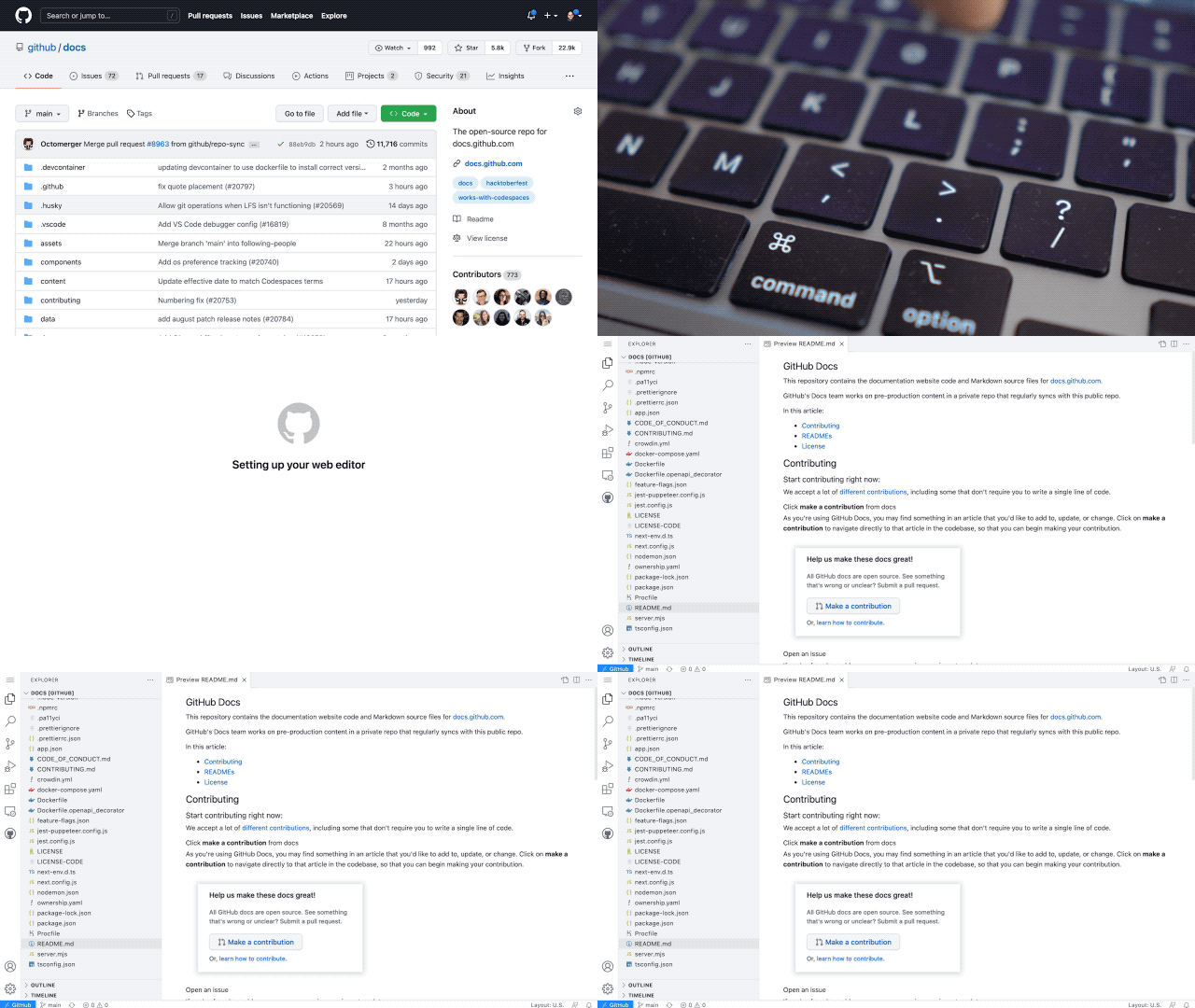
Not so while ago GitHub introduced, ability to very quickly run VSCode in the browser for any repository hosted there. Press the . key on any repository or pull request, or swap .com with .dev in the URL, to go directly to a VS Code environment in your browser.

github dev

This VSCode is a light version of the Desktop version but works entirely in Browser. And due to this, it has a limitation for extensions which was allowed to work this way. And let me introduce the new version 1.2.1 of VSCode-ObjectScript extension which now supports running in Browser mode.

6
3 1352
Article Nikita Savchenko · Feb 12, 2019 13m read

ˮ This is one of my articles which was never published in English. Let's fix it!

Hello! This article is about quite a practical way of developing InterSystems solutions without using the integrated tools like Studio or Atelier. All the code of the project can be stored in the form of "traditional" source code files, edited in your favorite development environment (for example, Visual Studio Code), indexed by any version control system and arbitrarily combined with many external tools for code analysis, preprocessing, packaging and so on.

6
6 3246
Article Ben Spead · Sep 6, 2017 1m read

This 'feature' have been around for a long time, but I don't see any articles on it so I thought I would make everyone aware.

A method is provided to customize the appearance of the Cache cube icon in the system tray so different instances can be visually distinguished.  When csystray.exe, the Cache/Ensemble cube program, starts, it will look for files named "up.ico" and "down.ico" in the \bin directory below the instance installation directory.  If these .ico files are present, csystray.exe will load the icons and display them in place of the default blue and gray Cache/Ensemble cube icons.

5
1 1438