#Best Practices

37 Followers · 307 Posts

Best Practices recommendations on how to develop, test, deploy and manage solutions on InterSystems Data Platforms better. 

InterSystems staff + admins Hide everywhere
Hidden post for admin
Article Sergei Sarkisian · Dec 30, 2016 27m read

This article is translation of one from Habrahabr InterSystems blog (Russian).
The original post can be found here: https://habrahabr.ru/company/intersystems/blog/251611/
 

Everyone familiar with InterSystems Ensemble, an integration and application development platform, knows what the Ensemble Workflow subsystem is and how useful it can be for automating human interaction. For those who don’t know Ensemble (and/or Workflow), I will briefly describe its capabilities (others may skip this part and learn how they can use the Workflow interface in Angular.js).

InterSystems Ensemble

6
1 4713
Article Murray Oldfield · Nov 18, 2019 8m read

The following steps show you how to display a sample list of metrics available from the /api/monitor service.

In the last post, I gave an overview of the service that exposes IRIS metrics in Prometheus format. The post shows how to set up and run IRIS preview release 2019.4 in a container and then list the metrics.

This post assumes you have Docker installed. If not, go and do that now for your platform :)

Step 1. Download and run the IRIS preview in docker

10
6 1660
Article Pierre-Yves Duquesnoy · Jan 27, 2021 29m read

Introduction {#Webinar:ImplementingIntegrationswith.NetorJava-Introduction}

InterSystems IRIS 2020.1 includes PEX (Production EXtension Framework) to facilitate the development of IRIS Interoperability productions with components written in Java or .NET.

Thanks to PEX, an integration developer with knowledge of Java or .NET can benefit from the power, scalability, and robustness of the InterSystems IRIS Interoperability framework and be productive in no time.

4
1 1281
Article Suriya Narayanan Suriya Narayanan Vadivel Murugan · Nov 12, 2016 5m read

In this article, we will discuss about Orphaned Messages.

What is an Orphaned Message

Every message body is associated with a message Header which holds the metadata. The Header holds information like source configuration name, target configuration name, time created, time processed, associated message body reference, session information, message body class name, message status. When there are message body records that do not have their corresponding Header records those are called Orphan message bodies. We will discuss possible causes which could end up with orphan message bodies.

5
8 4762
Article David Loveluck · Feb 25, 2019 4m read

There have been some very helpful articles in the community that show how to use Grafana with IRIS (or Cache/Ensemble) by using an intermediate database.

But I wanted to get at IRIS structures directly. In particular, i wanted to access the Cache History monitor data that is accessible by SQL as described here

https://community.intersystems.com/post/apm-using-cach%C3%A9-history-mo…

and didn't want anything between me and the data.

5
4 1745
Article Mark Bolinsky · Jan 29, 2016 4m read

** Revised Feb-12, 2018

While this article is about InterSystems IRIS, it also applies to Caché, Ensemble, and HealthShare distributions.

Introduction

Memory is managed in pages.  The default page size is 4KB on Linux systems.  Red Hat Enterprise Linux 6, SUSE Linux Enterprise Server 11, and Oracle Linux 6 introduced a method to provide an increased page size in 2MB or 1GB sizes depending on system configuration know as HugePages.

At first HugePages required to be assigned at boot time, and if not managed or calculated appropriately could result in wasted resources.  As a result various Linux distributions introduced Transparent HugePages with the 2.6.38 kernel as enabled by default.  This was meant as a means to automate creating, managing, and using HugePages.  Prior kernel versions may have this feature as well however may not be marked as [always] and potentially set to [madvise].  

Transparent Huge Pages (THP) is a Linux memory management system that reduces the overhead of Translation Lookaside Buffer (TLB) lookups on machines with large amounts of memory by using larger memory pages.  However in current Linux releases THP can only map individual process heap and stack space.

9
5 5758
Article Eduard Lebedyuk · Nov 26, 2018 2m read

In this article, I would show how you can upload and download files from InterSystems products via http.

The questions about working with files over http arise fairly often on community and I'm usually linking to my FileServer project which demonstrates file upload/download but I'd like to talk a bit more on how we can serve and receive files from InterSystems products.

Downloading a file

If you have a file in on a file system and you know the path you can serve it from REST or CSP context by calling this method:

3
5 3087
Article Timothy Leavitt · May 12, 2016 6m read

The topic of for/while loop performance in Caché ObjectScript came up in discussion recently, and I'd like to share some thoughts/best practices with the rest of the community. While this is a basic topic in itself, it's easy to overlook the performance implications of otherwise-reasonable approaches. In short, loops iterating over $ListBuild lists with $ListNext or over a local array with $Order are the fastest options.

As a motivating example, we will consider looping over the pieces of a comma-delimited string.

A natural way to write such a loop, in minimal code, is:

21
5 10113
Article Nicholai Mitchko · Apr 15, 2022 3m read

Adding VSCode into your IRIS container

One of the easiest ways to setup repeatable development environments is to spin up containers for them. I find that when iterating quickly, it was very convenient to host a vscode instance within my development container. Thus, I have created a quick container script to add a browser-based vscode into an IRIS container. This should work for most 2021.1+ containers. My code repository can be found here

InterSystems IRIS container with vscode and pre-connected

CredValue
User_SYSTEM
PasswordSYS

Overview

5
0 1055
Article Yaron Munz · Jul 12, 2022 5m read

Overview

We started to use Azure Service Bus (ASB) as an enterprise messaging solution 3 years ago. It is being used to publish and consume data between many applications in the organization. Since the data flow is complex, and one application’s data is usually needed in multi applications the “publisher” ---> ”multiple subscribers” model was a great fit. The ASB usage in the organization is dozens of millions of messages per day, while IRIS platform is having around 2-3 million messages/day.

The Problem with ASB

3
3 857
Article Lorenzo Scalese · Apr 22, 2022 8m read

Apache Web Gateway with Docker

Hi, community.

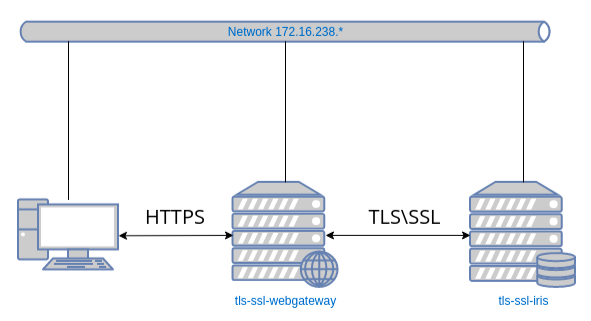
In this article, we will programmatically configure an Apache Web Gateway with Docker using:

  • HTTPS protocol.
  • TLS\SSL to secure the communication between the Web Gateway and the IRIS instance.

We will use two images: one for the Web Gateway and the second one for the IRIS instance.

All necessary files are available in this GitHub repository.

Let’s start with a git clone:

git clone https://github.com/lscalese/docker-webgateway-sample.git
cd docker-webgateway-sample

Prepare your system

To avoid problems with permissions, your system needs a user and a group:

15
8 2160
Article Pete Greskoff · Jun 27, 2018 8m read

NB. Please be advised that PKI is not intended to produce certificates for secure production systems. You should make alternate arrangements to create certificates for your productions.
NB. PKI is deprecated as of IRIS 2024.1: documentation and announcement.

In this post, I am going to detail how to set up a mirror using SSL, including generating the certificates and keys via the Public Key Infrastructure built in to InterSystems IRIS Data Platform. I did a similar post in the past for Caché, so feel free to check that out here if you are not running InterSystems IRIS. Much like the original, the goal of this is to take you from new installations to a working mirror with SSL, including a primary, backup, and DR async member, along with a mirrored database. I will not go into security recommendations or restricting access to the files. This is meant to just simply get a mirror up and running. Example screenshots are taken on a 2018.1.1 version of IRIS, so yours may look slightly different.

3
4 1829
Article Henry Pereira · Aug 2, 2021 8m read

Easy, easy, I'm not promoting a war against the machines in the best sci-fi way to avoid world domination of Ultron or Skynet. Not yet, not yet 🤔

I invite you to challenge the machines through the creation of a very simple game using ObjectScript with embedded Python.

I have to say that I got super excited with the feature of Embedded Python on InterSystems IRIS, it's incredible the bunch of possibilities that opens to create fantastic apps.

Let's build a tic tac toe, the rules are quite simple and I believe that everyone knows how to play.

8
5 1603
Article sween · Jul 29, 2021 6m read

We are ridiculously good at mastering data. The data is clean, multi-sourced, related and we only publish it with resulting levels of decay that guarantee the data is current. We chose the HL7 Reference Information Model (RIM) to land the data, and enable exchange of the data through Fast Healthcare Interoperability Resources (FHIR®).

2
1 904
Article Vicky Li · Nov 14, 2016 14m read

As we all know, Caché is a great database that accomplishes lots of tasks within itself. However, what do you do when you need to access an external database? One way is to use the Caché SQL Gateway via JDBC. In this article, my goal is to answer the following questions to help you familiarize yourself with the technology and debug some common problems.

Outline

2
8 4740
Article Sylvain Guilbaud · Apr 20, 2022 4m read

During a major version upgrade it is advisable to recompile the classes and routines of all your namespaces (see Major Version Post-Installation Tasks).

do $system.OBJ.CompileAllNamespaces("u")
do ##Class(%Routine).CompileAllNamespaces()

To automate this administration task and keep a log of any errors, below is an example of a class to import and compile into the USER namespace that you can use after each upgrade : admin.utils.cls

3
1 1462
Article Murray Oldfield · Mar 8, 2016 8m read

Your application is deployed and everything is running fine. Great, hi-five! Then out of the blue the phone starts to ring off the hook – it’s users complaining that the application is sometimes ‘slow’. But what does that mean? Sometimes? What tools do you have and what statistics should you be looking at to find and resolve this slowness? Is your system infrastructure up to the task of the user load? What infrastructure design questions should you have asked before you went into production? How can you capacity plan for new hardware with confidence and without over-spec'ing? How can you stop the phone ringing? How could you have stopped it ringing in the first place?

13
6 4870
Article Eduard Lebedyuk · Nov 20, 2019 9m read

In this article, I would like to talk about the spec-first approach to REST API development.

While traditional code-first REST API development goes like this:

  • Writing code
  • REST-enabling it
  • Documenting it (as a REST API)

Spec-first follows the same steps but reverse. We start with a spec, also doubling as documentation, generate a boilerplate REST app from that and finally write some business logic.

This is advantageous because:

  • You always have relevant and useful documentation for external or frontend developers who want to use your REST API
  • Specification created in OAS (Swagger) can be imported into a variety of tools allowing editing, client generation, API Management, Unit Testing and automation or simplification of many other tasks
  • Improved API architecture.  In code-first approach, API is developed method by method so a developer can easily lose track of the overall API  architecture, however with the spec-first developer is forced to interact with an API from the position if API consumer which usually helps with designing cleaner API architecture
  • Faster development - as all boilerplate code is automatically generated you won't have to write it, all that's left is developing business logic.
  • Faster feedback loops - consumers can get a view of the API immediately and they can easier offer suggestions simply by modifying the spec

Let's develop our API in a spec-first approach!

6
10 3520
Article Yuri Marx · May 13, 2022 8m read


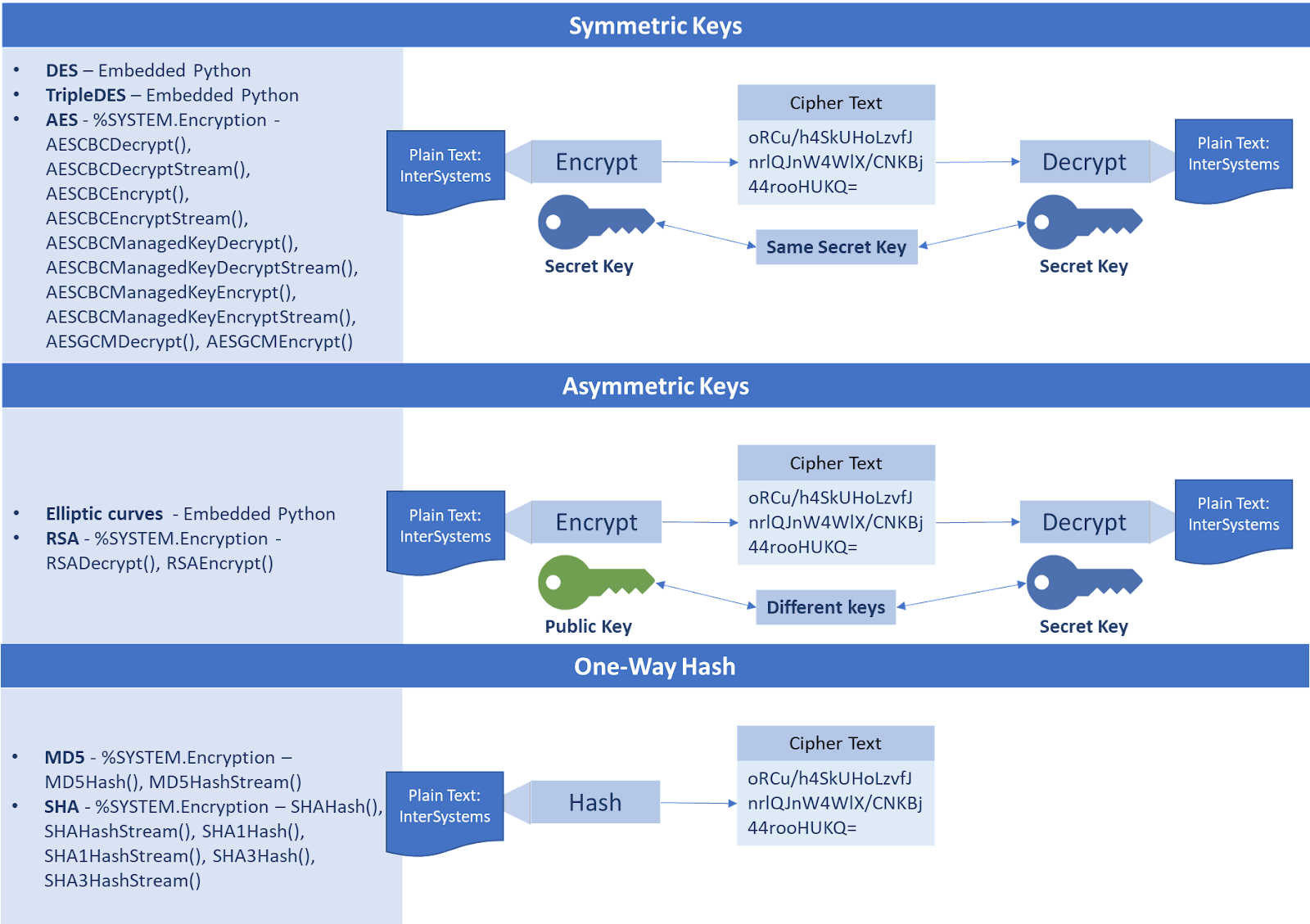
The InterSystems IRIS has excellent support for encryption, decryption and hashing operations. Inside the class %SYSTEM.Encryption (https://docs.intersystems.com/iris20212/csp/documatic/%25CSP.Documatic…) there are class methods for the main algorithms on the market.


IRIS Algorithms and Encrypt/Decrypt types

As you can see, the operations are based on keys and include 3 options:

3
3 1673
Article Lucas Enard · May 3, 2022 44m read

This formation, accessible on my GitHub, will cover, in half a hour, how to read and write in csv and txt files, insert and get inside the IRIS database and a distant database using Postgres or how to use a FLASK API, all of that using the Interoperability framework using ONLY Python following the PEP8 convention.

This formation can mostly be done using copy paste and will guide you through everystep before challenging you with a global exercise.
We are available to answer any question or doubt in the comment of that post, on teams or even by mail at lucas.enard@intersystems.com .

1
1 832
Article Tani Frankel · May 6, 2020 2m read

While reviewing our documentation for our ^pButtons (in IRIS renamed as ^SystemPerformance) performance monitoring utility, a customer told me: "I understand all of this, but I wish it could be simpler… easier to define profiles, manage them etc.".

After this session I thought it would be a nice exercise to try and provide some easier human interface for this.

The first step in this was to wrap a class-based API to the existing pButtons routine.

I was also able to add some more "features" like showing what profiles are currently running, their time remaining to run, previously running processes and more.

The next step was to add on top of this API, a REST API class.

With this artifact (a pButtons REST API) in hand, one can go ahead and build a modern UI on top of that.

For example -

15
4 1349
Article Robert Cemper · Jan 2, 2022 3m read

Thanks to @Yuri Marx we have seen a very nice example for DB migration from Postgres to IRIS.
My personal problem is the use of DBeaver as a migration tool.
Especially as one of the strengths of IRIS ( and also Caché) before is the availability of the
SQLgateways that allow access to any external Db as long as for them an access usinig 
JDBC or ODBC is available. So I extended the package to demonstrate this.

3
2 899
Article Timothy Leavitt · Mar 17, 2021 3m read

I ran into an interesting ObjectScript use case today with a general solution that I wanted to share.

Use case:

I have a JSON array (specifically, in my case, an array of issues from Jira) that I want to aggregate over a few fields - say, category, priority, and issue type. I then want to flatten the aggregates into a simple list with the total for each of the groups. Of course, for the aggregation, it makes sense to use a local array in the form:

agg(category, priority, type) = total

Such that for each record in the input array I can just:

Do $increment(agg(category, priority, type))
10
4 1211
Article Evgeny Shvarov · Jun 13, 2016 1m read

Hi, Community!

Want to share with you one debugging approach from the Russian forum.

Suppose I want to debug the application  and I want it to stop the execution on a particular line.

I add in code this line:

l +d,-d

When I want to start debugging in this line I block d in terminal

USER> l +d

And execute the app.

The app stops on this line and lets me connect to it with Studio debugger.

To release lock I do in terminal

USER> l -d

And what are your debugging practices?

8
1 776