- HealthShare Unified Care Record Overview – Virtual December 15-16, 2025
- Overview of HealthShare Unified Care Record® architecture, data flows, consent, and notifications
- This 2-day course provides an overview of HealthShare Unified Care Record®. It focuses on architecture, data flows, consent, alerts, user management and terminology.
- This non-technical course provides an introduction to the product for those who do not need the detail provided in the 5-day HealthShare Unified Care Record Fundamentals class.
- Building and Managing HL7 Integrations – In Person December 15-19, 2025 9:00am-5:00pm EST
- Build, configure, and manage HL7® V2 interfaces using InterSystems integration technologies.
- This healthcare-focused 5-day course teaches implementation partners, integrators and analysts how to rapidly build HL7 integration solutions.
- Students build a production that processes and routes HL7 messages.
- Students learn how to work with the pre-built HL7 business services, business processes and business operations to receive and send HL7 messages.
Hey Community,
We're pleased to invite everyone to the upcoming kick-off Webinar for InterSystems "Bringing Ideas to Reality" Contest!
During the webinar, our speakers will explore the Community Opportunity Ideas from the InterSystems Ideas Portal, which are the topics of this programming contest. They will show how to develop, build, and deploy applications using the InterSystems IRIS data platform.
Date & Time: Monday, November 17 – 10:30 am EST | 4:30 pm CET
Hi Everyone,
As I'm sure most of you will be aware, we have an excellent resource available to developers in the Open Exchange, which is a place for Community Members to share open source resources, templates, tools and demos built with or for InterSystems technologies. This has been a massive success, with >1100 projects shared!
However, the growing size of the Open Exchange inevitably leads to some excellent resources being buried and lost in the sea of resources.
Hi community
I have a persistent data class where there are some properties that contain underscores in their names, for example:
Property "client_name" As %String(MAXLEN = 250) [ SqlFieldName = client_name ];
In Architect, I would like to use this property in an expression, in this field:.png)
But I can't figure it out. If I use %source.client_name, it gives a compilation error. If I use %source."client_name", it treats it as the string "client_name" instead of getting the value from the field. Any suggestions on how to do this?
Hi developers!
How do you debug implementation code in .impl classes of REST.API in InterSystems IRIS?
Especially if you don't have access to globals, so no things like:
Set ^AAA="here we are"not possible in this case.

Suppose I have the following signature of the REST.API method called as POST and containing JSON. :
In my previous article, I structured network communications
in these 3 possible layers, and covered the last
- Client <---> Transport
- Server <---> Transport
- Client <---> Server
In fact, you have the most control over the last one.
The IRIS side as a server is yours and under your full control.
Up to now, the Transport layer was assumed to be as passive as a bare wire.
This assumption should be verified. I once met a Windows environment with
a quite surprising setup where a Firewall-like filter was isolating internal
processes and causing a lot of trouble.
Chasing errors or misbehavior in the network can be quite a challenge.
Differently to a local application on the DB server, you always have at least 3 players:
- A client to place a request
- some kind of transport layer
- and a server to provide a reply.
This results in a minimum of 3 possible communication layers
- Client <---> Transport
- Server <---> Transport
- Client <---> Server
The last one is probably the easiest to check, while the other
two deal with the same counterpart just from opposite sides.
Over the past several years, the InterSystems Developer Community has accumulated more than 1,000 open-source projects. Many of them serve as examples and learning materials — but a significant number have become useful tools, libraries, integrations, and real-world components used in production.
Some of these projects are mine, and like many community developers, I’ve seen the same recurring problem:
- It’s easy to create an open-source project.
- It’s hard to maintain, support, and develop it sustainably — especially without funding.
Writing code is one thing.
Supporting it for years, keeping up with new IRIS versions, building CI pipelines, writing documentation, fixing issues, reviewing PRs — all of this demands both time and motivation, and the biggest motivator is often financial support.
This is not a new challenge.
The global open-source world has faced this for decades and has developed various models to support OSS ecosystems.
I believe it’s time for the InterSystems community to start a discussion about adopting a similar model.
Hey Community!
We're happy to share a new video from our InterSystems Developers YouTube:
⏯ Foreign Tables In 2025.2 @ Ready 2025

Hey Community,
We're happy to invite you to a LinkedIn Live session in Dutch
🎤 Data exchange in healthcare according to the FHIR standard with Python 🎤
Event details:
📅 Date: Thursday, November 27th
🕓 Time: 1:30-2:15 PM EST

.png)
Power your IrisCluster serviceTemplate with kube-vip
If you're running IRIS in a mirrored IrisCluster for HA in Kubernetes, the question of providing a Mirror VIP (Virtual IP) becomes relevant. Virtual IP offers a way for downstream systems to interact with IRIS using one IP address. Even when a failover happens, downstream systems can reconnect to the same IP address and continue working.
The lead in above was stolen (gaffled, jacked, pilfered) from techniques shared to the community for vips across public clouds with IRIS by @Eduard Lebedyuk ...
Articles: ☁ vip-aws | vip-gcp | vip-azure
This version strives to solve the same challenges for IRIS on Kubernetes when being deployed via MAAS, on prem, and possibly yet to be realized using cloud mechanics with Manged Kubernetes Services.
Using embedded Python while building your InterSystems-based solution can add very powerful and deep capabilities to your toolbox.
I'd like to share one sample use-case I encountered - enabling a CDC (Change Data Capture) for a mongoDB Collection - capturing those changes, digesting them through an Interoperability flow, and eventually updating an EMR via a REST API.
.png)
Hi guys,
Is it bad to have too many Business Services in a production and what's the limit, I'm looking to convert our system tasks (around 30 of them) into Business Services and wondering if it's a better option?
Thanks
Hi,
I have just installed WebTerminal on my local instance of Health Connect 2025.1, but it does not work and returns a HTTP 401 error.
Can any one help, as I have never installed WebTerminal before?
Has there been any changes in Health Connect to stop it working in version 2025.1?
Thanks.
Neil
If one of your packages on OEX receives a review, you get notified by OEX only of YOUR own package.
The rating reflects the experience of the reviewer with the status found at the time of review.
It is kind of a snapshot and might have changed meanwhile.
Reviews by other members of the community are marked by * in the last column.
I also placed a bunch of Pull Requests on GitHub when I found a problem I could fix.
Some were accepted and merged, and some were just ignored.
So if you made a major change and expect a changed review, just let me know.
Our subject matter experts (SMEs) often find themselves stretching their knowledge and testing their skills—but also having fun!
👉How do you want to challenge yourself in the coming year?
For inspiration, meet a few of the professionals behind our exams, who talk about what they've gained from being part of our SME community:
Hi,
I'm using the iris for health community edition and I cannot seem to get the FHIR server configuration UI to show up. I was able to create a FHIR server programaticlly but none of the user interface features that the installation guide talks about are available. Once I was created the server I was able to see a Bulk FHIR Coordinator in the management portal, ut that's it. Are the UI features not available in the community edition or do they need to be enabled somehow?
This is the guide that I am using https://docs.intersystems.com/irisforhealth20251/csp/docbook/DocBook.UI.Page.cls?KEY=HXFHIRINS_server_install_new#HXFHIRINS_server_install_new_portal
Hi, Community!
Are you looking for ways to strengthen your InterSystems IRIS® data platform deployment? See how mirroring can help:
Hey Intersystems Community!
I'm trying to get IRIS to serve static files, including security and redirect to login if no session is present.
This is the flow I am trying to accomplish:
- User Opens a page, <my-iris-instance>/my-app/index.html, index.html being a static file
- User is redirected to the default IRIS Login page since no session is present
- User logs in
- User gets redirected back to index.html
For CSP applications this seems to work. I can open "http://localhost:52773/csp/sys/sec/%25CSP.UI.Portal.Applications.Web.zen?
I have a small web application developed on angular js hosted on IRIS using web application option from management portal.
I am looking out for a login page which can simply use Health Share authentication to get user login.
Simple CSP login page to come when application is launched .
I have a quite complex FHIR Implementation Guide (IG) which is based on several other FHIR IGs. It's likely the versions of IGs conflict with each other.
From what I understand, I would need to load in all the other FHIR IG's first?
I don't actually need FHIR profiles to be in our FHIR Repository - I'm just after terminology and the examples for our test system.
Is it possible to load a FHIR IG just as data? (I think I mean here, ignore the FHIR profiles and dependencies between them)
You may have noticed that to configure a mirror for InterSystems IRIS for Health™ and HealthShare® Health Connect there is a special requirement. I wanted to go through it step by step in this article.
This assumes you have already configured the second failover member and confirmed a successful failover member status in the mirror monitor:
.png)
Step 1: Enable HS_Services user (on backup and primary)
Step 2: Switch to Namespace HSSYS and go to Interoperability > Configure > Credentials.
🚀 We’re excited to share that InterSystems is once again joining Hack Jak Brno 2025.
📅 Event dates: 28 - 30 November 2025
📍 Location: Masaryk University in Brno
🔗 Learn more and register at www.hackjakbrno.cz 🚀

Hi guys,
I'm looking to mimic this Post request URL where I'm sending a token :.png)
So I created the below code but I'm getting "HTTP/1.1 405 Method Not Allowed" error
s Url="myurl/confirmed?id="_token
Set Httprequest1=##class(%Net.HttpRequest).%New()
Set Httprequest1.SSLConfiguration="LS2"
Set Httprequest1.Server="myserver.com"
Set Httprequest1.Timeout=30
Set Httprequest1.Https=1
Set Httprequest1.Port=7711
set Httprequest1.ContentType="application/json"
Do Httprequest1.SetHeader("Accept","application/json")
Do Httprequest1.SetHeader("Accept-Language","en_US")
//D Httprequest1.EntityBody.
Can someone help me understand what type of user error (?) is going on here please?
One one system, I write out a group of $c() values and get the expected results:
USER>for i=250:1:260 { write i," ", $c(i),! }
250 ú
251 û
252 ü
253 ý
254 þ
255 ÿ
256 Ā
257 ā
258 Ă
259 ă
260 Ą

USER>w $zv
IRIS for Windows (x86-64) 2023.1.4 (Build 580U) Fri Apr 19 2024 11:16:07 EDT
USER>
On another system, I get some unexpected results:
USER>for i=250:1:260 { write i," ",$c(i),! }
250 ú
251 û
252 ü
253 ý
254 þ
255 ÿ
256 Ā
257 Ä
258 Ä‚
259 ă
260 Ä„

USER>w $zv
IRIS for Windows (x86-64) 2025.1.1 (Build 308U) Thu Jul 10 2025 16:00:01 EDT
USER>i am looking for a Class or Function to check if a Base64 document is valid ( will results into Full file after decoding or not ),
i was not able to find any predefined class in Objectscript ,
has anyone worked on something similar before ?
any advice will be welcomed
I would like to share with you a little trick to customize how messages are displayed in the Message Viewer. In particular, how you can display messages as JSON (instead of the default XML representation).
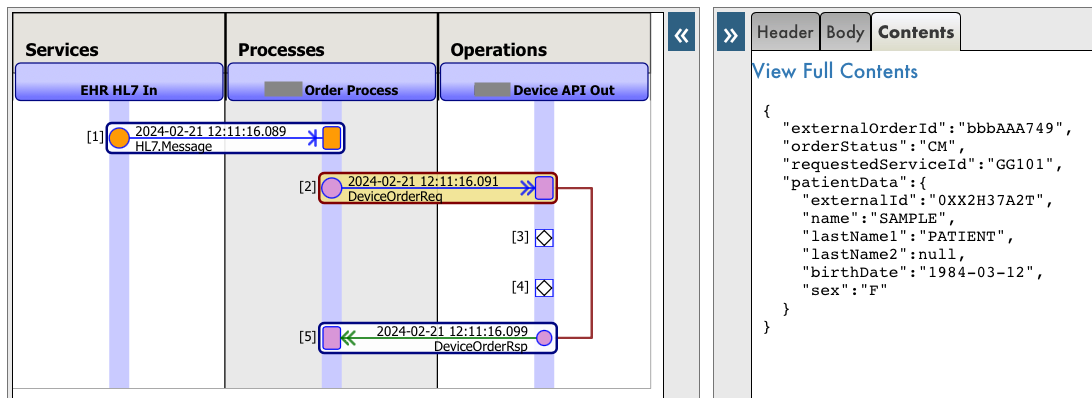
Messages are objects that are used to communicate interoperability productions components. In my example I have defined a message that later I serialize as JSON to send to an external API. This message is defined as a regular message and also as a %JSON.Adaptor so I can export / import directly to or from JSON.
Class interop.msg.DeviceOrderReq Extends (Ens.Request, %JSON.Adaptor)
{

Parameter %JSONNULL As BOOLEAN = 1;

Property externalOrderId As %String(MAXLEN = "");

Property orderStatus As %String;

Property requestedServiceId As %String(MAXLEN = "");

Property patientData As interop.msg.elements.PatientData;

}
Hey Community,
Enjoy the new video on InterSystems Developers YouTube:
⏯ Using SerenityGPT to Build Out an Application GenAI Middleware at InterSystems @ Ready 2025
Introduction
In this article, we will explore various approaches to extending and customizing the behavior of InterSystems IRIS (and IRIS Health) built-in interoperability message routers.
Message routers perform one of the core functions of Enterprise Application Integration (EAI) and are among the most frequently used business processes in interoperability productions.