Hi Community,
Just got this schedule finalized (and you are the first to see it.
Hi Community,
Just got this schedule finalized (and you are the first to see it.
what class or API I shall be using to execute a piece of sql to another server from one server? From within cache itself not java or python or any other languages.
Anything like $System.SQL.%Connect(...) ?
Hey Community,
Don't miss the latest videos on InterSystems Developers YouTube channel:
In the good old days (tm) determining the size of the data, streams, and indices for a class/table was easy - you just ran %GSIZE and check D, S, and I globals respectively.
However, nowadays sharding, optimized global names, and indices in separate globals produce %GSIZE output looking like this:
            Global Size Display of /irissys/data/IRIS/mgr/irisshard/
                              1:35 PM  Dec 02 2020

          IRIS.Msg       1     IRIS.MsgNames       1     IRIS.SM.Shard       1
       IS.DGoWeK.1   24359       IS.DGoWeK.2       3       IS.DGoWeK.3    2810
       IS.DGoWeK.4    2542        IS.V0Zli.1     373        IS.V0Zli.2       2
        IS.k22Ht.1  238028        IS.k22Ht.2       3        IS.k22Ht.3   25819
        IS.k22Ht.4    7426       ISC.Src.Jrn       1           ROUTINE       1
           oddBIND       1            oddCOM       1            oddDEF       1
            oddDEP       1            oddEXT       1           oddEXTR       1
            oddMAP       1           oddMETA       1            oddPKG       1
           oddPROC       1        oddPROJECT       1            oddSQL       1
 oddStudioDocument       1     oddStudioMenu       1           oddTSQL       1
            oddXML       1           rBACKUP       1              rINC       1
          rINCSAVE       1            rINDEX       1       rINDEXCLASS       1
         rINDEXEXT       7         rINDEXSQL       1              rMAC       1
          rMACSAVE       1              rMAP       1              rOBJ       1

TOTAL: 301403For our WSDL the portType value is being suffixed with "Soap" at the end.
When i update the the SERVICENAME parameter. in the Service I can update the start of the portType value. Is there a way to prevent the suffix being added?
Hi,
I have 3 simple tables: Encounter, Patient and Immunizations. Encounter makes a reference to Patient, and Patient contains a list of Immunization objects.
I've tried using PowerBI to access IRIS (using ODBC connector, not InterSystems BI connector), PowerBI reports the error:
Expression.Error: The column 'Patient' of the table wasn't found.
Details:
    Patient
it does this for two of the three tables I need only (Patient and Encounter), but not for Immunization IRIS table..
Anyone know why and how to fix ?
Thanks - Steve
You may have seen my series of articles on GlobalToJSON closing with Embedded Python.
And to me, Embedded means inside a Class and not PEX or other external variants.
The first variants showed that ePy is not an ultimate requirement. ISOS/COS may do it as well.
Here I try to position ePy inside IRIS.
Hi everyone, I'll be honest with you I don't have much idea how to do this, but I was asked to install IRIS for Health on an AWS ubuntu machine(ssh -i "teleker-net.pem" ubuntu@xx.xxx.xx.xxx(no I will put the real number)). My boss has sent me the .key and .pem files that I am supposed to need for the installation.
I am quite confused with the information that I have found to connect to AWS because it is not that I want to do it from any new, but that I need to connect to a machine that already exists, but I do not think so. I do not know if I explain myself very well.
Hello Everyone,
I have a question, someone know how to put a password in a pdf file? Or in a pdf base64?
Best regards, Flávio.
This month I announce the release of version 1.8.0 of the VS Code extension, which contains the following enhancements and bug fixes.
The big news is support for server-side project files as some of you old-timers will remember from Studio. If you work client-side, VS Code already has great project management features. You can simply use a folder as a project, or use multi-root workspaces. But if you work server-side, you might appreciate some better artifact management capabilities, and that's what this feature is about. Read more in this new Projects chapter of the documentation.
Hi guys,
has anyone done a simple angular searchbar with a REST API on Caché in the back?
I've done this Let's write an Angular 1.x app with a Caché REST backend here in the community and it
works fine for me.
The REST in Caché is already developed but im hanging at the searchbar in Angular, don't know how to solve this.
Has somebody an example to help me out?
Any help would be appreciated.
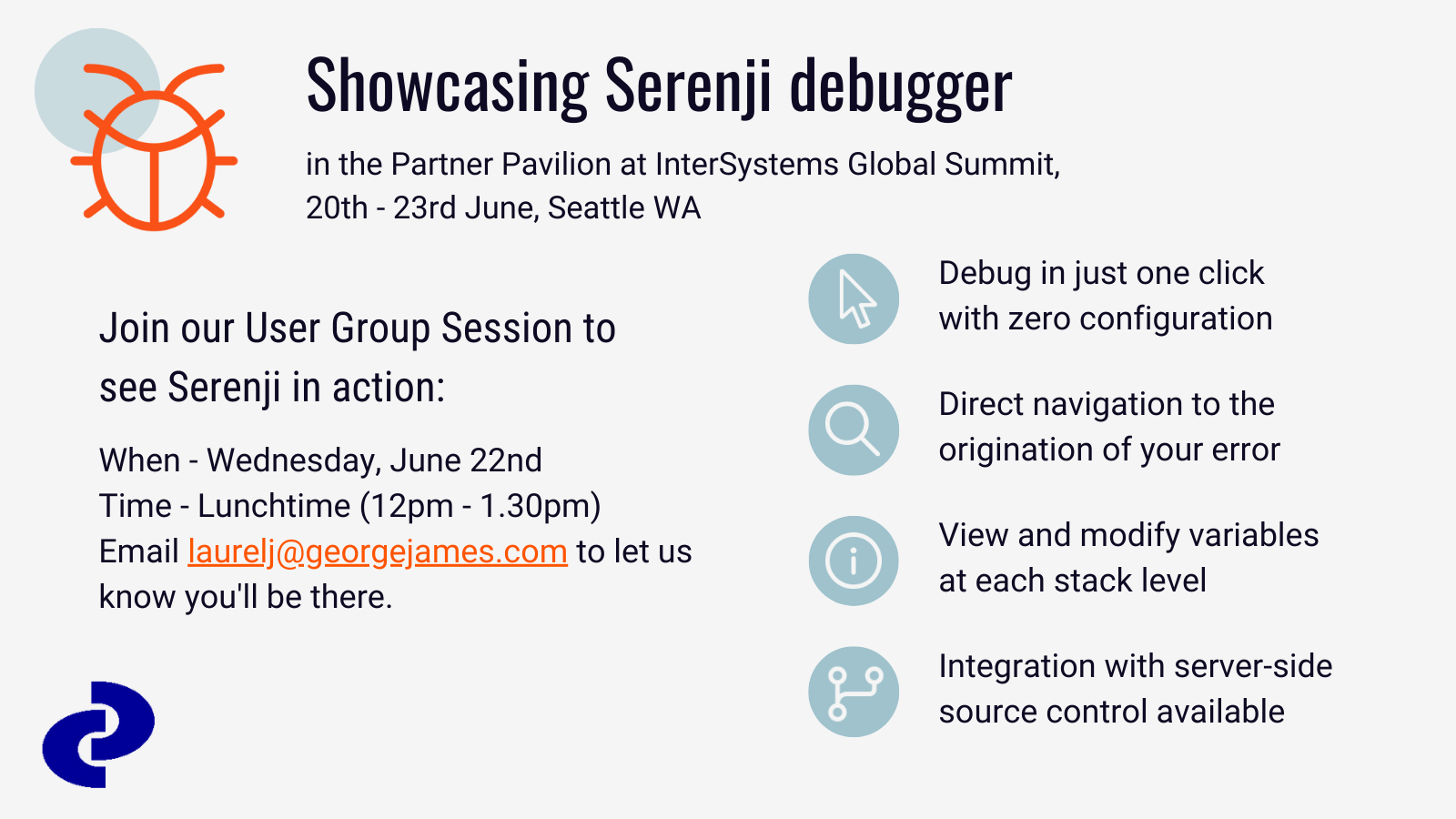
Come and say hi to us in the Partner Pavilion at the Global Summit!
We’ll be showcasing our Serenji on-the-spot debugger which has undergone some big changes in the last year—users can now enjoy a seamless debugging experience with zero configuration, along with taking advantage of the latest features in VS Code itself, enabling users to smoothly identify and quickly fix errors in your code, contributing to the production of quality, maintainable code.
If you want to see Serenji in action look for us in the Partner Pavilion, we'll be on hand to show you a demo. Prospective users are also welcome to join our User Group Session during the lunchtime session on Wednesday, June 22nd. Email laurelj@georgejames.com to let us know you'll be there.
Hi my fellows camrades,
I have a question that seems really simple but it's quite a pain in my ass right now.
I had to rename (take a file from a directory and move it to another) which is a .hl7. Whenever this file has been displaced, I have to change the extension from .hl7 to .OK without using the rename method. Maybe using the attribut?
Do you have any ideas how I could do it?
This should follow the step i have explained right before.
I have a service to take the file but i need an operation to rename it then change his name.
Thanks in advance for your help,
Thomas
How I can get current date/time on format YYYYMMDDhhmmss?
I tried $ZDATETIME($HOROLOG,8), but I got 20220606 17:59:56 and I want 20220606175956
Thanks
Hi Guys,
We currently running all our clients in Ensemble 2014, but now we are having a problem that 2014 can't resolve (TLS version is 1 where we need TLS 1.2 or higher).
basically, all we're looking for is a classmethod in Ensemble 2018 that uses HTTP request to connect to a client server and get tokens & some JSON files and then save them in a class available in our current 2014 production server.
Hi guys,
A client want to programmatically list all namespaces and whether they are interoperability or not. Do we have apis or sql to do that? Thanks.
I've tried several methods of %SYS.Namespace but did not find it yet. Also when I use sql to select from %SYS.Namespace through jdbc, it always return an empty result set.
I noticed today that when we are creating a message from one doc type to another doc type, that the message type categories are not necessarily set. This is causing some issues with routing rules when we try to reference the Message Type Categories. Is there a way to make sure the Message Type Categories are being set within a DTL to make sure this doesn't cause problems down the road?
Thanks
Scott
Hi there,
I'm passing a JSON object to the server as such:
{"key":"value","key":"value","key":"value"}From the client:
- Build object
object=JSON.stringify(object)
-pass to server side method as %String
On the server:
s object={}.FromJSON(object)Instead of getting something like
I get
I can't access that object using %Get as if says invalid OREF.
Hi Team,
"Unable to logon to Server Ensemble" also I have don't have access to Ensemble studio and Management portal also, on Ensemble Server (2015.2.0.664.1) Production Server.
PFA error screenshot for your reference.
2022.1 is an extended maintenance release, which means that maintenance builds will be available for two years, followed by an additional two years of security-specific builds.
InterSystems IRIS Data Platform 2022.1 expands support to include the following new & updated operating systems for production workloads:
Hello! I need help reading a file and putting the contents into variables.
File path would be, c:\temp\zipcitystate.csv or txt
Data looks like this
00501,Holtsville,NY
00544,Holtsville,NY
00601,Adjuntas,PR
00602,Aguada,PR
I need to add the first area to variable ZIP, Second to CITY and third to STATE. they are separated by a comma.
Any help would be appreciated
Hi developers!
Here is the score of technical bonuses for participants' applications in the InterSystems Grand Prix 2022 programming Contest!
Hey Developers,
New video is already on InterSystems Developers YouTube channel:
⏯ InterSystems HealthShare Analytics Solution: Create & Deliver Real-Time Insight at Scale
Hey Developers,
Let the voting week begin! It's time to cast your votes for the best applications in the Grand Prix Programming Contest!
🔥 You decide: VOTE HERE 🔥
How to vote? Details below.
In the first article about IRIS Megazord, Henrique explains what drove us to create such an application. It basic is a composition of these previous project which we did:
But we also started the development of a new feature, called Flow Editor. In this article we are going to know more about it.
The aim of this feature is to test a new way to create IRIS Interoperability productions, as Henrique explained in the previous article.
Very recently Docker showed a very new feature added to their Docker Desktop tool. It was a good way to start using Docker on macOS and Windows, and they also released the same tool for Linux as well. And new feature Extensions add an ability to extend this GUI application with some extra abilities from extensions.
.png)
Hi Community,
This article will demonstrate how to create Patient and Patient Observation Resources by using iris-fhir-client application.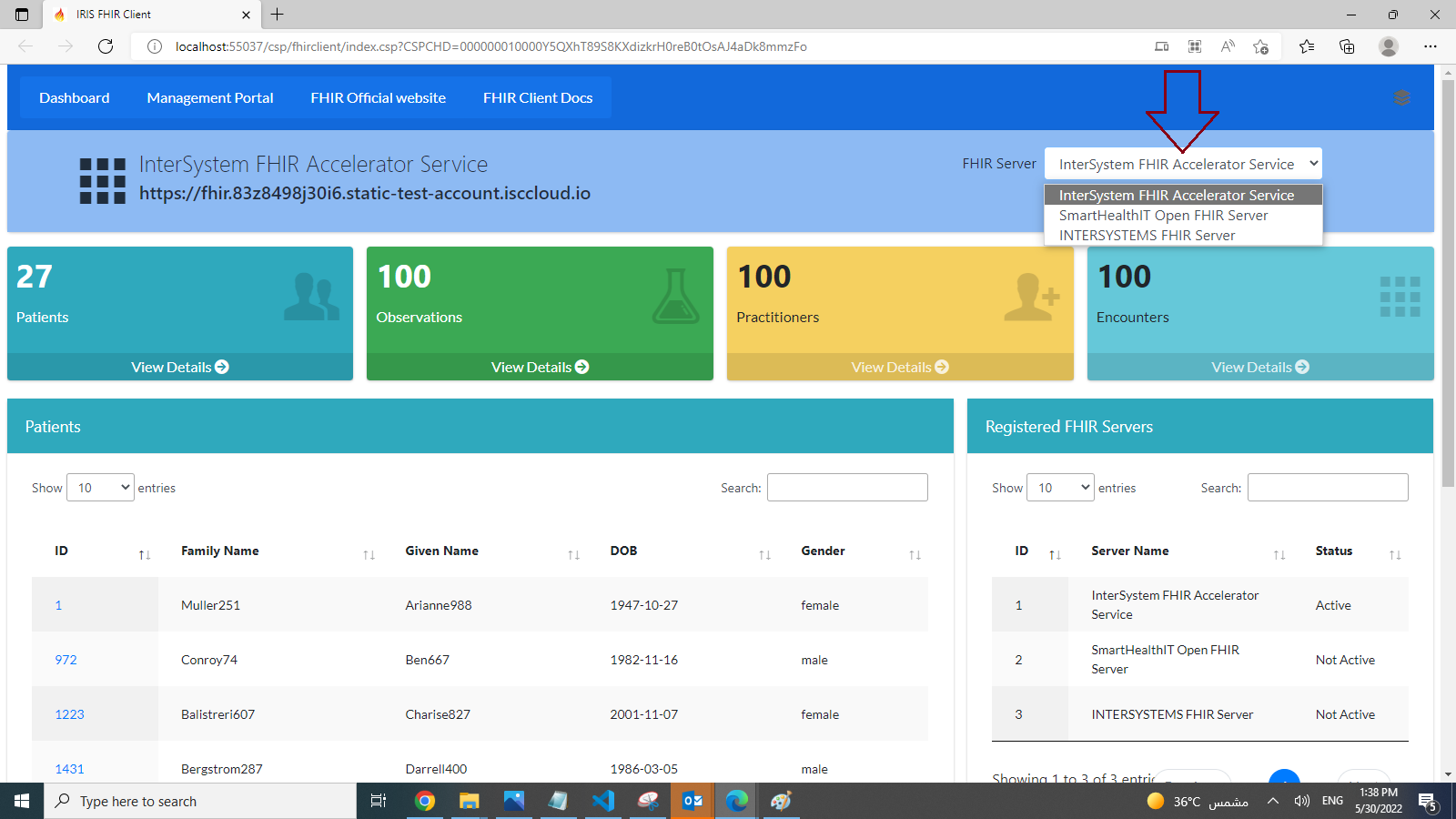
I recommend to read my first article about this app and watch Youtube Video before continue
so let's start
Hey Community,
Here is a digest of the Developer Community videos on InterSystems Developers YouTube Channel in May 2022:
Hi all
I have a Zen page which displays the contents of a table. One of the columns is a file path to a file on a local disk.
Is it possible, on a Zen page, to allow that file that described by the file path to be downloaded when a hyperlink is clicked on?
Cheers
It is very interesting to compare different BI technologies. It is curious to me what the differences are in functionality, development tools, speed and usability.
For this application, I chose a dataset with water conditions in various European countries. This is an open source dataset containing observational data from 1991 to 2017.
The team and I decided to make a model based on this BI dataset using IRIS BI, Tableau, PowerBI and InterSystems Reports (powered by Logi Reports).
For the frontend, we made a web interface in PythonFlask via Embedded Python.