Question Simon Barker · May 29, 2020

I've got a REST service that I can access via a browser. I can get it to take HTML tags as data and display it back to me (so I know the REST part is working). So if I send it this:

http://MyServer:57772/TestArea/rest/TestQuery?UUID=1&RTX=RTX123456&CareType=Palliative
 

Then I can pick out the data and tell it to display in the browser, which is great but what I really want to do is put the data into a string and send to a business process that will do lots of looking up but eventually return a URL that my REST service will then redirect the browser to.

Been trying to follow advice from here but

5
0 544
Question Md Asif Khalil · Jun 7, 2020

Hi All,

I have created a custom method into persistent class to call vendor Rest API from Ensemble that is working fine through Terminal, but my concern is:

I want to call only if  Error, Warning or Alert are generated. Is there any way that it would call automatically to send that Logs records through API or from where I need to call custom method of persistent class.

I also tried to put that persistent class method from Ens.Util.Log class but it's calling multiple time automatically.

Thanks,

Asif

1
0 223
Article Oleh Dontsov · Jun 4, 2020 1m read

Sometimes you need quickly and easily import data into IRIS. For this, an IRIS import manager has been developed.

This application allows you to import JSON data and also provides a really simple interface for transferring data from MongoDB collections to IRIS globals. It has never been so easy.

Let's look at examples.

Import JSON

Suppose we have data in JSON format and we want to import it into IRIS. To do this, you just need to specify the global name and insert the data. After import, you will see the imported data. If global exists data will be overwritten.

Import MongoDB collections

There is

5
0 794
Article Renato Banzai · Jun 2, 2020 4m read

picture

Globals as a Graph Data Structure in Python

How to use the IRIS Native API + Python to see globals as a Graph Network Chart.

Iris Globals

Reading the documentation these topics are related to globals:

  • A global consists of a set of nodes (in some cases, only one node), identified by subscripts.
  • Each node can contain a value.
  • ObjectScript includes functions to iterate through the nodes of a global and quickly access values.
  • A global is automatically stored in the database. When you assign a value to a node of a global variable, the data is written immediately to the database. - You can see the
4
1 604
Announcement Anastasia Dyubaylo · Jun 1, 2020

Hi Community!

This week is a voting week for the InterSystems IRIS Native API Programming Contest! We have 8 applications — so you have a set of applications to choose from!


How to vote? This is easy: you will have one vote, and your vote goes either in Experts Nomination or in Community Nomination.

5
1 418
Question Oliver Wilms · Jun 5, 2020

Hello,

How can I use ISC_DATA_DIRECTORY once IRIS runs inside a container? Some background...

We plan to deploy multiple containers running the same Health Connect IRIS Interoperability production in containers.So far we use docker run to start a container with ISC_DATA_DIRECTORY individual per container inside a efs that gets mapped using -v.I can imagine automating this task - we have not yet looked at cloud manager - and assigning individual ISC_DATA_DIRECTORY to each container.

5
0 524
Article Peter Cooper · Mar 18, 2018 1m read

Hi All
This is the index to a series of articles I hope to create over the coming months.

ZEN and ZEN Mojo are no longer being actively developed by Intesystems - this is a great shame as it is a fine product that works so well for business applications.
However ZEN is a 15 year old product and I need a path forward to replace the ZEN UI with a supported development framework.

This article is an index of the other articles I have, or plan to write. - the articles will be subject to change as I develop my thoughts and climb the learning curve.

5
1 1354
Question Daniel Sanches · Jun 28, 2019

I'm trying to sign an xml but this is showing an Id attribute in the Signature tag and the xmlns attribute is not appearing.

This is the xml generated:

<Signature Id="Id-80170FF0-0678-47D5-8C8B-771AA4E334E6">
            <SignedInfo>
                <CanonicalizationMethod Algorithm="http://www.w3.org/TR/2001/REC-xml-c14n-20010315"/>
                <SignatureMethod Algorithm="http://www.w3.org/2000/09/xmldsig#rsa-sha1"/>
                <Reference URI="#ID2102103519037442275900010755000000003309115569507501">
                    <Transforms>
                        <Transform
7
1 717
Article Renato Banzai · Jun 5, 2020 3m read

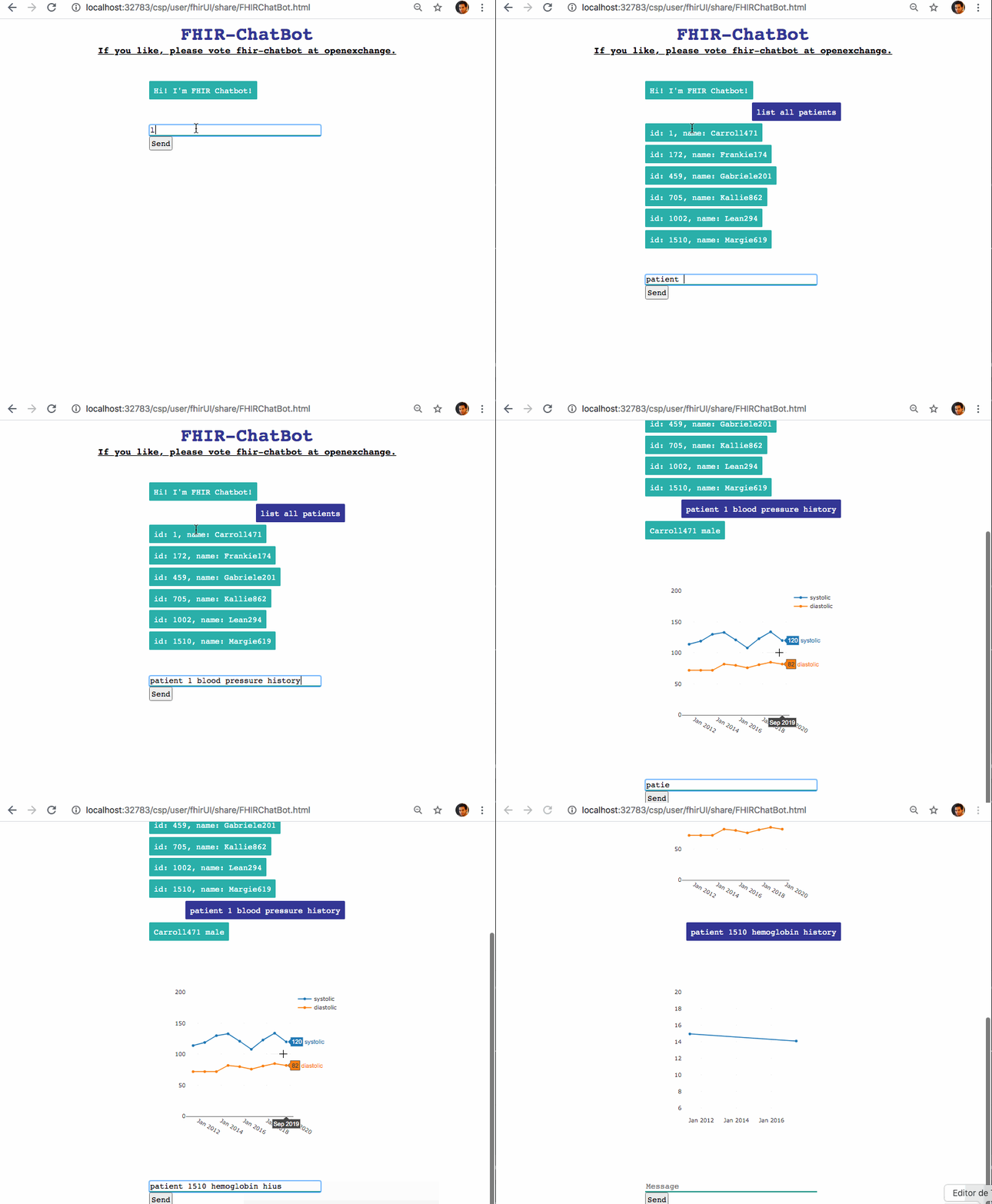
Hi everyone! If it doesn't bother you, could you help me teach my bots to talk?

Open my chatbot here: Help my chatbots to talk!

What? Aren't your chatbots smarts?

Smart isn't the best term for this scenario. They are trained but with little data! Most of chatbot solutions uses Machine Learning to create a way to talk with people and Machine Learning needs one important thing to performs well: DATA

How does it work?

A simple way to explain: imagine someone who has a brain but dont have any experience in his life he just born.

3
0 354
Announcement Anastasia Dyubaylo · Jun 5, 2020
0
0 246
Article Yuri Marx · Jun 2, 2020 3m read

What is the OData

OData (Open Data Protocol) is an ISO/IEC approved, OASIS standard that defines a set of best practices for building and consuming RESTful APIs. OData helps you focus on your business logic while building RESTful APIs without having to worry about the various approaches to define request and response headers, status codes, HTTP methods, URL conventions, media types, payload formats, query options, etc. OData also provides guidance for tracking changes, defining functions/actions for reusable procedures, and sending asynchronous/batch requests (source: OData.org).

The OData use

1
4 943
Article Mikhail Khomenko · Dec 23, 2019 12m read

Last time we deployed a simple IRIS application to the Google Cloud. Now we’re going to deploy the same project to Amazon Web Services using its Elastic Kubernetes Service (EKS).

We assume you’ve already forked the IRIS project to your own private repository. It’s called <username>/my-objectscript-rest-docker-template in this article. <root_repo_dir> is its root directory.

Before getting started, install the AWS command-line interface and, for Kubernetes cluster creation, eksctl, a simple CLI utility. For AWS you can try to use aws2, but you’ll need to set aws2 usage in kube config file as described here.

1
3 1668
Question Arto Alatalo · Apr 29, 2020

Hi Community! I need your advice.

The method below is 6 times slower on production server than on developing machine:

ClassMethod runme4()
{
    s cnt=615210
    s st=$zh
    for i=1:1:cnt {
        s p=##class(digi.packet).%OpenId("packet||5237")
        w:p="" "not found",!
        k p
    }
    w $zh-st,!
}

BUT the server is 6 times faster if OpenId replaced with simple read of a large global (s p=^someLargeGlobal). Any ideas what makes OpenId so slow only on the server?

And another question: I wanted to profile the code with %Monitor.System.LineByLine but it gives me statistics for

27
0 1238
Article Muni Ganesh · Jun 4, 2020 2m read

Hi All,

I am writing this article to tell about the application "CRUD-GLOBALS-IRISNATIVEAPI-JAVA" which is developed as part of "InterSystems IRIS Native API programming contest". The intention of this application is to manage the Globals which are in IRIS instance through java program using IRIS Native API. To use this application basic knowledge of CACHE Globals structure is required.

In this application as of now we  have options to Create,View  Globals and Data Search in Globals. Update and Delete will be added in next releases.

You may think that CRUD operations of Globals already we have

0
0 482
Article Tani Frankel · Jun 4, 2020 10m read

In this article I'd like to share with you a phenomena that is best you avoid - something you should be aware of when designing your data model (or building your Business Processes) in Caché or in Ensemble (or older HealthShare Health Connect Ensemble-based versions).

2
0 500
Announcement Anastasia Dyubaylo · May 9, 2020

Hi Developers!

We are pleased to announce the next competition in creating open-source solutions using InterSystems IRIS Data Platform!

Please welcome the third InterSystems IRIS Online Programming Contest for Developers!

And the topic for this contest is InterSystems IRIS Native API.

The contest will last three weeks: May 18 – June 7, 2020


28
1 2156
Article Janne Korhonen · Jun 4, 2020 5m read

A lot of developers like to work with Studio and have been looking into source code version control such as GIT or into enabling modern development workflows like CICD or DevOps processes.

This article describe an elementary solution to get you started in CICD and DevOps, even if you are not yet ready to move to Atelier or forth coming VS Code approach which enable client side source code version control.

Step 1: Setting up version control with Studio and GIT

While Atelier and VS Code enable client side source code control with ecosystem of IDE plugins Studio offers server side hooks (code that

0
0 1080
Article Renato Banzai · Jun 3, 2020 4m read

picture

Creating a Chatbot with IRIS and Python

In this article I'm going to show how to integrate the InterSystems IRIS Database with Python to serve a Machine Learning Model of Natural Language Processing (NLP).

Why Python?

With a large adoption and use in the world, Python have a great community and a lot of accelerators | libraries to deploy any kind of application. If you are curious (https://www.python.org/about/apps/).

Iris Globals

As I start to learn about ^globals they became familiar to use as a fast way to ingest data in a out-of-box data model.

0
1 1265
Question Scott Roth · Jun 3, 2020

Cache for UNIX (IBM AIX for System Power System-64) 2018.1.3 (Build 414U) Mon Oct 28 2019 11:24:02 EDT [HealthShare Modules:Core:15.032.9026 + Linkage Engine:15.032.9026]

We had an odd situation come up last night. Towards the end of the day one of my team members added a rule to an existing routing rule. When he had hit saved, he got a warning that he would overwrite someone else's changes. He hit cancel, then was able to click save. What he did not know is that there was a syntax issue in his rule that he had put in. He was missing a {  that wasn't caught till hours later. 

So a couple of

3
0 291
Article Yuri Marx · Jun 3, 2020 5m read

SAP offers a broad support to OData in all your products. So, OData can be an excellent option to exchange data between SAP and InterSystems IRIS.

  1. Follow the instructions in the article https://community.intersystems.com/post/odata-and-intersystems-iris to expose your IRIS data as REST OData services.
  2. To consume InterSystems IRIS data from SAP using OData, follow these steps (credits to the next steps of this tutorial: https://sapyard.com/sapui5-for-abapers-consuming-odata-service-from-sapui5-application-crud-operations/) :
  3. Create a new SAPUI5 application by the name crud_demo.
  4. Create a
0
3 792
Article Sergey Mikhailenko · Jun 2, 2020 8m read

When you first start working with InterSystems IRIS, it’s a common practice to install a system with only a minimum level of security. You have to enter passwords fewer times and this makes it easier to work with development services and web applications when you're first getting acquainted. And, sometimes, minimal security is more convenient for deploying a developed project or solution. And yet there comes a moment when you need to move your project out of development, into an Internet environment that’s very likely hostile, and it needs to be tested with the maximum security settings (that is, completely locked down) before being deployed to production. And that’s what we’ll discuss in this article. For more complete coverage of DBMS security issues in InterSystems Caché, Ensemble, and IRIS, you may want to read my other article, Recommendations on installing the InterSystems Caché DBMS for a production environment. The security system in InterSystems IRIS is based on the concept of applying different security settings for different categories: users, roles, services, resources, privileges, and applications. Users can be assigned roles. Users and roles can have privileges on resources — databases, services, and applications — with varying read, write, and use rights. Users and roles can also have SQL privileges on the SQL tables located in databases.

2
3 1180