When building a Production, should I create separate message classes for each integration flow, or is it acceptable to reuse generic request/response classes across different Business Operations? I'm trying to understand how to keep things organized as the number of integrations grows.
We have another great initiative for you to sink your teeth into! Following last year's resounding success, we're hosting a new edition of the Demo Games. But with a twist: our North American Sales Engineers have submitted their best demo videos, but this time, you're the ones to take part and win a prize.
Please welcome the North American Demo Showcase! 🎉
What is the most efficient, memory-safe way to get the names of the corrupted indexes on very large tables for a rebuild. However, if an index has millions of corrupted rows, the .errors array in %ValidateIndices grows too large and throws a errorerror.
The competition brought together outstanding publications, each showcasing expertise and innovation. With so many high-quality submissions, selecting the best was a true challenge for the judges.
Let's meet the winners and look at their articles:
Hi! We are deploying the iris image in a Kubernetes environment and the cluster state is "Hung" , looking the alerts endpoint we get 2 alerts:
[ { "time":"2026-03-24T13:45:44.548Z", "severity":"2", "message":"System appears to have failed over from node a69a9f137593" }, { "time":"2026-03-24T13:46:30.274Z", "severity":"2", "message":"Error: <PROTECT>KillAlive+1^%SYS.CDIRECT in SERVERS" } ] Any idea / help where those are comming from and how to address them?
Health Galaxy creates an AI access point on top of any FHIR server, bringing healthcare into the AI future that has become a reality for many other industries.
AI access: Health Galaxy gives AI agents a single gateway into any healthcare system, so they can pull patient data, schedule appointments, and check insurance automatically instead of a human doing it manually.
Ease of use: You point it at an existing FHIR endpoint, click a button, and it generates an MCP endpoint automatically from the capability statement.
FHIR: Since we are using FHIR, we can leverage both the storage and exchange capabilities of InterSystems IRIS.
🗣 Presenter: @Zelong Wang, Sales Engineer at InterSystems
I recently started using Cursor/VSCode with an IRIS container for development rather than Studio/Terminal. I've noticed that whenever I use %G (so basically all the time), when I exit %G, the terminal window simply closes, rather than returning me to my usual namespace prompt. %G also does not retain the command stack like it does in old school terminal, so I'm forced to constantly retype every global reference. Anyone figured out a solution to this? It's a relatively minor problem in the grand scheme of things, but a time consuming and irritating one.
What is the recommended approach for handling upgrades in an InterSystems IRIS Kubernetes environment?
For example, if we deploy version 1.0.0 of our product and subsequently need to upgrade to 1.0.1, and this upgrade requires changes to SQL tables containing customer data.
The quickest solution that comes to mind is creating an 'upgrade method' that runs on startup to check if any data migration actions are required. However, I'm wondering if there are better solutions or established best practices for this.
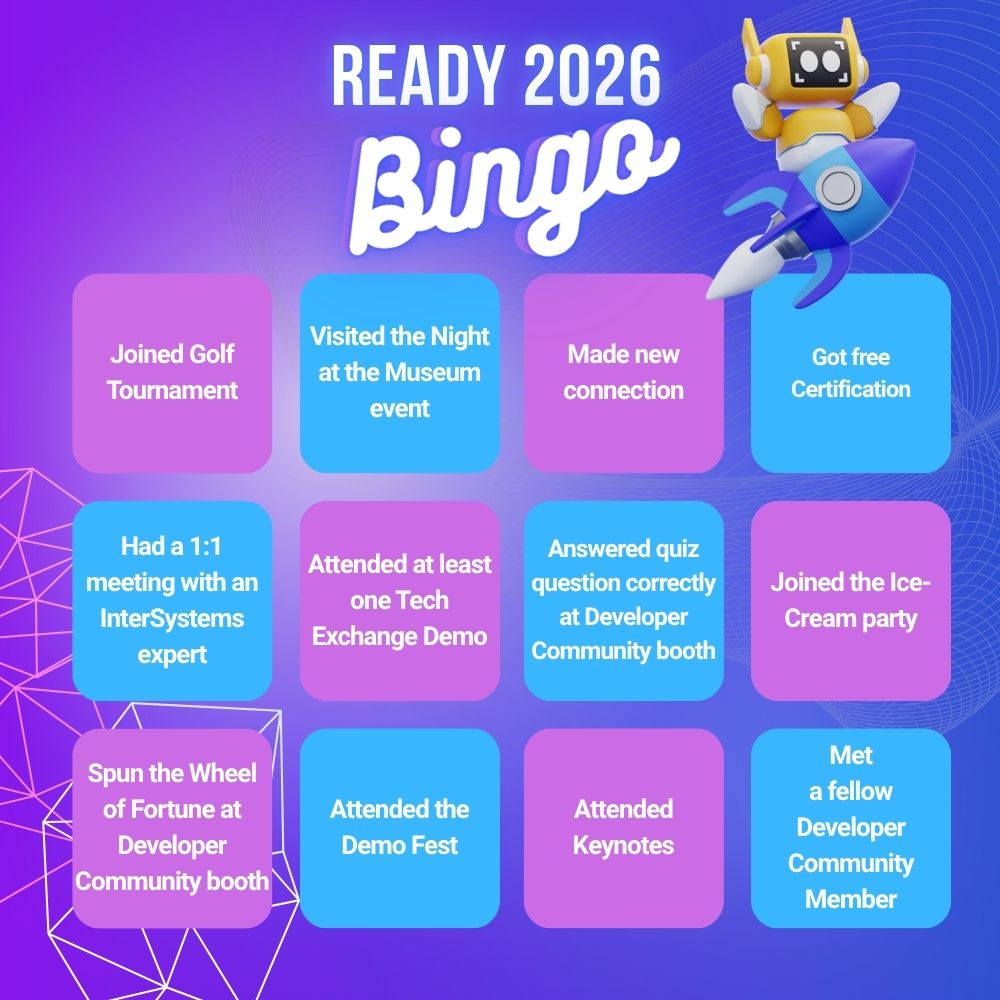
What was your READY experience like? 🎉 We’ve put together a bingo card — check out how many squares match your experience!
Mark the moments that happened to you or share them in the comments below. And if you had a memorable READY moment that’s not on the card, tell us about it — we’d love to hear your story ✨
I’m thrilled to share that after several years of deep diving into the InterSystems IRIS data platform, I have finally summarized my project experiences into a new book IRIS (Data Platform) Programming Technical Guide. It is published by Beihang University Press, a prestigious central-level comprehensive publisher renowned for its leading role in aerospace, science, and technology publishing.
Writing this book was a significant engineering challenge for me. My goal was to bridge the gap between "understanding the syntax" and "building a production-ready project.
We are using IRIS for Health to develop an agentic AI chatbot workflow that can interact with a patient using voice commands, reach out to an EHR or other system for context, and provide recommendations back.
Presenters: 🗣 @Vic Sun, Sales Engineer at InterSystems 🗣 @Brad Nissenbaum, Sales Engineer at InterSystems 🗣 Danielle Micciantuono, Clinical Solutions Specialist at InterSystems
ExplantIQ is an intelligent data application that tackles one of healthcare's most overlooked financial and regulatory risks: the management of explanted medical device warranty credits. When an implanted device is removed from a patient (due to failure or recall) hospitals are legally required to pursue manufacturer credits, refund payers if the credit exceeds 50% of the device's cost, and report to CMS. Miss that obligation and you're facing a reverse False Claims Act violation. Industry data shows hospitals miss 81% of eligible credits.
ExplantIQ, built entirely on InterSystems IRIS for Health and DeepSee, solves this by unifying clinical, supply chain, billing, and FDA recall data into a single real-time compliance dashboard, complete with KPI scorecards, trend analytics, and a Text-to-SQL AI Assistant that lets compliance officers query live operational data in plain English. No separate BI tool. No additional architecture. All questions can be answered without leaving your browser tab.
Create an operational data store using the data flowing through your production. Create user-defined analytics tables based on fields and paths to their data from incoming documents with varying standards (FHIR, CDA, HL7v2, etc.).
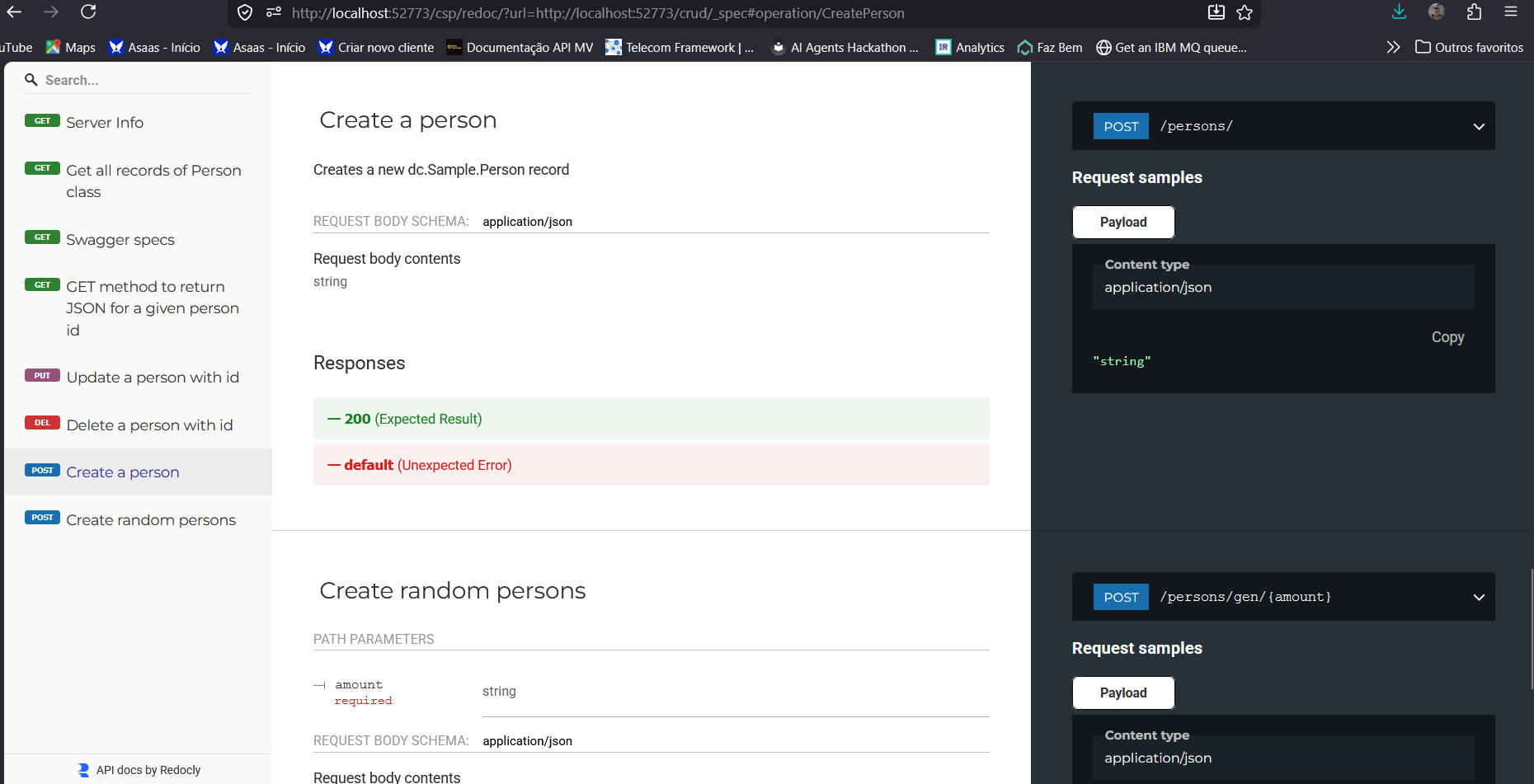
Redoc is an Open Source solution capable of rendering API specifications in OpenAPI 2.0 or 3.0+ as very beautiful and functional web portals. Currently, to have something similar, we need the ZPM SwaggerUI extension or we need to install IAM - InterSystems API Manager and then configure the IAM Developer Portal. Well, now the community has one more option, iris-redoc. This solution installs a web application on your IRIS instance that uses Redoc to present a beautiful web portal for your REST APIs:
For those who learned Caché ObjectScript from scratch: what kind of personal or practice projects did you build to get comfortable with the language? I come from a C# background and I'm looking for project ideas that are small enough to be feasible but meaningful enough to actually teach the core COS concepts.
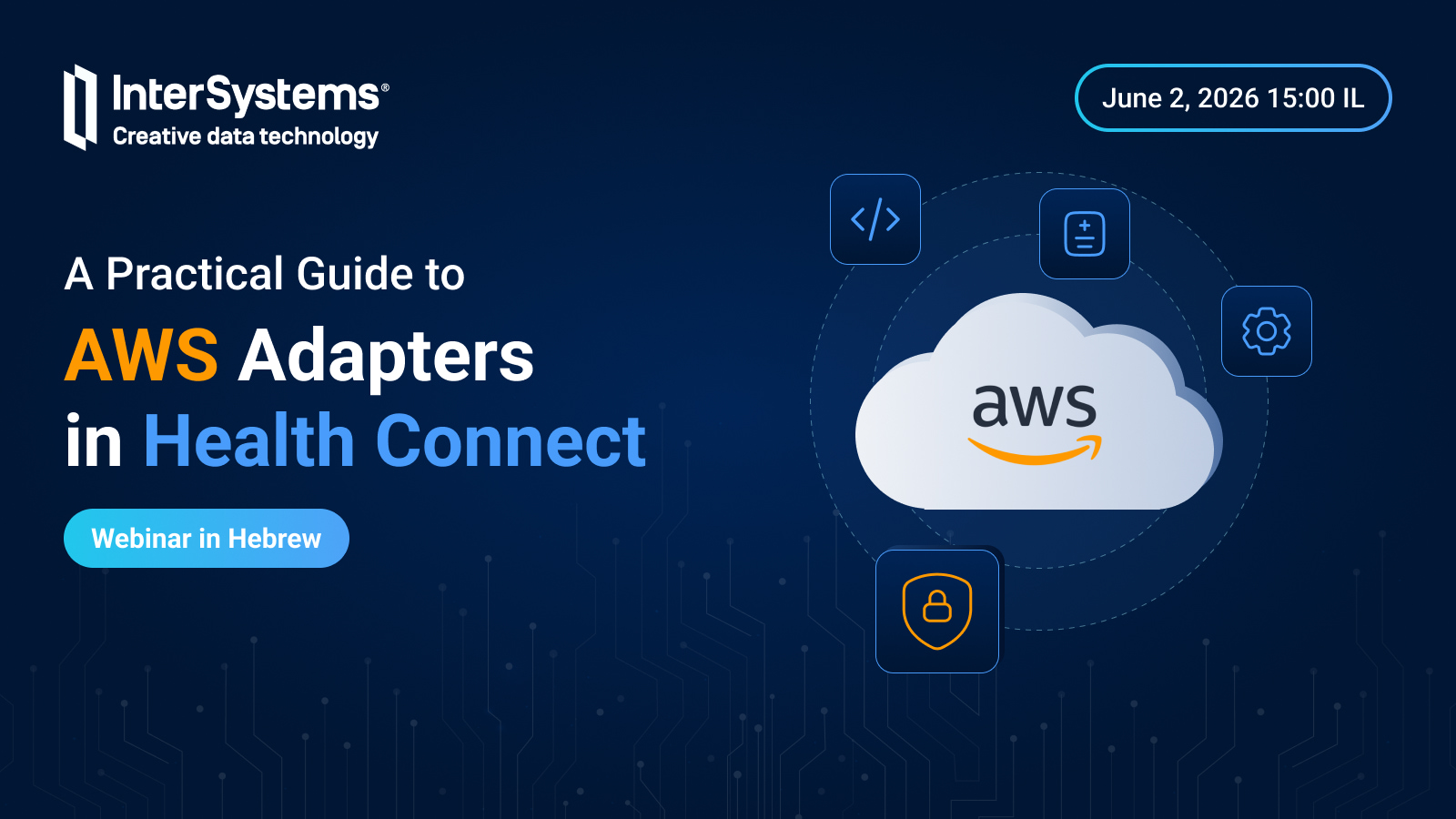
Discover how to accelerate cloud-based integration with InterSystems' native AWS adapters for S3, SQS, SNS, and CloudWatch.
This session provides a practical look at building modern interoperability workflows — from secure file ingestion and asynchronous messaging to automated notifications and centralized monitoring.
Recently, a question on the Community was asked by @Vermon Ferre about storing data from inherited classes in different globals. So, I decided to simulate the following behavior: I created a superclass called Article.MainClass and two subclasses, Article.Class1 and Article.Class2. By default, when each class extends %Persistent IRIS creates independent storage structures for them. This will work as intended if the first class in the list of superclasses is %Persistent. But it also means that if there are any parameters in the main class, they will be lost, because only parameters from the first class in the list get inherited.
Welcome to another installment of the Platforms Update. A few notables to highlight:
Ubuntu 26.04 has been released, and corresponding IRIS support is coming soon.
IRIS 2026.2 will bring an end to support for Ubuntu 22.04 and Windows 10.
Revised minimum CPU specifications are in effect for 2025.3+
For those newly acquainted with these communications, this update provides details about recent enhancements as well as anticipated changes based on current information; however, future projections remain uncertain and the content should not be interpreted as a definitive product roadmap.
Today, coding assistants like Claude, GitHub Copilot and Cursor have transformed the way developers write code. However, these tools are limited by being isolated from the systems and data sources that developers work with daily. This limitation can be overcome through the Model Context Protocol (MCP), an open standard designed to connect AI assistants to external data sources and tools in a secure and standardized way.
In this review article, we'll explore the current state-of-the-art regarding the MCP within the InterSystems ecosystem.
I was really surprised that such a flexible integration platform with a rich toolset specifically for app connections has no out-of-the-box Enterprise Service Bus solution. Like Apache ServiceMix, Mule ESB, SAP PI/PO, etc, what’s the reason? What do you think? Has this pattern lost its relevance completely nowadays? And everybody moved to message brokers, maybe?
Wiki time: An enterprise service bus (ESB) implements a communication system between mutually interacting software applications in a service-oriented architecture (SOA) .