Contestant

There seems to be a generous use of ClassMethods in ObjectScript code generally. I hope my own experiences aren't representative, but I bet they are. Forgive me for giving away the ending of this article, but in short: don't use them. Unless you can make a pretty convincing case that you have to, just never use them.1

What is a ClassMethod? In an ObjectScript class, you can define methods in two different ways: in a Method, you must instantiate an instance of the class to call the method, and in a ClassMethod, you can call the method without instantiating the class. Of course, in a ClassMethod, you don't have access to any properties of the object (because there's no object), but you can access globals (they are global, after all) and Parameters (which are class constants).

2 0
0 12

There are numerous excellent tools available for testing your REST APIs, especially when they are live. Postman, various web browser extensions, and even custom ObjectScript written with %Net.HttpRequest objects can get the job done. However, it is often difficult to test just the REST API without inadvertently involving the authentication scheme, the web application configuration, or even network connectivity. Those are a lot of hoops to jump through just to test the code within your dispatch class. The good news is that if we take our time to understand the inner workings of the %CSP.REST class, we will find an alternative option suited for testing only the contents of the dispatch class. We can set up the request and response objects to invoke the methods directly.

9 5
7 194

Hello!!!

Data migration often sounds like a simple "move data from A to B task" until you actually do it. In reality, it is a complex process that blends planning, validation, testing, and technical precision.

Over several projects where I handled data migration into a HIS which runs on IRIS (TrakCare), I realized that success comes from a mix of discipline and automation.

Here are a few points which I want to highlight.

1. Start with a Defined Data Format.

Before you even open your first file, make sure everyone, especially data providers, clearly understands the exact data format you expect. Defining templates early avoids unnecessary bank-and-forth and rework later.

While Excel or CSV formats are common, I personally feel using a tab-delimited text file (.txt) for data upload is best. It's lightweight, consistent, and avoids issues with commas inside text fields.

PatID   DOB Gender  AdmDate
10001   2000-01-02  M   2025-10-01
10002   1998-01-05  F   2025-10-05
10005   1980-08-23  M   2025-10-15

Make sure that the date formats given in the file is correct and constant throughout the file because all these files are usually converted from an Excel file and an Basic excel user might make mistakes while giving you the date formats wrong. Wrong date formats can irritate you while converting into horolog.

4 12
2 210

Project Overview / Introduction

Developing and testing REST APIs in InterSystems IRIS often requires a significant amount of boilerplate code. While ObjectScript provides powerful tools for building APIs, writing consistent and repeatable tests can be time‑consuming. This is where IrisOASTestGen comes in.

4 2
0 94

Target Practice for IrisClusters with KWOK

KWOK, Kubernetes WithOut Kubelet, is a lightweight tool that simulates nodes and pods—without running real workloads—so you can quickly test and scale IrisCluster behavior, scheduling, and zone assignment. For those of you wondering what value is in this without the IRIS workload, you will quickly realize it when you play with your Desk Toys awaiting nodes and pods to come up or get the bill for provisioning expensive disk behind the pvc's for no other reason than just to validate your topology.

Here we will use it to simulate an IrisCluster and target a topology across 4 zones, implementing high availability mirroring across zones, disaster recovery to an alternate zone, and horizontal ephemeral compute (ecp) to a zone of its own. All of this done locally, suitable for repeatable testing, and a valuable validation check mark on the road to production.

0 0
0 66

Hi, Community!

Looking for ways to improve your application testing? See how to build requirements such as performance and scalability into your development workflow:

Testing Non-functional Requirements in Applications

https://www.youtube.com/embed/wkL7ciIOSzY?utm_source=youtube&utm_medium=social&utm_campaign=wkL7ciIOSzY
[This is an embedded link, but you cannot view embedded content directly on the site because you have declined the cookies necessary to access it. To view embedded content, you would need to accept all cookies in your Cookies Settings]

1 0
0 71

https://www.youtube.com/embed/v61csTb0i-0
[This is an embedded link, but you cannot view embedded content directly on the site because you have declined the cookies necessary to access it. To view embedded content, you would need to accept all cookies in your Cookies Settings]

If you like what you see please support this in the Developer Tools 2025 contest. Voting closes at midnight EDT on Sunday 3rd.

3 1
0 89

Overview I'm excited to announce the release of testcontainers-iris-node, a Node.js library that makes it easy to spin up temporary InterSystems IRIS containers for integration and E2E testing. This project is a natural addition to the existing family of Testcontainers adapters for IRIS, including testcontainers-iris-python and testcontainers-iris-java.

Why testcontainers-iris-node? As a Node.js developer working with InterSystems IRIS, I often faced challenges when setting up test environments that mimic production. testcontainers-iris-node solves this by leveraging the testcontainers-node framework to create isolated IRIS environments on-demand.

This is particularly valuable for:

  • Integration testing with IRIS databases
  • Testing data pipelines or microservices
  • Automating test environments in CI pipelines

Features

  • Launches IRIS in Docker containers using Testcontainers
  • Supports custom Docker images and configuration
  • Wait strategies to ensure IRIS is ready before tests begin
  • Clean teardown between test runs

2 0
1 99

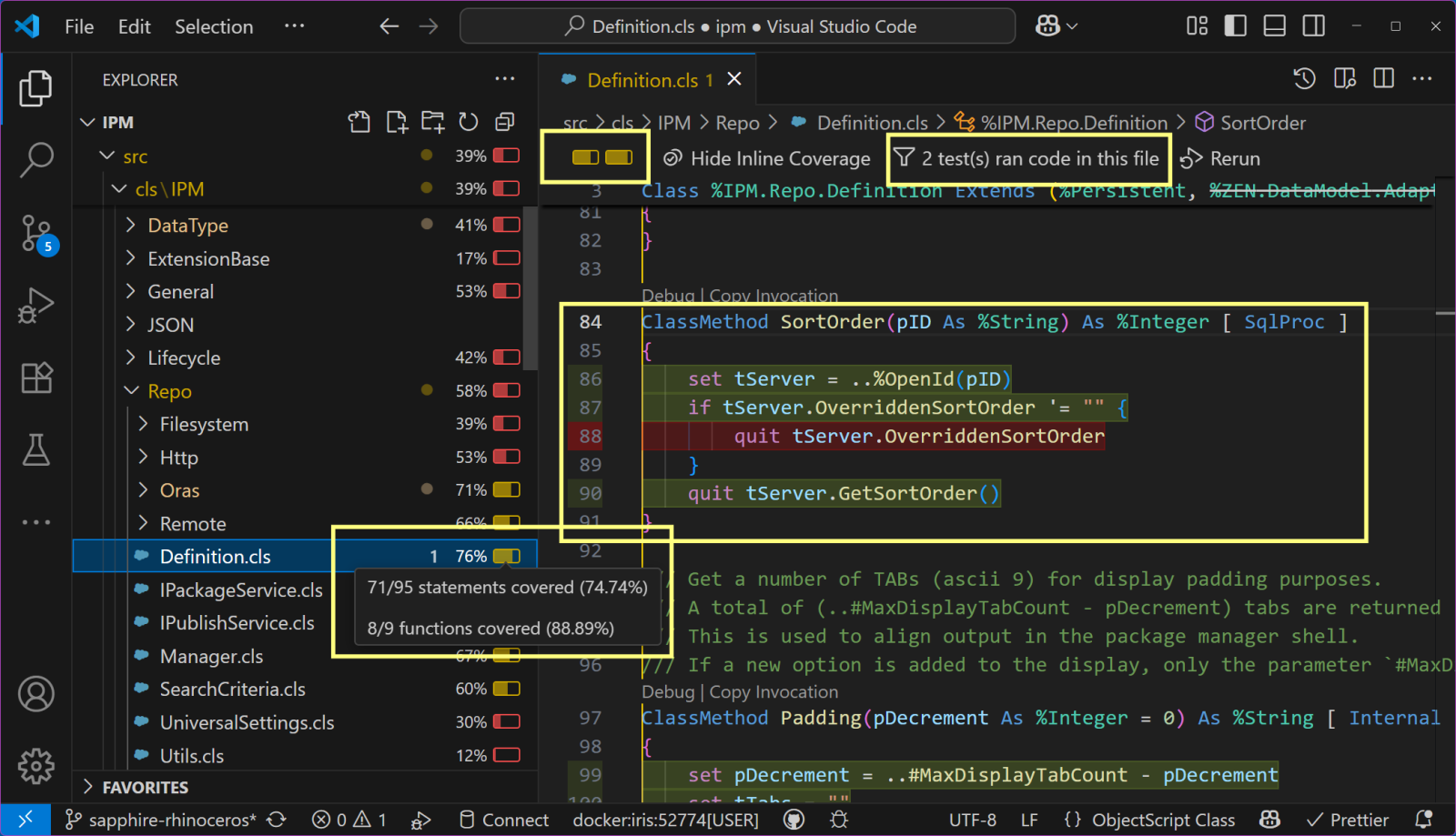
The new version of InterSystems Testing Manager which I released last week brings @Timothy Leavitt's cool
Test Coverage Tool to VS Code, and is my entry for the 2025 Developer Tools contest.

Here's a teaser screenshot showing how the unit tests of the IPM project don't yet cover a feature that apparently allows an IPM repository to override its sort order.

2 1
0 127

Are you curious about how to run Python scripts directly in your InterSystems IRIS or Caché terminal? 🤔 Good news it's easy! 😆 IRIS supports Embedded Python, allowing you to use Python interactively within its terminal environment.

How to access the Python Shell?

To launch the Python shell from the IRIS terminal, simply run the following command:

5 4
1 173

Hey Community,

Last week, the InterSystems team held our monthly Developer Meetup in a new venue for the first time ever! In the AWS Boston office location in the Seaport, over 71 attendees showed up to chat, network, and listen to talks from two amazing speakers. The event was a huge success; we had a packed house, tons of engagement and questions, and attendees lining up to chat with our speakers afterwards!

Photo of a large audience watching the speaker Jayesh Gupta present his topic
Jayesh presents on Testing Frameworks for Agentic Systems to a full house

7 0
1 79

At hackathons that InterSystems participated and I supported, many students were asking how all their teammates could use the same IRIS database that they spun up in a container. I suggested using ngrok to expose their localhost IRIS and realized we don't have documentation on that. Hence, I thought this would be great to let more people knwo about this powerful technique for enhancing collaboration during development and testing.

6 0
1 161

One of the pain points for maintaining HL7 interfaces is the need to run a reliable regression test upon deployment to new environments and after upgrades. The %UnitTest class allows unit tests to be created and packaged alongside interface code. Test data can also be maintained within the unit test class, allowing for quick and easily repeatable smoke-testing and regression testing.

Resources:

  • Standard %UnitTest class

13 1
1 486

Hi folks!

I'm building a very simple REST API.

But before testing it via a Web Server what I want to make sure that REST API methods work in principle.

Is it an easy way to "fake" the web-server request and get a result e.g. of the method with signature like that?

ClassMethod GetAllRecords(pRequest As %CSP.Request, pResponse As %CSP.Response) As %Status

e.g. calling it in Terminal?

0 6
0 247

Hello all!
We fully tested our system http://DataAI.link on InterSystems Cache database and on old IRIS.
We cannot find a free download of IRIS for developer as it was before.
We are looking for help from the community to test our system from the http://DataAI.link by register a user with connection to your testing IRIS database and play with our reports, analytics, AI.

0 2
0 138

image

Hi Community,

In this article, I will introduce my application iris-HL7v2Gen .

IRIS-HL7v2Gen is a CSP application that facilitates the dynamic generation of HL7 test messages. This process is essential for testing, debugging, and integrating healthcare data systems. The application allows users to generate a wide variety of HL7 message types, validate their structure against HL7 specifications, explore the message hierarchy, and transmit messages over TCP/IP to production systems. These features are particularly useful in settings where compliance with HL7 standards is mandatory for interoperability between different healthcare organizations or systems.


Application Features

  • Dynamic HL7 Message Generation: Instantly create HL7 messages for a range of message types, facilitating comprehensive testing.
  • Message Structure Exploration: Visualize the structure of generated messages based on HL7 specifications.
  • Value Set Visualization View predefined sets of allowable coded values for specific fields.
  • Message Validation: Validate messages against HL7 standards to ensure compliance.
  • TCP/IP Communication: Easily transmit messages to production using TCP/IP settings.
  • Broad Message Type Support: Supports 184 different HL7 message types, ensuring versatility for various healthcare integration needs.
  • ClassMethod: Generate a Test Message by Invoking a Class Method
  • Version Support: Currently Supports HL7 Version 2.5

8 0
4 427
Article
· Oct 17, 2024 2m read
ORU to MDM with large HL7 v2 messages.

I was working on a DTL but kept getting ERROR #5002... MAXSTRING errors. The problem was that most of the DTL GUI action steps only support the string data type when working with the segments. A %String has a limit of 3,641,144 characters and my OBX5.1 was 5,242,952 characters long as the example provided. Of course PACS admin stated ultra high quality up to and including 4K resolution files were needed, so we could not get the vendor to compress or reformat these files to compressed jpg or something similar.

3 7
1 444

Hi everyone,

In this article, I’m excited to introduce CodeInspector, a tool designed to simplify code validation by applying custom rules tailored to your development requirements. Whether you're managing a large codebase or working in an agile environment, CodeInspector helps ensure code quality by offering flexibility and adaptability to specific project needs.

4 3
0 246