#Vector Search

2 Followers · 140 Posts

Vector search is a method used in information retrieval and machine learning to find similar items based on their mathematical representations as vectors. In this approach, each item is represented as a high-dimensional vector, with each dimension corresponding to a feature or characteristic of the item. Vector search algorithms then compare these vectors to find similar items, such as having similar features or being close together in the vector space. Read more here.

New
Article José Pereira · Jun 13 11m read

A vector-search knowledge base of past clinical assessments, running on InterSystems IRIS, gives the LLM a deterministic calibration signal — making its triage reasoning faster, more structured, and clinically defensible.


The Problem with Probabilistic Medicine

The LLM answered correctly. But would it answer the same way for the next patient with the same profile? Same conditions, same medications, same symptoms — would the risk score drift? Would the priority shift from "emergency" to "urgent"? Would the follow-up tasks be different?

1
0 42
New
Article Anna Vinogradova · Jun 14 5m read

In my first article, I described the baseline version of the FHIR Patient Snapshot Agent: a Streamlit and Python application that retrieves FHIR resources from InterSystems IRIS for Health and uses an LLM to generate a concise patient summary.

This follow-up article explains how I extended the project with two additional InterSystems-focused features:

  • Source context vector search
  • Embedded Python artifacts for IRIS-compatible review

The goal was to make the project more useful as a clinical summarisation prototype while keeping the design small enough to understand and reproduce.

0
0 22
New
Article Moises Kerschner · Jun 13 10m read

The real problem

At 4:57 PM on a Friday, a routine laboratory order failed.

The patient's sample was already in transit. The external reference laboratory rejected the request — it could not uniquely identify the patient. The insurance operator rejected authorization for a different reason. Neither system spoke the same language, neither exposed compatible error messages, and the only integration layer in the middle simply forwarded requests.

A laboratory technician spent the next 25 minutes navigating portals, copying identifiers, and manually reconciling data between systems.

0
0 30
Article Muhammad Waseem · Jun 8 7m read

Hi Community,

In this article, I will introduce my application iris-fhir-agents A multi-agent clinical AI platform powered by InterSystems IRIS for Health. Features agents for triage, specialist consultation, pharmacy safety, and FHIR server exploration — all grounded by IRIS Vector Search RAG. Includes a no-code Agent Builder that lets you design and deploy custom clinical agents without writing a single line of code.

2
0 75
Article Yuri Marx · Jun 11 2m read

The successful construction and implementation of AI agents to address diverse use cases in the healthcare sector depend on high-quality data and APIs, effective governance, and management. The InterSystems IRIS FHIR server delivers all of this and is also fluent in Python, Vectors, and Interoperability. Combined with a strong LLM, patients, physicians, caregivers, and managers gain access to state-of-the-art technology for personal and public health.

1
1 55
Article Antor Chowdhury · Jun 12 8m read

Most "AI agent + FHIR" projects end up with the same shape: a FHIR server over here, a vector database over there, and a Python service in the middle whose job is to call an embedding API, marshal float arrays back and forth, and keep two datastores in sync. Three moving parts, two network hops, and an embedding client you now own forever.

Triage Park: our entry for the InterSystems Programming Contest: AI Agents for FHIR, doesn't have any of that. The agent never computes an embedding. It never imports an OpenAI embeddings client. There is no vector database.

0
0 35
Article Luana Machado · Jun 9 12m read

1. Introduction

Epidemiological surveillance is one of the foundational pillars of public health. Régis Júnior et al. (2026) define it as a continuous system of data collection, analysis, interpretation and dissemination of health events — a function whose effectiveness depends critically on the quality of information systems, data analysis capacity, and coordination between different levels of care.

2
2 51
Article Muhammad Waseem · Jun 9 6m read

Hi Community,

Have you ever wished your EHR could think? Not just display data. Not just fire alerts. But actually read a patient record, reason over clinical guidelines, and write a structured referral order back to the system — in response to a single message from a clinician

In this article, I am going to show you how to create your own custom clinical AI agent.


🏥 About iris-fhir-agents App

iris-fhir-agents is a multi-agent clinical AI platform built entirely on InterSystems IRIS for Health.

0
0 55
Article Sean Connelly · Jun 8 1m read


I’m pleased to share a demo of FHIR Agent Studio, now available on YouTube.

FHIR Agent Studio Demo

https://www.youtube.com/watch?v=vktfq_kvNnk

FHIR Agent Studio brings AI agents together with FHIR, InterSystems IRIS, Vector Search, and large language models to demonstrate how developers can explore, build, and test agent-driven healthcare workflows.

You can also find more information here:

Introduction article: https://community.intersystems.com/post/introducing-fhir-agent-studio-ai-agents-fhir-intersystems-iris

GitHub repository: https://github.com/SeanConnelly/ai-studio-for-fhir

0
0 46
Article Mihoko Iijima · May 28 31m read

Vector search is a retrieval method that converts text, images, audio, and other data into numeric vectors using an AI model, and then searches for items that are semantically close. It enables “semantic similarity search” from free text, which is difficult with keyword search alone.

However, in real use, I encountered cases where results that are “close in meaning” but logically the opposite appeared near the top of the search results.

This is a serious issue in situations where affirmation vs. negation matters. If the system returns the wrong answer, the impact can be significant, so we cannot ignore this problem.

This article does not propose a new algorithm. I wrote it to share a practical way I found useful when semantic search fails due to negation.


0
2 76
Article Thomas Dyar · May 27 15m read

TL;DR: This article demonstrates how to run GraphRAG-style hybrid retrieval—combining vector similarity, graph traversal, and full-text search—entirely within InterSystems IRIS using the iris-vector-graph package. We use a fraud detection scenario to show how graph patterns reveal what vector search alone would miss.


Why Fraud Detection Needs Graphs

Every year, businesses and consumers lose billions to fraud. In 2024 alone, consumers reported $12.5 billion lost—a 25% increase year over year. What makes modern fraud so difficult to detect is that fraudsters rarely work alone.

0
0 67
Article Pietro Di Leo · Oct 9, 2025 4m read

Introduction

In a previous article, I presented the IRIStool module, which seamlessly integrates the pandas Python library with the IRIS database. Now, I'm explaining how we can use IRIStool to leverage InterSystems IRIS as a foundation for intelligent, semantic search over healthcare data in FHIR format.

This article covers what I did to create the database for another of my projects, the FHIR Data Explorer. Both projects are candidates in the current InterSystems contest, so please vote for them if you find them useful.

You can find them at the Open Exchange:

In this article we'll cover:

  • Connecting to InterSystems IRIS database through Python
  • Creating a FHIR-ready database schema
  • Importing FHIR data with vector embeddings for semantic search
2
2 276
Article Pietro Di Leo · Oct 6, 2025 4m read
4
1 337
Article Yu Han Eng · Oct 5, 2025 3m read

IRIS Audio Query is a full-stack application that transforms audio into a searchable knowledge base.

Project Structure

community/
├── app/                   # FastAPI backend application
├── baml_client/           # Generated BAML client code
├── baml_src/              # BAML configuration files
├── interop/               # IRIS interoperability components
├── iris/                  # IRIS class definitions
├── models/                # Data models and schemas
├── twelvelabs_client/     # TwelveLabs API client
├── ui/                    # React frontend application
├── main.py                # FastAPI application entry point
└── settings.py            # IRIS interoperability entry point
2
3 259
Article Alberto Fuentes · Sep 1, 2025 6m read

Customer support questions span structured data (orders, products 🗃️), unstructured knowledge (docs/FAQs 📚), and live systems (shipping updates 🚚). In this post we’ll ship a compact AI agent that handles all three—using:

  • 🧠 Python + smolagents to orchestrate the agent’s “brain”
  • 🧰 InterSystems IRIS for SQL, Vector Search (RAG), and Interoperability (a mock shipping status API)

⚡ TL;DR (snack-sized)

  • Build a working AI Customer Support Agent with Python + smolagents orchestrating tools on InterSystems IRIS (SQL, Vector Search/RAG, Interoperability for a mock shipping API).
2
5 409
Article Tomo Okuyama · Mar 1 6m read

Why This Integration Matters

InterSystems continues to push AI capabilities forward natively in IRIS — vector search, MCP support, and Agentic AI capabilities. That roadmap is important, and there is no intention of stepping back from it.

But the AI landscape is also evolving in a way that makes ecosystem integration increasingly essential. Tools like Dify — an open-source, production-grade LLM orchestration platform — have become a serious part of enterprise AI stacks.

2
0 250
Article Yuri Marx · Feb 22 4m read

The facial recognition has become the most popular method for validating people's identities, thus enabling access to systems, confirmation of personal and documentary data, and approval of actions and documents.
The challenges are related to performance when the database is very large, accuracy, and especially the privacy of biometric facial data. For these challenges, nothing is better than using InterSystems Vector Search, as it allows:

  1. Performing vector searches in millions of records with much faster responses than traditional methods.
5
5 189
Article Ikram Shah · May 18, 2024 3m read

In the previous article, we saw in detail about Connectors, that let user upload their file and get it converted into embeddings and store it to IRIS DB. In this article, we'll explore different retrieval options that IRIS AI Studio offers - Semantic Search, Chat, Recommender and Similarity. 

New Updates  ⛴️ 

  • Added installation through Docker. Run `./build.sh` after cloning to get the application & IRIS instance running in your local
  • Connect via InterSystems Extension in vsCode - Thanks to @Evgeny.
1
1 490
Article Muhammad Waseem · Feb 25 4m read

image

Hi Community,
In this article, I will introduce my application iris-CliniNote .

CliniNote is a full-featured clinical notes application that combines classic CRUD operations with **real-time AI-assisted notes matching** powered by **InterSystems IRIS native vector search**. The standout feature: while a doctor is writing or editing a clinical note, a side panel shows the **top 5 most similar notes** based on the semantic content of the note being written — **excluding the current patient** to avoid trivial matches. This gives clinicians immediate access to "patients like this one" — helping with differential diagnosis, treatment pattern recognition, and rare presentation detection.

Online Demo

https://irisclininote.sandbox.developer.intersystems.com/csp/clininote/login.html

0
0 57
Article Ashok Kumar Thangavel · Feb 24 2m read

In the modern healthcare landscape, finding clinically similar patients often feels like looking for a needle in a haystack. Traditional keyword searches often fail because medical language is highly nuanced; a search for "Heart Failure" might miss a record containing "Congestive Cardiac Failure."

I am excited to share iris-medmatch, an AI-powered patient matching engine built on InterSystems IRIS for Health. By leveraging Vector Search, this tool understands clinical intent rather than just matching literal strings.

0
0 147
Article Alyssa Ross · Mar 9 6m read

One objective of vectorization is to render unstructured text more machine-usable. Vector embeddings accomplish this by encoding the semantics of text as high-dimensional numeric vectors, which can be employed by advanced search algorithms (normally an approximate nearest neighbor algorithm like Hierarchical Navigable Small World). This not only improves our ability to interact with unstructured text programmatically but makes it searchable by context and by meaning beyond what is captured literally by keyword.

In this article I will walk through a simple vector search implementation that Kwabena Ayim-Aboagye and I fleshed out using embedded python in InterSystems IRIS for Health. I'll also dive a bit into how to use embedded python and dynamic SQL generally, and how to take advantage of vector search features offered natively through IRIS.

0
1 255
Article Alberto Fuentes · Feb 13 10m read

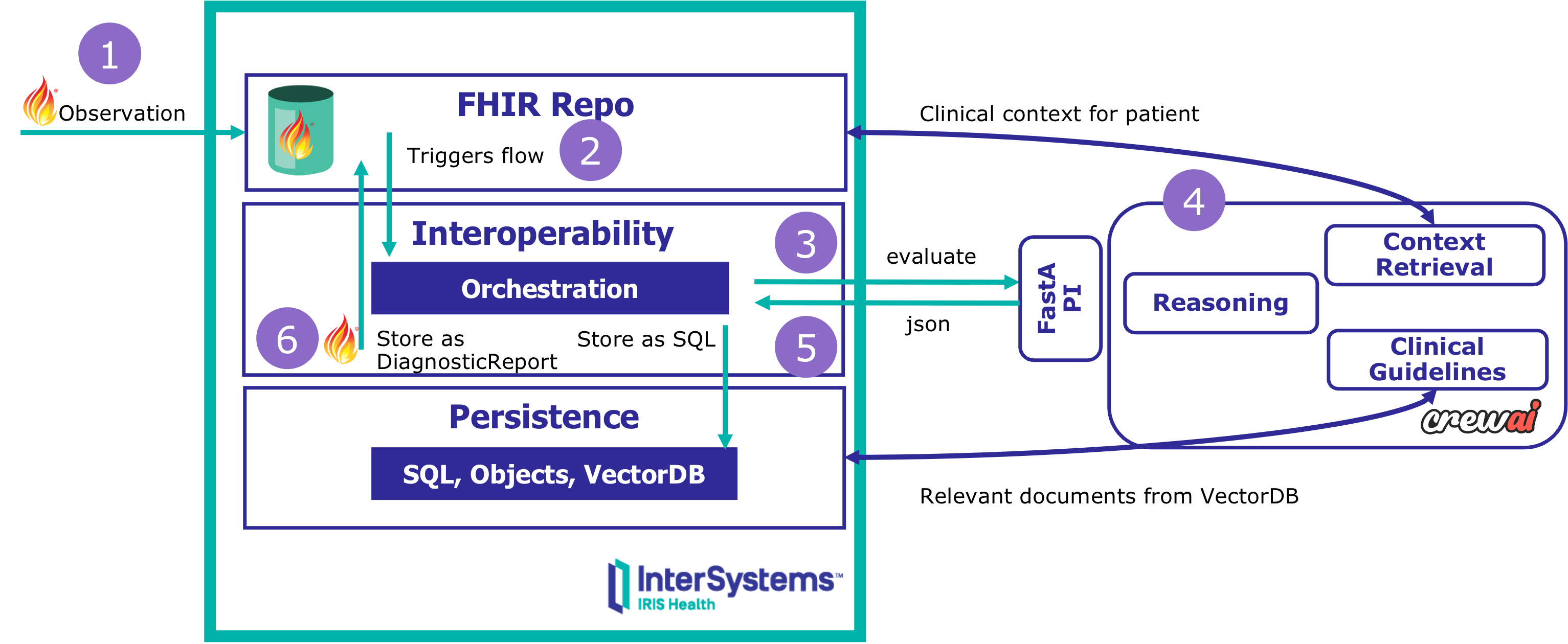
10:47 AM — Jose Garcia's creatinine test results arrive at the hospital FHIR server. 2.1 mg/dL — a 35% increase from last month.

What happens next?

  • Most systems: ❌ The result sits in a queue until a clinician reviews it manually — hours or days later.
  • This system: 👍 An AI agent evaluates the trend, consults clinical guidelines, and generates evidence-based recommendations — in seconds, automatically.

No chatbot. No manual prompts. No black-box reasoning.

This is event-driven clinical decision support with full explainability:

image

Triggered automatically by FHIR events ✅ Multi-agent reasoning (context, guidelines, recommendations) ✅ Complete audit trail in SQL (every decision, every evidence source) ✅ FHIR-native outputs (DiagnosticReport published to server)

Built with:

  • InterSystems IRIS for Health — Orchestration, FHIR, persistence, vector search
  • CrewAI — Multi-agent framework for structured reasoning

You'll learn: 🖋️ How to orchestrate agentic AI workflows within production-grade interoperability systems — and why explainability matters more than accuracy alone.

2
2 216
Article Luis Angel Pérez Ramos · Apr 18, 2025 3m read

Who hasn't been developing a beautiful example using a Docker IRIS image and had the image generation process fail in the Dockerfile because the license under which the image was created doesn't contain certain privileges?

In my case, what I was deploying in Docker is a small application that uses the Vector data type. With the Community version, this isn't a problem because it already includes Vector Search and vector storage. However, when I changed the IRIS image to a conventional IRIS (the latest-cd), I found that when I built the image, including the classes it had generated, it returned this error:

6
1 403
Article Thomas Dyar · Dec 27, 2025 10m read

The Rut

Up until early this year, I haven't been not doing much coding at all -- I had gotten sick of it.

After many years as a hands-on software engineer and data scientist, I got burned out around 2015. I switched to business development roles focused on "external innovation," then joined InterSystems in 2019 as a product manager. I missed the creative aspects of coding, but not the tedium. The endless cycle of boilerplate, debugging, and context-switching had left me creatively depleted.

0
1 158
Article Piyush Adhikari · Dec 24, 2025 1m read

InterSystems IRIS embedded vector search capabilities lets us search unstructured and semi-structured data. Data is converted to vectors (also called ‘embeddings’) and then stored and indexed in InterSystems IRIS for semantic search, retrieval-augmented generation (RAG), text analysis, recommendation engines, and other use cases.

This is a simple demo of IRIS being used as a vector database and similarity search on IRIS.

Prerequisites:

  1. Python
  2. InterSystems IRIS for Health - as it will be used as the vector database

Repository: https://github.

0
1 144