#Performance

5 Followers · 190 Posts

Performance tag groups posts regarding software performance issues and the best practices on solving and monitoring performance issues.

Question Anzelem Sanyatwe · Apr 17, 2021

We are seeing more and more customers being lured with latest infrastructure technologies, particularly Composable Infrastructure. Coming with all sorts of data center consolidations and costs savings.

Question is: are there any concerns for HealthShare/TrakCare being run on these platforms or things to look out for? Anyone out there, already on these platforms?

To be more specific this is HPe Synergy with 480 Compute blades booting as bare metal.

Regards;

Anzelem.

3
0 326
Question Michael Lei · Mar 17, 2021

Want to perform SNMP performance monitoring of cache2010 on AIX 5.3. Since the SNMP service that comes with AIX does not support agentX, it cannot extend the support for cache database. Therefore, I plan to deploy net-snmp on AIX first, then enable agentX, and finally configure cache's subagent. Is this workable? Any documents? Thx!

1
0 312
Announcement Steven LeBlanc · Feb 19, 2020

AWS launched their first generation of Amazon EC2 A1 instances last year, powered by Arm-based AWS Graviton processors. At AWS re:Invent 2019, Amazon announced the second-generation AWS Graviton2 processors and associated Amazon EC2 M6g instance type, boasting up to 40% better price performance over current generation Intel Xeon based M5 instances.

The AWS Graviton2-based M6g instances are currently in preview, and InterSystems jumped on the opportunity to measure their performance with the InterSystems IRIS Data Platform.

9
0 3415
Article Mark Bolinsky · Mar 6, 2020 7m read

Introduction

InterSystems has recently completed a performance and scalability benchmark of IRIS for Health 2020.1, focusing on HL7 version 2 interoperability. This article describes the observed throughput for various workloads, and also provides general configuration and sizing guidelines for systems where IRIS for Health is used as an interoperability engine for HL7v2 messaging.

3
4 2030
Article Tony Pepper · May 25, 2016 5m read

New Tool Available

Please see PerfTools IO Test Suite for a later version of the Random Read IO tool.

Purpose

This tool is used to generate random read Input/Output (IO) from within the database. The goal of this tool is to drive as many jobs as possible to achieve target IOPS and ensure acceptable disk response times are sustained. Results gathered from the IO tests will vary from configuration to configuration based on the IO sub-system. Before running these tests ensure corresponding operating system and storage level monitoring are configured to capture IO performance metrics for later analysis.

17
3 4013
Article Daniel Kutac · Aug 21, 2020 3m read

Dynamic PoolSize (DPS) Experiment

Purpose:

Enhance Ensemble or IRIS production so it can dynamically allocate pool size for adapter-based components based on their utilization.

Sometimes, an unexpected traffic volume occurs, and default pool size allocated to production components may become a bottleneck. To avoid such situations, I created a demonstrator project some 2 years ago to see, whether it would be possible and feasible to modify production, so it allowed for dynamically modifying its components per their load.

3
0 636
Announcement Jacquie Clermont · Jul 21, 2020

Hi Community!

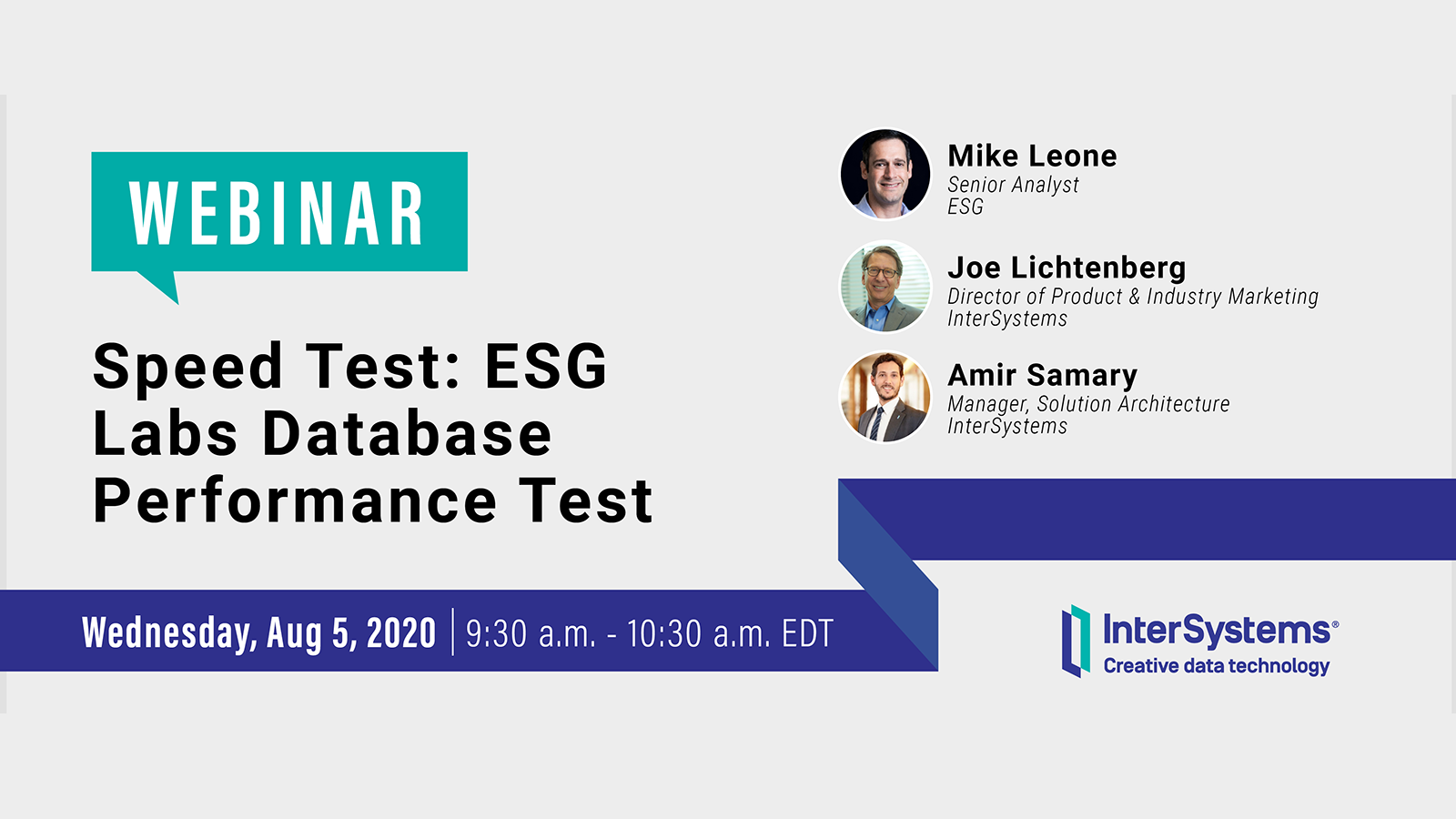
We're pleased to invite you to the upcoming "Speed Test: ESG Labs Database Performance Test" webinar on August 5 at 9:30 AM EDT!

Join our live webinar with Mike Leone, senior analyst with Enterprise Strategy Group’s Validation Services, to learn about a speed test that measures and compares the concurrent real-time data ingest and query performance of InterSystems IRIS® data platform, a leading in-memory database, a cloud relational database, and a traditional relational database. 

1
0 560
Question Eriks Tauckels · Jul 3, 2020

Running cache 5.0.21 64 bit on Windows server 2016 in virtual environment. Trying to understand why every single process disk read speed (simple sql data walks) caps  around ~20MB/s, however 2 paralell such tasks on different data areas can reach 19MB/s each, four - 17MB/s each, that is 70MB/s total, etc. Also simple copy file to nul on that system reach ~400MB/s.

What can keep single query on idle system from reaching for example 200MB/s? Virtualization? Windows? Cache? Processors are below 1-3%

4
0 514
InterSystems Official Steven LeBlanc · May 13, 2020

AWS has officially released their second-generation Arm-based Graviton2 processors and associated Amazon EC2 M6g instance type, which boasts up to 40% better price performance over current generation Intel Xeon based M5 instances. 

A few months ago, InterSystems participated in the M6g preview program, and we ran a few benchmarks with InterSystems IRIS that showed compelling results. This led us to support ARM64 architectures for the first time.

Now you can try InterSystems IRIS and InterSystems IRIS for Health on Graviton2-based Amazon EC2 M6g instances for yourselves through the AWS Marketplace!

2
0 1010
Question Arto Alatalo · Apr 29, 2020

Hi Community! I need your advice.

The method below is 6 times slower on production server than on developing machine:

ClassMethod runme4()
{
    s cnt=615210
    s st=$zh
    for i=1:1:cnt {
        s p=##class(digi.packet).%OpenId("packet||5237")
        w:p="" "not found",!
        k p
    }
    w $zh-st,!
}

BUT the server is 6 times faster if OpenId replaced with simple read of a large global (s p=^someLargeGlobal). Any ideas what makes OpenId so slow only on the server?

And another question: I wanted to profile the code with  %Monitor.System.

27
0 1254
Article Sergey Kamenev · May 28, 2020 7m read

A More Industrial-Looking Global Storage Scheme

In the first article in this series, we looked at the entity–attribute–value (EAV) model in relational databases, and took a look at the pros and cons of storing those entities, attributes and values in tables. We learned that, despite the benefits of this approach in terms of flexibility, there are some real disadvantages, in particular a basic mismatch between the logical structure of the data and its physical storage, which causes various difficulties.

0
0 991
Question alex chang · May 21, 2020

Hi, 

iris version: IRIS for UNIX (Ubuntu Server LTS for x86-64 Containers) 2019.4 (Build 383U) Fri Dec 6 2019 08:49:54 EST

os: Ubuntu 18.04 LTS

memory: 16G

Disk: 256G SSD

Iris config: default.

soft/hard limit: 65535

I build follow simplest flow to do performance test.

1. create A EnsLib.HTTP.GenericService name it IncomingHTTPService listen on 9980

checked create connection per request

Keepalived = 0

Qsize = 1000

2. create A EnsLib.HTTP.GenericOperation name it OutgoingHTTPOperator to connect localhost:8080(it's a nginx server serve a static html page)

3.

5
0 396
Article Murray Oldfield · Feb 20, 2017 3m read

Note (October 2022): yape has been deprecated and replaced by YASPE, there is no more development on yape.


Note (June 2019): A lot has changed, for the latest details go here

Note (Sept 2018): There have been big changes since this post first appeared, I suggest using the Docker Container version, the project and details for running as a container are still in the same place  published on GitHub so you can download, run - and modify if you need to.

5
2 2053
Article Murray Oldfield · Apr 1, 2016 2m read

Previously I showed you how to run pButtons to start collecting performance metrics that we are looking at in this series of posts.


##Update: May 2020.

Since this post was written several years ago, we have moved from Caché to IRIS. See the comments for an updated link to the documentation for pButtons (Caché) and SystemPerformance (IRIS). Also, a note on how to update your systems to the latest versions of the performance tools.

2
0 1741
Article Sergey Kamenev · May 11, 2020 8m read

Introduction

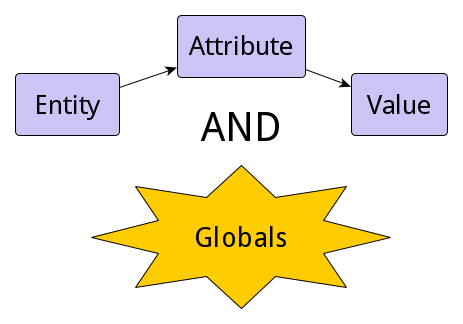
In the first article in this series, we’ll take a look at the entity–attribute–value (EAV) model in relational databases to see how it’s used and what it’s good for. Then we'll compare the EAV model concepts to globals.

Sometimes you have objects with an unknown number of fields, or perhaps hierarchically nested fields, for which, as a rule, you need to search.

Take, for example, an online store with diverse groups of products. Each product group has its own unique set of properties and has common properties as well.

0
4 4476
Article Allyson Gerace · Feb 6, 2019 8m read

See Part 1 here.

Part 2: Index Handling

Now you have a good idea of what kind of indices you need for your class and how to define them. Next, how do you handle them?

Query Plan

(REMEMBER: Like any modifications to a class, adding indices in a live system has its risks – if users are accessing or updating data while an index is populated, they may encounter empty or incorrect query results, or even corrupt the indices that are being built.

1
0 1953
Question Julian Matthews · Apr 27, 2020

Hi all.

A long time ago I enabled Activity Monitoring to be able to save myself headaches in the future when looking at the performance of various message routes through our productions.  It's served it's purpose of answering questions on how many messages we process a week etc but I had not had the chance to really dig down into the stats for specific message types or destinations to pin point issues.

That time has come, as I have an outbound that periodically queues up without much rhyme or reason.

3
0 362
Article Allyson Gerace · Feb 6, 2019 13m read

This is the first in a pair of articles on SQL indices.

Part 1 - Know your indices

What is an index, anyway?

Picture the last time you went to a library. Typically they have books sorted by subject matter (and then author and title), and each shelf has an end-plate with a code describing the subject of its books. If you wanted to collect books of a certain subject, instead of walking across every aisle and reading the inside cover of every book, you could head straight for the bookshelf labelled with your desired subject matter and choose your books.

2
6 2300
Article Murray Oldfield · Jun 5, 2019 2m read

If a picture is worth a thousand words, what's a video worth? Certainly more than typing a post.

Please check out my "Coding talks" on InterSystems Developers YouTube:

1. Analysing InterSystems IRIS System Performance with Yape. Part 1: Installing Yape


Running Yape in a container.

2. Yape Container SQLite iostat InterSystems

Extracting and plotting pButtons data including timeframes and iostat.

3
2 1702
Announcement Derek Robinson · Feb 26, 2020

In Episode 4 of Data Points, we welcome @Benjamin De Boe to the pod to discuss some of the things you can do to optimize your SQL queries in InterSystems IRIS. We've all heard — either from ourselves or from others — the "this runs too slowly" complaint. I thought Benjamin did a great job walking through many of the things within IRIS you can look at with your queries to see what can be improved.

0
0 272
Discussion Benjamin De Boe · Jan 9, 2020

Hi,

we're planning some work on our SQL Query Plan functionality for a future release of InterSystems IRIS and are interested to hear how you're using them today, or what'd keep you from using them. Rather than try and fit everything in a rigid survey, I thought a simple thread on our beloved DC might also reveal some use patterns that we support or could do a better job on. 

6
0 399
Discussion Neerav Verma · Jan 16, 2020

Hi All,

We have few queries which are simple selects . For simplicity let's say there is a query that joins two tables and gets few columns and both tables have no indexes.

Select Tab1.Field1, Tab2.Field2
From Table1 Tab1
Join Table2 Tab2
On Tab2.FK = Tab1.PK
When we do query plan for this it shows approx 6 million,  however if we make a simple adjustment to the query

Select Tab1.Field1, Tab2.Field2
From Table1 Tab1
Join Table2 Tab2
On Tab2.FK = Tab1.PK
WHERE Tab1.Id > 0 (Which will always be the case)

The query plan comes down to few thousands. So approx 99% improvement.

5
0 392
Article Peter Steiwer · Jan 6, 2020 4m read

What is %SQLRESTRICT

%SQLRESTRICT is a special %FILTER clause for use in MDX queries in InterSystems IRIS Business Intelligence. Since this function begins with %, it means this is a special MDX extension created by InterSystems. It allows users to insert an SQL statement that will be used to restrict the returned records in the MDX Result Set. This SQL statement must return a set of Source Record IDs to limit the results by. Please see the documentation for more information.

Why is this useful?

This is useful because there are often times users want to restrict the results in their MDX Result Set based on information that is not in their cubes. It may be the case that this information may not make sense to be in the cube. Other times this can be useful when there is a large set of values you want to restrict. As mentioned before, this is not a standard MDX function, it was created by InterSystems to handle cases were queries were not performing well or cases that were not easily solved by existing functions.

0
2 740