We are looking for Innovators!
We invite early stage startups to join Caelestinus digital health and FHIR startup incubator for the season 2023!
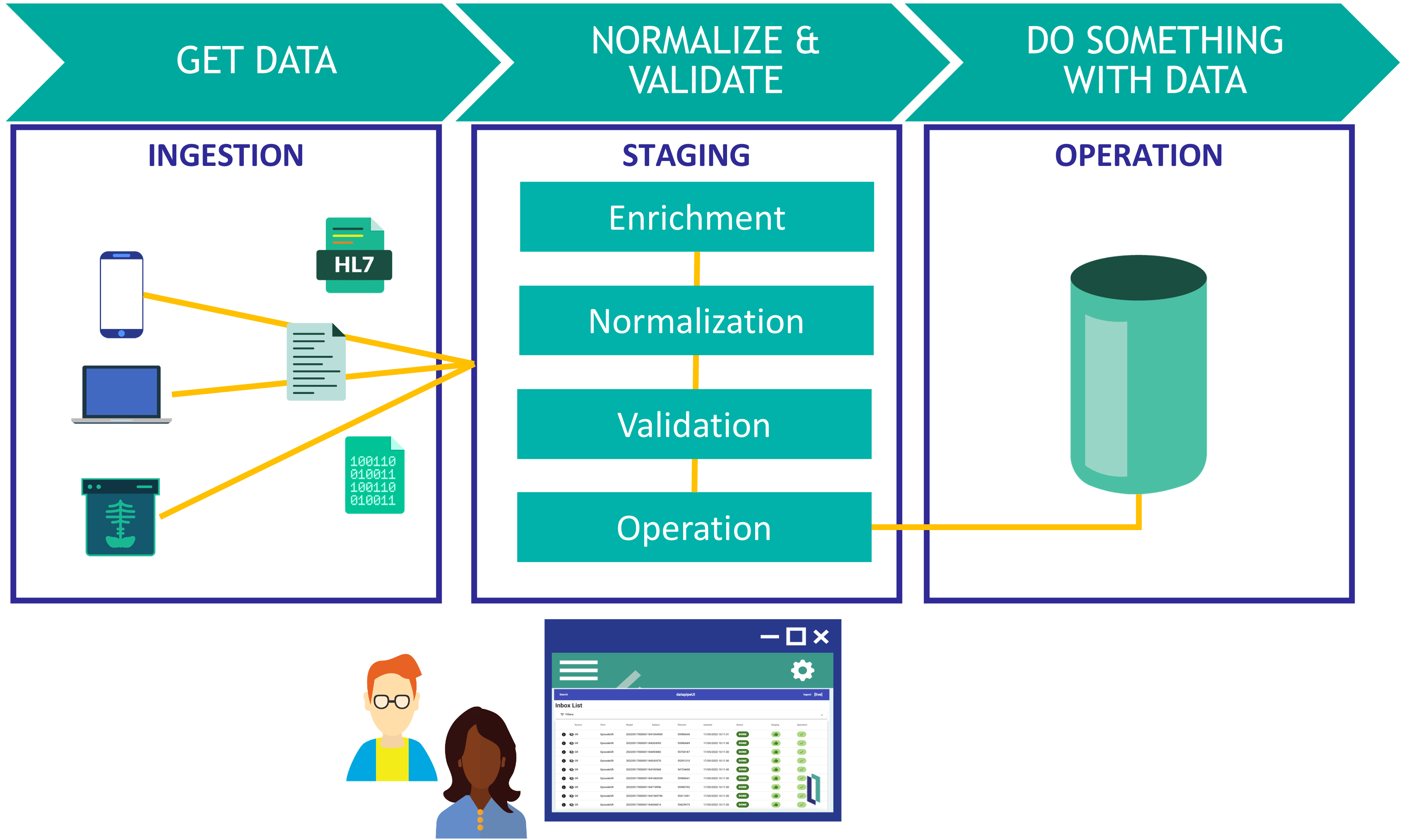
In healthcare, interoperability is the ability of different information technology systems and software applications to communicate, exchange data, and use the information that has been exchanged.
We are looking for Innovators!
We invite early stage startups to join Caelestinus digital health and FHIR startup incubator for the season 2023!
Hi folks!
Have a question for those who are masters of interoperability.
I have a basic task of having one CSV with some data. I need to transform one column in the initial dataset and get the new csv with the same form.
What's the best approach with Interoperability?
Should I user record mapper?
Should I use streams, objects?
What is the best practice?
Hi Community,
I would like to take advantage of our topic on capture for Health Data Warehouses (on DC-FR) to show you how to quickly create HTTP SOAP and REST clients. IRIS, as well as applications available on Open Exchange offers solutions to generate them from a WSDL or a swagger specification.
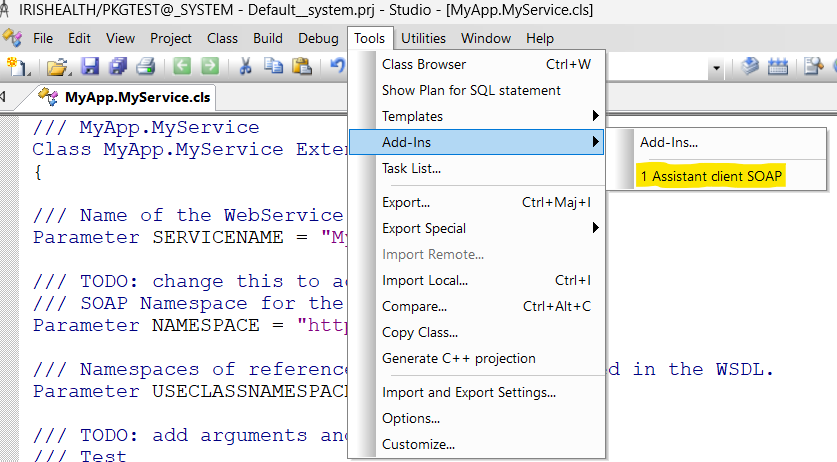
Nothing could be easier than creating a SOAP client. All you need is the WSDL.A wizard is available from the IRIS Studio. It allows you to generate not only your classes for a web service client but also the “Business Services” and “Business Operations” if you want to consume them with the interoperability framework.

In today's fast-paced and highly competitive manufacturing industry, efficient machine communication and data exchange is essential to maximize productivity and minimize downtime. That's where MTConnect comes in. MTConnect is an open, royalty-free standard that provides a common language for communication between machines, devices, and software applications in a manufacturing environment.
The MTConnect technology consists of a set of XML schemas and protocols that define the structure and format of the data to be transmitted, as well as the rules for
Hi folks!
I'm playing with IRIS interoperability at the moment and it turned out that Data Transformation cannot be the element of production by itself.
It can be called either from data rule or from business process.
But why?
What if I just want to change the message with the transformation and transfer the message somewhere else? Why the overhead with Rule or Business process?
Hi Community,
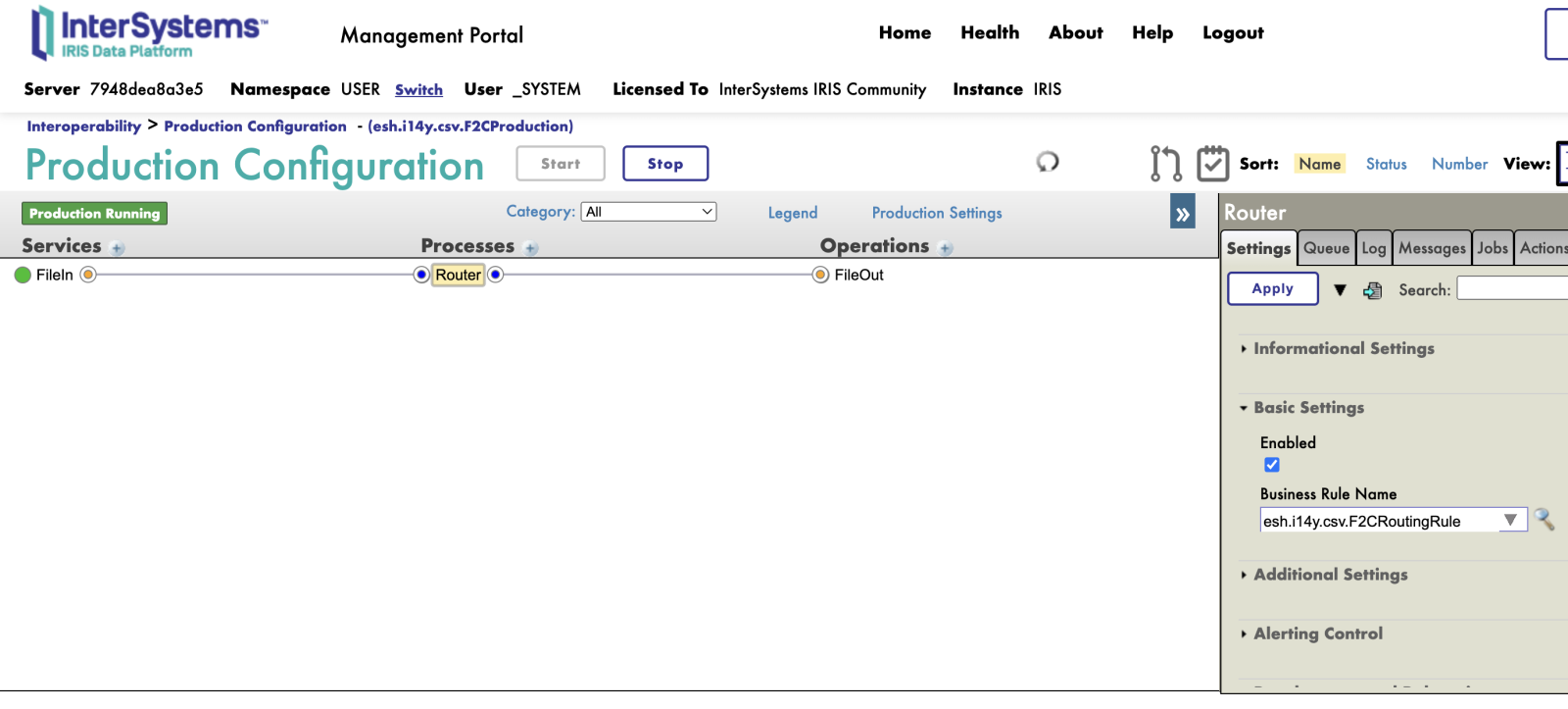
I have created a HL7 production in my working environment, Ens.Alert ,EMailAlert, PagerAlert, and BadMessageHandler are created.
Can anyone explain how Ens.Alert and BadMessageHandler will work when an HL7 message in Passed in Business service and how these 2 are related when any error occurs in the Production envinorment?
I have a production with one Business Host - a Business Service which I need to scale automatically to consume ~80% of CPU time.
Business Service pulls data from a (non-FIFO) queue so that I can adjust pool size without any issues.
So far, I'm planning a different BS running every X seconds and sampling CPU with $system.Process.GetCPUTime() and scaling the pool size of the main BS up/down based on that metric.
Has anyone tried something similar? Any advice/code samples would be appreciated.
Hi community,
I am working on Converting Non HL7 message (Using record maps) into HL7 message.
1.Can anyone share few details how to save Non HL7 message into SQL table and the converted HL7 message into SQL table
2.In Message Viewer is there any SQL tables are linked to the session id or where the information regarding the message will be stored? Will the message trace details are stored in globals or in SQL table,If yes can anyone share the details in which tables or globals will it be stored?
.png)
Joe
Hi Interoperability experts!
I'm into interoperability now with data transformations and I wonder: how can I use DTLs?
I've created one that transform Ens.Request into Ens.Response. How can I use it now in the production?
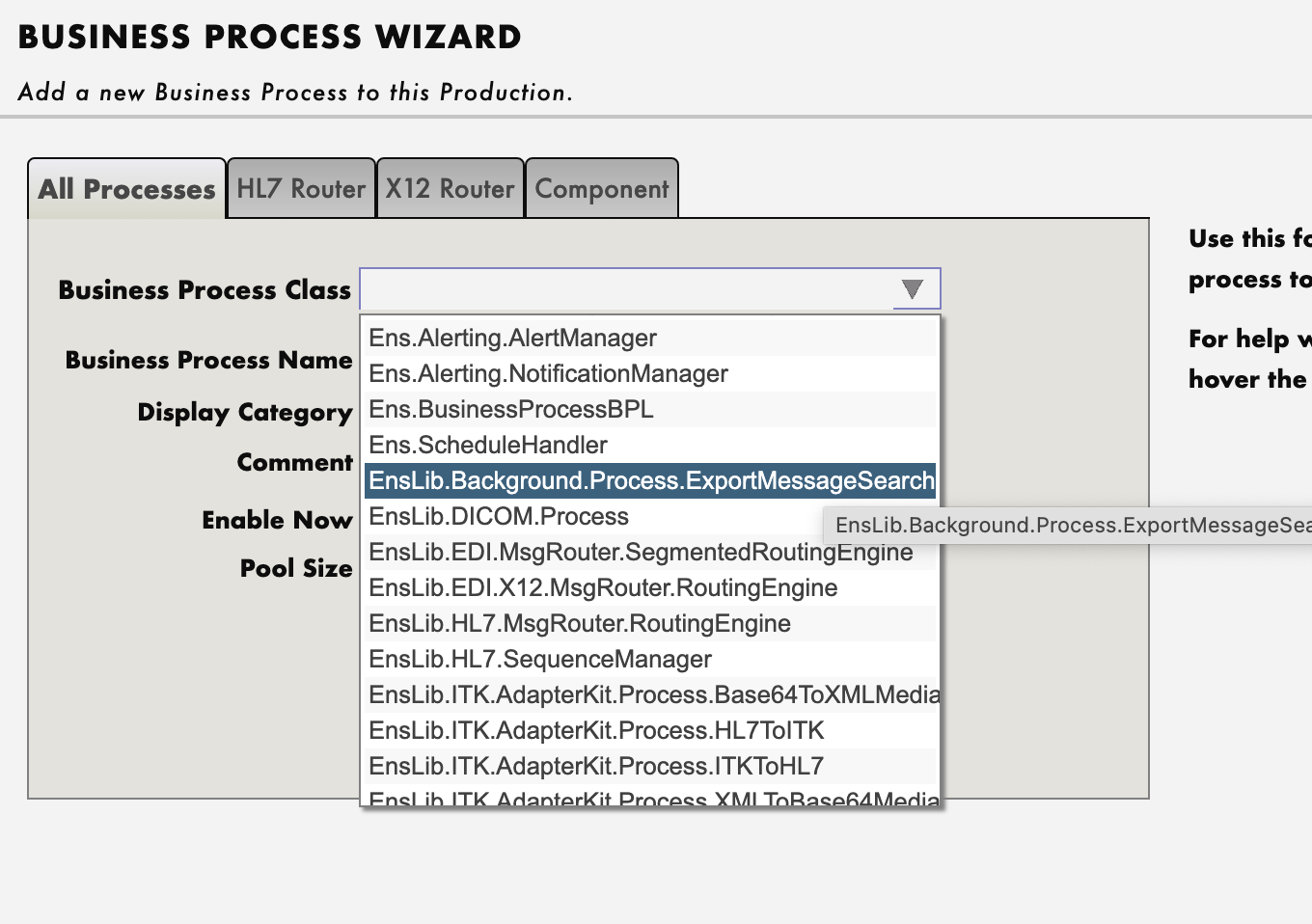
I'm trying to add the business process expecting to see it available in the list but it seems it is not the case.
Tried documentation and it doesn't say either what to do after creation the DTL. If it is obvious could you please help?

In Interoperability productions Inbound Adapters extract and separate retrieval logic from actual payload processing, which is left to a BS.
At a high level, an adapter looks like this:
Class MyAdapter Extends Ens.InboundAdapter {
Method OnTask() As%Status
{
Set request = ..RetrieveRequest()
Set sc = ..BusinessHost.ProcessInput(request)
Set..BusinessHost.%WaitForNextCallInterval=1
Quit sc
}
}However, in many cases, RetrieveRequest retrieves a batch payload, so our adapter looks like this instead:
Class MyAdapter Extends Ens.InboundAdapter {
Method OnTask() As%Status
{InterSystems IRIS 2020.1 includes PEX (Production EXtension Framework) to facilitate the development of IRIS Interoperability productions with components written in Java or .NET.
Thanks to PEX, an integration developer with knowledge of Java or .NET can benefit from the power, scalability, and robustness of the InterSystems IRIS Interoperability framework and be productive in no time.
For an IRIS Interoperability framework expert, PEX makes it easy to enrich integrations with pre-existing Java- or .NET-language external
Poor glycemic control is associated with a greater risk of miscarriage, NICU admission, operative delivery, and shorter gestational periods.Especially at risk are those with preexisting diabetes, who would benefit from maintaining near-normal glycemia before conception.All DIP patients would benefit from earlier referral to the diabetes service.Emphasis is placed on the early detection and effective treatment of DIP to achieve normoglycemia if associated complications, perinatal mortality, and maternal morbidity are to be reduced.
I know InterSystems has the SAP Java Connector.
Has anyone used that to communicate between IRIS and SAP S/4HANA Cloud? Or some other means?
Hi Community,
I need to convert HL7 Message into FHIR Format.Can anyone share basic reference for FHIR ADT^A01 message?
For converting HL7 message to FHIR we need to convert HL7 to SDA3 format and then converting SDA3 to FHIR format.
Please Share few basics steps for converting SDA3 to FHIR message?
Thanks
Smythee
Morning everyone,
I would appreciate some advice please- hopefully there is plenty of experts out there.
We are setting up an sFTP share between hospital trusts here in the UK and I have set the outbound operation up using a custom extension of EnsLib.HL7.Operation.FTPOperation.
We are configuring a VPN tunnel to run between the sites also so there is a bit of firewall / network routing to take place to enable the connection but to add in a complication we are on a mirrored cluster and usually present on a Virtual IP address.
Could somebody confirm for me please whether specifically for ftp
Check out this short demo on the InterSystems Developer YouTube channel showing how the new Production Component Driver can be used for Source Control of Interoperability Productions.
The driver enables highly granular management of interoperability productions with tight integration into the InterSystems IRIS management portal.
⏯ Using Deltanji for Source Control of Interoperability Productions
Hey Community,
Enjoy watching the new video on InterSystems Developers YouTube:
I am sending an HL7 message from a BPL transform operation to a business operation that uses EnsLib.HL7.Operation.FileOperation.
The context is that our application queues up outbound data that the business service polls every minute. The objects in the queue are sent to the business process to transform and then to the operation to send outbound. My goal is to have the business operation inform the business process (by a response) that the message was sent and what the message identifier is.
Original
In this article, we will discuss about Orphaned Messages.
Every message body is associated with a message Header which holds the metadata. The Header holds information like source configuration name, target configuration name, time created, time processed, associated message body reference, session information, message body class name, message status. When there are message body records that do not have their corresponding Header records those are called Orphan message bodies. We will discuss possible causes which could end up with orphan message bodies.
Thank you to everyone who joined our User Group Session yesterday!
It was great showing off the new Deltanji Production Component driver that facilitates source control of interoperability productions, and we had some really insightful discussions as well.
If you missed out on the session and would like a copy of the recording, feel free to drop me a message.
Hi Community,
In this video, you will learn about exciting new ways to perform analytics using data in your HL7® FHIR® repository:
⏯ InterSystems IRIS FHIR SQL Builder: Sneak Peek @ Global Summit 2022
Hi Community ,
Can anyone please explain how to use EnsLib.EMail.AlertOperation operation to send notification to my email id when any error occurs in my production?
Please give any example how to use EnsLib.EMail.AlertOperation operation class
Thanks,
Smythee
Hi developers!
If you missed our presentation at the InterSystems UK&I Summit and our demo during the Source Control roundtable, but you still want to find out more about source control for Interoperability Productions... there’s another chance to see it at our User Group Session next Thursday, November 3rd at 3pm (GMT).
The new driver enables highly granular management of Interoperability Productions with tight integration into the InterSystems IRIS management management portal.
Sign up via eventbrite here >> https://bit.ly/3yqzfvS
I am demonstrating a use case of how we can create an IRIS Interoperability Production for special use in an external language.InterSystems IRIS, within Interoperability has a framework called Production Extension (PEX), using which we can create productions and program them as per their purpose using external languages like Java, Python etc, and also develop custom inbound and outbound adapters to communicate with other applications.
The new production component driver for Deltanji enables highly granular management of InterSystems Interoperability Productions with tight integration into the management portal. We presented it at the InterSystems UK&I summit this week and it received a great reception.
It solves the current pain-point of Interoperability Productions being defined in a single monolithic class definition. Deltanji source control increases the granularity with which items can be managed. Instead of versioning a single class definition containing all the configuration items, this new component driver allows individual configuration items to be managed separately. Each configuration item has its own versioning and revision history and can be checked-out, checked-in, and deployed independently of any other items in the same Production.
Because each configuration item within a production class is managed by Deltanji as a first-class component in its own right, Deltanji provides all the source control, versioning, and workflow capabilities that it provides for any other component.
Watch the below clip to see it in action.
We'll be talking about this new feature in more detail at our User Group Session on November 3rd at 3pm (GMT). Register your attendance on Eventbrite here - https://bit.ly/3yqzfvS
To find out more about Deltanji, visit our website georgejames.com or drop us an email info@georgejames.com
The concept of low code development is getting more and more important across all industries. Everybody who is starting to get into low code programming, will inevitably come across Node-RED. InterSystems IRIS is renowned for its interoperability and so should be accessible via Node-RED.
For those who have not heard of Node-RED yet: Node-RED is a Low-Code programming application, which is based on so called nodes that are connected with wires.Nodes process incoming messages and forward them to the next connected node.
FTP (File Transfer Protocol) is a network protocol for transmitting files over TCP/IP connections in a network (including the Internet) configured to transfer files via this protocol.In an FTP transaction, a file sender is called a local host.A file receiver involved in FTP is a remote host, and it is usually a server.Although many file transfers can be conducted using Hypertext Transfer Protocol (HTTP), FTP is still commonly used to transfer files behind the scenes for other applications, such as banking services.
We will receive an ORM message in Business Service in Iris. From that ORM, an ADT^A31 message will be generated and sent out to the EMR before the ORM message is sent out. The ORM message has to wait until Iris receives an acknowledgement from the EMR indicating the ADT message was received. Then, the ORM message will be sent to the EMR. What do I need to set up to hold the ORM message until the acknowledgement is received?
Thank you!
Patty Aguirre-Romero
1. Review of Interface Settings: Ensure these are set purposefully! (Documentation linked)
(Documentation Linked)
2. DTL Editor Enhancements