Hello,
I just watched the recording of Michael Brady's presentation on Ensemble Disk Free Space Monitoring. Is the sample code for the Task definition class still available? How can I obtain a copy?
Thanks

InterSystems Ensemble is a complete and easy-to-use integration platform that enables users to connect people, processes, and applications in record
time.
Hello,
I just watched the recording of Michael Brady's presentation on Ensemble Disk Free Space Monitoring. Is the sample code for the Task definition class still available? How can I obtain a copy?
Thanks
Hi
Do any of you Java Ensemble enthusiasts have a simple example of an Ensemble Production and .Jar they would be willing to share with me.
Hi Everyone,
I'm currently implementing an interface solution to send through data to community pharmacies here in the UK from our hospital PAS system. As part of this project i have created a BPL which calls a SQL operation to infiltrate our Data warehouse and add to the message - this is all done and working as i expect.
We have multiple interfaces to Epic. We currently have the IP address set to epicsup. We now want to update all of the interfaces with this IP addresses to epictst. Is there a method to do this?
Hi All,
i have a issue in getting the complete file path when using the FTP Adapter in service.
EnsLib.FTP.PassthroughService / EnsLib.FTP.InboundAdapter
I need to know the folder name (including sub folder) where the new file is found by the service when looking up for new files.
The normal file class is working good as expected
More details below,
In the below two examples you can notice folder name is fetched by normal File adapter, but in FTP only the file name is available.
FTP class gives the o/p as
<?xml version="1.0" ?>
<!-- type: Ens.
Those of you that worked already with ECP might know that it operates not only across
operating systems, processor technologies (big-little-endian), but also -with limits- across versions in C/E.
This cross-version feature also includes IRIS (verified for 2020.1) and C/E (2018.3)
We have a vendor that every couple of days will just stop transmitting messages, but still hold the TCP/IP connection open. No matter how many times we troubleshoot and talk with them, they don't seem to think its an issue with system. Normally if I just restart the service it will get the data flowing again.
I know ideal is for them to fix the issue, but in the meantime I have setup an Inactivity time out alert. I was wondering with the correct filtering if there was a way to say if the Inactivity Alert is triggered during the business day, to have the Alert trigger a restart of the service?
Hello,
We would need to get the body from a REST message.
How could we do that in a service?
Could you provide an example, please?
We have read:
https://community.intersystems.com/post/restful-way-data-transfer
I have a service named FTP_In that is of class EnsLib.HL7.Service.FTPService. It picks up files from multiple subfolders and sends them to an EnsLib.HL7.MsgRouter.RoutingEngine. What I want to do is somehow capture the subfolder as a variable for use in the routing rules. Is this possible?
Let's say I have the following files and directory structure on my FTP Server
I want the Routing Rule to be able to send anything that came from the /green/ folder to one operation and from /yellow/ to another.
I am putting together a new interface to take in a CSV file and output an HL7 message.
I have used the record mapper to create the source class and I am putting together the transform, but when trying to test it I am not seeing the data populate the HL7 as intended.
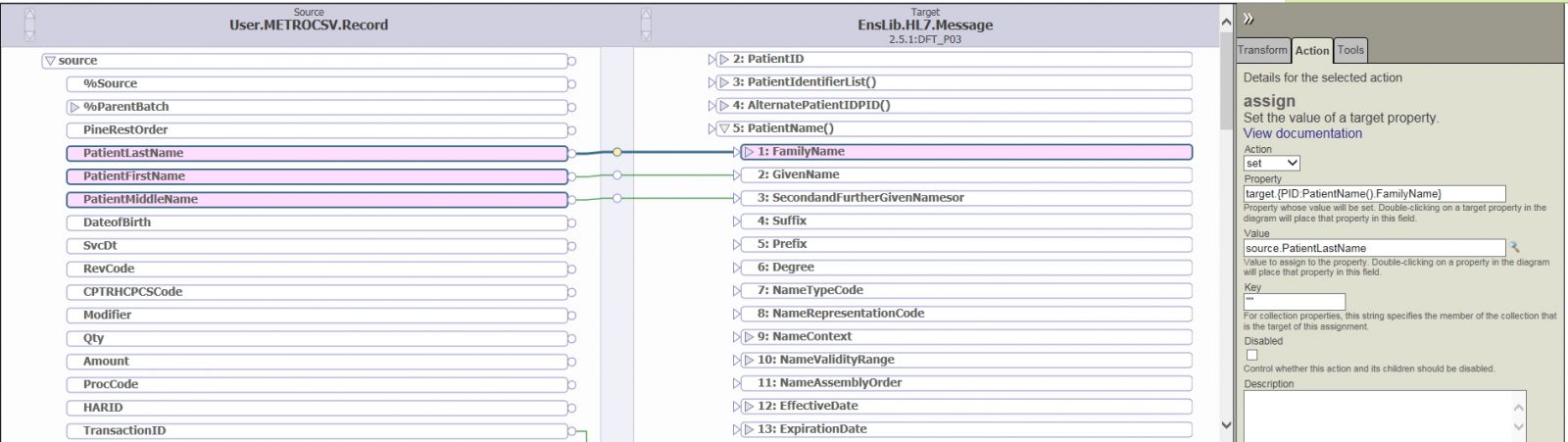
Also.... if I put a <DatofBirth> in the tester, it shows up in the HL7 as I would expect..... that's what really has me scratching my head here.
Hi, I want to INSERT a customerID and customerName to a table if the customerID does not exist. Or UPDATE if they've changed their name.
I've reviewed the documentation (https://docs.intersystems.com/irislatest/csp/docbook/Doc.View.cls?KEY=R…) and have confused myself with the INSERT OR UPDATE statement. Rather than using two individual statements , is there a way to get it in one?
What I have at the moment doesn't do anything. In fact it errors.
I intend to use this within a code block in a DTL.
set customerName = ##class(BAB.Utils.ExternalSystem.TransformFunctions).
Hi, I'm still very much new at Ensemble DTL. I am trying to set up an algorithm that requires loading fields from an OBX into an Array. I don't think that I know how to iterate through the OBXs. I know that there is a "for loop", that I will try to play with, but in the mean time, could someone tell me what is wrong with the following?
For example the code below works when I hard code the number 1 in OBXgrp(1)
set addarray(1) = source.GetValueAt("PIDgrpgrp(1).ORCgrp(1).OBXgrp(1).OBX:ObservationValue(1)")
write addarray(1)
I get the value that I expect.
An error occured when HS.IHE.XDSb.Registry.Operations on the BUS sends query request to the registry. The error is
Error 6242: HTTP request to SOAP webservice returned unexpected status: 403.
Any thoughts as to why? The settings on the components haven't changed. The process worked a few days ago.
07/16/2020 14:54:07 *********************
Input to Web service with SOAP action = SOAP1.2
<env:Envelope xmlns:S="http://www.w3.org/2003/05/soap-envelope" xmlns:env="http://www.w3.org/2003/05/soap-envelope"><env:Header><To xmlns="http://www.w3.org/2005/08/addressing">https://crispapitest.azure-api.
Hi,
I've added a REST service which worked fine on our test system but failed on the production environment because UnknownUser does not have %All set and I really don't want it set on production (in fact I've also switched it off on test).
Is there a way to allow a single REST service to have unauthorised access?
I was thinking adding a resource/role to UnknownUser specifically for that service but I've never touched on Users/Roles/Resources so I'm struggling to work out what needs adding where.
Thanks
My custom Business Operation typically creates a Ens.StringResponse with StringValue which is sent back to my custom Business Service. Is there a way I can use the assign, or some way, in Rule Editor in a Business Process (EnsLib.MsgRouter.RoutingEngine) so that it can send back a Ens.StringResponse with a StringValue to the Business Service when not routing the message to any operation?
I am having difficulties with using the ..Strip() function in my DTL to strip the slash ( / ) from the phone number portion of an x12 834. There are very few records that have the slash in the phone number, so I am trying to filter out any characters other than numbers so that all phone numbers are formatted 1112223333.
Here is the code portion of the strip:
Set HomePhone ..Strip(source.{loop2000(k1).loop2100A.PER:CommunicationNumber},"*AW","-()/").
I am then checking the length of HomePhone.
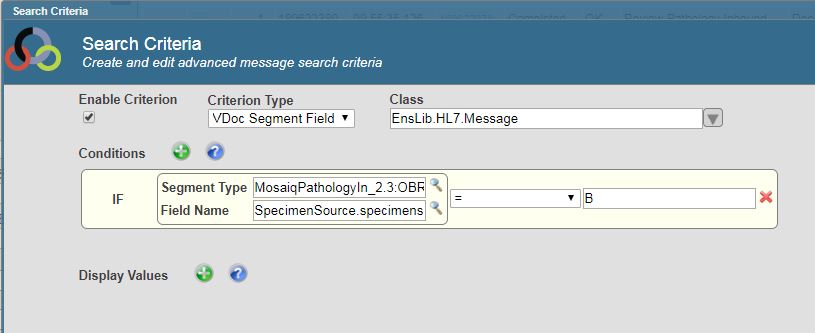
I'm trying to get a count of specific message type with a specific entry and thought I could build the query in Message Viewer but this does not provide counts (as far as I am aware). So when I take the SQL from 'Show Query' it omits the segment criteria as the code shows below.
I have attached the criteria that has been excluded. Is this possible?
Thank you
SELECT head.ID AS ID,
       {fn RIGHT(%EXTERNAL(head.TimeCreated),12)} AS TimeCreated,
       head.SessionId AS SESSION,
       head.Status AS Status,
       COUNT (*) AS messages,
       CASE head.IsError
           WHEN 1 THEN 'Error'
           ELSE 'OK'
       END AS Error,
       head.SourceConfigName AS SOURCE,
       head.TargetConfigName AS Target,
       head.SourceConfigName,
       head.TargetConfigName,
       head.MessageBodyClassName AS BodyClassname,
       head.MessageBodyId AS BodyId,
       EnsLib_HL7.Message.%ID AS Body_ID,
       NULL AS Body_OBR_SpecimenSource_specimensourcenameorcode_identifier
FROM Ens.MessageHeader head,
     EnsLib_HL7.Message
WHERE head.TargetConfigName = 'ReviewOrders Router'
  AND head.%ID >= 189143244
  AND head.%ID <= 189589516
  AND (((head.SourceConfigName = 'Review Pathology Inbound'
    OR head.TargetConfigName = 'Review Pathology Inbound'))
  AND head.MessageBodyClassName='EnsLib.HL7.Message'
  AND head.MessageBodyId=EnsLib_HL7.Message.%ID)
ORDER BY head.ID DESC
I want to write the values that are stored in an array into the OBX 5 field. The text in MyArray(1) will go in the the first OBX 5 field. Then the text in MyArray(2) will populate the next OBX 5 field.
My question is how do you format the Set > Action Tab > Value entry so that it pulls the data from MyArray(source.{PIDgrpgrp().ORCgrp().OBXgrp().OBX:SetIDOBX})
I know the array is ok, because when I hard code MyArray(2) in the Set > Action Tab > Value, then the OBX lines contain the correct element in MyArray(2). When I drop source.{PIDgrpgrp().ORCgrp().OBXgrp().
Good morning all,
Could we please get some insight on what is possible (or what other organizations may be using) for tracking uptime for our HL7 engine? We can use Activity Tracking to show how many messages went through, but are there any good canned reports (or queries) about the number of message failures or the amount of time that an interface was down?
We are using alerting to the team to know about not getting messages or if messages failed. Has anyone created a report or dashboard against the Ens.Alert table or would you recommend elsewhere?
Hi,
Can anyone point me to an example of a DTL & Class method that can pull a base64 encoded PDF out of a MDMT02 message?
This is really asking for two things;
- how to make a DTL that extracts a specific subfield of an HL7 2.3 message into a message of its own,
and
- how to transform an base64 encoded document into its original binary form for writing to a file.
I'd also love to see an example of an HL7 2.n MDM^T02 ==> HL73.ITK2 non-coded CDA
I've seen some snippets in the community Q&A, but I've not been able to find any examples either here, or in the documentation or training materials.
Hi, what’s the syntax for picking up low/high cases?
I have tried
*.zip;*.ZIP
But, it’s not working any pointers much appreciated.
t's also an example for a customized command extension (ZZJSN) in Caché & IRIS
This is the Caché version for fast JSON formatting but it also works in IRIS.
Requires package ZPretty
To allow parallel existence in IRIS this is named ZZJSN
see:
USER>ZWRITE jsn
jsn="{"Name":"Li,Robert K.","SSN":"672-92-9664","DOB":"1975-01-12","Home":{"Street":"986 Washington Blvd","City":"Boston","State":"PA","Zip":"95802"},"Office":{"Street":"6012 First Place","City":"Reston","State":"MT","Zip":"77739"},"Spouse":{"Name":"Avery,Zelda H.","SSN":"323-13-7437","DOB":"1943-03-27","Home":{"Street":"196 Main Drive","City":"Youngstown","State":"WY","Zip":"53229"},"Office":{"Street":"4056 Franklin Court","City":"Bensonhurst","State":"IA","Zip":"27688"},"FavoriteColors":["Black"],"Age":77},"Age":45,"Title":"Associate Marketing Manager","Salary":10421}"
Hi,
I am attempting to set up a security role for our support team so they can have read access to the production and messages.
I have given the role RW rights on the resource associated with the database. However, when I log into Management Portal and select "Ensemble", the "Available Ensemble namespaces" list is empty.
What permissions do i need to set to be able to navigate to the production?
IRIS and Caché / Ensemble offer the possibility to add Languages Extension as SystemFunctions, SystemVariables, SystemCommands
The related documentation tells you where to add the system-wide extension. Parameter passing is not covered explicitly.
Hi Team,
When I tried to open ensemble in my system I got bellow error.
I have done lots of code in my local system but now not able to open the ensemble.
.png)
Hello, guys!
I'm facing a problem when I compile my code in Atelier (version 1.3) when connected to an Iris Community instance in Docker container.
When compiling, the code is synchronized with the server correctly, however, in the IDE, the code is inserted into the class again.
Class after compile:
Lets say I have a serial Class A ,Serial Class B,Serial C and Persistent Class Ens.Request
Class SerialA Extends (%SerialObject, %XML.Adaptor) [ ProcedureBlock ]
{
      Property SerialB as SerialB
     Property SerialC as SerialC
}
     Class SerialB Extends (%SerialObject, %XML.Adaptor) [ ProcedureBlock ]
{
    Property SerialB as %String
}
Class SerialC Extends (%SerialObject, %XML.Adaptor) [ ProcedureBlock ]
{
     Property SerialC as %String
}
Class PersistantClass Extends Ens.Request
{
     Property Record as SerialA
}Hello,
We would need to know the Ens.Response SourceConfigName to identify which Operation has raised an exception.
We have tried:
$$$LOGINFO("..%Process.%PrimaryResponseHeader.SourceConfigName..: "_..%Process.%PrimaryResponseHeader.SourceConfigName) //It outputs an empty string

$$$LOGINFO("response.SourceConfigName: "_response.SourceConfigName) //It generates an exception
We would need to get from an Ens.Response which body is null, its SourceConfigName:
.png)
How could we know it? 📛
Been cleaning up our production 2017.1 instance of Health Connect in preparation to a move to Health Connect 2020.1 (on IRIS!)
One thing I have found I we have built up a number of old classes and other configuration files.
It would be nice to start on the new server with a clean slate.
Is there any way to identify classes that haven't been used for a long time so they can be reviewed and removed?
Kind regards,
Stephen
Hi,
Business Rules can define a context object, whose properties are exposed and used in the expressions of the rules. For example, my context object is an object with 3 properties. PropA, PropB and PropC.
When constructing my rules, I can call a custom function, and I have one I built myself called 'myFunction' which takes arguments and I pass in properties of my context object. (I can pass in the value of the context object's PropA, B or C).