Is there an equivalent to $System.OBJ.MakeClassDeployed (see documentation) that has the same effect for routines, deleting the .mac/.int but not the .obj?

InterSystems Caché is a multi-model DBMS and application server. See more details here.
InterSystems Caché is a multi-model DBMS and application server. See more details here.
Is there an equivalent to $System.OBJ.MakeClassDeployed (see documentation) that has the same effect for routines, deleting the .mac/.int but not the .obj?
A feature I recently used in working on ISC internal applications is the ability to send emails on behalf of someone. This is useful when generating system notifications from an application when you want some of them to show up as being from a specific person, perhaps posting comments on a work ticket.
In my case I was updating our facilities work order system for tracking requests. Normally all notification emails are sent from the same noreply email address. I wanted to change that so comments added from the original requester would show up as being from them and stand out.
Hi,
Any COS API could detect the underlying system is supported unicode or not ?
Thanks for your help.
I have been following the online Zen Quickstart Tutorial using the lastest release documentation. In addition to playing around with the styling and making a few minor functionality tweaks, I wanted to add an additional column that shows a count of the number of phone numbers for that Contact (as shown in the image below).
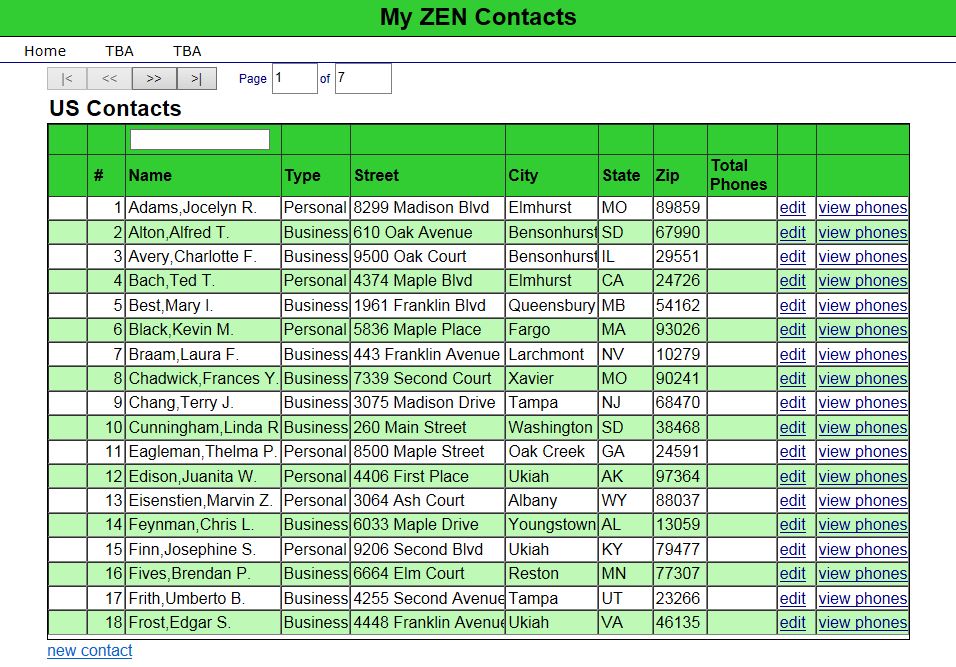
The idea here is that you can see what contacts have phone numbers without having to click on the "view phones" link. All I have done here is add a blank additional column to the %ZEN.Component.tablePane object
I have a tablePane ZEN Component and I am trying to get a filter running on the Specimen Id / Lab Number. The SQL is fairly complex with 3 UNION ALL statements joining 4 tables and a couple of lookup tables.
How would I get the filter on SpecId to work for my tablePane? It's not automatically applying the filter for me so I think I need code something.
Using a <FORM>
The OnLoadForm attribute calls a method but doesnt allow definition...
It seems to send pKey and accepts back pValues
Method LoadForm(pKey As %String,
                ByRef pValues As %String) As %Status
Is there any way to send more than just pKey as I need multiple values when loading the form.
There's plenty of goodness in the %-packages InterSystems supplies, and it seems that every new version of Caché brings something new. The browser-based class documentation (a.k.a. Documatic) generally provides a good level of information, but on the basis that "a picture is worth a thousand words" I sometimes want a diagram.
For example, when trying to navigate the %Dictionary package for a project that needed to find out about class definitions, here's one of the UML class diagrams I created.
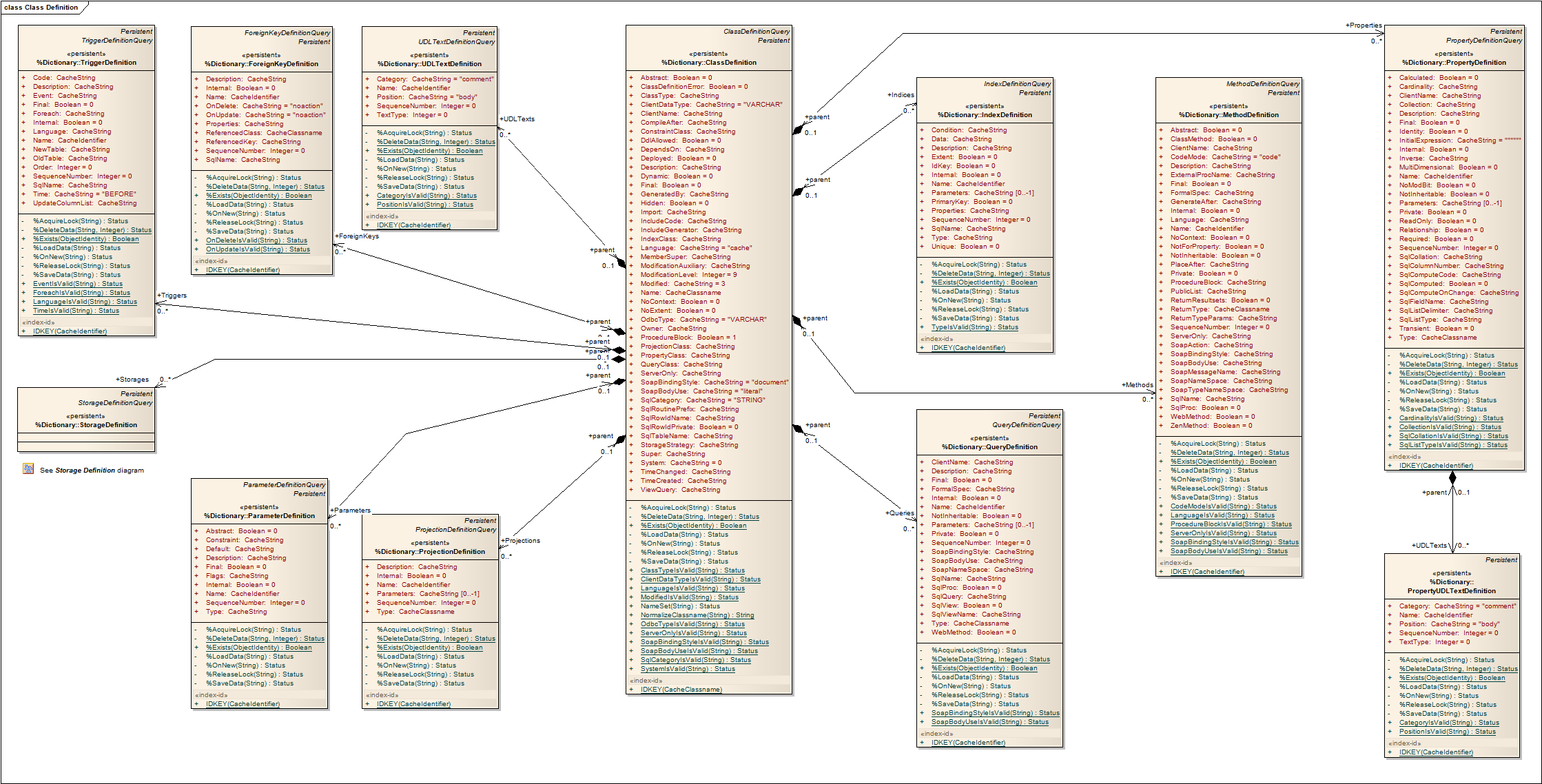
It was generated from a 2008.
A method to convert certain non-readable ASCII characters in a %Stream.FileCharacter object first copies it into a %Stream.FileBinary object and then loops through each character one at a time to find and convert these offensive characters to our interpretation of their readable ASCII equivalents . The loop is sequential (while 'bStream.AtEnd) and is taking too long for large files. Any suggestions for an existing Cache method to do this or is there another way, besides a sequential loop, to examine every character of a binary Stream?
This was what I first wrote. Here is the test, first putting in an invalid value:
Deployment Type? (G)ateway or (I)HE: F
Invalid Choice
Deployment Type? (G)ateway or (I)HE: G
Hello,
I am trying to integrate the Git with Studio. I have followed the below process to achiche Git tab in my Studio for Namespace
https://github.com/intersystems-ib/cache-git-studio
But I am getting the below error when I trying to Add the file. GitCodecache is my git repository.
fatal: c:/GitCodecache/cls/User/Testing.xml: 'c:/GitCodecache/cls/User/Testing.xml' is outside repository
class '%Studio.SourceControl.Interface', method 'GetStatus':
Hi,
I have a stored procedure which would generate a standard Cache String and it would be called through JDBC and I would
dump the result in java console/standard output.
What kind of characters should I use in COS so when output get send back to Java side, it knows it contains new line character ?
Thank for your help.
How to install Cache 2015 in linux with webserver NGINX?
By default, Analyzer executes queries as components are added. Often, there are times where you may know exactly what you are looking to do, and you do not want Analyzer to execute 5 queries as you drag and drop items onto rows/columns and select your filters. This is where toggling Auto-execute off can help.
How to know the severity, priority, urgency of error in InterSystems cache
Hi,
I've organized my repository using TortoiseSVN. I was careful to use only svn commands while creating my file structure. Now all Subversion commands are working at the command line but not from within my IDE (Cache Studio). Basically I'm trying to write a plug-in for my IDE to use Subversion from within the Studio. Trying to integrate Subversion into my IDE, something like Subclipse, but for Cache Studio. The error occurred after reorganizing my code into directories. For example at the command-line, svn info and svn status and all other commands work perfectly. All Subversion commands work at the command prompt!
Hi Group, I've followed the instructions from the documentation to configure LDAP and Ensemble to authenticate, however, I'm unable to authenticate using an account in the LDAP. The user is able to authenticate in a Linux shell. I have added the ObjectClass of IntersystemsAccount and the 3 group definitions to the schema. Other than adding the user to this group, do I have to change the user's objectClass at all?
This is not on active directory - it is a Linux based LDAP solution (slapd).
Hi,
I am saving 2000 objects of a class in a loop.
In one environment it is taking a total of 86 seconds and in another environment it is taking 0.55 seconds.
The code (the class and the code for save) is same for both the environment. I have Ensemble 2012.1.5.956
Can somebody help me to identify the cause of the discrepancy. Is there any memory or any other setup which may cause the problem.
Thank you in davance,
Susobhan
Hi All,In CSP how to call one method to another method (i.e) i created one script language as cache from that one script to another script that one also a cache script ,how to call the script.
Please will correct the code:
a is a perse Unicode to Unicode mapping value.Str=other status. It is how to convert English to french .
I am sending an HTTP request to cache class:
s rObj=##class
The request gets to the OnPreHTTP class method
Class xyz Extends %CSP.Page [ ProcedureBlock ]
{

ClassMethod OnPreHTTP() As %Boolean
{
    q 1

}

}
The question is how to retrieve the request payload in the OnPreHTTP method.
I am trying to write some code that takes in a string and does a serverside transformation of it to find embedded URLs and replace it with clickable links. I found the following regex for Javascript which is rated highly on StackOverflow;
    replacePattern1 = /(\b(https?|ftp):\/\/[-A-Z0-9+&@#\/%?=~_|!:,.;]*[-A-Z0-9+&@#\/%=~_|])/gim;
    replacedText = inputText.replace(replacePattern1, '<a href="$1" target="_blank">$1</a>');
And I tried to do the following in Caché ObjectScript but it's not working:
set matcher=##class(%Regex.Matcher).%New("/(\b(https?|ftp):\/\/[-A-Z0-9+&@#\/%?=~_|!:,.
I use Cache Instance. I'm trying to implement OAuth 2.0 in Cache instance.
Is it possible to use Cache instance as Client and Server?
And What is the Difference between CLIENT and AUTHSERVER instance?
Why is it used? I want to know which instance use which type of application?
Has anyone ever worked with a load balance for ECP servers access? If yes, wich one?
What are the pros and cons of such a solution? We use ECP servers as data servers via ODBC, thanks!
I created the sample rest services in Cache, I also set output in JSON format.
Can anyone explain how to pass JSON in Rest Services using POSTMAN?
Thanks.
Hi all,
I've created a WebApi and I've deployed in our development environment. So we test calling http://localhost:57772/Client/login and it works.
Now, I wondering how to change the port to call in pre production environment.
I've changed the port in the business service object, but it is ignored.
Other workaround is change the WebServerPort in System > Configuration > Startup Setting but it changes for all environment (connect to managment portal, etc..)
Is there any way to change the port of the WebApi to redirect to 80 (for example) u other one?
Best regards,
Francisco
I created a simple CRUD operation using Rest Services in Cache.
Class EX.example Extends %CSP.REST{<Created a simple class with three properties and performed the CRUD operation for below Class Definition
Sample.Classes Extends %Persistent
Please review the code and give me some suggestion to improve coding standard.
Thanks
Hi all,
I have the following problem with a WebApi that I've developed in EBS.
I have a GET method that reads the parameters and puts into a message to process.
Class MyApp.BS.ServiceRestBase Extends (%CSP.REST, Ens.BusinessService)
XData UrlMap [ XMLNamespace = "http://www.intersystems.com/urlmap" ]
{
<Routes>
<Route Url="/login" Method="GET" Call="Login"/>
</Routes>
}
/// Login
ClassMethod Login() As %Status
{
// Get the parameters
set login = %request.Get("login")
set password = %request.Get("password")
set app = %request.Get("app")
I'm trying to implement Crud operation in rest services.
I'm confused about this implementation.
Is it possible to call rest services method in CSP pages?
If not means, can you tell me another way?
I need some examples or reference to implement Crud operations.
Thanks
Hi, I tried the new rest file in User namespace. But I couldn't run it.
Here the Code:
Class com.Testing %CSP.REST
I tried it in the below link:
http://localhost:57772/csp/user/testing/insert
Can anyone help me resolve this error?