Hi, Community!
Please find a new session recording from Global Summit 2017:
This tag relates to the discussions on the development of analytics and business intelligence solutions, visualization, KPI and other business metrics management.
Hi, Community!
Please find a new session recording from Global Summit 2017:
Hi,
I have a persistent class “sp.SensorReading” which has a number of Properties: Date, SensorName, SensorReading. (sometimes multiple readings from the same sensor, on a given day)
...
Temp 28 Jan 33.5
Temp 29 Jan 31.2
Temp 30 Jan 33.1
Temp 30 Jan 34.1
Temp 31 Jan 32.1
Temp 31 Jan 33.1
System Monitor is a flexible and highly configurable tool supplied with Caché (Ensemble, HealthShare), which collects the essential metrics of the operating system and Caché itself. System Monitor also notifies administrators about issues with Caché and the operating system, when one or several parameters reach the admin-defined thresholds.
Hi,
Has anyone ever estimated the amount of disk space consumed by the iKnow indexing process ? I know this will be a rough estimate, but, I imagine that for sizing purposes, that would be enough.
The language the unstructured text is in is English.
thanks in advance -
Steve
Hi, Community!
This week we have two videos.
Please find the second Developer Community Video of the week on InterSystems Developers YouTube Channel:
Hello,
I have a series of data organized by time (year and month) so I can use a time dimension to drill down data. So far so good.
However, I need to display the data not by calendar years and months but rather by seasons. The season has 12 calendar months but starts in September. So I'd like to see the data from September / Year N to August / Year N+1 using the same hierarchy as normal time dimension.
Has anyone done something similar?
Obviously, the season can start by any month, not only September :)
TIA!
Hi, Community!
We introduced the new dashboard which shows the stats on members' articles, questions, and answers.
Hope it would help you to find the authors you would like to follow and find interesting posts you could miss.
The Data Platforms department here at InterSystems is gearing up for this year's crop of interns, and I for one am very excited to meet them all next week!
We've got folks from top technical colleges with diverse specialties from hard core engineers to pure computer scientists to mathematicians to business professionals. They come from countries around the world like Vietnam, China, and Finland and they all come with impressive backgrounds. We're sure they will do very well this summer.
Hi all,
I was wondering if InterSystems offers any message profiling capabilities. What I mean by "message profiling" is essentially stats or metrics gathered from a collection of data submissions of a particular type. For instance, average number of segments <XYZ> in a specific HL7 V2 message type. Or the number of sections found in a HL7 V3 CDA documents.
Curious if there is anything like this provided "out-of-box".
Thanks!
James
Hi, Community!
I hope you know the option to use DeepSee analytics portal for Developer Community stats. You can find it in Community-Analytics menu.
Let me introduce the beta of new analytical dashboard 'Articles' Views', which is available in Authors folder.
It consists of two dashboards, first shows the running total of the views for the articles (to see the impressive growing curve).
The second shows the daily additions in unique views (to analyze the dates of spikes).
Use the filters of Author, Article name, Publishing year and year timescale of analysis.
The >/</= etc. operands in named filters are great... except they won't work with measures ('native' or calculated - and what a boon it would be if they could work with both).
Are there any plans to add this capability?
And are there any plans to have a 'named filter' control within widgets that would let you change the operand?
Thanks.
Back in my COBOL days, there was a utility that would analyze running COBOL code and expose bottle necks and those modules that were inefficient or were executed multiple times. This was to help the programmer know where to concentrate streamlining efforts.
Is there any such utility for Caché Routines?
Hi, All!
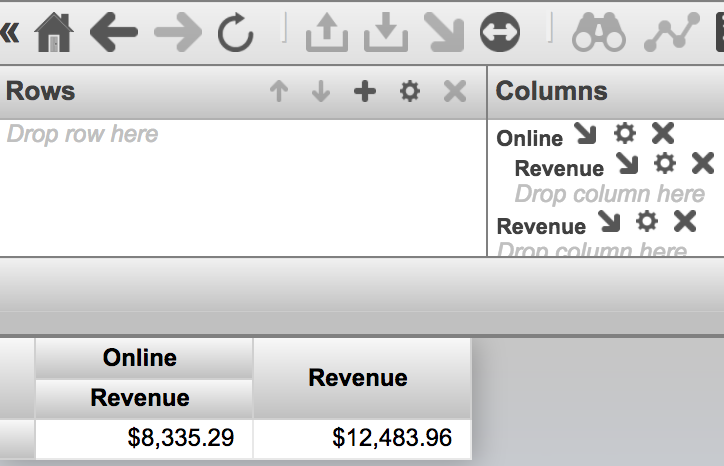
What is the calculated measure expression for the percentage of a member?
Say in Holefoods I want to see in a Cols Online sales in Revenue, All the revenue and % of Online sales for the Revenue?
I have the following:
With expression:
SELECT NON EMPTY {NONEMPTYCROSSJOIN([Channel].[H1].[Channel Name].&[2],[Measures].[Amount Sold]),[Measures].[Amount Sold]} ON 0 FROM [HOLEFOODS]How can I add the percentage of All in Revenue for Online channel?

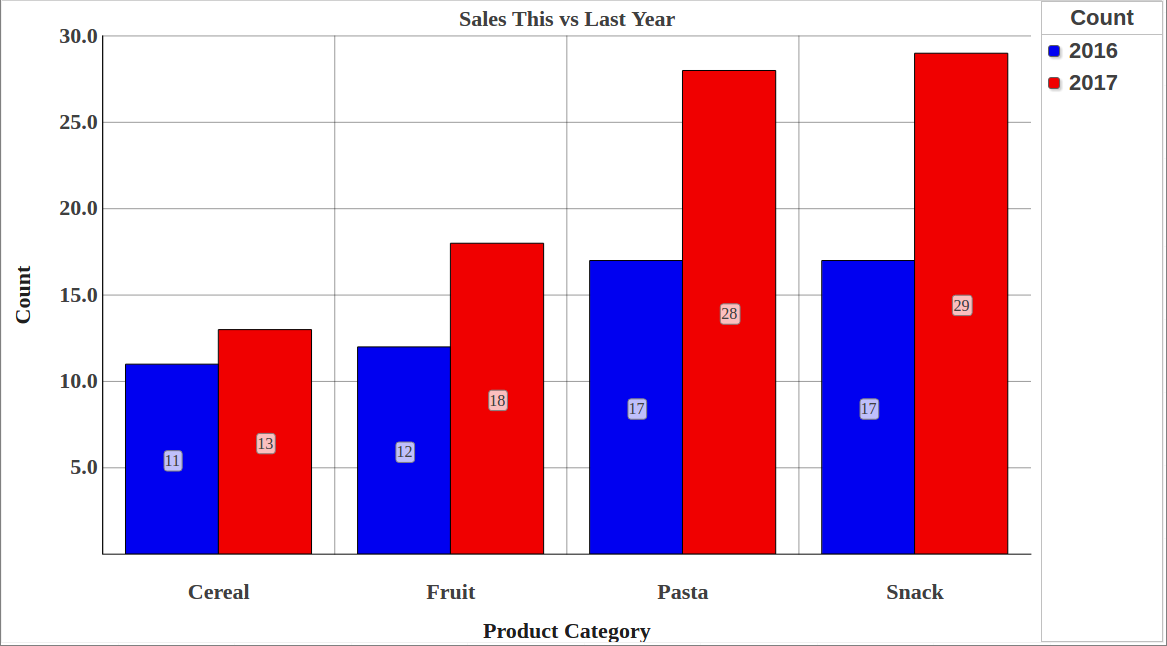
How are we doing THIS year versus the same period LAST year?
This is a common need in Business Intelligence. In fact, many design specifications for reports make use of a comparison between a selected period (year, quarter, etc) up to a certain date (for example November 15th, 2016) and a summary of the same information for the previous year (i.e. up to November 15th, 2015).
This post shows how to implement this in DeepSee.
Hello!
My group and I are currently doing a research project on natural language processing and iKnow plays a big role in this project. I am aware that the algorithms iKnow use aren't public, and I respect that.
My question is, are there any public documents/research that explains, at least part of, the algorthims iKnow uses and the motivations for using them?
I am trying to create a query that returns the best and worst performing products for a given customer, based on this year's net sales versus last year's net sales, weighted by the total net sales for all of the products sold to this customer in the last two years.
I have created Last Year Net Sales (up to the last month end): AGGREGATE(PERIODSTODATE([Invoice Date].[H1].[YEAR],[Invoice Date].[H1].[Month].[NOW-13]),measures.[Net Sales])
This year Net Sales: AGGREGATE(PERIODSTODATE([Invoice Date].[H1].[YEAR],[Invoice Date].[H1].[Month].[NOW-1]),measures.[Net Sales])
In DeepSee we have a field that is numeric but is used as a dimension. In DeepSee it sorts this field in the following order. 10, 11, 15, 2, 3, 5, 6, 8, 990. Is there a way to have DeepSee sort it numerically instead of treating it like a character field? We would want to see it show up in the dimension as 2,3,5,6,7,10,11,15,990.
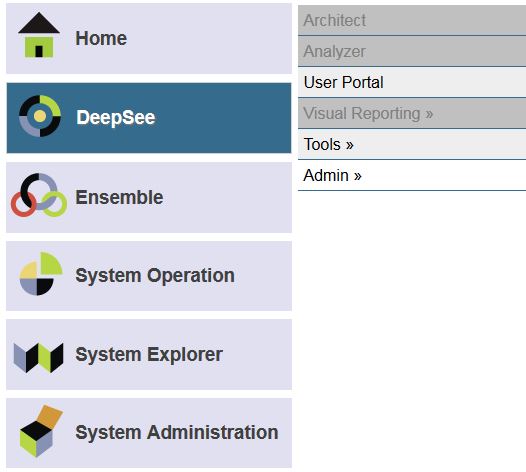
Whether you are accessing DeepSee for the first time ever or you are configuring DeepSee on a new instance, there are two common issues that are encountered after clicking on the “DeepSee” option in the System Management Portal.
Issue #1: Architect/Analyzer is grayed out!
Issue #2: DeepSee must be enabled before use.
There are two common causes for this problem.
I've asked a lot of questions leading up to this, so I wanted to share some of my progress.
The blue line represents the number of messages processed. The background color represents the average response time. You can see ticks for each hour (and bigger ticks for each day). Hovering over any point in the graph will show you the numbers for that period in time.
This is super useful for "at a glance" performance monitoring as well as establishing patterns in our utilization.
Here is the query used:
This article contains the tutorial document for a Global Summit academy session on Text Categorization and provides a helpful starting point to learn about Text Categorization and how iKnow can help you to implement Text Categorization models. This document was originally prepared by Kerry Kirkham and Max Vershinin and should work based on the sample data provided in the SAMPLES namespace.
Hi,
I am using iknow text categorization to classify texts. I have 11 medical articles as my training set. Here is part of the source code:
Hi,
I am looking for a mapping from SDA collections to the HS Analytics (HSAA) data model. Specifically HS.SDA3.Container.Observations to the tables (Couldn't find all the fields in HSAA.Observation). Can someone help? Thanks
Regards
Joseph Thottungal
Hello!
I'm trying to make a simple hello world program for iKnow but the documentation only shows examples using the scripting language or XML XData.
The domain is already created and configured, what I hope for is to be able to work with the data in some high-level language.
Is it possible to do something like this:
int domainId = 1;
IKnow iknow = new IKnow( domainId );
List concepts = iknow.getTopConcepts();
Any feedback will be greatly appreciated!