I am currently working on a issue with WRC on one of my Inbound SQL Adapters not returning all the records it should be. If I looked at the count of the records in Ensemble and compare it to that of a Microsoft SQL View, Ensemble seems to be off by a few records here and there. I am using a full dynamic select statement in my settings of the adapter.
Greetings!
I'm new to Zen reports and I'm wondering if what I'm trying to do is possible. I have a classmethod that accepts three parameters to generate an xml file from a global. I've set up my Report Definition to call the ClassMethod that generates the .xml file; however, I'm trying to figure out how to pass the parameters to that ClassMethod from the Report Definition. The example in the documentation shows parameter passing using SQL (which I'm not using), so I'm curious if this will work.
I'm trying to create asynchronous Ensemble service/operation pair for SOAP passthrough.
General configuration:
- Ensemble Service receives a message and immediately returns an answer to a caller (message received or some error)
- Ensemble Service asynchronously calls Business Operation
- Business Operation does guaranteed message delivery, etc.
Is it a viable approach?
Any tips? Ideas? Caveats? Code?
Seems like I can sublass EnsLib.SOAP.GenericService and change Sync to ASync (and provide a default reply immediately).
I'm getting this error a lot in Atelier. These are not extremely large files, and I can't seem to find a magic line count or byte size that triggers the issue to occur.
I'm using the latest (I believe) version 1.0.262. Is there a setting that allows larger files to be parsed successfully within the editor?
Hi Guys,
We need to print html reports, in the server side, to a specific printer that is installed on the Cache Server , and using the Internet explorer that is installed on the Cache Server to do that .
Hi!
While i am trying to write a data i am getting a error as "<PROPERTY DOES NOT EXIST>zFile+15^User.zKQRest.1 *value,%Collection.ListOfObj" but there are values stored in it. How can i break it write it separately.
Hello everyone .
I am trying to update a setting of an operation directly via the code of a business operation.
Concretely, my customer want a counter for the number of calls to the operation and the possibility to redefine the point of this counter.
Hi,
I am new to Cache' MV but have extensive experience with other Pick flavors especially Unidata.
I need to determine the impact of adding several indexes to a large file with over 51,000,000 records.
On other systems, I could use FILE.STAT, ANALYZE.FILE and shell to the OS to determine how large the index file was.
None of those seem to be available in Cache' MV. Shelling to the OS just tells me the size of CACHE.DAT.
What is the best way to determine what the disk impact would be if I added an index (CREATE-INDEX) to a file?
TIA,
Steve
Hello,
I have a DB server (ser-app-db) where cache is installed as server.
I have a Web server (ser-app-w) where cache is installed as web server and configured as CSP gateway.
I followed the configuration guide (https://docs.intersystems.com/latest/csp/docbook/DocBook.UI.Page.cls?KE…) and ser-app-w perfectly display the CSP and CLS pages.
But that's not working for my REST service, for exemple with the REST sample:
http://ser-app-db/csp/samples/docserver/request(GET): work and show the request
http://ser-app-w/csp/samples/docserver/request(GET): return a 404.
Hi
1. Is it possible do define an index like that :
create index UIX on MyTable (Column1) where Column1 is not null
2. What happens if we add an index on a property that is NOT required, meanning that not all records will be indexed because we do not allow null subscripts ?
Good day,
I need to find out if it is possible somehow to receive actual linux TIMESTAMP for example with $NOW() or other functions.
I was trying to recalculate it with $NOW() function, but without success. I would like to simulate Redis TIME command in COS.
My tryings:
USER > set time = $NOW()

USER > w (($PIECE(time,",",1)*86399) + $PIECE(time,",",2))
5573319043.403186
But in Redis it is:
> time 1) 1502471158
On web page: http://try.redis.io/
type "time" + enter. And it will results as short documentation says: https://redis.io/commands/time
And this behavior I would like to implement in COS.
I have a list of %Library.ArrayOfObjects . Each of list elements has some properties. I have to sort list by one of its objects properties. Is there a predefined method to doing that? (quicksort maybe?)
I have a tablePane. TablePane can have one, or two, or three parameters. It depends on some conditions.
At first I add all three parameters to tablePane.
set p1 .id = ..id1
do table.parameters.Insert(p1 )
do %page.%AddComponent(p1 )
set p2 = ##class(%ZEN.Auxiliary.parameter).%New()
set p2 .id = ..id2
do table.parameters.Insert(p2 )
do %page.%AddComponent(p2 )
set p3 = ##class(%ZEN.Auxiliary.parameter).%New()
set p3 .id = ..id3
do table.parameters.Insert(p3 )
do %page.%AddComponent(p3 )
Then through javascript I set parameters values and query
When I open a BPL in Atelier and right click 'Open diagram editor' I get a Java Incompatible browser error message (see below).
I'm using Windows 8.1, Atelier 1.0.190 and IE 11.
All the M.S. updates are up to date.
I also have firefox and chrome installed.
Trying to change default browsers etc. did not work.
java.lang.RuntimeException: Incompatible browser is installed. Please update your system browser.
    at com.intersys.eclipse.studio.ui.bpl.WebEditor.createPartControl(WebEditor.java:168)
at org.eclipse.ui.internal.e4.compatibility.CompatibilityPart.createPartControl(CompatibilityPart.I understand this is a rather broad topic (and at times involves religious sentiments) yet I would like to look at it from the Caché perspective:
- Do you use an issue tracking / collaboration system? If so which one. Any you would recommend or immediately dismiss based on personal experience?
- How do you keep track of large code bases? Thousdands of folders named backup1, backups2, ..., SVN, git?
- Do you have a development server to which you commit and test features there, or do you rather run a local copy of caché and implement features locally first, then push to the
Hi, I am trying to understand the transformational methods.
- LogicalToDisplay()
- LogicalToOdbc()
- OdbcToLogical()
- DisplayToDisplay()
I have created a small class with the only property of List as %List, see below.
{
Property List As %List;
}
Then I entered the following commands in the Terminal
Set Oref=##class(LastName.Demo2).%New()
FOR I=1:1:5 S $LI(List,I)="Value="_I
Set Oref.List=List
WRITE Oref.ListLogicalToDisplay(Oref.List)
^
<METHOD DOES NOT EXIST> *ListLogicalToDisplay,LastName.Demo2
zw Oref
Oref=<OBJECT REFERENCE>[2@LastName.
The data type %Char or %Library.Char
The description says it is a fixed length character field.
How do I set the fixed length?
Or by just setting %Char to something, does that automatically define its length?
Are the parameters MINLEN, MAXLEN involved? Or are these the way I set the fixed length?
Any help with this?
In a previous exercise, I was able to show the power of Caché.
A medium-designed set of interdependent tables with some GB of data.
URLs cross reference over some million pages resulting in ~3 billion records
Competition was between
- Caché
- PostgreSQL
- MySQL
Criteria were Speed + Storage consumption
I composed a customized loader fed over a "raw" TCP connection
Mapping the "objects" into the final table by directly writing to Global Storage.
Hi,
I use cache 5.0 and access cache through OpenVMS.
The disk-space under a particular namespace has grown up in size due to cache.dat. How to recreate cache.dat to bring up more space back on disk?
Hi Everybody
Question , I need to define a user that will be limited to only to one namespace.
I defined the start up namespace in the user's definition , but it doesn't limit the user.
Any advice would be appreciated.
Thank you Simcha
While using custom business service i'm not getting the Acknowledgement . But i tried with standard business service im getting acknowledgement . can you please help me to figure out the issue. Thanks in advance!!!
Hi, Community!
I'm pleased to announce that we deployed a new release of Developer Community.
This release comes with improved Search.
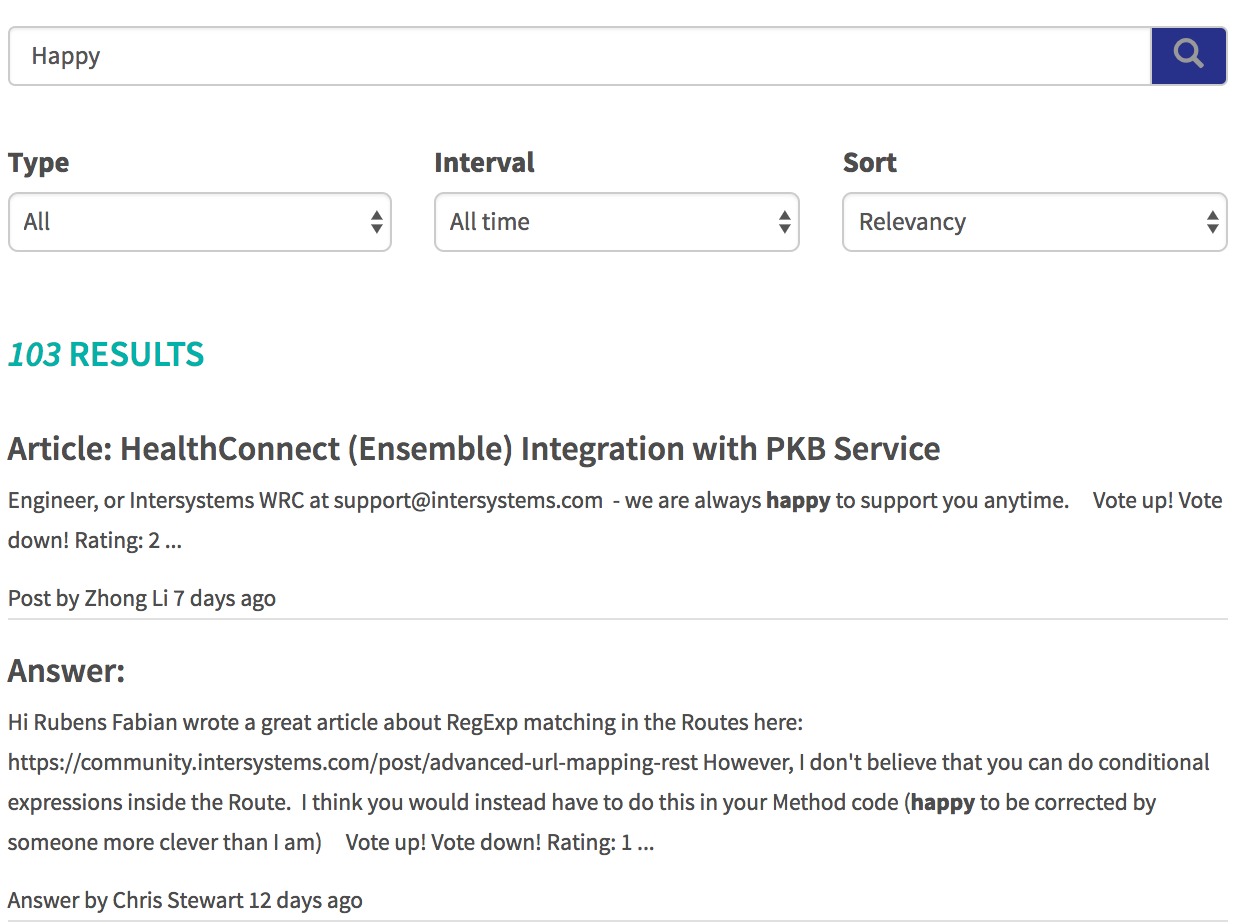
The updated search feature introduces full-text scan, auto complete for the key words, filters on articles, questions, comments, members and works faster.
Here is the small video on how it works.
Also, we fixed a few bugs and made DC faster.
Hope you like it!
Stay tuned for the next release and introduce your issues here in comments or and enhancement requests and other issues in the DC Feedback group!
Hi, folks!
There is an interesting discussion in the neighboring topic which raises a question for me: is there any reason to have %Status as a return value for COS method?
Hello All,
While extracting the huge amount of data in the cache through the Zen page, file extraction timing is greater than session time out. How to increase the session timing in Zen/CSP gateway or If any other solution would be appreciated. Please advise.
Major difference between GOTO and do command?
I have a Caché server with external apache.
It has a hostname, i.e.: http://myserver.com
There is an index page, which is available over http://myserver.com/index.html (/ is a Caché CSP app)
How can I make index.html available from http://myserver.com?
Here's the relevant parts of my apache config:
<Directory />
    CSP On
    DirectoryIndex index.html
    Options FollowSymLinks
    AllowOverride All
    Require all granted
</Directory>
<Location />
DirectoryIndex index.Okay, so I ran into a rather odd bug. I have a remote test machine (tst-intersystems) running for which I accidently opened a lot of windows in my Studio (i.e. 500+). The result is that the studio runs out of memory and crashes. Now, every time I try to connect to this remote machine studio immediately attempts to open all windows effectively not allowing me to start studio anymore.
Hi, Community!
Check the new video of the week about InterSystems Atelier:
In this short article we talk about how to get Yape running in a docker container to avoid having to setup python on your machine.
It's been a while since the last article in this series, so let's recap quickly.
We talked about using matplotlib to create a basic graph. Afterwards we introduced dynamic graphs using bokeh. In the 3rd part we talked about generating heatmaps using monlbl data.
A common theme in the feedback I got over various channels was the difficulty setting up an environment to run any of these.
GIS stands for Geographic Information System.
and it's not a typical arena for Caché. But it's definitely an environment with high data volume.
You see 3 major areas
- Visual front end:
A mature area well covered by a bunch of commercial and open source products.
No need for Caché there.
- GIS mathematics:
JTS (Java Topology Suite) is fixed standard that covers all requirements and can be linked to Caché by the Java Gateway
or the C, C++ incarnation of this standard library using Caché Call Out Gateway.
So far no added value by Caché.