This is more a WARNING than a question

Dasha.AI is a platform that allows you to create and manage voice interfaces for your applications. One of Dasha’s distinctive features is that most users believe they are talking to a human, not a robot.
Voice is the most natural way for people to interact. Dasha allows to use voice interface to interact with your application as naturally as communication between people.
The voice interface cannot completely replace the traditional user interface of the application, but some tasks could be perfectly solved with the help of the speech interface.
Hello,
We would like to convert a string which represents a dynamic JSON object, to a JSON.
We have:
linea: {"app_id":"5cf57b56-c3b4-4a0d-8938-4ac4466f93af","headings":{"en":"Cita Atención Primaria","es":"Cita Atención Primaria"},"subtitle":{"en":"C.P. ISORA","es":"C.P. ISORA"},"contents":{"en":"Aqui el contenido del mensaje si aplicase","es":"Aqui el contenido del mensaje si aplicase"},"data":"{\"centro\":\"C.P.
Hi Community,
Please welcome the new video on InterSystems Developers YouTube, recorded by @Patrick Jamieson:
⏯ A Healthcare Data Management Solution - What Kinds of Data
You may have seen earlier this week that we launched a brand-new learning podcast called Data Points! There are three episodes released, one of which was a really interesting discussion with Thomas Dyar — a product specialist here at InterSystems focused on machine learning. Take a listen and reach out if you're interested in exploring more about IntegratedML!
Hi Community! Here is a digest of the Most Noticed InterSystems Developer Community Articles for 2019. Please welcome!
Most viewed
 1,439
1,439Preview releases are now available for the 2020.1 version of InterSystems IRIS and IRIS for Health!
Kits and Container images are available via the WRC's preview download site.
The build number for these releases is 2020.1.0.199.0. (Note: first release was build 197, updated to 199 on 2/12/20)
InterSystems IRIS Data Platform 2020.
Preview releases are now available for the 2020.1 version of HealthShare Health Connect!
Kits, Container images, and evaluation keys are available via the WRC's preview download site.
The build number for these releases is 2020.1.0.199.0. (Note: first release was build 197, updated to 199 on 2/12/20)
HealthShare Health Connect 2020.
Hi Community!
As you know we launched the InterSystems Open Exchange — the marketplace for solutions and tools on InterSystems Data Platforms!
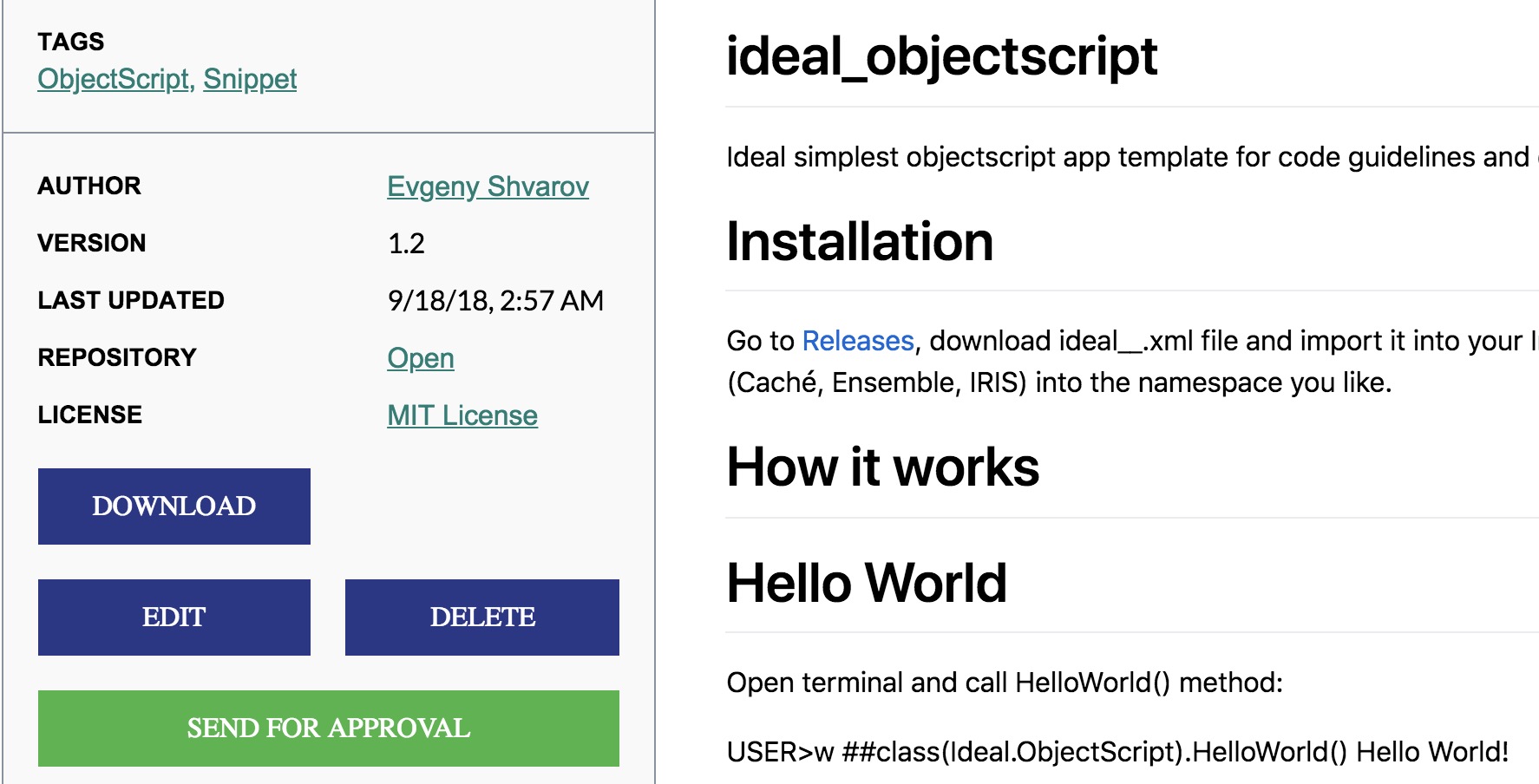
But how to publish your application on OE?
Before we start, let me answer the few basic questions.
Hello,
We would like to store a list into a global. The need is to get the full Web Service's Response Message, because of currently, our Operation sends the message to the Process, whith an empty list:

We have created a copyList which is a clone of the list which is being returned from the web service client:
set copyList = ##class(%ListOfObjects).%New()
set copyList = pResponse.RSPK21QUERYRESPONSE.%ConstructClone(1)
$$$LOGINFO("copyList: "_copyList)
$$$LOGINFO("copyList count: "_copyList.Count())
$$$LOGINFO("copyList.GetAt(1): "_copyList.GetAt(1))
$$$LOGINFO("copyList.PID8: "_copyList.
Hello,
We would like some help:
We have found that in the following code:
Class Operaciones.SOAP.Gasometros.GestionPacientes.SeleneHL7Service Extends Ens.BusinessOperation [ ProcedureBlock ]
{

Method operacion(pRequest As Mensajes.Request.GestionPacientes.operacionRequest, Output pResponse As Mensajes.Response.GestionPacientes.operacionResponse) As %Library.Status
{
 Set ..Adapter.WebServiceClientClass = "WSCLIENTE.GestionPacientes.ConsultaCandidatos"
 Set MSH=pRequest.MSH,SFT=pRequest.SFT,QPD=pRequest.QPD,DSC=pRequest.DSC
 Set tSC = ..Adapter.InvokeMethod("operacion",,.MSH,.SFT,.MSA,.ERR,.QAK,.QPD,pRequest.RCP,.RSPK21QUERYRESPONSE,.DSC)  Quit:$$$ISERR(tSC) tSC
 Set tSC = pRequest.NewResponse(.pResponse)  Quit:$$$ISERR(tSC) tSC

 Set pResponse.MSH = $get(MSH),pResponse.SFT = $get(SFT),pResponse.MSA = $get(MSA),pResponse.ERR = $get(ERR),pResponse.QAK = $get(QAK),pResponse.QPD = $get(QPD),pResponse.DSC = $get(DSC)
 do pResponse.RSPK21QUERYRESPONSE.Insert($get(RSPK21QUERYRESPONSE).GetAt(1))

 $$$LOGINFO("pResponse: "_pResponse)
 $$$LOGINFO("pResponse.MSH.MSH1.content: "_pResponse.MSH.MSH1.content)


 Quit $$$OK
}

Parameter ADAPTER = "EnsLib.SOAP.OutboundAdapter";

XData MessageMap
{
<MapItems>
    <MapItem MessageType="Mensajes.Request.GestionPacientes.operacionRequest">
        <Method>operacion</Method>
    </MapItem>
</MapItems>
}

}
Hi, everybody,
I've been reading some posts in the community but I haven't been able to come to a conclusion. Here's my point.
I have a cache code, and following this guide https://cedocs.intersystems.com/latest/csp/docbook/DocBook.UI.Page.cls?… but I can't understand how to run this from jenkins for example, without using the console, and thus automate the process. That is to say, if it were possible to do it, what steps should I follow.
Thank you very much
I understand RecordMaps can be used to send delimited files through a production without custom coding. The data segments are delimited by tilde character followed by $Char(10) in Linux/Unix. When I test the same IO data in Windows, I have $Char(13) and $Char(10) instead of just $Char(10). I like to use just tilde character for record delimiter and ignore $Char(13) and $Char(10) between the tilde and the leading data of the next segment / record. Is this good idea or not if someone wants to generate classes will it override code? I believe in X12 schema it ignored leading control characters.
Is possible config a docker-compose.yml to start arbiter-2019.4.0.383.0-docker.tar alone ?
What parameter you need ?
i can't find a simple sample
Hello,
We would like help to know why our web service which gets Patient's ID number, does not accept messages?
We observe its Event Log, and it contains the following pattern:
We detail each log to give info to discover what's happening:
First there is a new connection:
Then it suddenly disconnects
After that it looks like the service restarts:

The next one is interesting: it outputs that UTF-8 encoding is invalid, inside EnsLib.SOAP.InboundAdapter
We have searched for UTF-8 inside SOAP.
I am moving some DeepSee components to another environment and would like to know if the pivots and dashboards have to reside in the "Other" branch of the Workspace in Studio.
Thank you,
LG
I've recently encountered a HS Caché that won't start informing that Collation 30 is not available, but I have not found an easy way of knowing what collation is 30.
I've found that the following command returns the ones from the current locale, but not from all locales:
Set Rset = ##class(%ResultSet).%New("%Library.Collate:CollationList")

d Rset.Execute()

While (Rset.Next()) {zw Rset.Number_": "_Rset.Name}
Thank you
Hello,
I am playing around with an HL7 business rule set and a EnsLib.HL7.MsgRouter.RoutingEngine component. I'm wondering how I can get the routing engine to fire a rule when a response is received from a business operation.
I have a simple "debug" statement in my rule to log the "Source" value when a message is received. This debug statement only seems to fire when the message comes as a request from the business service (trace item #1 below).
I'm not sure what the purpose of this is, but the Management Console causes the browser to refresh periodically. If you're in a form or an editor such as the DTL or Routing Rule editors, you may lose work unless you save frequently. This did not occur in Caché 2018 and earlier releases.
I've had a couple of incidents where I've created a number of rules in the DTL editor, answered the phone or stepped away for a few minutes, then come back to find any work since the last save erased.
I've noticed this in both 2019 and 2020 releases of IRIS.
Heads up!
Hi Community,
Enjoy watching the new video on InterSystems Developers YouTube Channel:
⏯ Machine Learning 301: Learning from Text

View Machine Learning 101 recording at: https://videos.intersystems.com/detail/video/5827774460001/machine-learning-101?autoStart=true&q=machine%20learning.
In addition to our webinar on machine learning (https://community.intersystems.com/post/rescheduled-webinar-its-machine-learning-not-rocket-science-july-31-1100-am-edt), we are pleased to announce a basic introduction to machine learning presentation that provides an overview of the basic algorithms by @Don Woodlock, InterSystems VP of HealthShare Platforms.
Hello,
I’m running a query to drive a report.
I have a persistent class that includes this:
Property CreationTime As %TimeStamp [ InitialExpression = {$ZDateTime($ZTimeStamp, 3, 1, 2)} ];
So the above populates the column with UTC time.
Is there a way to convert to local time inside the SQL query?
Thanks!
Hi all — we're excited to release the first three episodes of the all-new Data Points podcast! The video below contains a short highlight from each episode, but head over to https://datapoints.intersystems.com to check out all three and subscribe on your favorite podcast app! In the coming days, we will share individual posts for each episode, to allow for further discussion. Feel free to let us know your thoughts, comments, questions, and suggestions for future topics!
*** Update 2/11/20 2:15pm ***
*** 2017.2.1 version is NOT affected ***
InterSystems has corrected a defect that can cause the CSP Gateway to forward a response to the wrong web client. This defect is not present in the Web Gateway.
The CSP Gateway is distributed as a component of a full instance installation and also as a standalone installer. Both distributions are affected by the defect. The CSP Gateway installed with the private Apache web server for the Management Portal is also vulnerable. The affected versions of the CSP Gateway are associated with Caché or Ensemble:
- 2016.1.
InterSystems has corrected a defect that can result in skipping a transaction rollback. This can only occur after activation or addition of a mirrored database on a primary mirror member.
This problem exists for:
- Caché and Ensemble 2018.1.3
- InterSystems IRIS data platform 2019.1.1, 2019.3, and 2019.4
- InterSystems IRIS for Health 2019.1.1, 2019.3, and 2019.4
- HealthShare Health Connect 2019.1.1
The conditions necessary for this defect to be triggered are quite specific. All of the following must apply:
- A database has been newly activated or added to a mirror on a primary mirror member.
How can I get the current date and time in the destination file when I'm using Stream.CopyFrom because Stream.CopyFrom preserves the date and time of the source file.
will InterSystems fix the Transaction-Handling for the .Net Connection Provider?
Nor the Property IsTransactionAcvtive nor TransactionLevel is set on the Connection when using BeginTransaction.
Latest PreView will give me problem as InterSystems removed removed the TStart() Option to create the Transaction that way which gave back a TransactionObject whith working versions...
Hello,
For many routines we write, we utilize a global we name ^HITLIST($JOB,"routineName") as temporary storage as needed. For various reasons this gets junked up and we are at a point where we need to do some routine garbage collection.
The idea is to write a utility that looks at all the ^HITLIST($JOB) nodes, check if the job is currently running and if it isn't then we can issues the KILL command on ^HITLIST($JOB).
We looked at the methods in %SYSTEM.Process and couldn't find a method that clear told us that a job was running or not. The most promising seemed to be %SYSTEM.Process.
I am looking to run some analysis on existing software to quickly identify global variable references. Ideally you would feed in a "starting routine" and after going through all referenced routines you would end up with a finite set of global variables. So the primary purpose is to take say 10,000 lines of code and map out the referenced global structures without relying on a programmers eye. I found the post on Object Script equivalent to Studio "Find in Files" interesting but the downside is that output is too verbose and would require parsing to extract the global structures. How would you override writing to the terminal so that you could parse the data?
Hi guys,
I thought I test the InterSystems IRIS for Health 2020.1, the Docker image. but for some reason, the container only lives for about 10 seconds and I can see from the message.log file that as soon as IRIS starts it then performs shutdown thus ending also container. Anyone else seen this?
here is the message.log part
*** Recovery started at Fri Feb 7 14:37:02 2020
Current default directory: /durable/iris-config/mgr
Log file directory: /durable/iris-config/mgr/
WIJ file spec: /durable/iris-config/mgr/IRIS.WIJ
Recovering local (/durable/iris-config/mgr/IRIS.