Just wonder if I could have some ways adding a percentage of weekly delta over the previous one on the top of each stacked bar in a bar chart widget like the one below.
.png)
Just wonder if I could have some ways adding a percentage of weekly delta over the previous one on the top of each stacked bar in a bar chart widget like the one below.
Hi Team,
I am trying to use the inbuilt class: EnsLib.HL7.Service.FileService to pass through an HL7 ADT message as a part of an HL7 to FHIR transformation. We have a client requirement, where we are receiving an NTE segment as a part of the ADT message. I am trying to map the NTE segment to an OBX Segment. I need to implement a counter for OBX segment whenever a NTE segment is found and map the NTE fields to the new OBX segment
How do I implement the counter for OBX?
Thanks
Santosh
If one of your packages on OEX receives a review you get notified by OEX only of YOUR own package.
The rating reflects the experience of the reviewer with the status found at the time of review.
It is kind of a snapshot and might have changed meanwhile.
Reviews by other members of the community are marked by * in the last column.
I also placed a bunch of Pull Requests on GitHub when I found a problem I could fix.
Some were accepted and merged, and some were just ignored.
So if you made a major change and expect a changed review just let me know.
Hi Community,
It's voting time! Cast your votes for the best applications in our Vector Search, GenAI and ML Contest:
%20(3)(3).jpg)
How to vote? Details below.

Current triage systems often rely on the experience of admitting physicians. This can lead to delays in care for some patients, especially when faced with inexperienced residents or non-critical symptoms. Additionally, it can result in unnecessary hospital admissions, straining resources and increasing healthcare costs.
We focused our project on pregnant women and conducted a survey with friends of ours who work at a large hospital in São Paulo, Brazil, specifically in the area of monitoring and caring for pregnant women.
Hi Developers!
We are happy to present the bonuses page for the applications submitted to the Vector Search Programming Contest!
With the rise of Gen AI, we believe that now users should be able to access unstructured data in a much simpler fashion. Most people have many emails that they cannot often keep track of. For example, in investment/trading strategies, professionals rely on quick decisions leveraging as much information as possible. Similarly, senior employees in a startup dealing with many teams and disciplines might find it difficult to organize all the emails that they receive. These common problems can be solved using GenAI and help make their lives easier and more organized.
Hello Community,
I'm trying to execute the FHIR R4 profile validation and got the below error. How to fix this below error
http://localhost:52773/csp/healthshare/learn1/fhir/r4/Patient/$validate?profile=http://examples.com/fhir/StructureDefinition/aktestpatient|4.0.1
.png)
ChatIRIS Health Coach, a GPT-4 based agent that leverages the Health Belief Model as a psychological framework to craft empathetic replies. This article elaborates on the backend architecture and its components, focusing on how InterSystems IRIS supports the system's functionality.
Hi, I was working with %sStream.FileBynary and following the doc when I find an info that I'm not sure of.
In the part of the doc where it talks about saving streams, it does not precise where it is saved.
I tried to fill my stream, then rewind, then set the file and finally saved.
And it puts in my default directory with the temporary name.
If I do a zwrite of my stream, I get these properties about the file and directory.
(StoreFile) = "zKc2m8v1.stream"
(NormalizedDirectory) = "C:\InterSystems\Community\mgr\user\stream\"
I figured it was maybe because I used a relative path while using LinkToFile.
Considering new business interest in applying Generative-AI to local commercially sensitive private data and information, without exposure to public clouds. Like a match needs the energy of striking to ignite, the Tech lead new "activation energy" challenge is to reveal how investing in GPU hardware could support novel competitive capabilities. The capability can reveal the use-cases that provide new value and savings.
Sharpening this axe begins with a functional protocol for running LLMs on a local laptop.
My local Mac has an M1 processor.
ChatIRIS Health Coach, a GPT-4 based agent that leverages the Health Belief Model (Hochbaum, Rosenstock, & Kegels, 1952) as a psychological framework to craft empathetic replies.
DNA Similarity and Classification was developed as a REST API utilizing InterSystems Vector Search technology to investigate genetic similarities and efficiently classify DNA sequences. This is an application that utilizes artificial intelligence techniques, such as machine learning, enhanced by vector search capabilities, to classify genetic families and identify known similar DNAs from an unknown input DNA.
.png)
K-mer Analysis: Fundamentals in DNA Sequence Analysis
Fragmentation of a DNA sequence into k-mers is a fundamental technique in genetic data processing.
Hi,
I'm trying to get an Ensemble 2017.1 environment to make a https connection to a webservice, but currently seeing SSL handshake errors. A fare bit of troubleshooting later, this looks to be related to SNI support, as the webservice I'm trying to hit will only take connections from clients that have SNI support, and has had TLS.v1 enabled for the troubleshooting. Testing this on 2017.2 versions and above the connection works fine, but on 2017.1 and below am seeing handshake errors.
This article introduces using the langchain framework supported by IRIS for implementing a Q&A chatbot, focusing on Retrieval Augmented Generation (RAG). It explores how IRIS Vector Search within langchain-iris facilitates storage, retrieval, and semantic search of data, enabling precise and up-to-date responses to user queries. Through seamless integration and processes like indexing and retrieval/generation, RAG applications powered by IRIS enable the capabilities of GenAI systems for InterSystems developers.
Hello developers,
Our project was designed to optimize patient clinical outcomes by reducing hospitalization time and supporting the development of resident and novice physicians. Additionally, it contributes to lowering financial waste in the healthcare system by improving the monitoring of pregnant patients, thereby decreasing risks and enhancing their safety.
Using the most accessible tool, the smartphone, was the obvious choice to make patients' lives easier.
Hi Community,
I'm looking for someone who has already made data ingestion into IRIS (or Caché) from Pentaho Data Integration.
Thanks in advance.
The introduction of InterSystems' "Vector Search" marks a paradigm shift in data processing. This cutting-edge technology employs an embedding model to transform unstructured data, such as text, into structured vectors, resulting in significantly enhanced search capabilities. Inspired by this breakthrough, we've developed a specialized search engine tailored to companies.
We harness generative artificial intelligence to generate comprehensive summaries of these companies, delivering users a powerful and informative tool.
Hi Community,
Here is a brief walkthrough on the capabilities of IRIS AI Studio platform. It covers one complete flow from loading data into IRIS DB as vector embeddings and retrieving information through 4 different channels (search, chat, recommender and similarity). In the latest release, added docker support for local installation and live version to explore.
Hi,
I use the data functions but don't know what they all do. Is there a dictionary that explains what each function does?
.png)
Thanks,
Lai Pham
Hi guys,
I try to make a test of encryption, decryption of a simple text.
I can crypt my text, but I can't decrypt it, do you see somewhere a dummy error of my part ?
Thanks for help
ClassMethod UnitTest()
{
set inputPlainText = "David"
// get private key
set privKeyFileName = "C:\temp\toto.pem"
set privobjCharFile = ##class(%Stream.FileCharacter).%New()
set privobjCharFile.Filename = privKeyFileName
set privKey = privobjCharFile.Read()
set Inputbase64 = $SYSTEM.Encryption.Base64Encode(inputPlainText)
// encrypte text using RSA
set encryptText = $System.Encryption.
I don't have a current project where I am needing to create a new operation that uses SOAP at the moment but as someone who still has some SOAP connections in her Production, I was curious if VSCode had an equivalent to the SOAP Wizard that helped create all of the SOAP classes needed based on the provided WSDL? Does anyone know? Or has this become a manual process?
Thanks in advance for help curbing my curiosity!
InterSystems is pleased to announce the general availability of:
This release adds support for the Ubuntu 24.04 operating system. Ubuntu 24.04 includes Linux kernel 6.8, security improvements, along with installer and user interface improvements. InterSystems IRIS IntegratedML is not yet available on Ubuntu 24.04.
Additionally, this release addresses two defects for all platforms:
In Cache End of file throws error but in IRIS no indication of End of file. I have to do an explicit $ZOF. How are you handling/detecting End of File in IRIS?
In cache this line will throw End of file error - F PREC=1:1 U FILE R REC D SOMETHING
But in IRIS this goes to forever, has anyone noticed this behaviour in IRIS?

Do you resonate with this - A capability and impact of a technology being truly discovered when it's packaged in a right way to it's audience. Finest example would be, how the Generative AI took off when ChatGPT was put in the public for easy access and not when Transformers/RAG's capabilities were identified. At least a much higher usage came in, when the audience were empowered to explore the possibilities.
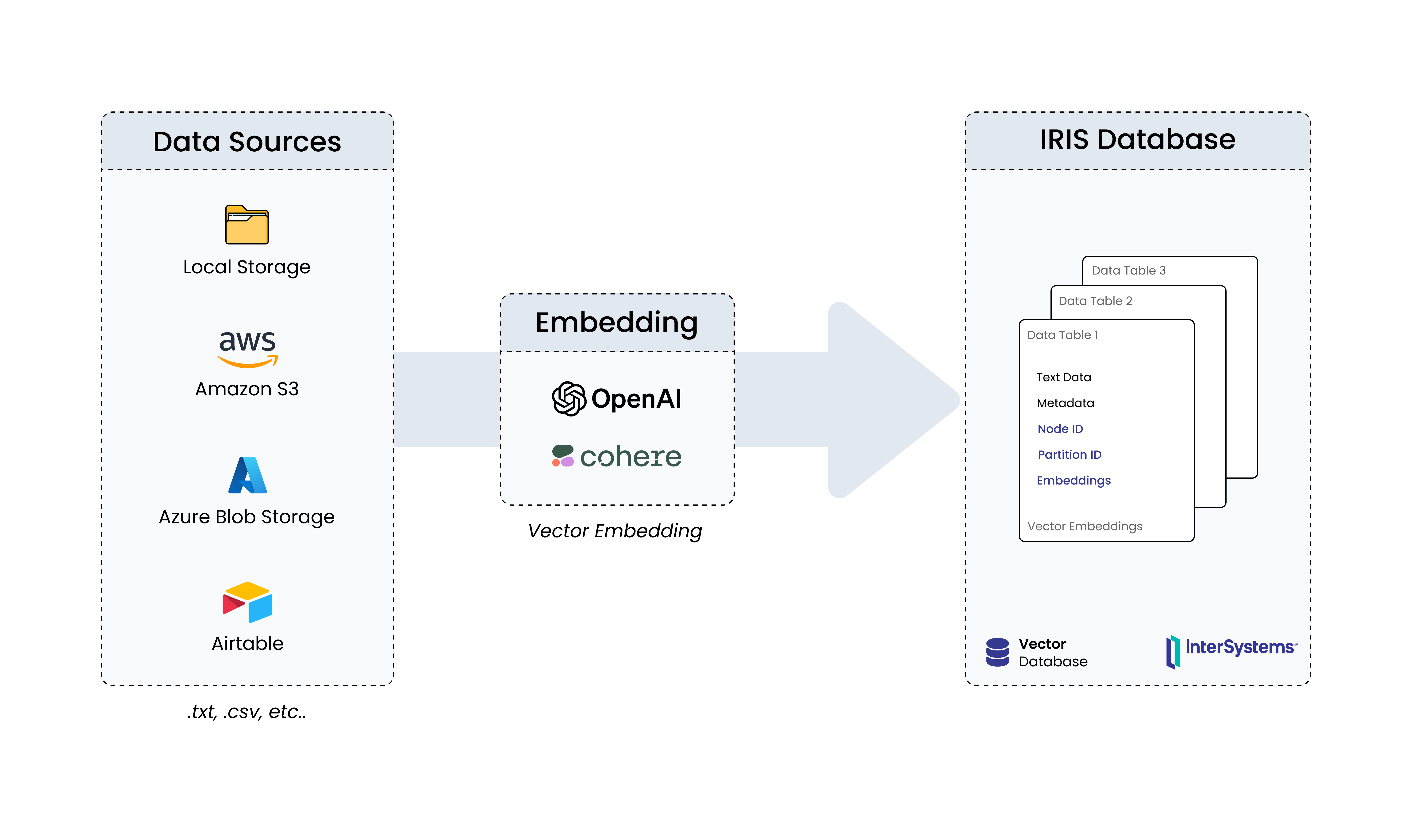
In the previous article, we saw different modules in IRIS AI Studio and how it could help explore GenAI capabilities out of IRIS DB seamlessly, even for a non-technical stakeholder. In this article, we will deep dive into "Connectors" module, the one that enables users to seamlessly load data from local or cloud sources (AWS S3, Airtable, Azure Blob) into IRIS DB as vector embeddings, by also configuring embedding settings like model and dimensions.
Hi
How do I view the .int code of a compiled class in VS Code?
I am trying to use gj::Locate and the setup works, the explanation is all fine but when i paste an error from the Error Logs into the gj::locate it firstly tells me that it can't find the .cls and when I paste in the .int reference in the text box where you can specify the class, method, line+offset it replies that it can't find the item.
This is something to do with the objectscript extension rather than gj::locate
Nigel
Hi, I need to use some pythonic library from cos.
To use them I need a python dict with some python object in it
Ex in python:
obj = pythonObject("value1")
dict = {object : obj
To do that I first tried to pass by dynamic object, to later convert them in dict from Json. But unfortunately the dynamic object doesn't accept python object inside it. And my pythonic function need to have an instance of my python object.
Hello Community,
I have below issue -
I have an ID with 123456.(ID as a dynamic value coming from request message)
I wanted it to be displayed as "123456" in Json Stream.
Code Example:
set object = ##class(%ZEN.proxyObject).%New()
set object.ID = ID
set x = ##class(%ZEN.Auxiliary.jsonArrayProvider).%WriteJSONStreamFromObject(.json,object)
Case:1
ID : 123456
Will output:
{
"ID": 123456
}
but I need :
{
"ID": "123456"
}
Case:2
ID : "123456" (adding double quotes)
Will output:
{
"ID": "\"123456\""
}
but I need :
{
"ID": "123456"
}
Thanks in advance.
Hello,
I would like you to propose this challenge.
It has been created by the CodeWars community here: https://www.codewars.com/kata/6523a71df7666800170a1954/python
I will copy and paste the description:
A number is Esthetic if, in any base from base2 up to base10, the absolute difference between every pair of its adjacent digits is constantly equal to 1.