Can you please any one assist me for How to connect with the InterSystems IRIS in Java(Quarkus) version 3.0.
Everything you need to know about VS Code for InterSystems technologies.
With the announcement of the deprecation of Studio, George James Software are here to make moving to VS Code as smooth as possible. Our expertise in InterSystems technologies and active contributions to the development of VS Code itself, as well as creating and maintaining a range of VS Code extensions, provide us with comprehensive knowledge and experience to guide you step-by-step so you're set up and ready to work in VS Code.
Hey Developers,
Enjoy watching the new video on InterSystems Developers YouTube:
I've tried to access this morning at https://containers.intersystems.com/contents and I'm receiveing a 503 as answer.
Come on! I need my dosis of IRIS + Docker!

If one of your packages on OEX receives a review you get notified by OEX only of YOUR own package.
The rating reflects the experience of the reviewer with the status found at the time of review.
It is kind of a snapshot and might have changed meanwhile.
Reviews by other members of the community are marked by * in the last column.
I also placed a bunch of Pull Requests on GitHub when I found a problem I could fix.
Some were accepted and merged, and some were just ignored.
So if you made a major change and expect a changed review just let me know.
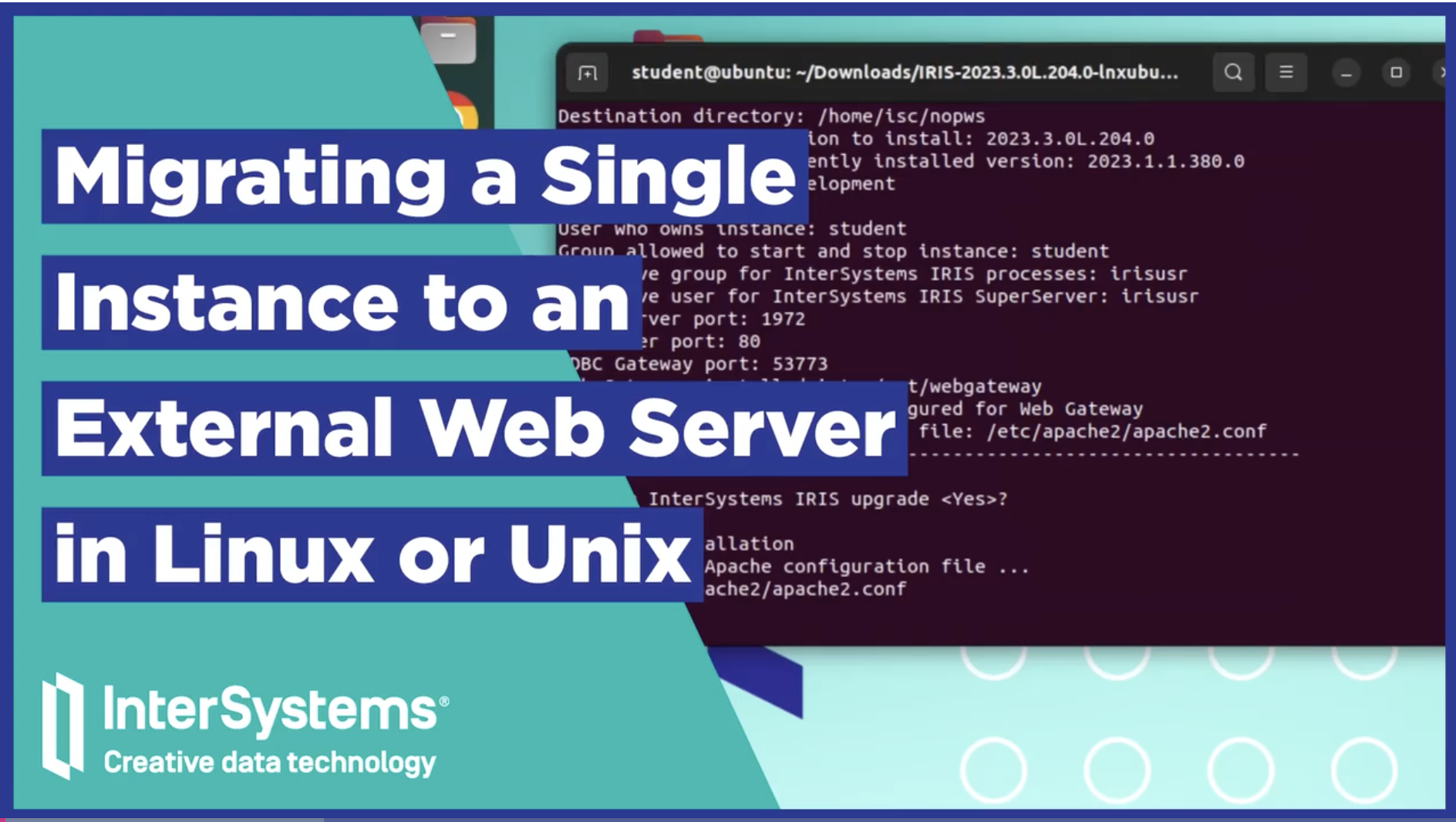
Hi all! I just wanted to share a new video – the first in a series of three – addressing the migration from the InterSystems Private Web Server to an external web server. This video covers the process of installing a web server and upgrading your IRIS instance in a Linux/Unix environment. Two more videos on the way will show the process for a mirrored setup in Linux/Unix, and for a single instance in Windows.
We continue with the series of articles related to the QuinielaML application. In this article we are going to cover how to prepare the raw data that we have captured using the Embedded Python functionality.
Welcome everybody!
Hi all,
I am trying to execute a query like the below code.
set statement = ##class(%ResultSet).%New("some_class:query_method"). // here query method is empty and with rowspec some columname
statement.Execute(param1)
I want to fetch data type of column value returned from above. eg - Name - VARCHAR, amount - INTEGER etc.
How can I get it. Or if not possible directly. Is there any other way to validate or get datatype of values returned. Line we have type() in python3
I need to search for the following values "SEDATION: " and "Procedure" In consecutive OBX 5 as seen below. Note that sometimes the OBX 5 containing "Procedure" may be followed by other characters/text hence I am leaning towards using a contains statement.
OBX|028|TX|OP^Operative Note^D4D^11504-8^Surgical operation note^XXX||SEDATION:  ||||||C|
OBX|029|TX|OP^Operative Note^D4D^11504-8^Surgical operation note^XXX||Procedure:
Only when they appear consecutively do I want to process the message as an ORU using the BPL. Not sure how to go about it and would appreciate any assistance. Thanks
InstallFoundation method is missing (IRIS 2023.2+)
Recently IRIS 2023.2 was released. This version removed this method InstallFoundation from this class HS.HC.Util.Installer. This was a private method and it was not documented. But it was widely used by the community to install FHIR server.
So if you encounter this error:
<METHOD DOES NOT EXIST> *InstallFoundation,HS.HC.Util.Installer
While build a demo our your own FHIR server, you can fix it by replacing this line:
to
Do ##class(HS.Util.Installer.Foundation).Install(namespace)
Hi developers,
We have received quite a lot of interest in using SQL on FHIR data. As you know, FHIR data is encoded in the form of a complex directed graph, and thus you can not easily query it with traditional SQL queries or business intelligence tools. Some customers have noticed that the "FHIR search tables" in IRIS for Health have flattened part of the FHIR graph, and have tried to use them for analytics. This is an undocumented and unsupported part of IRIS for Health, and can change without notice.
Is it possible to "Ping" a remote host in IRIS for Health using ObjectScript? We host hundreds of TCP connections over hundreds of VPNs. I'm working on a project that would make it nice to have way to ping remove clients over the VPN to monitor connectivity and keep the tunnels alive.
Another thought/method would be to make an OS system call (AWS Linux), but I don't see a way to do that either.
Currently we are using Delegated Authentication using ZAUTHENTICATE to look at the groups that are associated with a user and if it matches a role within IRIS, to assign the user to that role within IRIS.
Instead of using ZAUTHENTICATE as custom code, I am looking to use the built-in LDAP Authentication instead. Since I already have two AD Groups called (Access.Ensemble.Developer.User and Access.Ensemble.DataLookup.User) is it possible to config the built in LDAP functionality to look for these groups and assign the users to the correct roles within IRIS without the custom ZAUTHENTICATE?
Hi,
Can anyone please help me to display date field in the format DDMMYYYY which I need single digit date needs to have leading 0 like 01022000.
I tried to-char but leading 0 is not there.
I am writing object script with the help of sql query for generating extracts.
can anyone please help on this.
thanks
jude
SCOPE OF SERVICES:
The Database Developer’s responsibilities will include, but are not limited to:
• Understand existing application using InterSystems Technology such as Cache Object Code, Ensemble, Older Style Tag and Routine.
• To perform support and maintenance of existing Cache code
• Analysis and migration of existing Cache code to Microsoft SQL; and Web Services (SOA)
REQUIRED SKILLS/EXPERIENCE:
A minimum of 5 proven years of experience in computer applications development planning, design, troubleshooting, integration, maintenance, and enhancement of Cache Database applications.
Hello,
I have a global whose structure is multi-level and I am trying through a class and a SQL query to display a table which includes all the values and levels.
Hi,
what is our experience of Microsoft Dynamics integration with IRIS/Ensemble ?
If you have any experience with IRIS/Ensemble using interoperability flows with Microsoft Dynamics, please share it is this discussion.
Best regards,
Sylvain
Hello,
as i'm trying to develop a operation and its methods (SQL adapter), I'm running into issues when i run my test class.
I have the class i want to test in the very same folder as my test class.
I followed the tutorial in the documentation.
When i run the test class, i get the following message error :
LogStateStatus:0::ERREUR #5002: Erreur Cache: <METHOD DOES NOT EXIST>zTestAdd+1^unitTests.testMyClass.1 *myMethod,Package.BO.MyClass
Here is my test class (heavily inspired bythe documentation :-) :
Class unitTests.testSqlInscription Extends %UnitTest.
Power BI
Connecting to a Data Source
To connect to AtScale, we will use the SQL Server Analysis Services database. Let's open it in the Power Query editor. To do that, select Transform Data on the Home.
In the window that appears, go to the Home, expand New Source and select Analysis Services.

Hi everyone,
Lately, I've been spending a lot of time with Visual Studio Code (VSC), and I've been wondering if there's a terminal or a panel within VSC that acts like the Intersystems Studio Output panel, which serves both as an input and output window and allows the execution of ObjectScript commands.
Could anyone help? Thanks :)
Hello and welcome to the Developer Ecosystem Summer News!
This summer we've had a lot of online and offline activities in the InterSystems Developer Ecosystem. In case you missed something, we've prepared for you a selection of the hottest news and topics to catch up on!
We are noticing some issues with the communication between our Arbiter and our servers. Looking at the following documentation to limit connections, and logging...https://docs.intersystems.com/irislatest/csp/docbook/DocBook.UI.Page.cls?KEY=GHA_mirror_set_config#GHA_mirror_set_agent_port
if I am configuring the ISCAgent on the arbiter, would we set
application_server.interface_address=<ip_address>to each IRIS server? Or does this mean to give it a specific NIC IP Address to use for communication?
Hii all,
I'm trying to fetch columnType from resultSet of type %Library.ProcedureContext.
Executed the class query by %Execute after %PrepareClassQuery.
Hi Guys,
In my Zen page I've a grid with a list of uploaded images and it's working fine when running from the Server where the application resides where I can just click to an image and my code displays the image in a second screen (MSDS.Image.StreamServer.cls) ,
.png)
but the problem if running the page from a client machine (internet), I get this annoying extra steps with the file downloaded as .cls then I'll have to click open and choose a program .
Most transactional applications have a 70:30 RW profile. However, some special cases have extremely high write IO profiles.
I ran storage IO tests in the ap-southeast-2 (Sydney) AWS region to simulate IRIS database IO patterns and throughput similar to a very high write rate application.
The test aimed to determine whether the EC2 instance types and EBS volume types available in the AWS Australian regions will support the high IO rates and throughput required.
Minimal tuning was done in the operating system or IRIS (see Operating System and IRIS configuration below).
InterSystems FAQ rubric
You can avoid the error by specifying a stream object as the argument of %ToJSON() used when generating a JSON string from a dynamic object.
A code example is below.
USER>set##classSee also the documentation for details.
on red hat, but I would also be interested in a wider answer.
after running a benchmark for 40 minutes, I have been asked if any rollbacks occurred in that time. Rollbacks from SQL or objects.
The application does not record this, so I am looking for a system level record.
The journal entries do the necessary reverse sets and commit just like any transaction. So i don't think i can detect them there.
The SQL documentation says "Messages indicating that a rollback occurred, and errors encountered during the rollback operation are logged in the cconsole.
Hi Community
In this article, I will introduce my application IRIS-FlaskBlog.
IRIS-FlaskBlog Application is a real-world application that leverages the functionality of Flask web framework, SQLALchemy ORM, and InterSystems IRIS. The application contains user registration and authentication with the help of Flask-Login python library, a responsive user interface to create and edit posts.
With the world (as well as our own technology) moving to the cloud at such a fast pace it is easy (at least for myself) to get caught up in the little details. One thing I, and some clients of ours, had run into a couple of times was the necessity to specify the version of the images one plans to use with the IKO.
For example, one issue that often gets overlooked is the compatibilityVersion field for the IKO. Depending on which IKO you are using there is a default value (for IKO 3.6 this happens to be 2023.2.0, and for IKO 3.5 this is 2022.3.0).
.png)