Hello,
First of all thanks for your time and help with this question.
We wonder how could we convert a String which represents an XML, to a class which extends from Ens.
InterSystems ObjectScript is a scripting language to operate with data using any data model of InterSystems Data Platform (Objects, Relational, Key-Value, Document, Globals) and to develop business logic for serverside applications on InterSystems Data Platform.
Hello,
First of all thanks for your time and help with this question.
We wonder how could we convert a String which represents an XML, to a class which extends from Ens.
Hi,
I am having an issue when I am publishing data to FHIR which is hosting in AWS. I am sending the data to the Cloud FHIR url but getting the below error.
Any idea how to resolve this issue? Any example to cretae FHIR repository using Object script?
:<!DOCTYPE HTML PUBLIC "-//IETF//DTD HTML 2.0//EN"> <html><head> <title>404 Not Found</title> </head><body> <h1>Not Found</h1> <p>The requested URL was not found on this server.</p> </body></html>
I need to write test cases for Object script but need help for understanding the mock library in IRIS? Or need Suggestion for how to use mocking
Hello everyone,
I am looking for the syntax or the way to use a class created in the "BNA" Namespace (my application) from the %SYS Namespace.
Here is the context:
I have a "BNA" application contained in the "BNA" NS, this application provides a user creation functionality. This feature creates both the user in a table in the application and in the Iris system.
I created an initialization script for my database to be able to reset it at will, this script starts by emptying the database of this data, then initializes the basic data.
Hi Developers!
I want to share with you the approach you can use working with Unit Testing which I personally find very convenient and robust.
Will not talk much here about Unit Testing, we have documentation, enough good articles on the topic not only on the Internet but here on Developers Community too, e.g. this one.
How can you manage the Unit Testing of your ZPM module?
This is pretty handy with ZPM. It has a special command "test" which runs all the tests you mentioned in the module. You can execute it as shown below:
zpm:USER>module-name test
And this command runs all the tests you mentioned in module.xml.
Let's see how it works.
Your may not realize it, but your InterSystems Login Account can be used to access a very wide array of InterSystems services to help you learn and use InterSystems IRIS and other InterSystems technologies more effectively. Continue reading to learn more about how to unlock new technical knowledge and tools using your InterSystems Login account. Also - after reading, please participate in the Poll at the bottom, so we can see how this article was useful to you!
Work Queue Manager (WQM) is a feature of InterSystems IRIS that enables you to improve performance by distributing work to multiple concurrent processes programmatically. The idea is that you split the work into chunks, and WQM distributes the chunks across worker processes and can provide the info that the work is done.
However, recently, I got an interesting question: there's a large logical transaction composed of ~1,000,000 individual objects and SQL inserts and updates. Some updates are CPU-intensive, so the original idea was to use WQM to split an update into chunks to speed things up.
But, here's a catch: if one of the individual 1,000,000 changes fails (there's a variety of application-level checks so that it can fail, and that's not even that abnormal a behavior), the entire transaction must be rolled back. That creates a problem: each chunk must report success before committing their individual transactions, and someone must get all these reports and decide if we are committing or not.
Unfortunately, it looks like WQM does not have a bidirectional communication between workers and manager, so I suggested an approach using events:
I had a question about using ZSTART, ZSTOP, and ZMIRROR.
Hi Everyone,
My name is Vignesh and I'm from Virtusa HR Team, we are hiring for a InterSystems Developer in US (Remote), If anyone is interested You can share your resumes avignesh@virtusa.com, also refer your friends.
-Building new and debugging and fixing existing HL7, CCD and custom data interfaces (JSON and XML) to internal and external destinations.
Most server-client communication on the web is based on a request and response structure. The client sends a request to the server and the server responds to this request. The WebSocket protocol provides a two-way channel of communication between a server and client, allowing servers to send messages to clients without first receiving a request. For more information on the WebSocket protocol and its implementation in InterSystems IRIS, see the links below.
Hi Community,
Can anyone point me to the docs that show how to add automatic class documentation for the arguments used in a method call? I can auto document the class, methods, properties etc. with the "///" but can't figure out how to get the nice argument documentation for the arguments used when calling a method.
Thanks in advance
I am sending an httpRequest from ObjectScript to a python server. I am not receiving a response in OS
OS config On the client side
// Create an HTTP request object
Set httpRequest = ##class(%Net.HttpRequest).%New()
// Set the server URL
Set httpRequest.Server = "http://127.0.0.1:8080"
// Set content type to JSON
Set httpRequest.ContentType = "application/json"
// Clear any existing entity body"{""name"": ""Lowell Buschert"", ""dob"": ""1970-12-09"", ""address"": ""XXXXX""}"
do httpRequest.EntityBody.Clear()
//Set httpRequest.
I save / compile a class and instantly run a debug. No issue
A few seconds later, try to run the same debug and get presented with either:
1) Target Source is not compiled (Open launch json) dialog box
OR
2) The version of the file on the server is newer.
In the meantime I have made no edits to the VS Code window at all.
If I pull a compare in response to #2 above, I am presented with a bunch of extent info built into the storage definition similar to the lines below.
Hello All
I'm not sure what the best practice is for this. I have a DTL for returning ORUs back to a hospital in a different time zone. They have requested that various timestamps have the time zone offset added to the HL7 format (%q%k, I think). First, I just wanted to be sure the system was aware it was DST. I was able to determine if DST is in effect like this:
<assign property='tzOffset' action='set' value='"-0500"' />
<code><![CDATA[
         SET dst=$SYSTEM.Util.IsDST()
         IF dst=1 {SET tzOffset = "-0400"}
         ]]>
    </code>
<assign property='target.
Our 3M Computer Assisted Coding system goes down on a regular basis for updates, the Applications folks like us to Disable the Business Operations when this happens and start them back up when they page the on-call person. The Business Operations have to be started in a sequence to guarantee that all the ADT being sent it processed before we start sending everything else.
Hi Community,
What is Defination of XData which we use using in Object script
we are using XData
How can we use XData for different functionalities
Thanks,
Joe
I have some code written in objectscript but need to trigger it from clinical viewer. Someone does a search for a patient with a not found response which then triggers the code
*** updated from a comment as original question may not have been clear**
To clarify my question this is the library property helper class Library property helper when you look at the documentation for computed from documentation here Computed documentation
ClassMethod FullNameComputation(cols As %Library.PropertyHelper) As %String
{
    return cols.getfield("FirstName")_" "_cols.getfield("LastName")
}
// ...
ClassMethod RecordsComputation(cols As %Library.PropertyHelper) As %Library.ListOfDataTypes
{
Set rsTProp = ##class(%SQL.Statement).%ExecDirect(,I recently realized it's been far too long since I talked about the latest features in the InterSystems ObjectScript Extension for Visual Studio Code.
I'm pleased to announce version 2.12.1 of the ObjectScript extension, containing a number of enhancements that make a developer's life easier. Some highlights are described below, including the #1 requested feature from Global Summit -- XML import!
As always, find the full list of modifications in the CHANGELOG, including many bug and vulnerability fixes.
“I have been waiting for thirty seconds for service. This is outrageous! I am leaving!”
“I am very sorry to hear that, sir. Perhaps, next time, you should make a reservation.”
If you heard that comment at your favorite restaurant, you would think the person saying it was being ridiculous. However, in the context of your API, it makes perfect sense. Just like your favorite eatery, your API has some regular patrons who, as you know, will be visiting one day or another. It would be great to be able to make a standing reservation for them as well.
It will involve a couple of IRIS fundamentals.
Hi Community,
Is there a way to call HL7 Data transformation directly from Business service without using Rule functionality in the production
In this scenario i need to call a data transformation in directly in business service and give the transformed message to Business operation
Please share if you have any ideas to implement this.
Thanks,
Smythee
Hello everyone!
I need to transform a String, which is a numerical value, to an Integer.
The value gets returned in my Rest service as "testingID": "1234567", but I need it to be "testingID": 1234567
Thanks beforehand! Appreciate all the help I can get! :)
Does the GetValueAt method of an EnsLib.HL7.message object change the contents of the HL7 message?
We want to do two things, given an incoming HL7 message, in our production:
set sc = message.OutputToLibraryStream(xmlstream,"","","TNHS.Utils.HL7toXML")
Set ReportId = message.GetValueAt("PIDgrpgrp(1).ORCgrp(1).ORC:3.Hi all,
I'm very new to this ecosystem so please bear with me:
I've startted learning online and have installed everything I need. I have VS code and I have most definitely installed the pack (3 packages) needed for working on it with ObjectScript. Even though this is the case I'm running into 2 problems:
1. when I type "class" I only get 4 option for auto complete. no "class with multiple inheritances" or anything of the sort. In fact, no Class at all, only ClassMethod. ClassResponse etc.
2.
Interacting with Users in the Terminal: A Guide to Using %Library.Prompt in IRIS
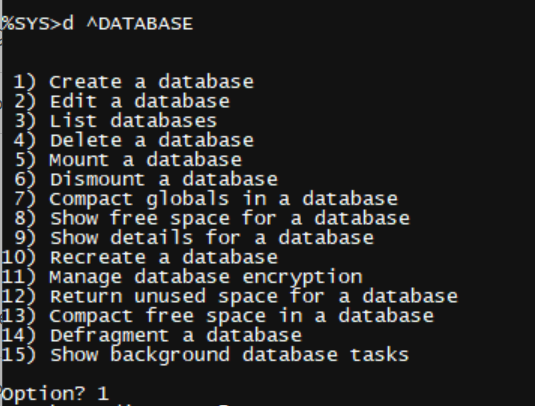
Have you ever wondered how commands like ^DATABASE engage users in the terminal? Or perhaps you're writing an automation routine and want ways to specify options directly from the terminal. Thankfully, the %Library.Prompt class in IRIS offers a straightforward way to do so!
For basic input, such as asking the user to provide a filepath or namespace, use the following code:
set status = ##class(%Library.Prompt).GetString("Input filepath:", .Hi community.
Yes, I know that there is other question "VS Code - debugging doesn't work" that is the same issue, but my IRIS instance is not using IIS.
Some times ago, I could debug without problems, but after some updates of Visual Studio, I get the following error
Failed to start the debug session. Check that the Intersystems server's web server supports WebSockets
I've activated the WebSocket protocol in the server (Windows Server 2019) but it still doesn't work.
The IRIS instance is not using IIS, I think it is using the Apache by default.
Do I need to do anything in special?
The launch.
Hello Community,
SQL language remains the most practical way to retrieve information stored in a database.
The JSON format is very often used in data exchange.
It is therefore common to seek to obtain data in JSON format from SQL queries.
Below you will find simple examples that can help you meet this need using ObjectScript and Python code.
ObjectScript : using Dynamic SQL with %SQL.
Introduction
This article attempt to summarize and update on the exchanges in this post. Please feel free to comment.
ObjectScript is based on MUMPS, a programming language dating back to 1966. At the time, and for quite a long period, memory and cpu resources were scarce, as was terminal screen space, and a very concise (and easily decodable) syntax was preferred (as, for example in C). Nowadays, we no longer have the same memory and screen limitations, and code readability and maintainability is far more important.
Looking at enabling long file paths (see https://learn.microsoft.com/en-us/windows/win32/fileio/maximum-file-pat…) on some Windows machines - does anyone know offhand if IRIS plays well with this in all respects?