just wondering - is there any reason why IRISList doesn't accept decimal values?
.. IRISList would be very handy und useful - but if i have to build a wrapper to serilize/ deserilize decimals ...

InterSystems IRIS is a Complete Data Platform
InterSystems IRIS gives you everything you need to capture, share, understand, and act upon your organization’s most valuable asset – your data.
As a complete platform, InterSystems IRIS eliminates the need to integrate multiple development technologies. Applications require less code, fewer system resources, and less maintenance.
just wondering - is there any reason why IRISList doesn't accept decimal values?
.. IRISList would be very handy und useful - but if i have to build a wrapper to serilize/ deserilize decimals ...
Last time we launched an IRIS application in the Google Cloud using its GKE service.
And, although creating a cluster manually (or through gcloud) is easy, the modern Infrastructure-as-Code (IaC) approach advises that the description of the Kubernetes cluster should be stored in the repository as code as well. How to write this code is determined by the tool that’s used for IaC.
In the case of Google Cloud, there are several options, among them Deployment Manager and Terraform. Opinions are divided as to which is better: if you want to learn more, read this Reddit thread Opinions on Terraform vs. Deployment Manager? and the Medium article Comparing GCP Deployment Manager and Terraform.
Loading your IRIS Data to your Google Cloud Big Query Data Warehouse and keeping it current can be a hassle with bulky Commercial Third Party Off The Shelf ETL platforms, but made dead simple using the iris2bq utility.
Let's say IRIS is contributing to workload for a Hospital system, routing DICOM images, ingesting HL7 messages, posting FHIR resources, or pushing CCDA's to next provider in a transition of care. Natively, IRIS persists these objects in various stages of the pipeline via the nature of the business processes and anything you included along the way. Lets send that up to Google Big Query to augment and compliment the rest of our Data Warehouse data and ETL (Extract Transform Load) or ELT (Extract Load Transform) to our hearts desire.
A reference architecture diagram may be worth a thousand words, but 3 bullet points may work out a little bit better:
.avro to keep the schema along the data: this will avoid to specify/create the BigQuery table schema beforehands..avro into the respective BigQuery tables you specify.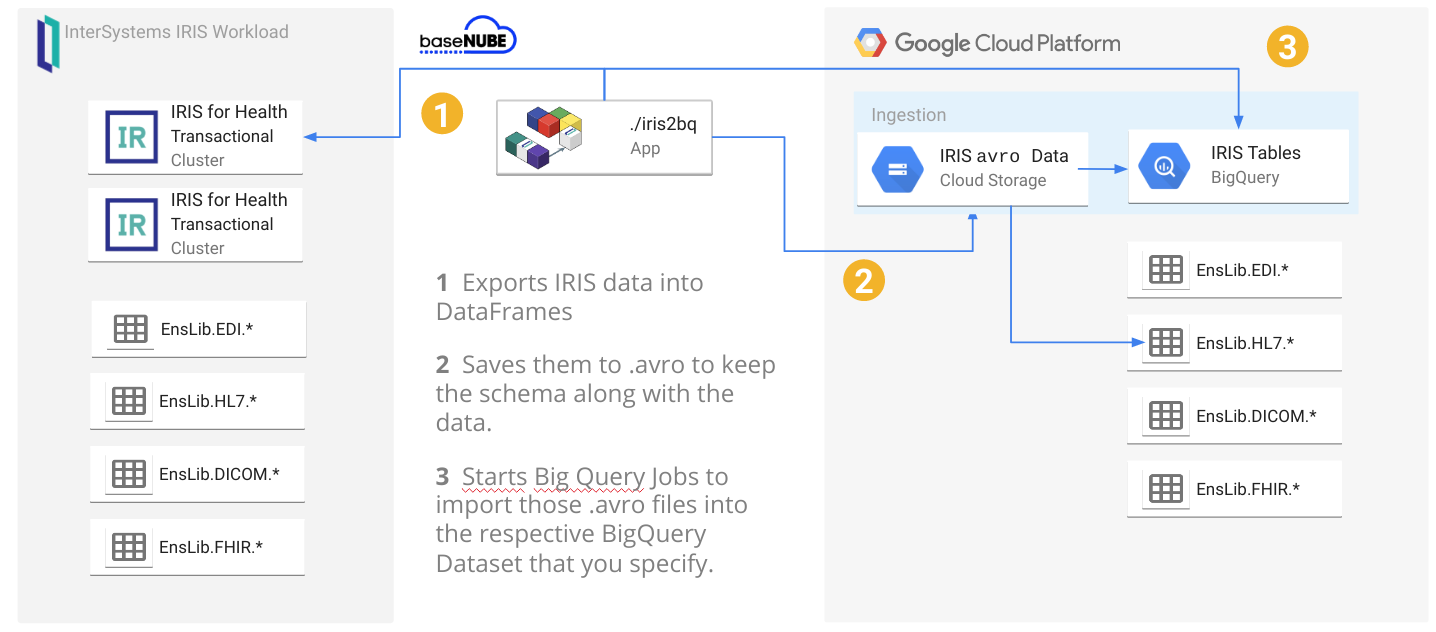
InterSystems and Intel recently conducted a series of benchmarks combining InterSystems IRIS with 2nd Generation Intel® Xeon® Scalable Processors, also known as “Cascade Lake”, and Intel® Optane™ DC Persistent Memory (DCPMM). The goals of these benchmarks are to demonstrate the performance and scalability capabilities of InterSystems IRIS with Intel’s latest server technologies in various workload settings and server configurations. Along with various benchmark results, three different use-cases of Intel DCPMM with InterSystems IRIS are provided in this report.
I want to send requests from custom BP with timeout and be able to understand that timeout event happened.
I thought that I need to implement OnTimeout method in my process (in either caller or callee), however it seems like OnTimeout is never called.
Let's say we have this parent process:
Class Timeout.Parent Extends Ens.BusinessProcess [ ClassType = persistent ]
{
Method OnRequest(pRequest As Ens.StringContainer, Output pResponse As Ens.StringContainer) As %Status {
set sc = .SendRequestSync("Timeout.Hi all!
I'd like to share the code we used in a hands-on session in the last InterSystems Iberia Summit (Spain) about developing a simple Angular app using InterSystems IRIS as backend.
_anim_preview.jpg)
Hi,
Do you have any experience in server side pagination with IRIS using Angular on the client side?
Any idea on a typical SQL request on the server side?
Thanks!
Blaise
Hi Developers!
This is the digest of new solutions and applications submitted to InterSystems OpenExchange in February 2020!
Sudoku game implementation in Excel using InterSystems IRIS as a server
RESTForms2 by Henry Hamon Pereira
RESTForms2 is a framework to create the REST API for InterSystems IRIS persistent objects automatically
FirstLook-Globals by Evgeny Shvarov
Firstlook example of InterSystems Globals
IRIS Interoperability Message Viewer by Henrique Gonçalves Dias
A new approach for the Interoperability Message Viewer
The iKnow Natural Language Processing technology was originally developed in Belgium and then acquired by InterSystems in 2010. In February 2020, InterSystems published the technology to open source, expanding the possible use cases for it beyond embedded use from the InterSystems IRIS Data Platform. iKnow is open to community contributions to enhance the engine, language models and interfaces for use in-text exploration, information extraction, and machine learning use cases.
Dear Community,
We're pleased to invite you to "ConferencIA", a conference about data and AI, which will take place on February 20 in Madrid, Spain!
At the event, both InterSystems experts and external thought leaders will share success stories and real projects, where AI is already a reality.

This error is sometimes seen while viewing a listing in InterSystems IRIS Business Intelligence:
ERROR #5540: SQLCODE: -99 Message: User <USERNAME> is not privileged for the operation (4)
As the error suggests, this is due to a permission error. To figure out which permissions are missing/needed, we can take a look at the SQL query that is generated. We will use a query from SAMPLES as an example.
SELECT TOP 1000 %ID, DateOfSale, Outlet->City, %EXTERNAL(Channel) AS Channel, Product->Name AS Product, UnitsSold, AmountOfSale AS Revenue, (Discount * 100) || '%' AS Discount, Comment FROM HoleFoods.
Dear Community,
We're pleased to invite you to the InterSystems Benelux Symposium 2020, which will take place from February 11th to 12th in Antwerp, Belgium!
At the Symposium, both InterSystems experts and external thought leaders will discuss what it takes to make your IT innovation work. You're more than welcome to join us in the Radisson Blu Astrid Hotel in Antwerp.

Fastest Path to Possible - With Digital Innovation
Ladies and gentlemen, good news for our town.
It finally happened - M was put in the cell.
And feels great there. Maybe it not a prison but an Excel cell.
Being there, he leads the whole M-gang. As well as conditional formatting in EXCEL.
Close integration of excel with the database provides a new convenient design tool.
Interactive reports, input forms, diagrams are generated only by m-commands in cells, without classical programming.
More detailed on https://github.com/mx-alex/MX
We will monitor the development of the situation and answer your questions.
best wishes
Alex
There is a special Query for reporting, it takes one cell of Excel. Example :
?$$omQuery 113^oPeat | Country Country:Province Date Product:Date Date:Product:-zr | tn EURO | zrzr| | if Date'<%XD81,Date'>%XD82 | set zrzr=zr,EURO=summa
The omQuery sets the structure and content of the required documents as well as filters and data processing procedures.
In one request, up to 9 reports are created, with subtotals by group.
trying import ClassDefinition File via <IRISClient.Ado.IRIS> result with error:
InterSystems.Data.IRISClient.IRISException (0x80004005): Exception thrown on server (code = 1242) : <REMOTE EXECUTE INVALID WRITE>Load+19^%apiOBJ
running: IRIS for Windows (x86-64) 2020.1 (Build 197U) Thu Jan 23 2020 09:56:09 EST
am i missing something?
public void LoadClass()
{
// import/ update <Installer.Package> to %SYS NameSpace
using (var c = new IRISConnection("SERVER=127.0.0.
If you had the opportunity to change something in the IRIS Interoperability Message Viewer, what would you do?
Our company is in the process of converting our software for use in Intersystems IRIS and one of the major sections of the software makes use of a custom statically-linked C library using the $ZF("function-name") functionality. During this, I found out that the process for setting up the C library to be used within the database platform has changed significantly between Cache and IRIS.
Dear Community,
In advance of the upcoming release of InterSystems IRIS 2020.1 and InterSystems IRIS for Health 2020.1, we're pleased to invite you to the “Office Hours: InterSystems IRIS 2020.1 Preview” webinars. These Q&A sessions will provide a forum for you to ask questions and learn about the latest product features in the upcoming releases.
The webinar will feature members of InterSystems product management team who will answer questions and provide additional information about the new features and enhancements.
We will be hosting two sessions on Thursday, February 20, 2020. Reserve your spot by clicking one of the buttons below for the appropriate time slot.
Hi developers!
Just want to check with you on best practices for that.
You collaborate for InterSystems IRIS repository. You fork it, then make changes, commit, push, pull request, discuss(if any), your PR is accepted.
What's next?
Do you delete the repository you forked in?
In Episode 4 of Data Points, we welcome @Benjamin De Boe to the pod to discuss some of the things you can do to optimize your SQL queries in InterSystems IRIS. We've all heard — either from ourselves or from others — the "this runs too slowly" complaint. I thought Benjamin did a great job walking through many of the things within IRIS you can look at with your queries to see what can be improved.
Any recommendations - From COS, From .net?
Hi Developers,
Enjoy watching the new video on InterSystems Developers YouTube:
   try{
        ....
        ....
        ....

        Set tSC = method_invocation()

        If $$$ISERR(tSC) {
            Quit tSC
        }

        ....
        ....
        ....

}
On compiling the above, I get an error saying "QUIT argument not allowed : 'tSC' ".
Hello,
We need to convert this structure, where we observe empty component separators "^":
MSH|^~\&|sistemaExterno|anonymized^anonymized|anonymized|anonymized|anonymized||RSP^K22^RSP_K21|anonymized|P|2.
Preview Mode was added to InterSystems IRIS Business Intelligence to give designers a quick view of what their resulting Pivot Table will look like without needing to wait for the results to fully execute. This can be beneficial when designing pivot tables because if you are dragging and dropping elements to see how they look/work in your pivot table and seeing if they have the desired data. Since you are exploring and designing, you don't necessarily care about the results at the moment, but you would still like to see how your table looks with the changes you have made.
I need to convert an array with an unknown number of indices to a JSON string for transmission (which is why it isn't possible to iterate through it using $ORDER). Does ObjectScript provide functionality to convert an array to a JSON string?
In a HTTP operation, which extends Ens.BusinessOperation, EnsLib.REST.Operation, one can read the component's AlertGroups property by simply referring to it with "..":
.png)
set AlertGroup =  ..AlertGroups
//Do something with AlertGroup
"AlertGroups" is a property of Ens.Host. The above however does not work in a business process which Extends Ens.BusinessProcessBPL which extends Ens.BusinessProcess which extends Ens.Host.
Hi Developers,
New video, recorded by @Benjamin De Boe, is available on InterSystems Developers YouTube:
⏯ Code in Any Language with InterSystems IRIS
Conversion Sequence step 4 (see table below)
Over the last few months, we have made changes to InterSystems IRIS to make it easier for you to move from Caché/Ensemble (C/E) to InterSystems IRIS. The most significant adjustments are the re-introduction of non-Unicode databases and the in-place conversion. InterSystems IRIS now fully supports non-Unicode databases with all the functionally that already exists with Caché. The in-place conversion supports an upgradelike process to install InterSystems IRIS right on top of your existing C/E deployments.
I wanted to share each of the first three episodes of our new Data Points podcast with the community here — we previously posted announcements for episodes on IntegratedML and Kubernetes — so here is our episode on InterSystems IRIS as a whole! It was great talking with @Jenny Ames about what sets IRIS apart, some of the best use cases she's seen in her years as a trainer in the field and then as an online content developer, and more. Check it out, and make sure to subscribe at the link above — Episode 4 will be released next week!
Hi Developers!
Another way to start using InterSystems ObjectScript Package Manager is to use prebuilt container images of InterSystems IRIS Community Edition and InterSystems IRIS for Health Community Edition.
We deploy this IRIS images on DockerHub and you can run it with the following command:
docker run --rm -p 52773:52773 --init --name my-iris -d intersystemsdc/iris-community:2019.4.0.383.0-zpm
Launch a terminal with:
docker exec -it my-iris iris session IRIS
And install zpm-module as:
USER>zpm

zpm: USER>install objectscript-math

[objectscript-math] Reload START

[objectscript-math] Reload SUCCESS

[objectscript-math] Module object refreshed.

[objectscript-math] Validate START

[objectscript-math] Validate SUCCESS

[objectscript-math] Compile START

[objectscript-math] Compile SUCCESS

[objectscript-math] Activate START

[objectscript-math] Configure START

[objectscript-math] Configure SUCCESS

[objectscript-math] Activate SUCCESS

zpm: USER>
And use same commands for InterSystems IRIS for Health using the tag: intersystemsdc/irishealth-community:2019.4.0.383.0-zpm
The images are being published on IRIS Community Edition and IRIS Community Edition for Health repositories of Docker Hub.
We will update tags with every new release of IRIS and ZPM.
Happy coding!