#InterSystems IRIS BI (DeepSee)

17 Followers · 324 Posts

InterSystems Business Intelligence enables you to embed business intelligence (BI) into your applications so that your users can ask and answer sophisticated questions of their data. Specifically, your application can include dashboards, which can include the following:

  • Interactive widgets that execute queries designed for specific user roles or for specific areas of your user interface.
  • Controls such as drop-down lists and data choosers that enable users to modify these queries.
  • Interactive drill options that enable users to view the displayed data in different ways.
  • Options to export, print, and send alerts to other users.
  • An option to launch the Mini Analyzer, which supports free-form analysis.
  • Execute custom actions that are provided as buttons or other controls.

In contrast to traditional BI systems that use static data warehouses, Business Intelligence is kept closely in synchronization with the live transactional data, as required for your business.

Learn more.

InterSystems staff + admins Hide everywhere
Hidden post for admin
Article Evgeniy Potapov · Nov 2, 2022 9m read

Today we will talk about Adaptive Analytics. This is a system that allows you to receive data from various sources with a relativistic data structure and create OLAP cubes based on this data. This system also provides the ability to filter and aggregate data and has mechanisms to speed up the work of analytical queries.

Let's take a look at the path that data takes from input to output in Adaptive Analytics. We will start by connecting to a data source -  our instance of IRIS. 

0
1 793
Article Evgeniy Potapov · Oct 3, 2022 8m read

When we work with IRIS, we usually have the ability to quickly deploy a ready-to-use infrastructure for BI (data, analytical cubes, and IRIS BI dashboards) using modules. When we start  using Adaptive Analytics, we typically want to have the same functionality. Adaptive Analytics has all the tools that we need. The documentation contains a description of how to work with an open web API. All interactions between the user interface and the engine also occur via the internal web API and can be emitted.

0
0 393
Article Evgeniy Potapov · Sep 13, 2022 5m read

When we are at the starting stage of BI project development, we must remember that it is crucial to select the right tool for its implementation. Today we want to show you how one of the principal functionality of dashboards is implemented in different BI systems. Let's talk about drill down from both points of view: the dashboard development, and the convenience and clarity for the end user. We will touch on the applications of this technology in IRIS BI, Power BI and Tableau.

1
0 953
Article Evgeniy Potapov · Sep 9, 2022 1m read

InterSystems Developer Community analytics. Project made with InterSystems IRIS BI (DeepSee), Power BI and Logi Report Designer to visualize and analyze members, articles, questions, answers, views and other pieces of content and activity on InterSystems Developer Community.

You can see your own activity, articles and questions. Track how your contribution changes developer community.

Analyse statistics about you and your friends using IRIS BI, Adaptive Analytics, InterSystems Reports, Tableau and Power BI.

0
0 335
Article Evgeniy Potapov · Sep 9, 2022 5m read

Power BI dashboards provide us with a good way to analyze aggregated information. We can even choose time periods for aggregation (you can find more details regarding it in our article about drill down). However, we might still be interested in a detailed look at specific data points. With the right data filling, we can display detailed data for any column of the chart with all filters applied to that chart. For example, we can see what exact questions were asked on the site on a particular day, who their author was, how many views they received, etc, and all of that without going beyond our

0
0 1087
Question Max Maduri · Aug 30, 2022

Hello,

I am still trying to figure that Calculated Measure stuff and I hope to learn from you. I have several cubes I am trying to create calculated measures using the Calculated Member Expression.

I have a cube called Cards. There is a measure called count that give total cards count of 15,000. There are two dimensions I am considering. One is the CreditGrade (A, B, C, D, nograde) and the other is the date of the scoredate.(2000-2015).

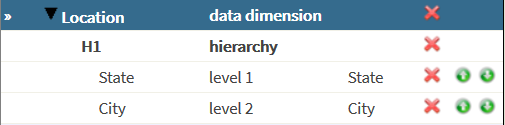
The CreditGrade dimension has two hierarchies. H1 being the creditnumber and H2 being the CreditGrade (The one I need).

2
0 242
Question Steve Pisani · Jun 8, 2022

Hi,

I have 3 simple tables:  Encounter, Patient and Immunizations.  Encounter makes  a reference to Patient, and Patient contains a list of Immunization objects.  

I've tried using PowerBI to access IRIS (using ODBC connector, not InterSystems BI connector),  PowerBI reports the error:

Expression.Error: The column 'Patient' of the table wasn't found.
Details:
    Patient

it does this for two of the three tables I need only (Patient and Encounter), but not for Immunization IRIS table.. 

Anyone know why and how to fix  ?

Thanks - Steve

1
0 281
Article Peter Steiwer · Mar 6, 2020 2m read

InterSystems IRIS Business Intelligence allows you to keep your cubes up to date in multiple ways. This article will cover building vs synchronizing. There are also ways to manually keep cubes up to date, but these are very special cases and almost always cubes are kept current by building or synchronizing.

What is Building?

1
0 743
Article Peter Steiwer · Mar 23, 2022 2m read

What is Selective Build?

Selective Build is a BI feature in InterSystems IRIS (introduced in version 2020.1). Selective Build allows you to build specific elements of your cube while keeping your cube online.

What is special about Selective Build?

Before getting into the details of Selective Build, a brief recap of the different phases during a regular cube build is important. Here are the phases in a regular cube build:
1) Delete existing data in cube
2) Populate cube with full set of data
3) Build all indices in the cube

0
1 516
Article Peter Steiwer · Nov 26, 2019 3m read

When designing a hierarchy in DeepSee, a child member must have only one parent member. In the case where a child corresponds to two parents, the results can become unreliable. In the case where two similar members exist, their keys must be changed so that they are unique. We will take a look at two examples to see when this happens and how to prevent it.

Example 1

There are a handful of states with a city named Boston. In my sample data, I have records from both Boston, MA and Boston, NY. My dimension is defined as:

1
1 945
Question Chip Gore · Jul 24, 2018

Hi -

I'm trying to get my Combo Chart to dynamically scale the Y axis, but it's not doing what I would like. The 1st Y series, if the MAX value is set to null, scales the chart and the series fine, but then the subsequent Y axis are not to that same scale. Each "null" Max'ed series is setting it's own scale based only on it's own ranges and not in sync with anything else.

Is there a way to force all of the "null" scaled columns to be in the SAME scale as each other AND be dynamic.

1
0 312
Question Lee Cascio · Jan 5, 2021

Is it supported to be able to use member functions to define a set, in particular a set defined with a member range in the form:

set = member1:member2? 

The docs only show hardcoded values being used for member1 and member2 and I can get it to work if I use hardcoded values.  However if I try to use member functions it throws an error:

"ERROR #5001: Both parts of a range must be members"

2
0 478
Question Neerav Verma · Jan 17, 2020

Hi All,

We have been using DeepSee which has been the integrated Analytic Dashboard built over Cache Cubes. It works fine but it's visual capabilities are limited and most probably is getting phased out.

If I am not wrong, Tableau is the suggested alternative to DeepSee . It is expensive and a big and considerable shift from existing technology

I wanted to get an opinion of the community as to these few key points
- What other BI tools others have been using with IRIS and what have been their experience
- For which tools are the best inbuilt support / api's avaialble in IRIS
-

10
0 727
Article Oliver Wilms · Jan 16, 2022 2m read

I participate in InterSystems Datasets Contest. I created dataset-finance and analyze-dataset-finance apps along with Online Demo.

The username is _SYSTEM and password is SYS. I created an online demo with a pretty dashboard here:

 https://finance.demo.community.intersystems.com/dsw/index.html#/login?from=%2FUSER%2FGenerated%2FSamples%20for%20finance.dashboard

 I wanted to create my own pivot table and went to regular management portal:

 https://finance.demo.community.intersystems.com/csp/sys/UtilHome.csp

 We can access Analyzer in USER namespace directly: 

0
0 227
Article Lydia Huang · Mar 11, 2016 4m read

The DeepSee Shell Best Practices Series - Run MDX queries in the DeepSee Shell

Introduction to DeepSee Shell

There is a basic introduction video about DeepSee shell on InterSystems video portal.

(http://video.intersystems.com/video/Video.Pages.VideoLibrary.cls?video=3449629690001&playlistid=3329216973001)

Key points in this video:

•Invoke DS shell command, generate MDX in Analyzer, copy in shell;

•Cube command, Select statement and Create statement

•Clauses: With, solve_order, Format_string

Why do you need DeepSee shell?

2
0 738
Article Nigel Salm · Sep 16, 2021 3m read

I have just created a new Global Master Topic, "IRIS Cheatsheets". IRIS has introduced a lot of new functionality, especially in scripting languages, FHIR R4 support, enhanced Interoperability Tools, and IRIS Analytics. Having spent 35 years working on Windows-based PC's and Laptops, I have surprisingly little knowledge of Linux, Docker and Git. Furthermore, I have written almost every application and Interface in ObjectScript with splatterings of SQL, .Net, and Java Gateways and the most basic knowledge of WinSCP, Putty, SSH. All that changed when I received my first Raspberry Pi. I first had

3
1 573
Article Oliver Wilms · Sep 11, 2021 5m read

I regret getting a late start in the InterSystems Analytics contest. I had tried a couple of times before to use Analytics, but I had not gotten too far. I have been recording financial transactions in Excel workbook ever since I had to retire Microsoft Money. Since my iris-for-money was not fully functional, I created a worksheet per account I was tracking. I had developed a CSP page in iris-for-money to import transactions by reading a CSV file. I realized this process requires escaping many characters that can cause the process to fail.

1
0 344
Article Dmitry Maslennikov · Sep 9, 2021 3m read

Previously I have already tried to play with Google Data Studio when I connected it to InterSystems FHIRaaS. It has quite a nice UI, with a few chart types available out of the box, it can be quite easily connected to some plain tables (stored as CSV or JSON, for instance), and gives the ability to build quite flexible analytics over it. So, I have decided to implement a new connector to InterSystems Analytics (DeepSee), with the ability to select a cube and do some queries on it.

0
0 402
Announcement Evgeny Shvarov · Aug 26, 2021

Hi Developers!

Here're the technology bonuses for the InterSystems Analytics contest that will give you extra points in the voting.

Adaptive Analytics (AtScale) Cubes usage - 4 points
InterSystems Adaptive Analytics provides the option to create and use AtScale cubes for analytics solutions.

You can use the AtScale server we set up for the contest (URL and credentials can be collected in the Discord Channel) to use cubes or create a new one and connect to your IRIS server via JDBC.

The visualization layer for your Analytics solution with AtScale can be crafted with Tableau, PowerBI, Excel, or Logi.

Documentation, AtScale documentation

Training

0
0 350
Article Evgeny Shvarov · Aug 13, 2021 4m read

Hi developers!

How to build an analytics solution with InterSystems IRIS?

To begin with, let's agree on the points of what is the analytics solution - and this could be a very wide topic. Let's limit the set of solutions to those you can present in the Analytics contest.

There are three kinds of analytics solutions that we will review here: monitoringinteractive analytics, and reporting

Monitoring

The typical monitoring solution consists of an online dashboard with KPIs that are being actively updated.

The key use case is of monitoring is to visually observe the KPI of fresh data every moment to react in case of an emergency.

Interactive Analytics

This solution supposes a set of interactive dashboards with filters and drill-downs.

The key use case is to explore the data with filters and drill-downs making business decisions upon graph and table data visualization.

Reporting

Reporting solution provides a set of static (usually) reports in a form of HTML or pdf documents that deliver the data in graph and text form in a predesigned form and could be sent via email.

The typical use case of a reporting system is to obtain reports on a given period that will illustrate the status of the product, process, service, sales, etc that is crucial for the business.

How InterSystems products could be used to build such solutions? Let's discuss this below!

0
1 532
Announcement Larry Finlayson · Jun 15, 2021

Hello!

The schedule into October 2021 for live virtual classroom training with hands-on exercises is available at classroom.intersystems.com.

In particular, we'd like to highlight a few courses currently only available once through October:

 Click here to register for a course!

0
0 223
Article Sam Duncan · May 6, 2021 4m read

When you have been using cubes for business intelligence in a namespace for some time, you may find that there are many cubes in the namespace, only some of which are actively being used. However, it can be difficult to tell which cubes users are or are not querying, and maintaining unused cubes can be costly both in terms of storage and of computation to keep them up to date. This article provides some suggestions and examples for monitoring which cubes are in active use, and for removing cubes that you determine are no longer necessary.

2
3 641