New
Modern platforms usually treat observability as three core signals:
- Metrics
- Logs
- Traces
OpenTelemetry (OTel) is the standard way to produce and ship all three signals.
Docker is a software technology providing containers, promoted by the company Docker, Inc. Docker provides an additional layer of abstraction and automation of operating-system-level virtualization on Windows and Linux.
Modern platforms usually treat observability as three core signals:
OpenTelemetry (OTel) is the standard way to produce and ship all three signals.
A Continuous Training (CT) pipeline formalises a Machine Learning (ML) model developed through data science experimentation, using the data available at a given point in time. It prepares the model for deployment while enabling autonomous updates as new data becomes available, along with robust performance monitoring, logging, and model registry capabilities for auditing purposes.
InterSystems IRIS already provides nearly all the components required to support such a pipeline. However, one key element is missing: a standardised tool for model registry.
The 2023.1.7 maintenance releases of InterSystems IRIS® data platform,InterSystems IRIS® for HealthTM, and HealthShare® Health Connect are now Generally Available (GA).
Please share your feedback through the Ideas Portal using the category Post-Release Feedback so we can build a better product together.
You can find the detailed change lists & upgrade checklists on these pages:
There are many EAPs available now. Check out this page and register to those you are interested.
In this article I'll show you how to set up in your laptop, very quickly, a cluster of IRIS nodes in sharding. It's not the goal of this article neither to talk about sharding in detail nor define a deployment of a production ready architecture, but to show how to set up quickly, in your own machine, a cluster of IRIS instances configured as shard nodes, with which you'll able to play and test this functionality. If you're insterested in knowing more about sharding in IRIS, take a look at the documentation clicking here.
First and foremost, I want to remark that IRIS sharding will allow us 2 things:
So, as I said, we let for other article playing with shard or federated tables, and just focus now in the previous step, that is, setting up the cluster of shard nodes.
InterSystems continues to push AI capabilities forward natively in IRIS — vector search, MCP support, and Agentic AI capabilities. That roadmap is important, and there is no intention of stepping back from it.
But the AI landscape is also evolving in a way that makes ecosystem integration increasingly essential. Tools like Dify — an open-source, production-grade LLM orchestration platform — have become a serious part of enterprise AI stacks.

In the previous article, we saw in detail about Connectors, that let user upload their file and get it converted into embeddings and store it to IRIS DB. In this article, we'll explore different retrieval options that IRIS AI Studio offers - Semantic Search, Chat, Recommender and Similarity.
InterSystems IRIS allows you to build REST APIs using ObjectScript classes and the %CSP.REST framework. This enables the development of modern services to expose data for web apps, mobile apps, or system integrations.
In this article, you'll learn how to create a basic REST API in InterSystems IRIS, including:
GET and POST methodsA full demonstration using Docker
using intersystemsdc/iris-ml-community:latest I failed with
Error: Invalid Community Edition license, may have exceeded core limit.
Shutting down the system : $zu(56,2)= 0Starting IRIS
What is the actual valid version with ML ??
We use local containers a lot for evaluation and development with Health Connect and other IRIS based applications.
When evaluating Podman Desktop on Windows as replacement for Docker Desktop, we are experiencing an issue with the durable %SYS:
The only way it works is when we use a named volume which then is located inside the WSL-Podman-Machine under /var/lib/containers/storage/volumes/.
When I build docker containers my build log usually looks like this:
#9 24.94 Using 'iris.cpf' configuration file
#9 25.82
#9 27.55 Starting Control Process
#9 27.55 Global buffer setting requires attention.  Auto-selected 25% of total memory.
#9 27.55 Allocated 4999MB shared memory
#9 27.55 3915MB global buffers, 391MB routine buffers
#9 29.84 This copy of InterSystems IRIS has been licensed for use exclusively by:
#9 29.84 No local key detected, trying license server.
#9 29.84 Copyright (c) 1986-2026 by InterSystems Corporation
#9 29.The 2025.1.3 maintenance releases of InterSystems IRIS® data platform,InterSystems IRIS® for HealthTM, and HealthShare® Health Connect are now Generally Available (GA).
Who hasn't been developing a beautiful example using a Docker IRIS image and had the image generation process fail in the Dockerfile because the license under which the image was created doesn't contain certain privileges?
In my case, what I was deploying in Docker is a small application that uses the Vector data type. With the Community version, this isn't a problem because it already includes Vector Search and vector storage. However, when I changed the IRIS image to a conventional IRIS (the latest-cd), I found that when I built the image, including the classes it had generated, it returned this error:
As applications grow, every database eventually hits scaling limits. Whether it's storage capacity, concurrent users, query throughput, or I/O bandwidth, single-server architectures have inherent constraints. This guide explains fundamental approaches to database scalability and shows how InterSystems IRIS implements these patterns to support enterprise-scale workloads.
We'll explore two complementary scaling strategies: horizontal scaling for user volume (distributing computational load) and sharding for data volume (partitioning datasets). Understanding the general principles behind these approaches will help you make informed decisions about when and how to scale your IRIS applications.
The examples in this guide use InterSystems IRIS in Docker containers.
1-command only required for an entire IRIS instance for Data Science projects, and leveraging this to compare query methods' speed (Dynamic SQL, Pandas Query, and Globals).
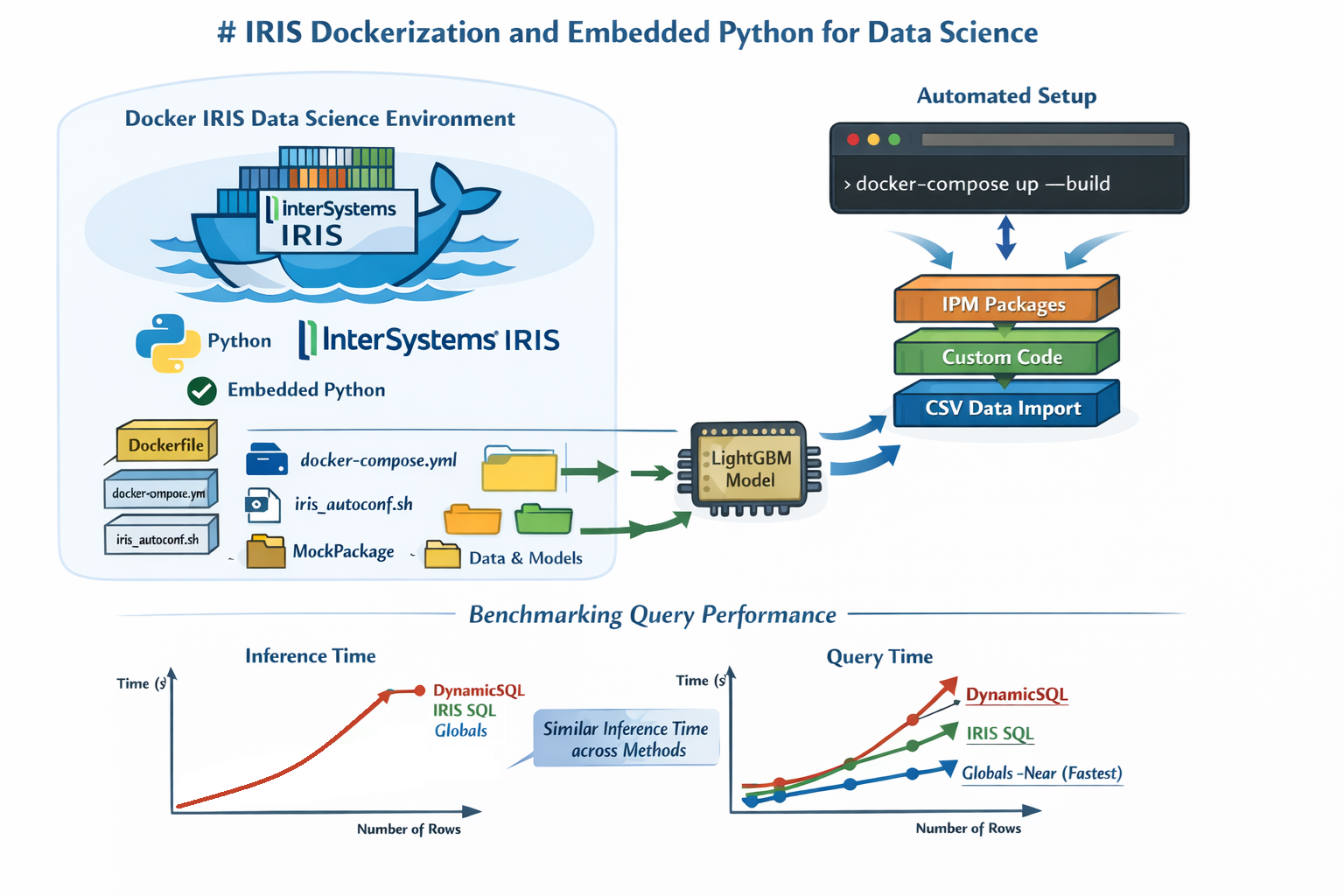
Before joining InterSystems, I worked in a team of web developers as a data scientist. Most of my day-to-day work involved training and embedding ML models in Python-based backend applications through microservices, mainly built with the Django framework and using Postgres SQL for sourcing the data.
Up until early this year, I haven't been not doing much coding at all -- I had gotten sick of it.
After many years as a hands-on software engineer and data scientist, I got burned out around 2015. I switched to business development roles focused on "external innovation," then joined InterSystems in 2019 as a product manager. I missed the creative aspects of coding, but not the tedium. The endless cycle of boilerplate, debugging, and context-switching had left me creatively depleted.
In this article, we will discuss all the debugging tools included in the Microsoft Visual Studio Code IDE.
What will be covered:
Let's start by learning about debugging requirements!
Prerequisites
There are two plugins (extensions) for debugging ObjectScript:
The first is part of the InterSystems ObjectScript Extension Pack. The second is Serenji, a standalone plugin that provides an editor, file manager, and debugging functionality. Both plugins can be installed from the plugin store. To activate key functionality, Serenji requires a license. For this article, we'll use the InterSystems ObjectScript Extension Pack to reduce the learning curve. After you've mastered the basics, you can consider purchasing a paid license for Serenji.
Table of Contents
Introduction.
In this article, we'll cover a quick start to Git development with the InterSystems Developer Community and version control practices when working with IRIS InterSystems. We'll cover scenarios where we need to export Interoperability classes, globals, and analytics elements such as cubes and dashboards. These scenarios encompass key version control practices with IRIS.
To get started, you'll need:
Getting started with IRIS InterSystems is very simple!
Security is fundamental to enterprise application development. InterSystems IRIS provides a comprehensive security framework that protects data, controls access, and ensures compliance. This guide introduces essential security features for developers new to IRIS, covering authentication, authorization, encryption, and practical implementation strategies.
Throughout this guide, we'll use Docker containers to demonstrate security configurations in a practical, reproducible environment.
The Load Data utility it is an excellent tool to load data from CSV/TXT files into an IRIS SQL Table, but it is required send the target file to the IRIS server and write the Load Data sentence to ingest the file content. Now it is possible select a file in VSCode, set the table destination and submit the request. The vscode-load-data utility will send the file to the IRIS server and run the Load Data command to you! Very simple:
.png)
Hi,
I'm using the iris for health community edition and I cannot seem to get the FHIR server configuration UI to show up. I was able to create a FHIR server programaticlly but none of the user interface features that the installation guide talks about are available. Once I was created the server I was able to see a Bulk FHIR Coordinator in the management portal, ut that's it. Are the UI features not available in the community edition or do they need to be enabled somehow?
This is the guide that I am using https://docs.intersystems.com/irisforhealth20251/csp/docbook/DocBook.UI.Page.cls?
When IRIS 2023.2 reaches general availability, we’ll be making some improvements to how we tag and distribute IRIS & IRIS for Health containers.
IRIS containers have been tagged using the full build number format, for example 2023.1.0.235.1. Customers have been asking for more stable tags, so they don’t need to change their dockerfiles/Kubernetes files every time a new release is made. With that in mind, we’re making the following changes to how we tag container images.
Major.Minor Tags: Containers will be tagged with the year and release, but not the rest of the full build number.
If you start with InterSystems ObjectScript, you will meet the XECUTE command.
And beginners may ask: Where and Why may I need to use this ?
The official documentation has a rich collection of code snippets. No practical case.
Just recently, I met a use case that I'd like to share with you.
When you build an IRIS container with Docker, then, in most cases,
you run the initialization script
iris session iris < iris.script
This means you open a terminal session and feed your input line-by-line from the script.
And that's fine and easy if you call methods, or functions, or commands.
Since InterSystems has recently announced the discontinuation of support for InterSystems Studio starting from version 2023.2 in favor of exclusive development of extensions for the Visual Studio Code (VSC) IDE, believing that the latter offers a superior experience compared to Studio, many of us developers have switched or are beginning to use VSC. Many may have wondered how to open the Terminal to perform operations, as VSC does not have an Output panel like Studio did, nor an integrated feature to open the IRIS terminal, except by downloading the plugins developed by InterSystems.
I’m excited to share the project I’ve submitted to the current InterSystems .Net, Java, Python, and JavaScript Contest — it’s called FHIR Data Explorer with Hybrid Search and AI Summaries, and you can find it on the InterSystems Open Exchange and on my GitHub page.
The article was motivated by the 2025 September Article Bounty
***************************************************************
The principle of Docker is just convincing to me.
This was the technical base for me to run about 700 reviews in OEX
with almost no side effects (except those caused by myself).
For beginners, I'll start with straight pure IRIS, no *health, *ML, *whatever
First, you need a Docker installation. It's available on almost any platform.
I was really surprised that such a flexible integration platform with a rich toolset specifically for app connections has no out-of-the-box Enterprise Service Bus solution. Like Apache ServiceMix, Mule ESB, SAP PI/PO, etc, what’s the reason? What do you think? Has this pattern lost its relevance completely nowadays? And everybody moved to message brokers, maybe?
Wiki time: An enterprise service bus (ESB) implements a communication system between mutually interacting software applications in a service-oriented architecture (SOA) .
Hey folks! Having recently onboarded to InterSystems, I realized that despite having a totally free and awesome Community Edition, it's not super clear how to get it. I decided to write up a guide highlighting all the different ways you can access the Community Edition of InterSystems IRIS:
Working with a containerized instance of the Community Edition is the recommended approach for folks who are new to developing on InterSystems IRIS, and in my opinion it's the most straightforward. InterSystems IRIS Community Edition can be found on DockerHub; if you have an InterSystems SSO account, you can also find it in the InterSystems Container Registry.
In either case, you'll want to pull the image you want using the docker CLI:
docker pull intersystems/iris-community:latest-em
// or
docker pull containers.intersystems.com/intersystems/iris-community:latest-em
Next, you'll need to start the container: In order to interact with IRIS from outside the container (for example, to use the management portal) you'll need to publish some ports. The following command will run the IRIS Community Edition container with the superserver and web server ports published; note that you can't have anything else running that depends on ports 1972 or 52773!
docker run --name iris -d --publish 1972:1972 --publish 52773:52773 intersystems/iris-community:latest-emIf you want to find out what exact version your Docker image is (and since the latest image tagging scheme you cannot just rely on the image tag; and assuming you don't want to actually run it just in order to find out) you can run this docker command:
I am brand new to using AI. I downloaded some medical visit progress notes from my Patient Portal. I extracted text from PDF files. I found a YouTube video that showed how to extract metadata using an OpenAI query / prompt such as this one:
ollama-ai-iris/data/prompts/medical_progress_notes_prompt.txt at main · oliverwilms/ollama-ai-iris
I combined @Rodolfo Pscheidt Jr https://github.com/RodolfoPscheidtJr/ollama-ai-iris with some files from @Guillaume Rongier https://openexchange.intersystems.com/package/iris-rag-demo.
I attempted to run
python3 query_data.