#DevOps

7 Followers · 96 Posts

Software engineering practice that aims at unifying software development (Dev) and software operation (Ops).

New
Article Murray Oldfield · 5 hr ago 3m read

Already included in SystemPerformance

There are nfs disk commands (including nfsiostat) included with SystemPerformance, but disabled by default. Enable them by running:

$$Enablenfs^SystemPerformance()

Doing so will add the following nfs commands, for example, on Linux:

  1. /usr/sbin/nfsstat -cn
  2. /usr/sbin/nfsiostat [interval] [count]

Ensure the commands are installed and runnable from the OS :)

This can be subsequently disabled via $$Disablenfs^SystemPerformance()


Adding a generic command to SystemPerformance

Adding an arbitrary OS tool creates a "user" command under ^IRIS.

0
1 12
Article Mikhail Khomenko · Jan 20 18m read

As applications grow, every database eventually hits scaling limits. Whether it's storage capacity, concurrent users, query throughput, or I/O bandwidth, single-server architectures have inherent constraints. This guide explains fundamental approaches to database scalability and shows how InterSystems IRIS implements these patterns to support enterprise-scale workloads.

We'll explore two complementary scaling strategies: horizontal scaling for user volume (distributing computational load) and sharding for data volume (partitioning datasets). Understanding the general principles behind these approaches will help you make informed decisions about when and how to scale your IRIS applications.

The examples in this guide use InterSystems IRIS in Docker containers.

4
5 255
Article Mikhail Khomenko · Dec 3, 2025 28m read

Security is fundamental to enterprise application development. InterSystems IRIS provides a comprehensive security framework that protects data, controls access, and ensures compliance. This guide introduces essential security features for developers new to IRIS, covering authentication, authorization, encryption, and practical implementation strategies.

0
3 258
Article Ariel Glikman · Apr 15, 2025 4m read

If you look at the values.yaml of the IKO's Helm chart you'll find:

useIrisFsGroup: false 

Let's break down what it is and in what situations you may want to set it to true.

FsGroup refers to the file system group.

By default, Kubernetes volumes are owned by root, but we need IRIS to own its files (IRIS in containers is installed under irisowner user). To get around this we employ one of two methods:

1) initContainers

The initContainers run before app containers (like IRIS) in a pod. They generally set up the environment for the application and then run to completion/terminate.

0
0 218
Article Jose-Tomas Salvador · Mar 5, 2025 8m read

In this article I'll show you how to set up in your laptop, very quickly, a cluster of IRIS nodes in sharding. It's not the goal of this article neither to talk about sharding in detail nor define a deployment of a production ready architecture, but to show how to set up quickly, in your own machine, a cluster of IRIS instances configured as shard nodes, with which you'll able to play and test this functionality. If you're insterested in knowing more about sharding in IRIS, take a look at the documentation clicking here.  

First and foremost, I want to remark that IRIS sharding will allow us 2 things:

  • Define, load and query shard tables, which data will be distributed transparently between the cluster's nodes
  • Define  federated tables, which offer a global and composed view of data belonging to different tables that will be physically stored in different distributed nodes

So, as I said, we let for other article playing with shard or federated tables, and just focus now in the previous step, that is, setting up the cluster of shard nodes.

1
3 279
Article Ariel Glikman · Feb 11, 2025 5m read

The Istio Service Mesh is commonly used to monitor communication between services in applications. The "battle-tested" sidecar mode is its most common implementation. It will add a sidecar container to each pod you have in your namespace that has Istio sidecar injection enabled.

It's quite easy to get started with, just put the istioctl executable in your PATH, and label your namespace such that it tells Istio to acitvate side car injection there.

3
2 364
Article Ariel Glikman · Feb 2, 2025 3m read

All pods are assigned a Quality of Service (QoS). These are 3 levels of priority pods are assigned within a node.

The levels are as following:

1) Guaranteed: High Priority

2) Burstable: Medium Priority

3) BestEffort: Low Priority

It is a way of telling the kubelet what your priorities are on a certain node if resources need to be reclaimed. This great GIF below by Anvesh Muppeda explains it.

If resources need to be freed, firstly pods with Best Effort QoS will be evicted, then those with Burstable, and finally those with Guaranteed.

0
2 389
Article Ariel Glikman · Nov 10, 2024 3m read

IAM - InterSystems API Manager is a great tool for monitoring your traffic. If you are trying to use it in your Kubernetes cluster you may have tried doing a deployment similar to this one:

apiVersion: intersystems.com/v1alpha1
kind: IrisCluster
metadata:
  name: iris
spec:
  licenseKeySecret:
    name: iris-key-secret
  configSource:
    name: iris-cpf
  imagePullSecrets:
    - name: intersystems-pull-secret
  topology:
    data:
      image: containers.intersystems.com/intersystems/iris-arm64:2024.1
      compatibilityVersion: "2024.1.
2
1 318
Article Yuri Marx · Oct 2, 2024 14m read

In the modern world, the most valuable asset for companies is their data. Everything from business processes and applications to transactions is based on data which defines the success of the organization's operations, analysis, and decisions. In this scenario, the data structures need to be ready for frequent changes, yet in a managed and governed way. Otherwise, we will inevitably lose money, time, and quality of corporate solutions.

3
1 451
Article Rodolfo Moreira dos Santos · Sep 25, 2024 3m read

Hi everyone,

In this article, I’m excited to introduce CodeInspector, a tool designed to simplify code validation by applying custom rules tailored to your development requirements. Whether you're managing a large codebase or working in an agile environment, CodeInspector helps ensure code quality by offering flexibility and adaptability to specific project needs.

Motivation

The idea behind CodeInspector was to build a tool that is both easy to implement and adaptable to different business contexts.

3
0 264
Article Ariel Glikman · Sep 2, 2024 1m read

Say I want to uninstall the IKO - all I need to do is:

> helm uninstall intersystems

What happens behind the scenes is that helm will uninstall what was installed when you ran :

> helm install intersystems <relative/path/to/iris-operator>

In some sense - this is symmetric to when we ran install - however with a different image.

You'll notice that when you install, it knows what image to take from:

operator:
  registry: containers.intersystems.com
  repository: intersystems/iris-operator-amd
  tag: 3.713.
0
0 262
Article Ariel Glikman · Mar 11, 2024 3m read

In case you're planning on deploying IRIS For Health, or any of our containerized products, via the IKO on OpenShift, I wanted to share some of the hurdles we had to overcome.

As with any IKO based installation, we first need to deploy the IKO itself. However we were getting this error:

Warning FailedCreate 75s (x16 over 3m59s) replicaset-controller Error creating: pods "intersystems-iris-operator-amd-f6757dcc-" is forbidden: unable to validate against any security context constraint:

proceeded by a list of all the security context constraints (SCCs) it could not validate against.

0
0 421
Article Carlos Sepulveda Mancilla · Dec 8, 2023 3m read

Windows Subsystem for Linux (WSL) is a feature of Windows that allows you to run a Linux environment on your Windows machine, without the need for a separate virtual machine or dual booting. 

WSL is designed to provide a seamless and productive experience for developers who want to use both Windows and Linux at the same time**.

WSL 2 is the default distro type when installing a Linux distribution. WSL 2 uses virtualization technology to run a Linux kernel inside of a lightweight utility virtual machine (VM). Linux distributions run as isolated containers inside of the WSL 2 managed VM.

0
1 494
Article Murray Oldfield · Sep 7, 2023 8m read

Most transactional applications have a 70:30 RW profile. However, some special cases have extremely high write IO profiles.

I ran storage IO tests in the ap-southeast-2 (Sydney) AWS region to simulate IRIS database IO patterns and throughput similar to a very high write rate application.

The test aimed to determine whether the EC2 instance types and EBS volume types available in the AWS Australian regions will support the high IO rates and throughput required.

Minimal tuning was done in the operating system or IRIS (see Operating System and IRIS configuration below).

0
0 1687
Article Philipp Bonin · Jun 19, 2023 3m read

OwnObjectScriptExtension

ObjectScript is a powerful language used in InterSystems products like InterSystems IRIS, enabling developers to build robust applications. To enhance the ObjectScript development experience, the OwnObjectScriptExtension is a Visual Studio Code extension that provides a range of tools and features. In this article, we will explore how the OwnObjectScriptExtension can improve your ObjectScript development workflow.


7
2 657
Article Alex Woodhead · Jan 28, 2023 3m read

Some Usage cases

1. A deployment may consist of two high availability instances and two disaster recovery instances in a different data center.

The corresponding UAT environment could replicate this giving a total of 8 instances. How do you confirm CPF and Scheduled task alignment across ALL instances.

2. Another team (possibly in anther organization) makes changes to an IRIS instance to correct a problem, improve security, or modify shared system task configuration. Capture the CPF before and after to see what was done across instances.

2
0 543
Article Lorenzo Scalese · Nov 10, 2022 8m read

REST API for Security Package

Hi community,

In this article, we will learn how to set up a REST API for the IRIS Security Package. We will be able to create users, roles, add applications, etc... by simple HTTP requests as well as generate a client application in ObjectScript.

Requirements

We need :

  1. An IRIS instance (installation kit or docker).
  2. ObjectScript package manager (ZPM).
  3. (Optional) A second IRIS instance to generate an ObjectScript client.

We will use a set of existing applications and libraries on OpenExchange.

1
0 819
Article Paul Hurley · Aug 17, 2022 1m read


IrisStat options
a All
b bits
c counters
d dump processes
e error log
f global module flags
g ^GLOSTAT info
h irisstat usage
j journal
k prefetch daemons
l LRU global buffers
m GFILETAB
n network
o clear irisstat
p processes
q hibernation semaphores
s irisstat exe directory
t run irisstat in loop
u locks
v Check versions
w write daemon queues
   
B Blocks in GBFSPECQ
C inter-job comms
D sample block collisions
E cluster status
G
0
0 462
Article Lorenzo Scalese · Jul 21, 2022 11m read

Hi community,

This is the third article in the series about initializing IRIS instances with Docker. This time, we will focus on Enterprise Cache Protocol (ECP).

In a very simplified way, ECP allows configuring some IRIS instances as application servers and others as data servers. Detailed technical information can be found in the official documentation.

This article aims to describe:

  • How to script the initialization of a data server, and how to script the initialization of one or more application servers.
  • How to establish an encrypted connection between these nodes with Docker.
0
2 1044
Article Evgeny Shvarov · May 28, 2022 3m read

Hi Developers!

This is yet another short post that is intended to simplify developers' life. Now we'll talk about how to make GitHub run unit tests with every push to the repository by adding just one file to the repo. For free.  On Github Cloud. Sounds great, isn't it?

It is possible and very easy to do. Credit goes to @Dmitry Maslennikov (and his repo), ZPM Package Manager, and GitHub Actions.  Let's see how this all works!

Something for Nothing by Robert Sheckley - YouTube

0
0 575
Article Lorenzo Scalese · Apr 22, 2022 8m read

Apache Web Gateway with Docker

Hi, community.

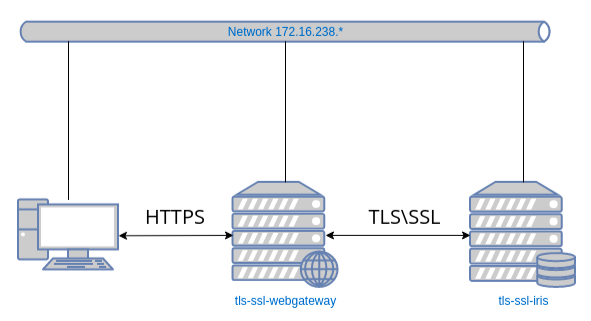
In this article, we will programmatically configure an Apache Web Gateway with Docker using:

  • HTTPS protocol.
  • TLS\SSL to secure the communication between the Web Gateway and the IRIS instance.

image

We will use two images: one for the Web Gateway and the second one for the IRIS instance.

All necessary files are available in this GitHub repository.

Let’s start with a git clone:

git clone https://github.com/lscalese/docker-webgateway-sample.
15
8 2181
Article Nicholai Mitchko · Apr 15, 2022 3m read

Adding VSCode into your IRIS container

One of the easiest ways to setup repeatable development environments is to spin up containers for them. I find that when iterating quickly, it was very convenient to host a vscode instance within my development container. Thus, I have created a quick container script to add a browser-based vscode into an IRIS container. This should work for most 2021.1+ containers.

5
0 1070
Article Lorenzo Scalese · Feb 8, 2022 11m read

History

Version Date Changes
V1 2022-02-08 Initial release
V1.1 2022-04-06 Certificates generation with sh file instead of pki-script
Using environment variables in configuration files

Hi Community,

Have you already set up a mirrored environment? Does it have a private network, virtual IP address, and SSL configuration? After doing this a couple of times, I realized that it is long, and there are a lot of manual actions required to generate certificates and configure each IRIS instance. It is a pain in the neck for people who often have to do this.

2
1 1307
Article Mikhail Khomenko · Jan 5, 2022 8m read

We’ve already considered how to run an IRIS-based application in GCP Kubernetes in Deploying InterSystems IRIS Solution into GCP Kubernetes Cluster GKE Using CircleCI. Additionally, we’ve seen how to run an IRIS-based application in AWS Kubernetes in Deploying a Simple IRIS-Based Web Application Using Amazon EKS. Now, let’s look at how to deploy an application to the Azure Kubernetes Service (AKS).

0
0 761
Article Mikhail Khomenko · Oct 11, 2021 9m read

In this article, we’ll look at one of the ways to monitor the InterSystems IRIS data platform (IRIS) deployed in the Google Kubernetes Engine (GKE). The GKE integrates easily with Cloud Monitoring, simplifying our task. As a bonus, the article shows how to display metrics from Cloud Monitoring in Grafana

Note that the Google Cloud Platform used in this article is not free (price list), but you can leverage a free tier. This article assumes that you already have a project in the Google Cloud Platform (referred to as <your_project_id>) and have permission to use it. 

0
2 515
Article Anton Umnikov · May 31, 2021 6m read

All source code to the article is available at: https://github.com/antonum/ha-iris-k8s&nbsp;

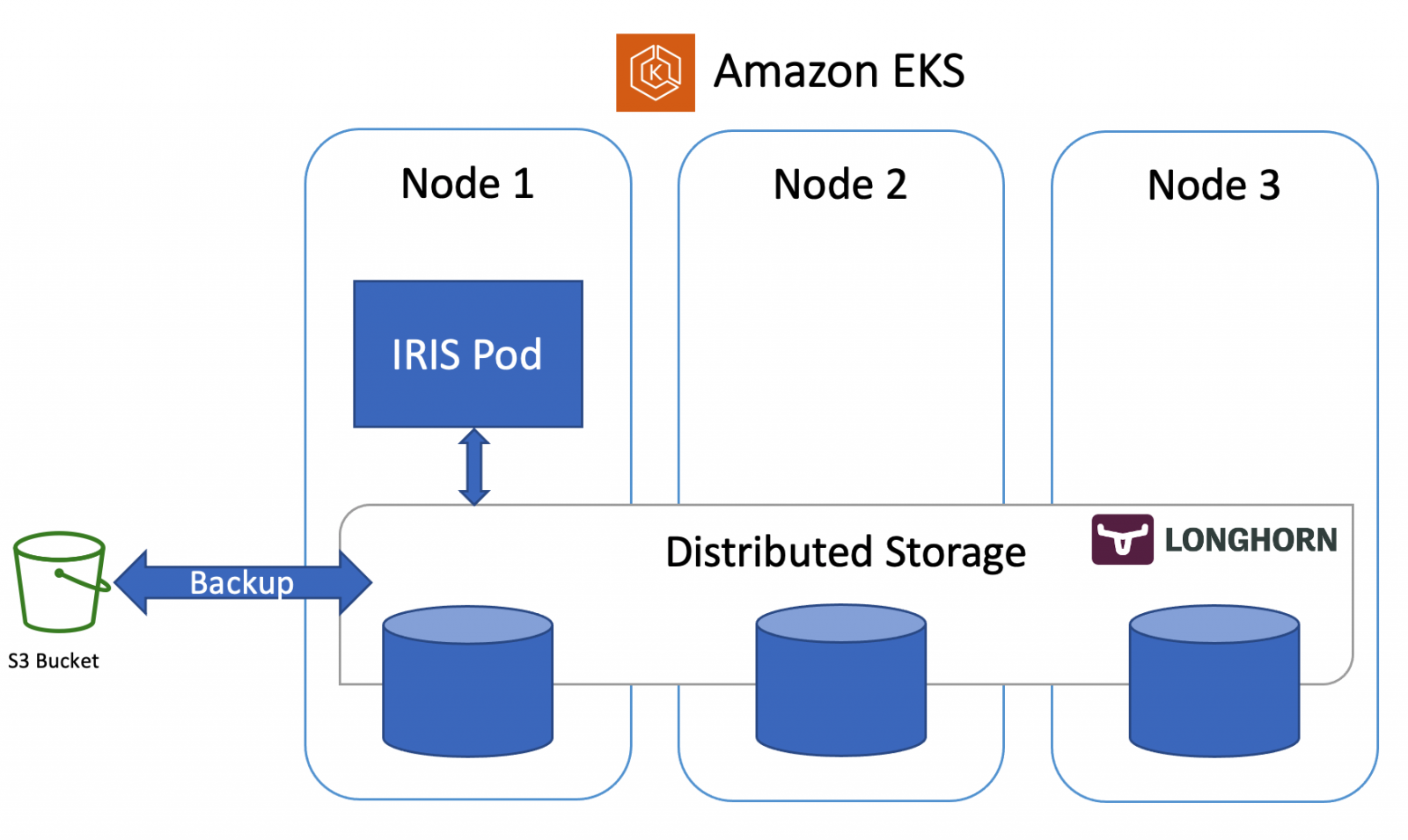
In the previous article, we discussed how to set up IRIS on k8s cluster with high availability, based on the distributed storage, instead of traditional mirroring. As an example, that article used the Azure AKS cluster. In this one, we'll continue to explore highly available configurations on k8s. This time, based on Amazon EKS (AWS managed Kubernetes service) and would include an option for doing database backup and restore, based on Kubernetes Snapshot.

Installation

Let's get right to business.

2
0 1581
Article Lorenzo Scalese · Apr 21, 2021 2m read

Hi Everyone,

In the previous article, we combine ZPM with Config-API to load a configuration on module loading\install.
It could be useful for small applications, but for a large application, it's not convenient.

You can need to create multiple namespaces and install many zpm modules on different namespaces.
Using the configuration document on zpm load\install is a problem for this special case.
Moreover, even if you need only one module and one namespace, ZPM client is designed to install on the current namespace and it's not possible to switch to another namespace during the install.

3
0 427
Article Robert Cemper · Apr 16, 2021 1m read

Some changes in IRIS configuration require a restart of IRIS.
This is no big issue as long as I have access to the server command line with sufficient privileges.
In a container, this is not always given.
Stopping IRIS from the terminal/session prompt is no problem.
But the restart after is.  

Note1: container start-stop is no option as it might be removed by option --rm in docker run
Note2: the target is linux (manly in docker).  Windows is excluded

GitHub

4
0 1147
Article Lorenzo Scalese · Apr 15, 2021 6m read

Hi Developers,

In the previous article, we describe how to use config-api to configure IRIS.

Now, let's try to combine the library with the ZPM client.
The goal is to load a configuration document during zpm install at the configure phase.

For this exercise, a template repository is available here (this is based on objectscript-docker-template ).

We attempt to :

  • Create a database MYAPPDATA.
  • Set Globals mapping for dc.PackageSample.*.
  • Add a user named SQLUserRO with read-only SQL role access.
  • Add an SSL Configuration named SSLAppDefault.
  • Create a REST application /rest/myapp.
7
1 384