Hello everyone,
I'm tryingt to install Ensemble from an existing Caché installation, is this possible? if possible, please send me links.
Best Regards.
Flávio.
Beginner tag unites articles and questions for those who are getting started with InterSystems Data Platform
Hello everyone,
I'm tryingt to install Ensemble from an existing Caché installation, is this possible? if possible, please send me links.
Best Regards.
Flávio.
Hello! I'm sending get request. When send the request bellow
Set httprequest.Server=url
Do httprequest.Get("/"_par1_"/"_par2)
Set statusCode = httprequest.HttpResponse.StatusCode
I get http status 200, but should get 410 status. Since the parameters passed are not valid.
If I send request differently as below, I get http status 410, which is correct.
What is the difference between these two requests Do httprequest.Get("/"_par1_"/"_par2) and Do httprequest.Get("/2019/0912")?
In many projects I was faced with storing hierarchical data (tree) in classes.
By tree, I mean such data, where each node has a parent node — an object of the same class.
Many examples of such data can be given. For example, a catalog in the online store. Suppose that this online store sells books, in this case, the category tree might look like this: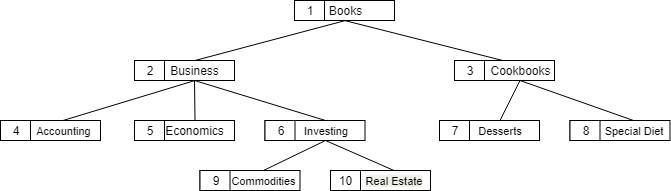
The number in front of the name is the category ID.
For storage, you can create classes: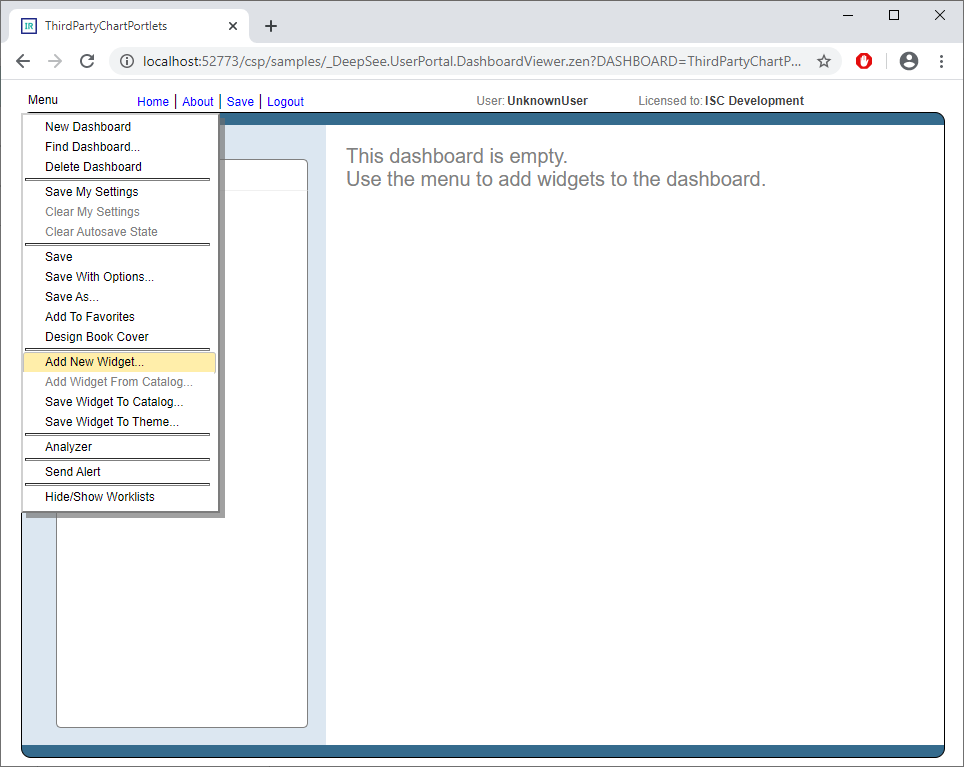
The MyApp.Category class is used to store the category tree and contains the property “Parent” - reference to the same class.
Hi all,
I'm looking to set up monitoring for several interfaces. I understand that I can set an Inactivity Timeout. However, obviously there are messages coming through more frequently during certain hours than other hours.
Is there a way to set an Inactivity Timeout for each hour of the day instead of one value that is used all day long?
Best,
Erin
Hi Community!
How can I know the port of management portal e.g. from terminal?
The one which looks like
localhost:port/csp/sys/exp/%25CSP.Portal.Home.zen
in browser?
Hi,
I have a program that displays the current running processes to the screen. I need to have a program execute that display program and capture the results to a file. The display program does pause at the bottom of each page waiting for an 'enter' to go to the next page.
Note( the display program will not successfully compile on the current system but it does work)
Also - very, very new to Mumps.
Thanks,
Bob
What would a sample DbContext look like and how would you register the DbContext in the Startup.cs ConfigureServices method?
Hi guys!
As you know there are two (at least) ways to get the stored value of the property of InterSystems IRIS class if you know the ID of an instance (or a record).
1. Get it by as a property of an instance with "Object access":
ClassMethod GetPropertyForID(stId As %Integer) As %String

{

set obj=..%OpenId(stId)

return obj.StringData

}
2. Get it as a value of a column of the record with "SQL access":
How can I remove elements from $lb property? Specifically last element?
$list does not work with $lb properties.
$listupdate can't remove elements
The only solution I found is a temp variable and $list, but isn't there something better?
Keywords: Jupyter Notebook, Tensorflow GPU, Keras, Deep Learning, MLP, and HealthShare
In previous"Part I" we have set up a deep learning demo environment. In this "Part II" we will test what we could do with it.
Many people at my age had started with the classic MLP (Multi-Layer Perceptron) model. It is intuitive hence conceptually easier to start with.
So let's try a Keras "deep learning MLP" with standard demo data that everybody in AI/NN community has been using. It is a kind of so called "supervised learning".
Now that the InterSystems IRIS Data Platform Community Edition is available on Docker Hub (https://hub.docker.com/_/intersystems-iris-data-platform), it seems like a great time to try InterSystems IRIS in a container. For some time already, the community edition has been available in the cloud, for example on AWS (https://community.intersystems.com/post/free-iris-community-edition-aws), but maybe it would be nice to try it locally as well. Fellow Windows users are no doubt used to eye rolling, being told “YMMV”, etc., whenever they mention using Docker for Windows.
Are there any third party tools that have native plugins for monitoring Cache?
 In the previous parts (1, 2) we talked about globals as trees. In this article, we will look at them as sparse arrays.
A sparse array - is a type of array where most values assume an identical value.
In practice, you will often see sparse arrays so huge that there is no point in occupying memory with identical elements. Therefore, it makes sense to organize sparse arrays in such a way that memory is not wasted on storing duplicate values.
In some programming languages, sparse arrays are part of the language - for example, in J, MATLAB. In other languages, there are special libraries that let you use them. For C++, those would be Eigen and the like.
Globals are good candidates for implementing sparse arrays for the following reasons:
Hi all. Today we are going to upload a ML model into IRIS Manager and test it.
Note: I have done the following on Ubuntu 18.04, Apache Zeppelin 0.8.0, Python 3.6.5.
These days many available different tools for Data Mining enable you to develop predictive models and analyze the data you have with unprecedented ease. InterSystems IRIS Data Platform provide a stable foundation for your big data and fast data applications, providing interoperability with modern DataMining tools.
In this series of articles we explore Data mining capabilities available with InterSystems IRIS.
The last time that I created a playground for experimenting with machine learning using Apache Spark and an InterSystems data platform, see Machine Learning with Spark and Caché, I installed and configured everything directly on my laptop: Caché, Python, Apache Spark, Java, some Hadoop libraries, to name a few. It required some effort, but eventually it worked. Paradise. But, I worried. Would I ever be able to reproduce all those steps? Maybe. Would it be possible for a random Windows or Java update to wreck the whole thing in an instant? Almost certainly.
Is there a way to have a context property be available across 2 or 3 different business processes? For example if I am setting a value in a context property within one business process and want to use the same context property in a second business process, is this possible? Is this something that can be done with the "Context Superclass"?
Hi Community!
New "Coding Talk" video is already on InterSystems Developers YouTube:
Create Your First InterSystems ObjectScript Code with IRIS Community, Github, Docker and VSCode
I'm using callin to get global values.
Here's a simple function to get string value from global and return it:
int GetGlobalStr(char *global, CACHE_EXSTRP result)
{
    int push = CACHEPUSHGLOBAL(strlen(global), global);

    // narg Number of subscript expressions pushed onto the argument stack.
    int narg = 0;

    // flag - Indicates behavior when global reference is undefined:
    // 0 — returns CACHE_ERUNDEF
// 1 — returns CACHE_SUCCESS but the return value is an empty string.Terminal scripts can be used to run pre-designed commands on the terminal, like a batch file. You can write anything that can be executed on terminal, like for loop, if else and so on, inside Terminal scripts. In this article, I will show you how to call Terminal scripts, how to use parameters in Terminal scripts and how to avoid session disconnected when running Terminal scripts. If you have any information about how to use Terminal scripts or you have any feedback, please feel free to leave a comment.
I have an above error when purging record map batches and was wondering if anyone out there has ever experienced this and if they have please any advice
Failed to purge body for header 9747192, BodyClassname='******.Batch':ERROR #5823: Cannot delete object, referenced by '*****.Record.%ParentBatch'I needed to know programmatically if last ran failed or not.
After some exploring, here's the code:
ClassMethod isLastTestOk() As %Boolean
{
  set in = ##class(%UnitTest.Result.TestInstance).%OpenId(^UnitTest.Result)
  for i=1:1:in.TestSuites.Count() {
    #dim suite As %UnitTest.Result.TestSuite
    set suite = in.TestSuites.GetAt(i)
    return:suite.Status=0 $$$NO
  }
  quit $$$YES
}
I have a lot of string properties, which need custom but similar Getters and Setters.
Currently I'm generating Getter and Setter in class generation code but that expands class definition.
Is there a way to specify custom datatype which would generate custom getters and setters?
I am trying to get the time difference between two time stamps one is recorded earlier to the one happening current but the problem is sql expect string while I have the other stored in a variable and if I do the following I get errors any help please
&sql(SELECT {fn TIMESTAMPDIFF(SQL_TSI_HOUR,$ZDT($H,3,1,3),tx)})please note that tx is a variable holding the time formatted the same way as the one being compared to
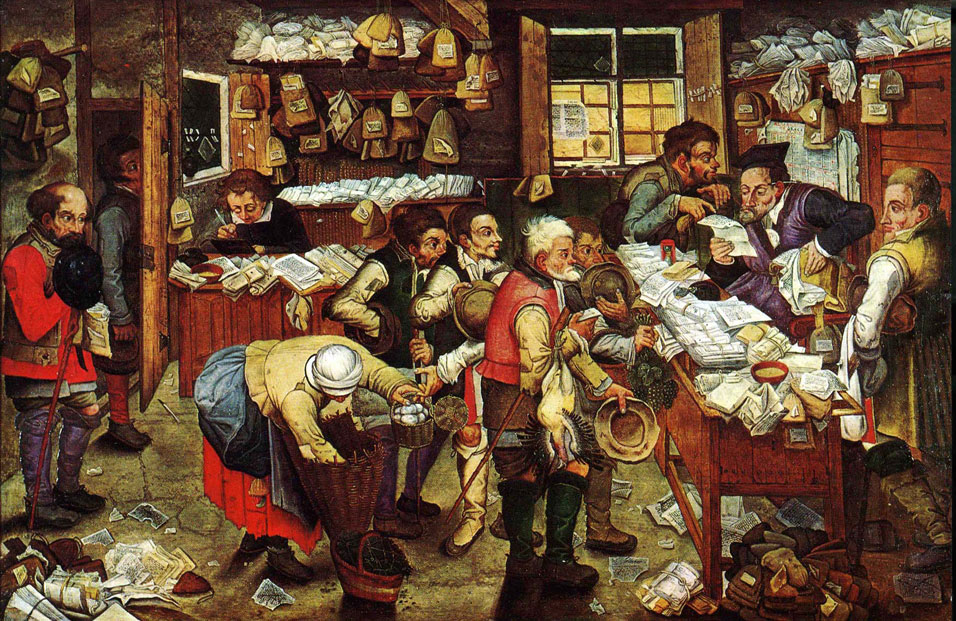
Pieter Brueghel the Younger, Paying the Tax (The Tax Collector), 1640
In my previous article, we just skimmed the surface of objects. Let's continue our reconnaissance. Today's topic is a tough one. It's not quite BIG DATA, but it's still the data not easy to work with: we're talking about fairly large amounts of data. It won't all fit into RAM at once, and some of it won't even fit on the drive (not due to lack of space, but because there's a lot of junk). The name of our subject is FIAS DB: the Federal Information Address System database - the databases of addresses in Russia. The archive is 5.5 GB. And it's a compressed XML file. After extraction, it will be a full 53 GB (set aside 110 GB for extraction). And when you start to parse and convert it, that 110 GB won't be enough. There won't be enough RAM either.
First time post, also a new Cache developer, hence the <Beginner> tag.
If our data has Predefined terms in a dictionary, and a user can add terms on their own, can the terms exist in different tables?
Lets call the tables "Terms" and the user data in "UserTerms".
If a third class definition has a property of "Term" can it not be either Terms or UserTerms?
I'm leaning towards using a Subclass strategy where the pseudo "Parent" (forgive me) is Dictionary.Term and the child is along the lines of Dictionary.Term.User
Dictionary.Term.User can inherit from Dictionary.
Is it possible to mimic what selenium does like navigating to a site and logging in and filling out a form then logout in COS.I am trying to do that in COS using %Net.HttpRequest class or should I be using a different class the idea is to be able to call a web app login into it and fill out form and log out
I am planning to implement Business Intelligence based on the data in my instances. What is the best way to set up my databases and environment to use DeepSee?

This is my first post, I have only been using Healthshare for a year.
We support multiple Healthshare test and development environments. We are trying to come up with the best solution for building an environment from scratch, as well as incremental updates. I am interested in hearing the pros and cons between using the Ensemble -> Export Production feature versus creating custom classes to do the install and setup.
At the moment we have custom classes (one for Access gateway, one for Registry, etc), that installs Healthshare and our custom settings using the %Installer tool.
InterSystems Data Platform includes utilities and tools for system monitoring and alerting, however System Administrators new to solutions built on the InterSystems Data Platform (a.k.a Caché) need to know where to start and what to configure.
This guide shows the path to a minimum monitoring and alerting solution using references from online documentation and developer community posts to show you how to enable and configure the following;
Caché Monitor: Scans the console log and sends emails alerts.
System Monitor: Monitors system status and resources, generating notifications (alerts and warnings) based on fixed parameters and also tracks overall system health.
Health Monitor: Samples key system and user-defined metrics and compares them to user-configurable parameters and established normal values, generating notifications when samples exceed applicable or learned thresholds.
History Monitor: Maintains a historical database of performance and system usage metrics.
pButtons: Operating system and Caché metrics collection scheduled daily.
Remember this guide is a minimum configuration, the included tools are flexible and extensible so more functionality is available when needed. This guide skips through the documentation to get you up and going. You will need to dive deeper into the documentation to get the most out of the monitoring tools, in the meantime, think of this as a set of cheat sheets to get up and running.
I have one abstract class and several subclasses. All share one data/id global.
How can I get concrete class name from id (without opening the object)?
What I have so far:
write $p($lg(^DATAGLOBAL(<id>),1),"~",*-1)It does the job, but is there a more official way?