2 Followers · 100 Posts

Amazon Web Services (AWS) is a secure cloud services platform, offering compute power, database storage, content delivery and other functionality to help businesses scale and grow.

Learn more.

Article Mark Bolinsky · Dec 5, 2016 26m read

Enterprises need to grow and manage their global computing infrastructures rapidly and efficiently while simultaneously optimizing and managing capital costs and expenses. Amazon Web Services (AWS) and Elastic Compute Cloud (EC2) computing and storage services meet the needs of the most demanding Caché based application by providing
 a highly robust global computing infrastructure.

0
4 8656
Article Mark Bolinsky · Feb 12, 2019 32m read

The Amazon Web Services (AWS) Cloud provides a broad set of infrastructure services, such as compute resources, storage options, and networking that are delivered as a utility: on-demand, available in seconds, with pay-as-you-go pricing. New services can be provisioned quickly, without upfront capital expense. This allows enterprises, start-ups, small and medium-sized businesses, and customers in the public sector to access the building blocks they need to respond quickly to changing business requirements.

Updated: 10-Jan, 2023 

3
12 7223
Article Anton Umnikov · Jan 21, 2021 26m read

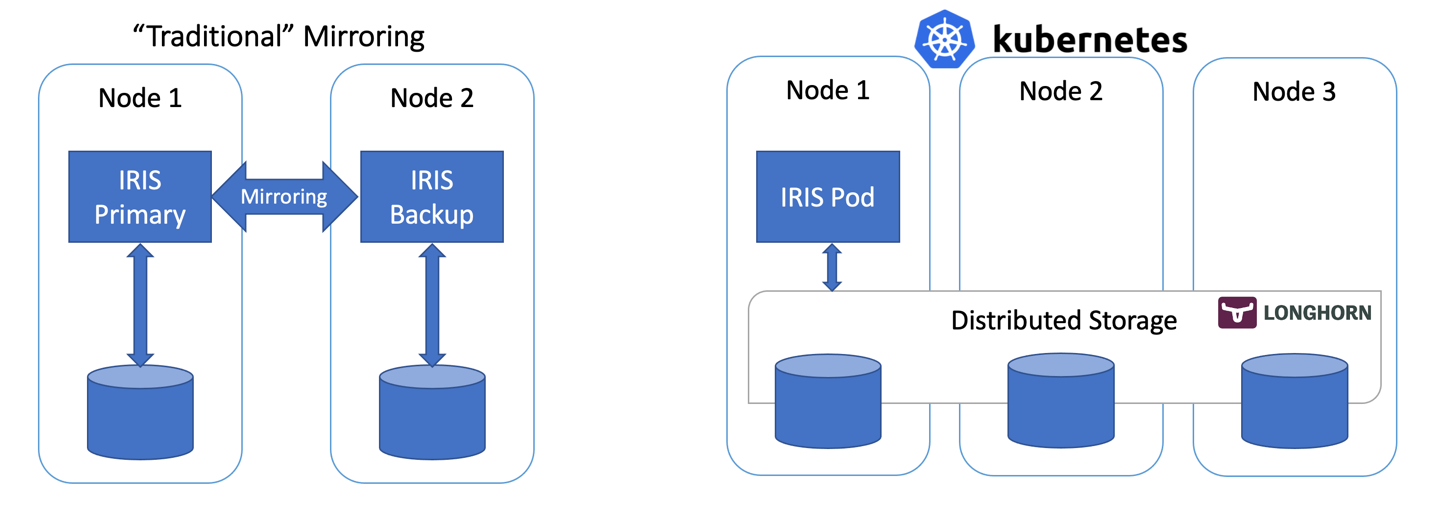
In this article, we’ll build a highly available IRIS configuration using Kubernetes Deployments with distributed persistent storage instead of the “traditional” IRIS mirror pair. This deployment would be able to tolerate infrastructure-related failures, such as node, storage and Availability Zone failures. The described approach greatly reduces the complexity of the deployment at the expense of slightly extended RTO.

16
8 4088
Article Eduard Lebedyuk · Nov 4, 2022 9m read

If you're running IRIS in a mirrored configuration for HA in AWS, the question of providing a Mirror VIP (Virtual IP) becomes relevant. Virtual IP offers a way for downstream systems to interact with IRIS using one IP address. Even when a failover happens, downstream systems can reconnect to the same IP address and continue working.

5
8 3442
Announcement Steven LeBlanc · Feb 19, 2020

AWS launched their first generation of Amazon EC2 A1 instances last year, powered by Arm-based AWS Graviton processors. At AWS re:Invent 2019, Amazon announced the second-generation AWS Graviton2 processors and associated Amazon EC2 M6g instance type, boasting up to 40% better price performance over current generation Intel Xeon based M5 instances.

The AWS Graviton2-based M6g instances are currently in preview, and InterSystems jumped on the opportunity to measure their performance with the InterSystems IRIS Data Platform.

9
0 3437
Announcement Anastasia Dyubaylo · May 4, 2021

Hey Community,

Please join the next InterSystems online programming competition:

🏆 InterSystems FHIR Accelerator Programming Contest 🏆

Submit an application that uses InterSystems FHIR-as-a-service on AWS or helps to develop solutions using InterSystems IRIS FHIR Accelerator.

Duration: May 10 - June 06, 2021

Total prize: $8,750 

👉  Landing page 👈


15
1 2919
Article Murray Oldfield · Nov 10, 2022 7m read

Overview

Predictable storage IO performance with low latency is vital to provide scalability and reliability for your applications. This set of benchmarks is to inform users of IRIS considering deploying applications in AWS about EBS gp3 volume performance.

Summary

  • An LVM stripe can increase IOPS and throughput beyond single EBS volume performance limits.
  • An LVM stripe lowers read latency.
1
0 2783
Article Anton Umnikov · Oct 17, 2019 5m read

October 17, 2019

Anton Umnikov
Sr. Cloud Solutions Architect at InterSystems
AWS CSAA, GCP CACE

AWS Glue is a fully managed ETL (extract, transform, and load) service that makes it simple and cost-effective to categorize your data, clean it, enrich it, and move it reliably between various data stores.

In the case of InterSystems IRIS, AWS Glue allows moving large amounts of data from both Cloud and on-Prem data sources into IRIS.

1
3 2296
Article sween · Apr 28, 2016 6m read

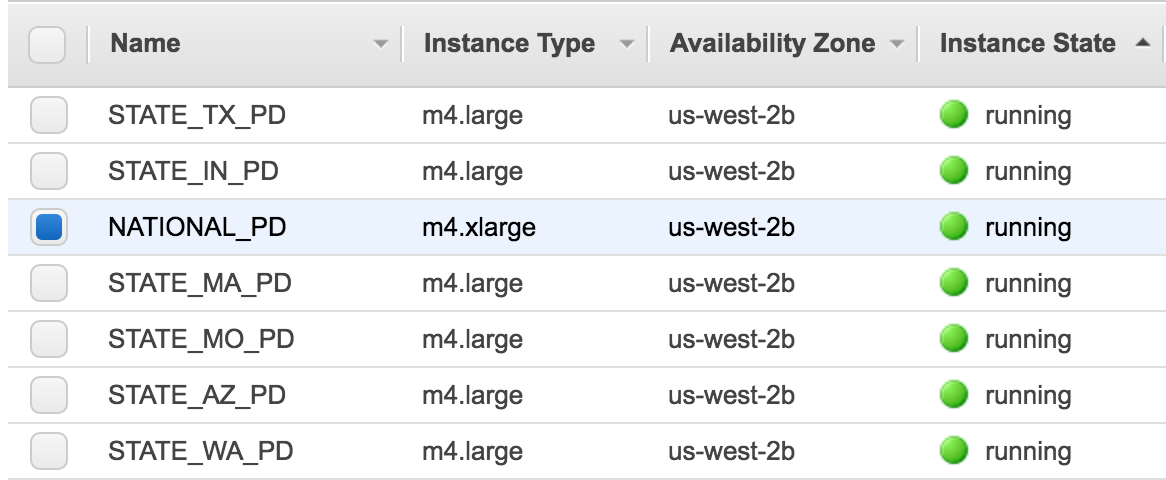
For Global Summit 2016, I set out to showcase a Reference Architecture I had been working on for a National Provider Directory solution with State Level Instances and a National Instance all running HealthShare Provider Directory and all running on AWS Infrastructure.

In short, I wanted to highlight:

  • The implementation of Amazon Web Services to provision the infrastructure, including the auto-creation of the state level instances through Cloud Formation.
  • The use of the HSPD Broadcast functionality to Notify Upstream Systems Changes in Master Provider Data.
  • The implementation of a transformation of the standard Broadcast Object to HL7 MFN for interoperability.
  • The principals of Master Data Management applied to the Provider Directory.
4
0 1922
Article Anton Umnikov · Feb 11, 2020 19m read

InterSystems IRIS Deployment Guide for AWS using CloudFormation template

Please note: following this guide, especially the prerequisites section requires Intermediate to Advanced level of knowledge of AWS. You'll need to create and manage S3 buckets, IAM roles for EC2 instances, VPCs and Subnets. You'll also need access to InterSystems binaries (usually downloaded via WRC site) as well as IRIS license key.
 

Aug 12, 2020
Anton Umnikov

Templates Source code is available here: https://github.com/antonum/AWSIRISDeployment

Table of Contents

InterSystems IRIS Deployment Guide – AWS Partner Network. 1

1
1 1881
Article David Reche · Jan 18, 2019 2m read

Good News!! You can use now the Free InterSystems IRIS Community Edition in the AWS Cloud

Hello,

It's very common that people new in InterSystems IRIS want to start to work in a personal project in a full free environment. If you are one of this, Good News!! You can use now the Free InterSystems IRIS Community Edition in the AWS Cloud.

It is pretty easy to create a new EC2 instance from InterSystems IRIS Community Edition in AWS Marketplace

15
4 1832
Article Murray Oldfield · Sep 7, 2023 8m read

Most transactional applications have a 70:30 RW profile. However, some special cases have extremely high write IO profiles.

I ran storage IO tests in the ap-southeast-2 (Sydney) AWS region to simulate IRIS database IO patterns and throughput similar to a very high write rate application.

The test aimed to determine whether the EC2 instance types and EBS volume types available in the AWS Australian regions will support the high IO rates and throughput required.

Minimal tuning was done in the operating system or IRIS (see Operating System and IRIS configuration below).

0
0 1783
Question Chris Paraskiv · Mar 20, 2017

This question is about calling AWS REST APIs. Based on:

http://docs.aws.amazon.com/general/latest/gr/sigv4_signing.html

AWS requires REST clients to call their APIs using Signature Version 4 which in case you don't know what I am talking about is a pain in the neck.  Here comes the question:

Has anybody, by any chance implemented the v4 signing alg. in COS? If yes, would she or he have the kind heart to share?

Thanks,

Chris

13
1 1739
Article Mikhail Khomenko · Dec 23, 2019 12m read

Last time we deployed a simple IRIS application to the Google Cloud. Now we’re going to deploy the same project to Amazon Web Services using its Elastic Kubernetes Service (EKS).

We assume you’ve already forked the IRIS project to your own private repository. It’s called <username>/my-objectscript-rest-docker-template in this article. <root_repo_dir> is its root directory.

Before getting started, install the AWS command-line interface and, for Kubernetes cluster creation, eksctl, a simple CLI utility. For AWS you can try to use aws2, but you’ll need to set aws2 usage in kube config file as described here.

1
3 1692
Article Anton Umnikov · May 31, 2021 6m read

All source code to the article is available at: https://github.com/antonum/ha-iris-k8s 

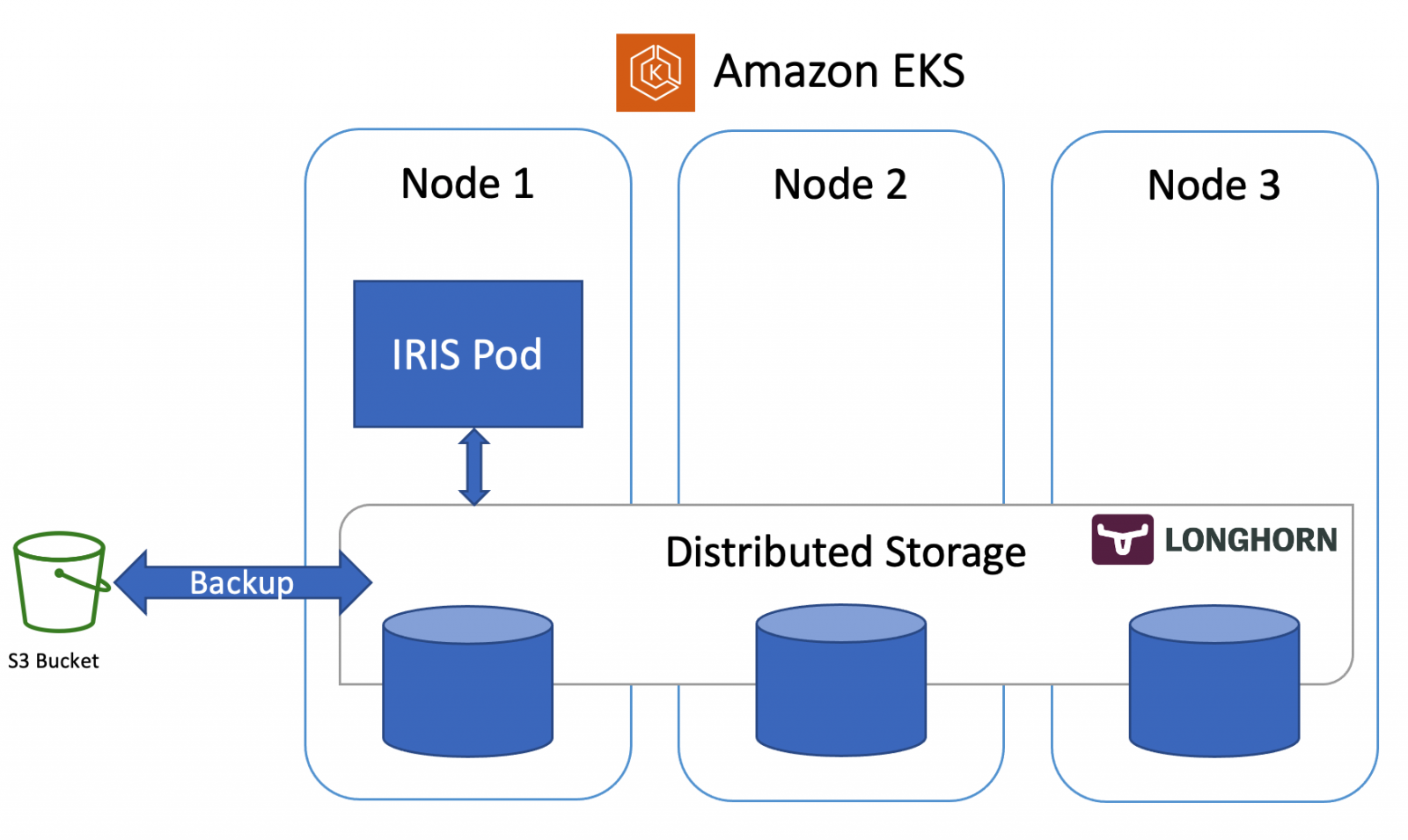
In the previous article, we discussed how to set up IRIS on k8s cluster with high availability, based on the distributed storage, instead of traditional mirroring. As an example, that article used the Azure AKS cluster. In this one, we'll continue to explore highly available configurations on k8s. This time, based on Amazon EKS (AWS managed Kubernetes service) and would include an option for doing database backup and restore, based on Kubernetes Snapshot.

Installation

Let's get right to business.

2
0 1619
Question Ricardo Baehr · Sep 12, 2017

Hi guys
Im trying to use an API running in AWS API Gateway.
This API is over https and i am using the SSL/TLS config of Caché.

set httpRequest = ##class(%Net.HttpRequest).%New()
set httpRequest.Server = server
set httpRequest.Https=1
set httpRequest.SSLConfiguration = "SSLPadraoAdapcon"

do httpRequest.SetHeader("Content-Type","application/json")
do httpRequest.EntityBody.Write(json)
do httpRequest.Post("/dev/router")
5
0 1412
Article Mikhail Khomenko · Mar 12, 2020 23m read

Imagine you want to see what InterSystems can give you in terms of data analytics. You studied the theory and now you want some practice. Fortunately, InterSystems provides a project that contains some good examples: Samples BI. Start with the README file, skipping anything associated with Docker, and go straight to the step-by-step installation. Launch a virtual instance, install IRIS there, follow the instructions for installing Samples BI, and then impress the boss with beautiful charts and tables. So far so good. 

Inevitably, though, you’ll need to make changes.

1
1 1317
Article Murray Oldfield · May 25, 2023 12m read

I am often asked to review customers' IRIS application performance data to understand if system resources are under or over-provisioned.

This recent example is interesting because it involves an application that has done a "lift and shift" migration of a large IRIS database application to the Cloud. AWS, in this case.

A key takeaway is that once you move to the Cloud, resources can be right-sized over time as needed. You do not have to buy and provision on-premises infrastructure for many years in the future that you expect to grow into.

Continuous monitoring is required. Your application transaction rate will change as your business changes, the application use or the application itself changes. This will change the system resource requirements. Planners should also consider seasonal peaks in activity. Of course, an advantage of the Cloud is resources can be scaled up or down as needed.

For more background information, there are several in-depth posts on AWS and IRIS in the community. A search for "AWS reference" is an excellent place to start. I have also added some helpful links at the end of this post.

AWS services are like Lego blocks, different sizes and shapes can be combined. I have ignored networking, security, and standing up a VPC for this post. I have focused on two of the Lego block components;

  • Compute requirements.
  • Storage requirements.
1
3 1292
Article Yuri Marx · May 22, 2023 6m read

Nowadays, most applications are deployed on public cloud services. It brings many advantages including savings in human and material resources, the ability to grow quickly and cheaply, greater availability, reliability, elastic scalability, and options to improve the protection of digital assets. One of the most popular options is AWS. It allows us to deploy our applications usings virtual machines (EC2 service), Docker containers (ECS service), or Kubernetes (EKS service).

11
3 1287
Question Neerav Verma · Jan 4, 2019

I am just curious if someone has used this service to send Alert emails through AWS / Ensemble

I have verified 2 email ids - One to send. One to receive

Have also configured an access key for the email smtp server and added the credential to ensemble

but I get this error

ERROR #6033: Error response to SMTP MAIL FROM: 530 Authentication required.

email-smtp.us-east-1.amazonaws.com

25

So my first opinion is the authentication is not happening via the credentials settings. It needs to be passed in a different way

If anyone has done it before. Do let me know

It's Ok I figured it out.

4
0 1167
Question Chip Gore · Sep 22, 2020

Hi -

I'm trying to get my VS Code instance that is connected to an AWS IRIS instance to edit/save/compile .csp files, but it's failing to work and I'm not sure why. The ".csp" is associated with the objectscript-csp code, and the server is connected, but things just don't act like they are enabled.

Should this work? and if so, what might I have missed in configuring things?

5
0 1060
Article Oliver Wilms · Aug 4, 2021 3m read

I have been working on redesigning a Health Connect production which runs on a mirrored instance of Healthshare 2019. We were told to take advantage of containers. We got to work on IRIS 2020.1 and split the database part from the Interoperability part. We had the IRIS mirror running on EC2 instances and used containers to run IRIS interoperability application. Eventually we decided to run the data tier in containers as well. Later we switched from using EC2 instances to Fargate “server-less” compute.

14
2 1043
InterSystems Official Steven LeBlanc · May 13, 2020

AWS has officially released their second-generation Arm-based Graviton2 processors and associated Amazon EC2 M6g instance type, which boasts up to 40% better price performance over current generation Intel Xeon based M5 instances. 

A few months ago, InterSystems participated in the M6g preview program, and we ran a few benchmarks with InterSystems IRIS that showed compelling results. This led us to support ARM64 architectures for the first time.

Now you can try InterSystems IRIS and InterSystems IRIS for Health on Graviton2-based Amazon EC2 M6g instances for yourselves through the AWS Marketplace!

2
0 1021
Question Abbad Minhas · Feb 3, 2022

We have a requirement to write to an AWS S3 bucket from Cache.

We haven't upgrade to IRIS yet, but are looking at doing so in the future. This requirement cannot wait for the upgrade to happen, unfortunately.

Will appreciate if any one can share any example code, that enables cache to write to an AWS S3 bucket? 

8
1 976
Announcement Ben Spead · Jul 7, 2021

Hello Developers!

Have you ever had to convert HL7v2 messages to FHIR (Fast Healthcare Interoperability Resources) and found the process complicated and confusing? InterSystems is rolling out a new cloud based SaaS offering called InterSystems FHIR Transformation Service, which makes the process easy.  We are excited to announce an Early Access Preview Program for our new offering, and we would love to have you kick the tires and let us know what you think!  All you need is a free AWS account, with an S3 bucket to drop in your HL7v2 messages, and another S3 bucket to get your FHIR output. 

5
0 965
Article Tomohiro Iwamoto · Dec 24, 2020 6m read

About this article:

In InterSystems IRIS, the default form of access to the management portal is HTTP, which means that if the client is in the office and the server is in the cloud, many clients probably desire to encrypt their traffic in some way.

Thus, we would like to show you some ways to encrypt your traffic to and from the IRIS management portal (or various REST services) running on AWS.

This article uses the IRIS built-in apache server for access. It should not be used for benchmarking purposes or as a method of access from production environments applications.

0
2 902
Question Raymond Lawrence · Oct 23, 2017

I am designing the software architecture for an Ensemble/Healthshare production to be deployed on Amazon AWS EC2 servers (2 mirrored m4.large - 4 vCPUs / 16 GiB RAM running RedHat Linux  3.10.0-327.el7.x86_64 and Healthshare for RHEL 64-bit 2016.2.1). It's a rather CPU-intensive production involving massive XSLT 2.0 transformations (massive both in terms of size and volume). I was wondering if anyone has experience configuring Ensemble productions on EC2 servers.

2
0 901
Announcement Anastasia Dyubaylo · Aug 4, 2022

Hey Community,

We're excited to announce that Community webinars are back!

Let us invite you all to @sween's webinar on Scaling InterSystems FHIR Server on Amazon Web Services with ECP.

Join this webinar to make a technical deep dive, see a demonstration, and benchmark horizontal scaling InterSystems FHIR Server on Amazon Web Services with Enterprise Cache Protocol (ECP).

Date & Time: Thursday, August 18, 8 AM ET | 2:00 PM CEST
👨‍🏫 Speaker: @sween, Full Stack Architect at Integration Required

8
0 856
Article Roy Leonov · Mar 12, 2024 5m read

As an IT and cloud team manager with 18 years of experience with InterSystems technologies, I recently led our team in the transformation of our traditional on-premises ERP system to a cloud-based solution. We embarked on deploying InterSystems IRIS within a Kubernetes environment on AWS EKS, aiming to achieve a scalable, performant, and secure system. Central to this endeavor was the utilization of the AWS Application Load Balancer (ALB) as our ingress controller.

3
9 813
Announcement Anastasia Dyubaylo · May 7, 2021

Hey developers,

The registration period for the FHIR Accelerator programming contest is in full swing! We invite all FHIR developers to build new or test existing applications using the InterSystems IRIS FHIR Accelerator Service (FHIRaaS) on AWS

And now you have a great opportunity to get FREE access to the FHIRaaS on AWS! So, to take the first step in mastering the FHIRaaS, you need to register on our FHIR Portal using this link:

👉🏼 https://portal.trial.isccloud.io/account/signup

2
0 811