Let assume you have a infinitely scaling algorithm implemented in your application, using replication, ECP, or any other means of horizontal scaling, and let assume you know how to run your system under any volume of requests, the trick is to deploy required number of computing nodes in the cluster. If we are talking about cluster of 2-4 nodes your administrator (or as they call it today "devops engineer") will install anything manually. Probably he will easily handle 5 nodes configuration in the cluster. But what if you need to deploy 10, 100, or 200 properly configured, interconnected nodes?
InterSystems is pleased to announce that Caché and Ensemble 2016.1.1 are now available as maintenance releases.
For a complete list of the corrections in 2016.1.1, please review the release notes.
Caché and Ensemble 2016.1.1 are available now for the same platforms as 2016.1.0, with the following exceptions:
-
OpenVMS is not available yet. It will be announced separately.
-
Support for Red Hat Enterprise Linux 7 for Power System-64 is now dropped.
The complete set of supported platforms, including specific point releases and/or patches, is detailed in the Supported Platforms document.
Learn about the creation and configuration of the HealthShare Business Services and Business Operations used to support the receipt and re-transmission of HL7 messages.
Hello WRC.
Is possible to obtain a node-cache modul for the nodeJS ver.4.4.4. and actual Caché 2015... ?
And what is the expected outlook of this.
A note about this new portal: If I put into "search box" some text with dot like .js or .css ( for example: test.js ) , I obtaint error page. Try it.
Of course, this "Developer Community" is nice, the right way.
Nice day for all, Jan Krestyn
Hello,
I have a question about how to set the value of a radioSet. Yes, I know -- the documentation says that setValue can be used "client side", but gives no example. Plus, I'm trying to set the value of a radioSet in %onAfterCreatePage, which is a Zen method? Server side method? I'm not sure.
In my Zen page I create a radioSet like this:
displayList="App One,App Two,App Three"
valueList="One,Two,Three"/>
I want to select a radio based on a sepcific value, that I get from code.
e.g.
Method %OnAfterCreatePage() as %Status
set value = class.
Setting the TZ Environment Variable on Linux
The Update Checklist for v2015.1 recommends setting the TZ environment variable on Linux platforms and points to the manpage for tzset. This is recommended to improve the performance of Cache’s time-related functions. You can find out more about this here:
https://community.intersystems.com/post/linux-tz-environment-variable-not-being-set-and-impact-caché
The manpage on my CentOS 7 test system (RHEL 6 says the same) has this to say:
“The tzset() function initializes the tzname variable from the TZ environment variable.
Hello,
I am still a beginner with COS and am struggling with these concepts. While digging through the official documentation will eventually tell you everything you need to know, getting started is nevertheless not an easy feat...
Is it possible to create a "lists/array/multidimensional 101" page for beginners?
Hi,
I am trying to use data transformation (DTL) to map a JSON to SDA. My elements in the source JSON is not one to one with SDA object. That means I have to add code to loop through these objects in order to complete the mapping. Can someone send me a sample that can look to create that? I am not very comfortable with scripting language used in Health Share. Appreciate your help.
Regards
Joseph
I was planning to fully map out all the transforms that incoming CCDs go through before they are displayed in the Clinical Viewer or sent back to another facility. When I opened the XSL files, I see some very good comments like the following:
<!--
Field : Patient Name
Target: HS.SDA3.
Field : Patient Name
Target: HS.SDA3.
I am hoping some of you network guys have ideas. InterSystems seems to be at a standstill. When I startup Studio and try to start Terminal I get License Limit Exceeded. Starting with Terminal and going to Studio, same thing. It started when I put down a 2016 version of Cache on top of a 2015. InterSystems told me to uninstall everything and start fresh. I did that but have the same problems. What can I look at? How do I start to debug this? Although I am the only one on my PC it is really impacting my performance.
-thank you
Updated DEV server from account 2013.x to 2015.2 (Build 664_3U) of Ensemble
| Version: |
Cache for UNIX (Red Hat Enterprise Linux for x86-64) 2015.2 (Build 664_3U) |
Platform : UNIX (Red Hat Enterprise Linux for x86-64)
When trying to start the JDBC gateway server got the following message
*****************************************************************************
Type: Error
Text: Execution returned: Exception in thread "main" java.lang.UnsupportedClassVersionError: com/intersys/gateway/JavaGateway : Unsupported major.minor version 51.0
at java.lang.ClassLoader.defineClass1(Native Method)
at java.
Hi,
Using cube CubeA and cube CubeB that contains calculated measure TotalClients.
I would like to use TotalClient calculated measure from a compound cube CubeC (CubeA,CubeB).
How would you do that?
Hi All,
I've created a sample implementation of the MQTT protocol, which is now available on GitHub.
The project demonstrates MQTT client capabilities and it's written in Caché Object Script.
Any comments, bug reports are welcome! Some more enhancements (like SSL / TLS support) are planned for the near future.
Introduction
The field test of Caché 2016.2 has been available for quite some time and I would like to focus on one of the substantial features that is new in this version: the document data model. This model is a natural addition to the multiple ways we support for handling data including Objects, Tables and Multidimensional arrays. It makes the platform more flexible and suitable for even more use cases.
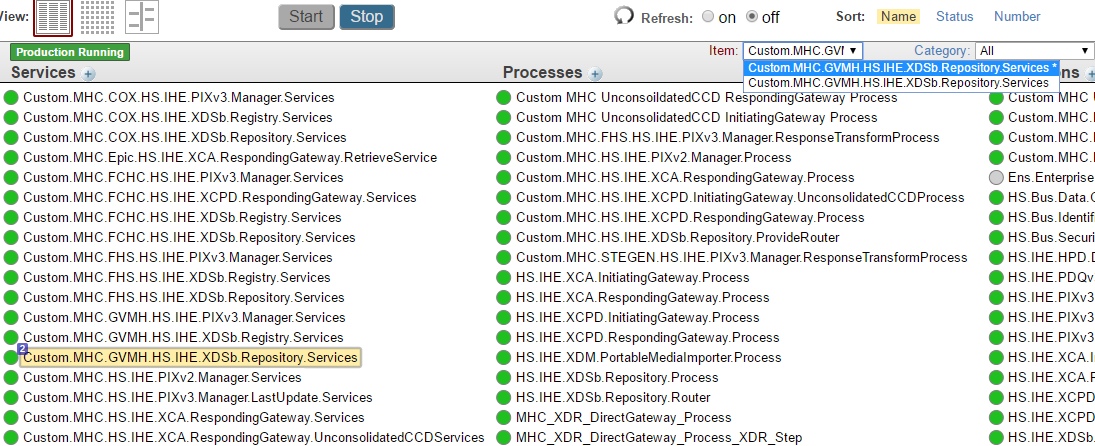
Occasionally I see a production item with a little 2 flag. When it has that, there is an "Item" dropdown. What does this mean?
Hi
I'm trying to inser a button into a grid cell with no sucssess.
Hello!
Are there any short ways of serializing COS entity to the string? I am searching for something like .$toJSON() , but I need Caché 2013.* support.
The one way I supposed to work is to use $listbuild:
set str = $LISTTOSTRING($LB(1,2,3,",",5))
set list = $LISTFROMSTRING(str,",")
zw list
list=$lb("1","2","3","","","5")
But the problem is that $listbuild does not escape delimiters, and it is not possible to deserialize serialized string. The structure I need to serialize may contain any characters.
Are there any short ways to do this in Caché to avoid writing custom parser?
I need to pass multiple values to a FILTER to a DeepSee DASHBOARD via the URL. The documentation seems to indicate this can be done, i.e.: "Where each filterspec is filter_name.filter_values" but there are no examples I can find that indicates what is used to separate multiple values. Say I want to pass the three values 5, 6, and 1395 to a filter. To pass just the 5 I know this works:
&SETTINGS=FILTER:LEAD.MYUSERID.H1.MYUSERID.5
but how do I include 6 and 1395. None of the following seem to work:
&SETTINGS=FILTER:LEAD.MYUSERID.H1.MYUSERID.5.6.1395
&SETTINGS=FILTER:LEAD.MYUSERID.H1.MYUSERID.
this is catching me all the time, again and again...
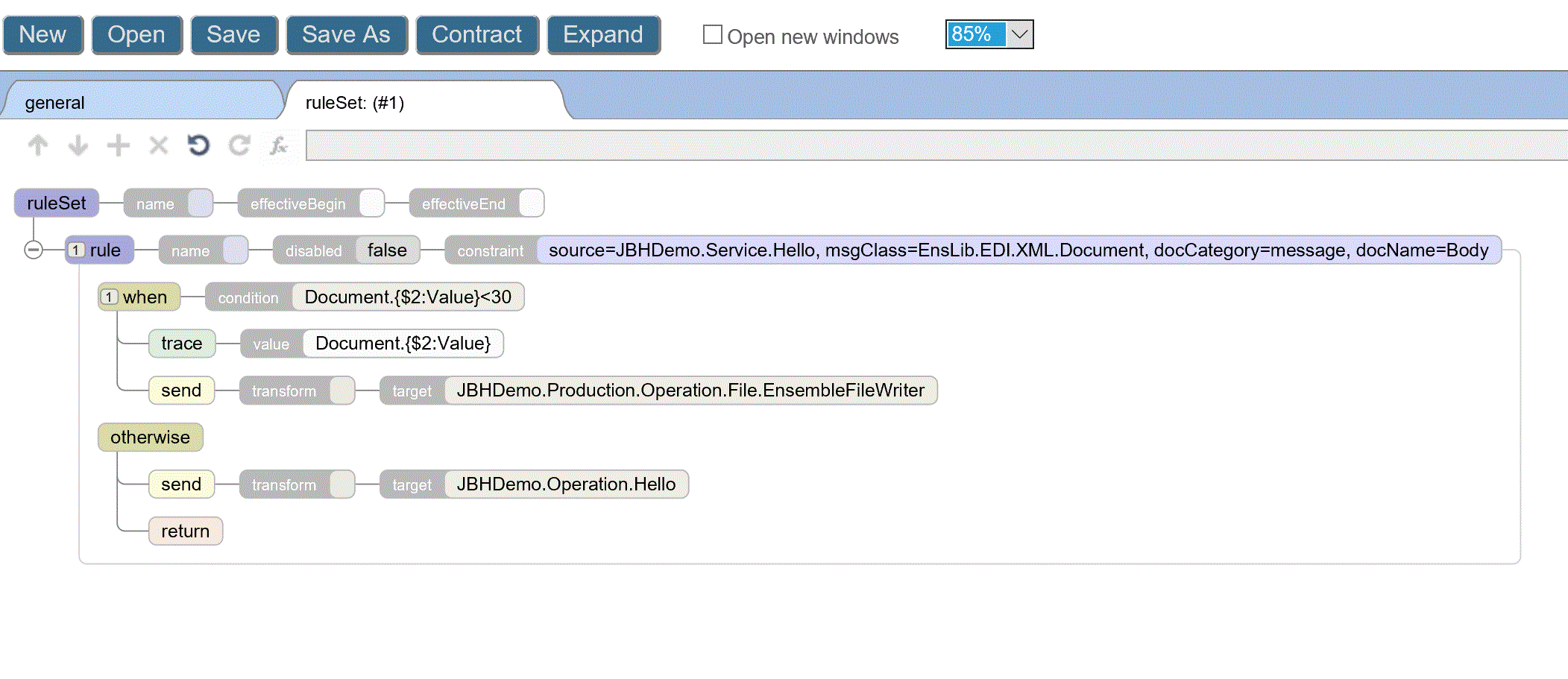
Haven't worked with XML VDOC for some time, I can't figure out, what is the correct way of using Property path. Can someone please help me to refresh my memory.
Simple example: I have a class called Body, with Value and Topic properties. I created a XML Schema for this class and imported it into Ensemble. So i have a category called message, with Body as DocType structure and Name and Topic properties of Body complex type ($2:Value and $2:Topic are element names)
My rule looks this way:
When using the "XML Cache Script" export via the Export context menu option (right clicking on a class in the Atelier Explorer View) sometimes the export dialog is empty.
Other times it is pre-filled with the project selected and the individual class chosen as expected. When it is blank you can choose the project but within the list of all classes there is no package hierarchy making it difficult to find your class.
Anyone know why sometimes you get the empty selection and sometimes you don't? I've tried to reproduce it at will but can't pick up a pattern.
NewBie's Corner Session 7 True and False
Welcome to NewBie's Corner, a weekly or biweekly post covering basic Caché Material.
Click on the Caché Cube in your system tray and select Terminal to try out these commands.
In COS, a 0 is false and any other number (positive or negative) is true.
Order is a necessity for everyone, but not everyone understands it in the same way (Fausto Cercignani)
Disclaimer: This article uses Russian language and Cyrillic alphabet as examples, but is relevant for anyone who uses Caché in a non-English locale. Please note that this article refers mostly to NLS collations, which are different than SQL collations. SQL collations (such as SQLUPPER, SQLSTRING, EXACT which means no collation, TRUNCATE, etc.) are actual functions that are explicitly applied to some values, and whose results are sometimes explicitly stored in the global subscripts. When stored in subscripts, these values would naturally follow the NLS collation in effect (“SQL and NLS Collations”).
I've been in IT since 1986.
I started with Pr1me INFORMATION and Primos on Pr1me hardware.
In the 90s and 00s, I used D3.
I'm giving Caché a try, but I'm kinda having some difficulty getting started.
I've installed Caché on a 64-bit Windows 7 workstation. It was installed under an administrator's account. From a standard users account, I'm trying to access the Management Portal at:
http://localhost:57772/csp/sys/UtilHome.csp
It is prompting me for credentials. Which ones do I use? I've tried several, but nothing is working.
Problem: Caché instance connects periodically to an Oracle database via jdbc and downloads data. Sometimes data on a remote server would change.
In DeepSee, having a customer account cube. The cube includes a time dimension AccountCreationDate.
How do you create a calculated measure to get the total number of accounts from the beginning to a certain date in abscissa ?
I tried many things including this:
AGGREGATE(%TIMERANGE([AccountCreationDate].[H1].[MonthYear].&[190001],[AccountCreationDate].[H1].[MonthYear].CURRENTMEMBER) ,[Measures].[%Count])
But I don't get the right result because the date in abscissa creates a filter on the first date.
I tried also with %MDX function, but then I loose the context for the CURRENTMEMBER.
Hi!
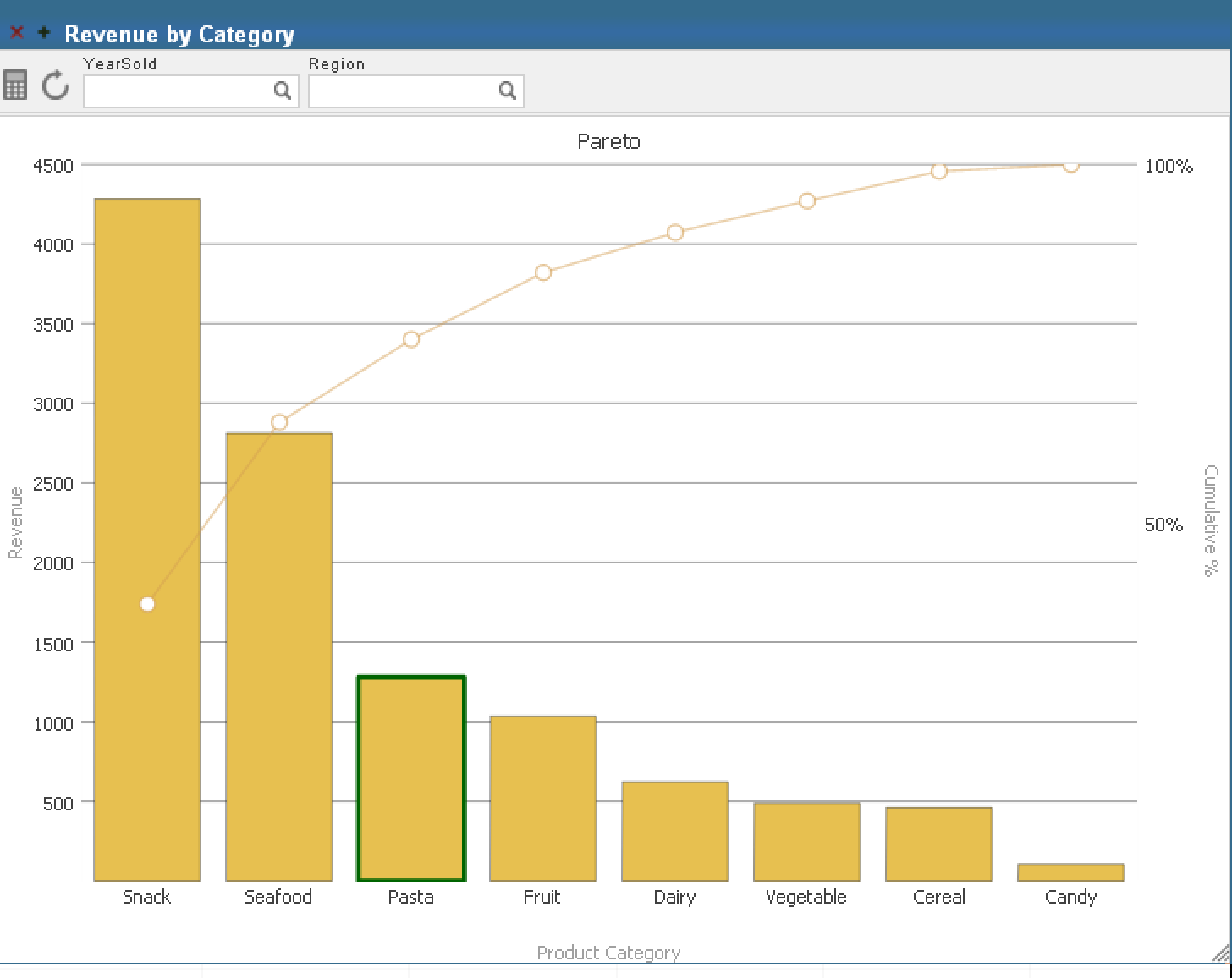
There is an example in Samples which shows how to implement 'running total' measure: "Pareto Chart for Category" dashboard.
To calculate running total this pivot uses calculated measure with %Cell expression:
Measures.[Revenue as Percent of Total] + %CELL(0,-1)
I am having a problem when using atelier on my instance, which I just synched from perforce on latest and then did a built
I am getting the error ERROR #5880: Unable to create source control class: %Studio.SourceControl.ISC [zSourceControlCreate+17^%Studio.SourceControl.Interface.1:%SYS]
every time I want to open any class or routine from %SYS namespace in the Server tab.
Did someone had the same issue?
Mario
Hello, is there a way to reset all of the Sample Classes back to their "Installed State."? In other words, delete all the other classes I have put into the samples namespace and leave only those classes that were there when I installed the instance.?
-thank you
Hello,
We are sometimes asked for examples of how to do 3rd party SQL database selects/updates/inserts/stored procedures from an Ensemble SQL Business Operation.
We have noticed that when compiling with Atelier (either Atelier itself or sending the code through the REST interface) that the build will fail if all brackets '() {} []' are not closed. This includes brackets opened in comments.
For example, this will fail:
class myclass
{
//if someVar {
}
I do not know if this issue has been fixed or if this issue has been brought up, but it has been a nuisance over here.