In %Net.SSH.Session there is a method settraceMask and that will create a wireshark cap file for help with troubleshooting a connection. I dont see any class in Net.FtpSession that can be used for troubleshooting. Is there a different method that I should use?
Apart from the database server itself, the standard bundle of the Caché DBMS includes DeepSee, a real-time business intelligence tool. DeepSee is the quickest and the simplest way of adding OLAP functionality to your Caché application.
Another standard component is an Audit subsystem with a web interface, which has the options for expanding with your own event types and an API for using in an application code.
Below is a small example of the joint use of these subsystems that answers the following questions: who did what and when in an information system?
Hi,
Does anyone use the 'Enable automatic WRC HealthCheck updates' ?
'InterSystems strongly advises that you enable WRC HealthCheck. If checked, reports are run and sent to the WRC periodically. These regular reports allow the WRC to better assist you. No private application information is sent. All configuration data is kept strictly confidential.'
Any reason to use / not use?
Hi Everyone,
I am trying to reference a field, however, in our production environment, it can be found in the first second or third iteration. My code was only qualifying on the first iteration. I have been attempting to include all iterations, but I have come up short...below is a snippet of what I am attempting to use. My original code simply had GetValueAt("PID:13.4") but this only referenced the first iteration. Thanks for any thoughts!
Set PID13 = pInput
Database Blocks Explorer for InterSystems Caché
Key features
Tree explorer
- Shows tree of database blocks;
- Export tree as SVG or PNG image;
- Shows every node in the block;
- Open any block just by clicking on node in parent block;
- Reload block info by clicking at the same node second time;
- Zoom in and out, fit and navigator;
- Easy way to switch between view modes (tree/map);
Fragmentation map
- Shows every block with the same colour for every globals;
- Legend for globals;
Installation
Minimal supported version is 2015.3 or 2016.1.
Hi, all!
As I know, InterSystems recommends the use of Huge Pages. And if count of Huge Pages is enough, we'll see (in cconsole.log) something like this during Cache startup:
12/29/17-14:40:50:360 (3625) 0 Allocated 4630MB shared memory using Huge Pages: 4096MB global buffers, 256MB routine buffers
But if count of Huge Pages is not enough for location of all Globals and Routines caches, Cache won't use Huge Pages.
The question is: does it exist any metrics (API) in Cache (not in OS), that can show us if Cache uses (or not) Huge Pages currently?
Thanks!
I'm referring to the document Using Cache with JDBC. Using this example, it sets the URL of the object ds of class CacheDataSource.
ds.setURL("jdbc:Cache://127.0.0.1:1972/SAMPLES");
My question is would you just copy and paste the URL from the login page to the string? I tried doing that and it returns an error saying "Invalid log file xyz"
Any help will be greatly appreciated! Thank you
I want to understand how this message is build:
[SYSTEM MONITOR] CPUusage Alert: CPUusage = 99, 99, 99 (Max value is 85).
Caché keep a log of cpu usage (99,99,99) and how is the frequency of check of this?
how can i chance the max value? is that possible?
Best,
Hi, the 2017 filed test key has expired. When can we get the new one?
Hello,
I want to process more requests per second in Ensemble 2015 (soap service). My problem is in a business process that makes a great transformation. I thought that I can put its group size to 4 (the current value is 1), or put 4 business processes and apply, for example, the round-robin algorithm.
Which alternative is better?
I have many items in business services.
one of my particular business service is frequently asking restart.
Is there any code to update particular business services out of all services?
Thanks in advance...
I have a running Cache DB system that the password for DBA isn't given the default password. How should one go to reset the password without having the credentials for DBA?
Connected Data London Conference
TRIADB is an emerging unique and valuable technology in NoSQL database modelling and BI analytics. The following video is from a presentation and demonstration of TRIADB prototype implemented on top of Intersystems Cache database and driven with a CLI in Python (Jupyter-Pandas). In fact this is the second time in the past year that a prototype based on this technology is implemented and demonstrated. The first one was built on top of OrientDB multi-model database and driven by a Mathematica notebook.
Hi I am new using atelier and i want to use some of the InterSystems server for me to train so is there any server connections that i can use. Please help me on this.
Hi,
Can I get "Window Size" from terminal? By command line.
Terminal > Edit > Window Size
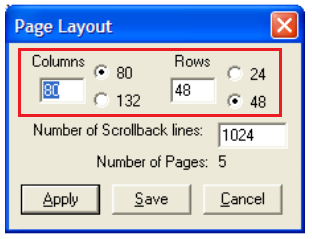
I already tried to use 'do CURRENT^%IS', but without success. It does not return the change, for example, when the column is 132.
Is there any routine or method for this?
Newbie question. So bear with me please.
We have a requirement to extract or build a file off of our local db to feed to HealthShare.
The requirement is for us to create the extract and send it to HealthShare the SDA format.
My initial thought is why would you do that when the SDA is native to HS. We could create a file in any format csv,tab etc let HS consume it, convert it to HL7 2.5.1 and then let HS do the work with the SDA.
However, the current direction is for us to query, get the data and map it to an xml file built off of the SDA.
Has anyone taken this approach?
Thanks in advance,
Hi, Community!
This post is a digest of the Developer Community postings in December 2017.
Most viewed
Adventofcode.Com 2017 is live :) 509
Getting Current Day in Cache 142
Atelier terminal 138
A List Of Public Caché Projects 129
How to Subtract or Add dates 128
Cache Synchronization of databases 124
AdventOfCode 2017. And The Winner is... Bert Sarens! 121
APM - Finding the expensive parts of your application 120
Most voted
Synopsis: I need to "sideline" messages for subsequent selection and data enrichment while maintaining manageability within the Ensemble framework.
Hi, Community!
New 2018 Year is coming!

Time to have a break and recall what a great year was 2017! And to plan how fantastic 2018 would be!
Best Wishes and Happy Holidays!
Hi, Community!
Please find a new session recording from Global Summit 2017:
Disaster Recovery for Federated Systems
A practical guide to using the tools PERFMON and MONLBL.
Introduction
When investigating performance problems, I often use the utilities ^PERFMON and ^%SYS.MONLBL to identify exactly where in the application pieces of code are taking a long time to execute. In this short paper I will describe an approach that first uses ^PERFMON to identify the busiest routines and then uses ^%SYS.MONLBL to analyze those routines in detail to show which lines are the most expensive.
The details of ^PERFMON and ^%SYS.
Hi everyone
I'm new in Cache development language and I'm starting setting up Unit Tests.
How do you check with an Assert whether a certain variable is null or undefined?
The following assert throws an error on the "null": do $$$AssertEquals(myObj, null, "myObj is null")
Thanks a lot for your help and best regards
Milena
InterSystems is ready for 2018 since Atelier 1.1 is now available as a stable release! Bring on the new year!
To subscribe to the NEW Atelier release channel, please follow the instructions on the Atelier Download page.
Stick with the beta update channel if you want to be an Atelier insider and get the latest new features and enhancements before anyone else.
select * from A left join B on A.x = B.x inner join C on B.y = C.y
does Cache SQL treat the join path: LEFT_JOIN(A,INNER_JOIN(B.C)) also a valid candidate path?
Thanks.
Hey guys!
Thanks for participating in our small but productive COS marathon on behalf Adventofcode 2017!
The leaderboard is here:
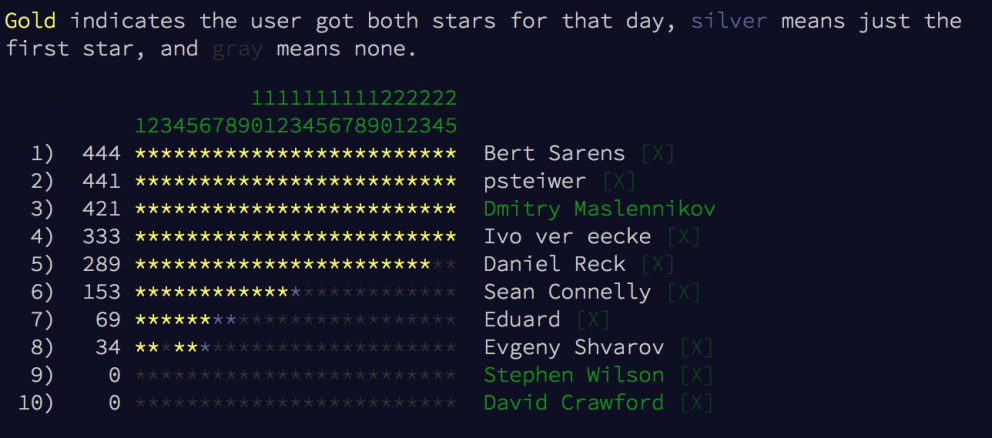
And we are ready to announce the winner but need your public repositories with COS solutions inside. Please share it below in comments.
We have results!
1st place: Bert Sarens! Repository.
2nd place: Peter Steiwer! Repository.
3rd place: Dmitry Maslennikov. Repository.
Congratulations Bert!
You get 10,000 Global Masters points and the title of the AdventOfCode champion in Caché ObjectScript at least until December 2018!
Peter and Dmitry!
What is difference between using a command $classmethod rather than just invoking them straight away?
For example if i need to call a class and its method i can just use like
do ##class(circle).radius()
rather than using
do $classmethod("circle",radius)(I suppose both of them doing the same function i am not aware of it)
Please help me understand what is different and is there any specific usage.
Correct me if i have made mistake.
I have made a complete copy of our test namespace into a secondary test namespace. Thereby we can test with our current EHR version and our soon to be deployed EHR version simultaneously. However, we have a number of saved searches within the Message Viewer that we would like to have available within our secondary namespace. Is it possible to export the saved searches within the message viewer?
Thanks!
Is there any config setting in Net.SSH.Session that I can use to set StrictHostKeyChecking to no, I am getting an error about unable to exchange encryption keys. Also how would I set keyboard-interactive I dont see any option to set this?
aSSH Error [80101012]: Authentication failed (username/password) [80101012]
[libssh2] 653.630730 Transport: Looking for packet of type: 20
[libssh2] 653.630730 Failure Event: -37 - Unable to exchange encryption keys
=> libssh2_transport_read() raw (952 bytes)
0000: 00 00 03 B4 04 14 37 FE 5D 7C 12 50 E1 41 3
Hi everyone
How can I connect using the Terminal to a remote server?
I changed the server indication on the Healthshare icon on the Windows toolbar.
The management portal works but not the Terminal. When I open the terminal it displays only some information about the server ("SSH-2.0-OpenSSH_7.2p2 Ubuntu-4ubuntu2.2"), but it doesn't give the possibility to log in.
Do you have any suggestions how I could fix it?
Thanks a lot and best regards
Milena