Hi Community,
If you're interested in containers, take a look at what we got planned for Global Summit, September 22-25, Boston Marriott Copley Place. Register now to take advantage of our early bird pricing.
Hi Community,
If you're interested in containers, take a look at what we got planned for Global Summit, September 22-25, Boston Marriott Copley Place. Register now to take advantage of our early bird pricing.
Hi Developers!
This is an anniversary announcement to celebrate 6,000 members on InterSystems Developers!

There are some other good figures came:
And we have the Spanish Community for 2 months running! Join Spanish DC!
Hello community,
I need to know if there is any method which can me say specified imported files or namespaces in Cache.
To better specification of my problem, I've got two installer manifests. Firts one did some resource changing and import some files and classes, second one must be started after the first one, because it's only his update, which creates some nemaspaces. So i need to check if the first manifest ran succesful and I can start the second one.
Is it good way trying to do this by some method or are there some other, better ways maybe by ccontrol, I don't know?
Hello,
Is it possible to write global output values to STDOUT, in a similar way to how csession can take routine intput, like below:
(In Cache Terminal)
%SYS>d ##class(%SYSTEM.License).
License Server summary view of active key.
Distributed license use:
Current License Units Used = 1
Maximum License Units Used = 1
License Units Authorized = 200
Local license use:
Current Connections = 1 Maximum Connections = 1
Current Users = 1 Maximum Users = 2
(From Linux OS Terminal)
[jhipp@test-sbox ~]# csession TEST "##class(%SYSTEM.
Good morning,
I'm trying to understand $ZF function, but only documentation isn't enought in this way. So my question is is there any possibility to get enviroment variable by this function into ensemble?
I've tried this as example from ducumentation, but there is an error and I don't know why...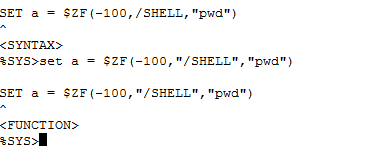
Thanks for your solutions.
Zdenek
Hello Community,
How do i disable an operation explicitly based on a value in a variable?
I set the ReplyCodeAction to E=D.
In the Operation Code i am throwing an explicit ERROR
THROW ##class(%Exception.General).%New("Shutting Down Operation",999,,"My own special exception")
But my operation still remains up.
Any suggestions please will be appreciated.
Thanks,
Jimmy Christian.
Hi Everyone!
InterSystems HealthShare is nominated for the Computable Awards 2019! The Unified Health Record that we implemented together with our partner Itzos in the St. Maartens Clinic has a chance to become the "ICT Project of the Year in Healthcare".
A great honour, but of course we also want to win. We need 4,000 votes! Therefore we'd like to ask you to vote!

Hallo Community!
Bitte melden Sie sich zum Webinar "Machine Learning Projekte mit R erfolgreich umsetzen" an: 2. August 2019 um 10:30 Uhr.

Veranstaltungsdetails:
Hello,
Does anyone know if it's possible to allow a user type access to only certain parts of the System Operations page? Specifically, the System Logs - Application Error Logs.
Thanks much!
Jerry
Hallo Community!
Bitte melden Sie sich zum Webinar "Machine Learning Projekte mit Python erfolgreich umsetzen" an: 26. Juli 2019 um 10:30 Uhr.

Veranstaltungsdetails:
I'm not saying that this is in anyway "best practices," but I'm in a peculiar situation where I need to restrict users from starting a "retired" Ensemble Production in a namespace that's been renamed. It's still an "Ensemble-activated" namespace; we need to keep it available for Ensemble Message Viewer access ... fortunately, only for a little while.
It's a bit of a hack ...
Open the Production class in Studio and add the following classmethod:
ClassMethod OnStart() As %Status
{
    Return $system.Status.Error(5001,"THIS PRODUCTION IS DISABLED.")
}
Hello community! I have to work with queries using all kinds of methods like embedded sql and class queries. But my favorite is dynamic sql, simply because of how easy it is to manipulate them at runtime. The downside to writing a lot of these is the maintenance of the code and interacting with the output in a meaningful way. In an effort to have as much dynamism as possible so that we're not rewriting code constantly, and so that we have as little code possible (while still making sense and getting the job done), I made a function that takes in any dynamic query and outputs a dynamic object.
Hi Everyone!
Please watch the new video on InterSystems Developers YouTube, recorded by @Sourabh Sethi in a new format called "Coding Talks":
A SOLID Design in InterSystems ObjectScript
Hello,
I have a large Data Lookup Table (> 150,000 records). It is too large to be opened from Ensemble --> Configure --> Data Lookup Tables to be deleted.
Is there another way that I can delete this table?
Thank you.
Hello,
I've got similar question as I have mentioned here once. Itś about enviroment variables and getting their values into manifest.
Now a know, that I must use this method $system.Util.GetEnviron("") but still if I try to use it it doesn't work. I need to set variable in bash.sh file and then get that value into manifest. If I try this in terminal it works only for system variables as you can see, but it shoul normally works for user variables to or not?
Hello,
I've got a csp page that has successfully set up a websocket connection to a Cache class. When the websocket object's close function is triggered at the browser I was expecting one of the class' methods to fire at the server. The onclose method is triggered at the browser but nothing at the server. Is a method supposed to fire at the server?
Thanks,
Dan
Cache for Windows (x86-64) 2015.1.4 (Build 803_6) Tue May 15 2018 12:08:36 EDT
As a developer, you have probably spent at least some time writing repetetive code. You may have even found yourself wishing you could generate the code programmatically. If this sounds familiar, this article is for you!
We'll start with an example. Note: the following examples use the %DynamicObject interface, which requires Caché 2016.2 or later. If you are unfamiliar with this class, check out the documentation here: Using JSON in Caché. It's really cool!
##Example
You have a %Persistent class that you use to store data.
Hi all,
I hope this is the right forum to ask this type of question, but I'm running out of ideas.
For reasons beyond my control, we run a version of Intersystems Caché (2013.1) that is not supported by Atelier. As such, I use Caché Studio to do my development.
The issue I have is, I don't run Windows or MAC, but Linux (Ubuntu 18.04 in my case). I've successfully managed to get Studio working using Wine and pretty much everything is usable.
There is just *one* issue which neither me or my peers can solve. If you hover over a line in the code editor, a tooltip reading 'First record' appears.
Hello everyone, it took some time but I'm finally getting things done again. Phew! But for now, allow me to introduce a tool that I've been using frequently.
I call it Forgery.
This description has been taken from my GitHub repository, also available on OpenExchange:
Forgery is a server-side utility that allows executing simulated HTTP request by forging calls to REST applications. This makes Forgery ideal for using together with test suites that need to call the API via HTTP but could face issues with license usage and its grace period.
Hi Developers!
We are ready to present you a new release of InterSystems Open Exchange. What's new?
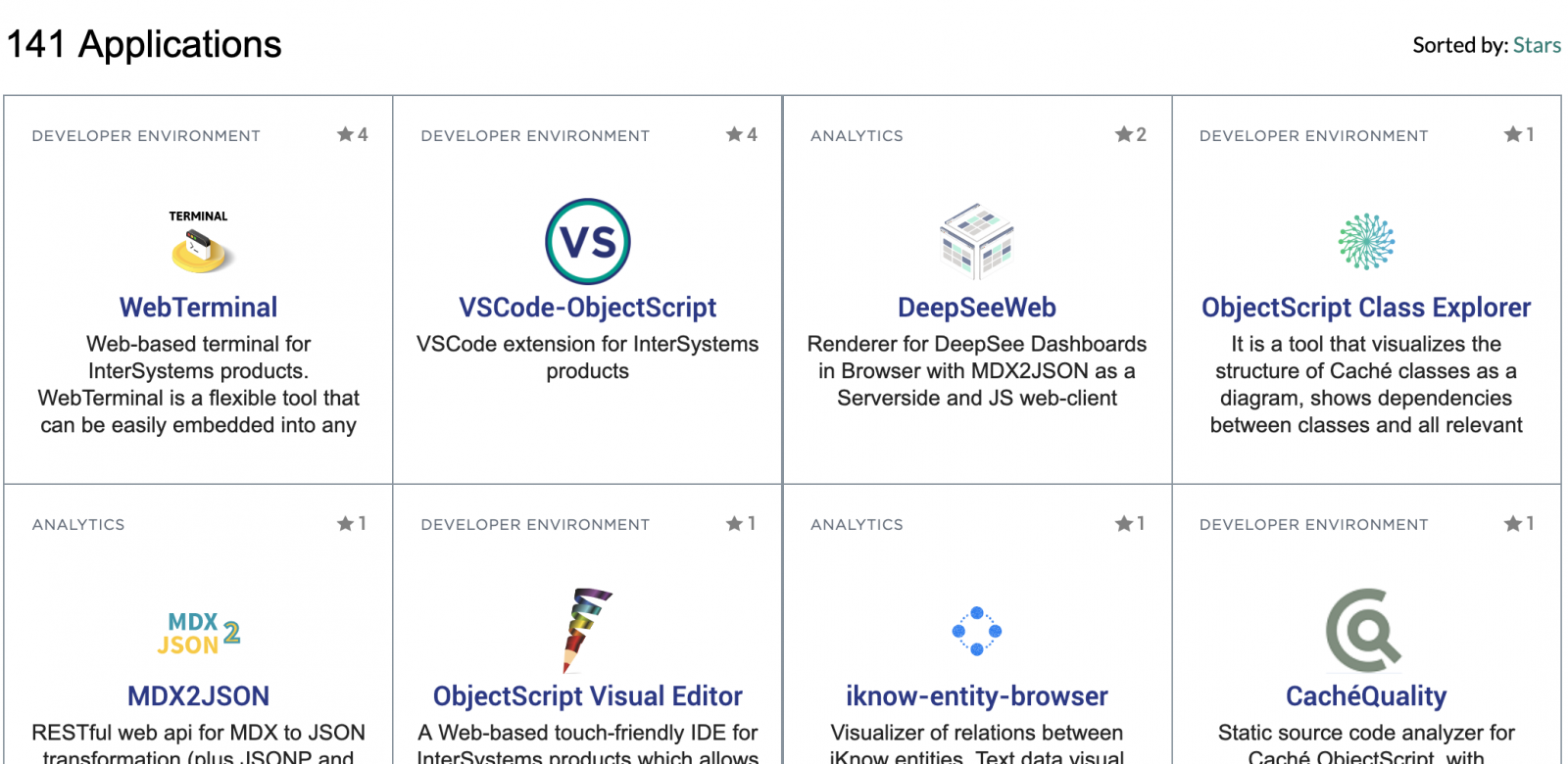
See the details below.
Opportunities exists for keen Caché developers to join our established software house in Redditch.
The Company
M-Tech Computers Ltd (www.amo.co.uk) is a successful independent software & IT Services company based in Redditch. M-Tech sells and supports AMO, a comprehensive multi-channel ERP solution including e-Commerce websites.
AMO is an integrated suite of software which covers all aspects of running a business including Sales from multiple channels (web sites, eBay, Amazon etc.
Hi,
I'm trying to send a file to other system using "Enslib.FTP.PassthroughOperation" and use below settings for connection and retry,
Connection Settings
StayConnected : -1
ConnectTimeout : 30
Additional Settings
RetryInterval : 15
FailureTimeout : 240
As per my analysis, if the connection is failed, it retries 16 times (FailureTimeout/RetryInterval). Initially, I assumed that ConnectTimeout also involves with RetryInterval and the total number of retry would be 6 times (FailureTimeout/(RetryInterval+ConnectTimeout)).
Hi Everyone!
You're very welcome to watch the new video on InterSystems Developers YouTube, recorded by @Evgeny Shvarov in the new format called "Coding Talks":
GitHub Flow with InterSystems IRIS: Edit with VSCode, Test with Docker, Commit, Push, Pull Request
Hi Community!
How can I know the port of management portal e.g. from terminal?
The one which looks like
localhost:port/
in browser?
Available at:
https://hub.docker.com/r/yape/yape/
$ docker container run --rm -v "$(pwd)":/data yape/yape --version
yape 2.2.6
See the readme at:
https://github.com/murrayo/yape
Changes include:
Greetings,
Can someone please show me via coding example(s) how to write an input prompt that will read in a function key, F7 for example, validate that the key pressed is F7 and then process it all via cache.
Hey everyone!
I had looked around a bit and couldn't find a native way to log queue counts in Ensemble/HealthShare so I wrote a quick task and persistent class to do it. Hope this saves someone a bit of time. Let me know your thoughts! Thanks!
Bobby Hanna
I have this fact table
| CheckTime | Error | Marker (1 or 0) |
| 2019-01-01 00:01:00 | 1 | 0 |
| 2019-01-01 00:02:00 | 5 | 1 |
| 2019-01-01 00:03:00 | 2 | 0 |
And the cube which is pretty much 1:1.
I have build an MDX:
SELECT NON EMPTY [Measures].[Error] ON 0,NON EMPTY [CheckTime].[H1].[Minute].Members ON 1 FROM [CHECKCUBE]Which produced this chart in DeepSeeWeb (there's obviously more data, but you get an idea):
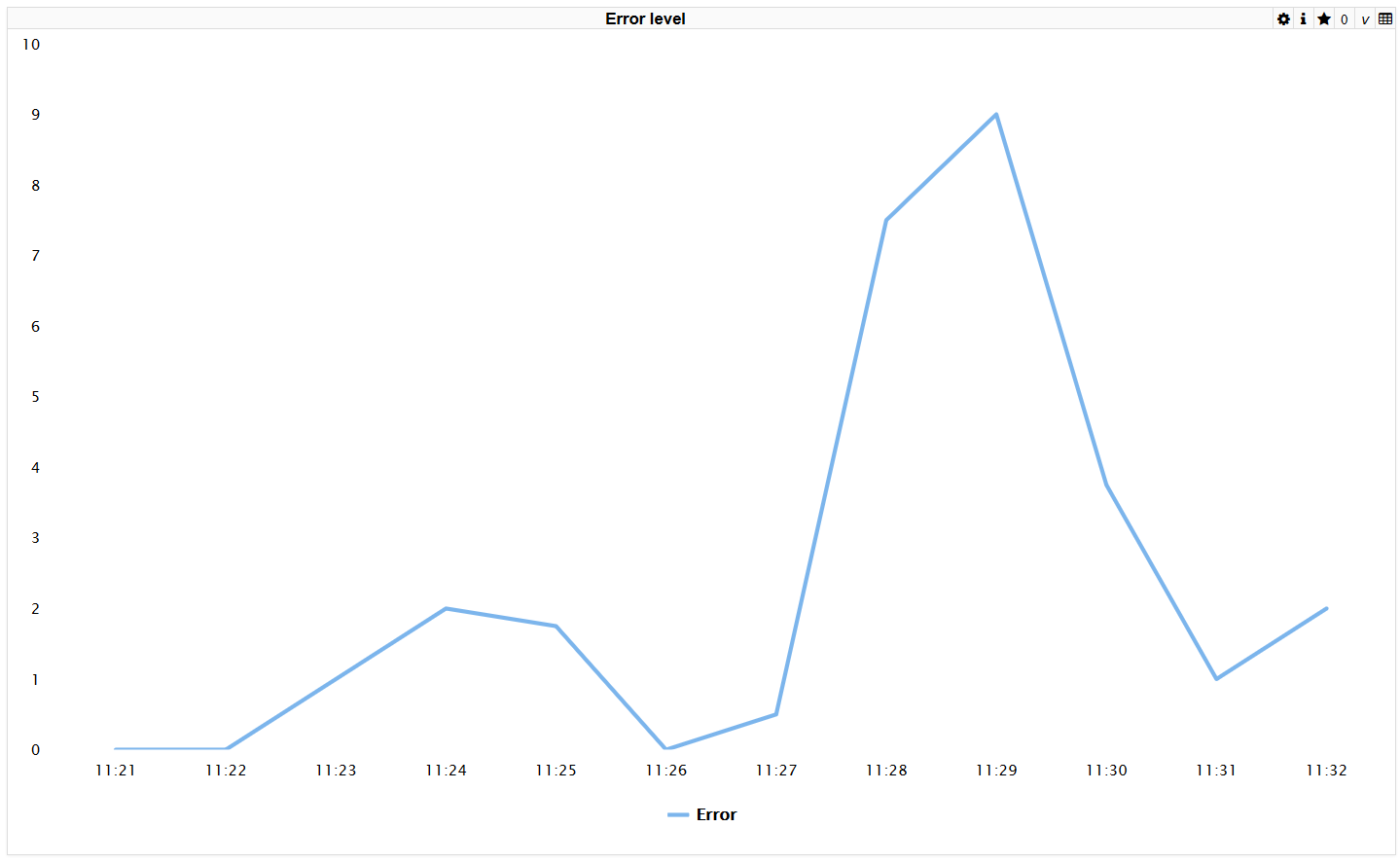
However, I want to add a Marker - if it equals 1 then I need some indication on the chart, so the graph should look like this:
Is there a way to do that in DeepSee or DeepSeeWeb?
Hi guys!
What is the IRIS analog for Ensemble.INC?
Hello,
as you can see in title my problem is with file ccontrol. I want to install whole Ensemble with Manifest if on machine wouldn't be any, or if I somehow find out instance of Ensemble I want to only use settings from included Manifest. I read that I can use file ccontrol to solve this task.
So can someone said me, how to work with ccontrol, is there some variable or function which returns me somethig? I have read some parts of documentation about ccontrol, but nothing help me so much, so you can give me link to part in documentation, where is this desribed.