Hi Developers,
Watch the new video on InterSystems Developers YouTube to learn how to develop with InterSystems ObjectScript using the Visual Studio Code plug-in.
Hi Developers,
Watch the new video on InterSystems Developers YouTube to learn how to develop with InterSystems ObjectScript using the Visual Studio Code plug-in.
Hey Developers,
The InterSystems Interoperability Contest is over. Thank you all for participating in our exciting coding marathon!
And now it's time to announce the winners!

A storm of applause goes to these developers and their applications:
Hi,
I need to develop a HL7 Q22/K22 query/response mechanism for a NHS Trust I am working for, but I do not know how to handle the message continuation.
Can any one give me any advise on this and/or point me in the direction of any documentation on the subject?
Thanks
Neil Thaiss
When logging in to the management portal page, how to send the encrypted user name and password when sending a request.png)
Report about what happened during a test - check Message Bank to see what happened on the instances that received test messages from Feeder
I developed Feeder on an IRIS instance while working in development VPC and I configured a Message Bank in a different namespace on the same IRIS instance. I added Feeder.csp and submitted Feeder app to Full Stack contest. I currently refactor the Feeder and Message Bank apps for Interoperability contest and to deploy in another VPC.
Below I show a sample report from development VPC:
NAMESPACE>DO ##class(UnitTest.TestReport).
Hey Developers,
This week is a voting week for the InterSystems Interoperability Contest! So, it's time to give your vote to the best solutions built with InterSystems IRIS.
🔥 You decide: VOTING IS HERE 🔥
How to vote? This is easy: you will have one vote, and your vote goes either in Experts Nomination or in Community Nomination.
Hey Developers,
Please welcome the first session from InterSystems Virtual Summit 2020:
⏯ Creating InterSystems IRIS Analytics Solutions Using Docker & VSCode
I have multiple files with different columns, first 9 values are fixed, so i want to ignore the first value, and next 8 values i want to combine into one value using ^ sign
Current Format
|||||||||||^^||||||^^|||||||||||||||||
|||||||||||^^||||^^|||||||||||||||||||||||
|||||||||||^^|||^^||||||||
Desired Format
^^^^^^|||^^||||||^^|||||||||||||||||
^^^^^^|||^^||||^^|||||||||||||||||||||||
^^^^^^|||^^|||^^||||||||
Reading each line from the file use below code.
#dim line as %String = tInput.ReadLine(, .
Hi everybody,
Is there a way to run code on another machine? Of course, all authentication info is known. I know only about RemoteResultSet but that seems to be query specific.
Thanks in advance,
Anna
P.S. The ultimate goal, in case that matters, is to create identical globals on 2 different machines with one run.

Every now and then you may encounter a situation where for various reasons
ODBC is the only option to access a remote system. Which is sufficient as long as you need to examine or change tables.
But you can't directly execute some commands or change some Global.
Greetings!
The application I work with has a need to update a user's google password using a service account and no user intervention other than clicking a link.
I'm in the process of figuring out how to do that from an IRIS server.
I've set up an OAuth 2.0 client with one client configuration, attempting to follow the documentation in https://community.intersystems.com/post/intersystems-iris-open-authoriz… as much as possible.
I also set up an SSL configuration to be used with Google.
According IDC, 80% of all data produced are NoSQL. See:
.png)
There are digital documents, scanned documents, online and offline texts, blob content into SQL, images, videos and audio. Imagine a Corporate Analytics initiative without all these data to analyze and support decisions?
In all the world, many projects are using techonologies to transform these NoSQL data into textual content, to allows analyze it.
Hi developers!
We introduced a set of bonuses to all the participants of the Interoperability Stack Contest.
And here is the table of current bonuses accomplishments:
Keywords: Python, JDBC, SQL, IRIS, Jupyter Notebook, Pandas, Numpy, and Machine Learning
This is another 5-minute simple note on invoking the IRIS JDBC driver via Python 3 within i.e. a Jupyter Notebook, to read from and write data into an IRIS database instance via SQL syntax, for demo purpose.
Last year I touched on a brief note on Python binding into a Cache database (section 4.7) instance.
GoogleTransled by moderator:
Where is the operation of verifying the user and password implemented in the path interface? Thank you very much for your answer!
1. Define Persistent Class
Call utility class to fetch json via query.
Class Test.JSONFromSQL Extends (%Persistent, %Populate)
{
Property FirstName As %String(POPSPEC = "FirstName()");
Property LastName As %String(POPSPEC = "LastName()");
Property CountOfThings As %Integer(POPSPEC = "Integer()");
ClassMethod OutputJSON() As %Status
{
If '..%ExistsId(1) Do ..Populate(100)
Set sql="select FirstName, LastName, CountOfThings from Atmus_Web_Test.JSONFromSQL"
Quit ##class(JSON.FromSQL).OutputJsonFromSQL(sql)
}
2. Utility Class
Class JSON.FromSQL Extends JSON.Base
{
ClassMethod OutputJsonFromSQL(
sql,
Hi Community!
How can I enable IRIS Text Analytics (formerly known as iKnow) in a given Namespace programmatically?
We use ExecureProcedure() to execute a stored procedure which returns a result set. But we see lot of "Invalid cursor state" errors when the result set is empty. The connection to SQL server database is made through ODBC.
ERROR #6022: Gateway failed: Fetch. + ERROR <Ens>ErrGeneral: SQLState: (24000) NativeError: [0] Message: [Microsoft][ODBC Driver 11 for SQL Server]Invalid cursor state
Here is the code snippet from the business operation class which uses EnsLib.SQL.OutboundAdapter
do ..Adapter.DSNSet(DataSourceName)
set sp = "{call sqlstoredprocedure(?,?,?)}"
set tSC = ..
We're looking to grow our team by adding an experienced healthcare interoperability resource to focus on Participant onboarding and troubleshooting, and testing and evaluation of in-house and third-party software solutions to ensure compliance with organizational standards and requirements.
Details of position are available on our Careers page.
#healthcare #remotework

“A Dry Martini”, he said. “One. In a deep champagne goblet.”
“Oui, monsieur.”
“Just a moment. Three measures of Gordons, one of vodka, half a measure of Kina Lillet. Shake it very well until it’s ice-cold, then add a large thin slice of lemon peel. Got it?”
"Certainly, monsieur." The barman seemed pleased with the idea.
Casino Royale, Ian Fleming, 1953
OAuth helps to separate services with user credentials from “working” databases, both physically and geographically. It thereby strengthens the protection of identification data and, if necessary, helps you comply with the requirements of countries' data protection laws.
With OAuth, you can provide the user with the ability to work safely from multiple devices at once, while "exposing" personal data to various services and applications as little as possible. You can also avoid taking on "excess" data about users of your services (i.e. you can process data in a depersonalized form).
Hooray!
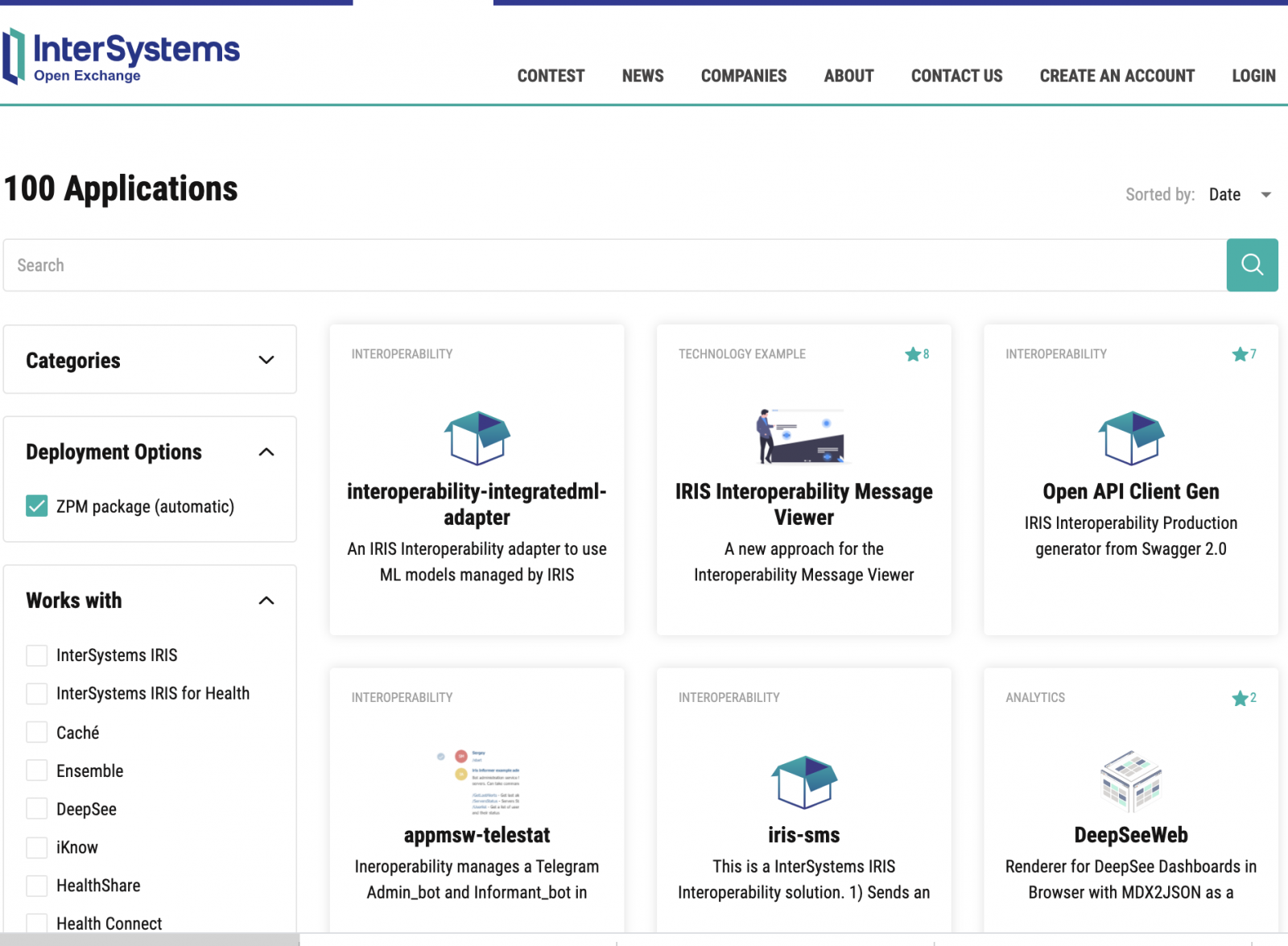
I'm pleased to announce that 100 ZPM modules are available in the public InterSystems IRIS zpm-repository! Now!
Thank you, developers! This is great that you adopt ZPM Package manager that fast and share your open source add-on libraries for InterSystems IRIS in a form of ZPM packages which means that each of them could be installed as:
USER>zpm "install module-name"
Wish to see the next milestone of 1,000 modules soon in 2021!
Thank you!
Hi,
I'm attempting to set up an Apache Rewrite Rule so that a url picks up a different csp page.
For example I want Apache http://hostname/csp/test/foo.csp to redirect to http://hostname/csp/test/bar.csp
Here is my example of Cache80.conf
<IfModule mod_ssl.c>
<VirtualHost _default_:80>
ServerName test.domain.com
DocumentRoot "/intersystems/irissys/csp"
ErrorLog ${APACHE_LOG_DIR}/error.log
CustomLog ${APACHE_LOG_DIR}/access.
Hi is there healthshare insallable for one user where one can create edge production, follow exercises to customize clinical viewer, create data loading routines takeing data from flat file and push data to ECR. Community version for IRIS for health does not have options to create edges and there is no clinical viewe
In the open exchange contest, the button vote not appears to me. How Can I do to vote in the contest?
Hi
Has anyone found a good terminal emulator replacement for Cache Terminal?
We want one where the up arrow works to bring back the last command typed (without extraneous characters appearing at the beginning of the line) and be able to run D ^JOURNAL and have it display correctly.
I tried WebTerminal a couple of years back and but it didn't work properly with the journal. I've tried RoyalTS and that doesn't do up arrow or the journal correctly even though it's supposed to be emulating a VT400.
Any suggestions?
thanks
Hi Community,
Please welcome the new video, specially recorded by @Yuri.Gomesfor the InterSystems Interoperability contest:
I've just installed Visual Studio Code, installed the InterSystems ObjectScript Extension Pack as documented here, connected it to a local InterSystems IRIS instance, and created a workspace associated with one of that instance's namespaces. However, after doing this, I don't see the ObjectScript button on the left toolbar when opening the workspace.
The ObjectScript extensions are installed and enabled as shown below; I've tried reinstalling them and restarting VSCode, but this doesn't make a difference:
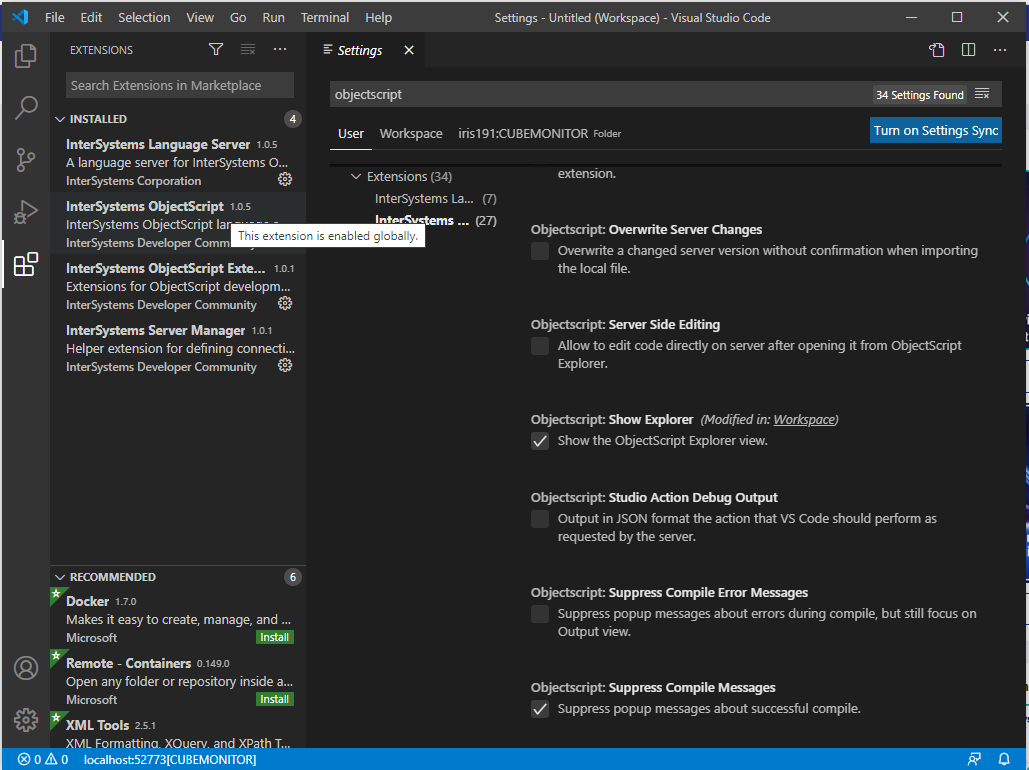
Has anyone seen behavior like this before?
We have an immediate requirement for an experienced Intersystems Ensemble/Health Connect consultant to join our team with a good grounding in OO Programming, Healthcare Integration and at least 2 years experience with InterSystems Ensemble/Healthshare Health Connect
Hello developers!
I submitted for the contest a solution that would allow organizing message notifications and providing information to users of the messenger Telegam. This is achieved by creating two bots: an administrator and an informant. The administrator manages the list of users connected to the bot informator and their access rights.
The Solution based on project https://github.com/intersystems-community/TelegramAlerts
IRIS Interoperability Productions formerly known as Ensemble are fun to work with. Yes, I really think my work is fun. I have seen File Passthrough Services and File Passthrough Operations come in handy. At one point we placed test messages in files, then we utilized a File Passthrough Service with Inbound File Adapter to send the contents of the file as a Stream to a File Passthrough Operation with Outbound TCP Adapter. The Operation pointed at a TCP service and sent the test messages.
Later I wanted to troubleshoot another service that received file contents as the body of HTTP requests.

