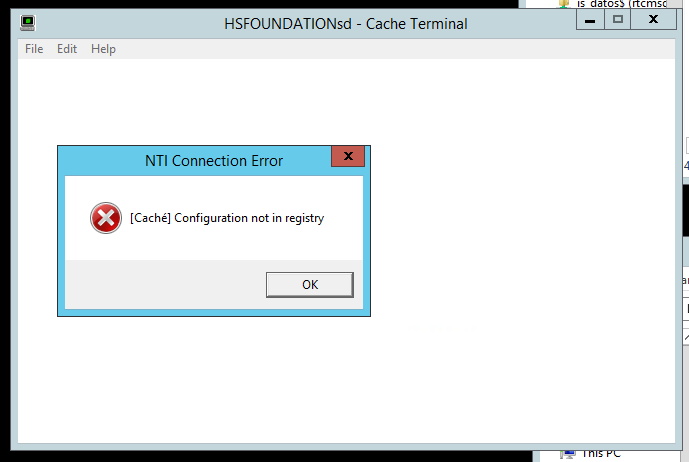
When assigning the filter to the server explorer in Atelier to hide system classes, it works only in server explorer.
The same server explorer option linked to a given project does not appear to observe the filter setting from the server connection, and has no ability to assign filters at the project level. Is this an enhancement needed or am i missing the logical requirement?
Also when assigning a tag to this post, only Atelier 1.1 BETA comes up. I believe i am using the stable release of 1.1
Has anybody used /epic/prd/bin/runlevel with different options to bring up or shutdown the cache db. I cannot see any information about it in the manual.
I am wondering about upgrading our Healthshare mirrored environment to the latest release. Has anyone upgraded recently to what version and what kind of effort was put into it. I am thinking it will take 2 analysts full time for 3 months. Am I out of the ball park on this estimate? We have bout 600 operations, Processes and services. What are some of the benefits we get from upgrading and what are some of the problems you ran into during the upgrade? Any information you have to share would be greatly appreciated.
Thanks
https://www.youtube.com/embed/ZOYZdojTqfQ [This is an embedded link, but you cannot view embedded content directly on the site because you have declined the cookies necessary to access it. To view embedded content, you would need to accept all cookies in your Cookies Settings]
Hello, I've completed this tutorial: https://community.intersystems.com/post/deepsee-period-date-vs-same-peri... I've used the "year" level instead of a pivot variable. I want to calculate something like the following variation: 100 * ([DateOfSale].[PTD] - [DateOfSale].[LYPTD]) / [DateOfSale].[LYPTD] I create a new calculated member, under the same dimmension with the above expression.
How to simply going to get the value of the system language from ^%z? Because I got a problem, U2 context isn't setup while connecting the SQL Connect.
In HealthShare clinician user specifications (as well as in the the clinical viewer), there are locations for specifying "proxy" user(s), but there doesn't seem to be anything in any of the documentation that explains what this actually means/enables.
Welcome to NewBie's Corner, a weekly or biweekly post covering basic Caché Material.
Caché and Cache
Caché and Cache are not the same. Caché is a product offered by InterSystems. Whereas Cache refers to memory storage. In computing, a cache /ˈkæʃ/ KASH, is a hardware or software component that stores data so future requests for that data can be served faster; the data stored in a cache might be the result of an earlier computation, or the duplicate of data stored elsewhere.
The related package avoids adding %JSONAdaptor to each class but uses instead SQL functions JSON_OBJECT() to create my JSON objects. With this approach, you can add JSON to any class - even deployed ones - without any need for change or recompiling.
The trigger was the Export of M:N relationships as JSON objects or arrays.
You probably have already seen this abbreviation SSO on different InterSystems sites: Community, Learning Portal, Global Masters, etc. It basically stands for Single Sign-On. This means that you need only one set of login and password and you can access all the Developer Ecosystem resources.
Hi, could someone tell me please how can I "unlock" a .cls file which author is Intersystems? I want to make some modifications and add some trace messages there. The file resides in the HS.FHIRServer namespace and it looks like read-only
In this webinar, we'll talk about how to choose a project and show you how to develop, build and deploy applications on InterSystems IRIS data platform. Also, there will be information about the hot internal projects at the moment (SQL client, VS Code unit tests and Jupyter notebooks), how to look at community opportunities in the Ideas portal, and what InterSystems would like to do with the management portal.
Date & Time: Monday, January 23 – 12 pm EST | 6 PM CET
IntegratedML is a feature helps us and our teams easily implement machine learning (ML) without dedicated ML experts and data scientists. If you do not need particularly complex ML function, integratedML is a good choice and convenient that only requires executing 3 SQL queries to build predictive models directly from InterSystems IRIS to ML engine.
Is there any cache command which can give who all has compiled a classes from the day it has been created. Specifically I want the 2 information username and time of compilation of class.
I tried with $$DATE^%R("TEST.1.INT"), but it only gives the last compilation time.
I have few odscodes in Lookup table named "AllowLT" .
Now I need to continue if I found value in lookup table or stop it. For that I have colleting the value form lookup table for input HL7 message OBR:21 value.
I know if found in lookup table it will return 1 or 0 . If not found what it will return below line? to return 0 in case , given key not available in lookup table , what I need to write?
Kidney Disease can be discovered from some parameters well known to the medical community. In this way, in order to help the medical community and computerized systems, especially AI, the scientist Akshay Singh published a very useful dataset for training ML algorithms in the detection/prediction of kidney disease. This publication can be found on the largest and best known data repository for ML, Kaggle at https://www.kaggle.com/datasets/akshayksingh/kidney-disease-dataset.
I am looking for an experienced IRIS for Health engineer to join the CVS Health family.
This position can be contractor, contractor for hire or direct hire.
We are doing our first implementation of the product and can use someone with experience.
The contractor role can be fully remote.
For a hire we are currently fully remote due to COVID, however, post CVID, we should be in a hybrid model (some remote and some onsite) in the Chicago area.
I have a PV1 repeating field that can contain multiple or a single value. I'd like to always pull the last value in the field but am not sure how to configure this in my DTL.
I'm looking for the best strategy for extracting data from a Cache table that houses 86 Million lines of data and around 190 columns. I'm currently using DBeaver and the Invoice Service dates go back to 1996. Optimistically I'm looking to pull to a pipe delimited flat file, but even a year's worth of data takes many hours to get query results.
I am trying to install IAM in my local and I downloaded IAM-0.34-1-1.tar.gz and extracted. I went to the location where iam_image.tar is available and run below command in the command prompt.
C:\ESB\HC\IAM-0.34-1-1.tar\IAM-0.34-1-1\IAM>docker load -i iam_image.tar unsupported os linux
Getting unsupported os Linux issue. Kindly let me know if anyone had this issue. Thanks!
I would like a REST client to be able to send a custom header with the http request, for example "APPLICATION-ID".
This can be seen in the CSP gateway trace but I have tried using %request.GetCgiEnv("HTTP_APPLICATION-ID") in various formats and parts of the classes but cannot work out where I can get this. Documentation says this should work but is for normal CSP pages.