Hey Community,
Enjoy the new video on InterSystems Developers YouTube:
⏯ A Day in the Life of a Developer - Data Platforms Roundup @ Ready 2025
Python is an interpreted high-level programming language for general-purpose programming. Created by Guido van Rossum and first released in 1991, Python has a design philosophy that emphasizes code readability, notably using significant whitespace
Hey Community,
Enjoy the new video on InterSystems Developers YouTube:
⏯ A Day in the Life of a Developer - Data Platforms Roundup @ Ready 2025
Hi all,
Let's do some more work about the testing data generation and export the result by REST API.😁
Here, I would like to reuse the datagen.restservice class which built in the pervious article Writing a REST api service for exporting the generated patient data in .csv
This time, we are planning to generate a FHIR bundle include multiple resources for testing the FHIR repository.
Here is some reference for you, if you want to know mare about FHIR The Concept of FHIR: A Healthcare Data Standard Designed for the Future
OK... Let's start😆
1. Create a new utility class datagen.utli.
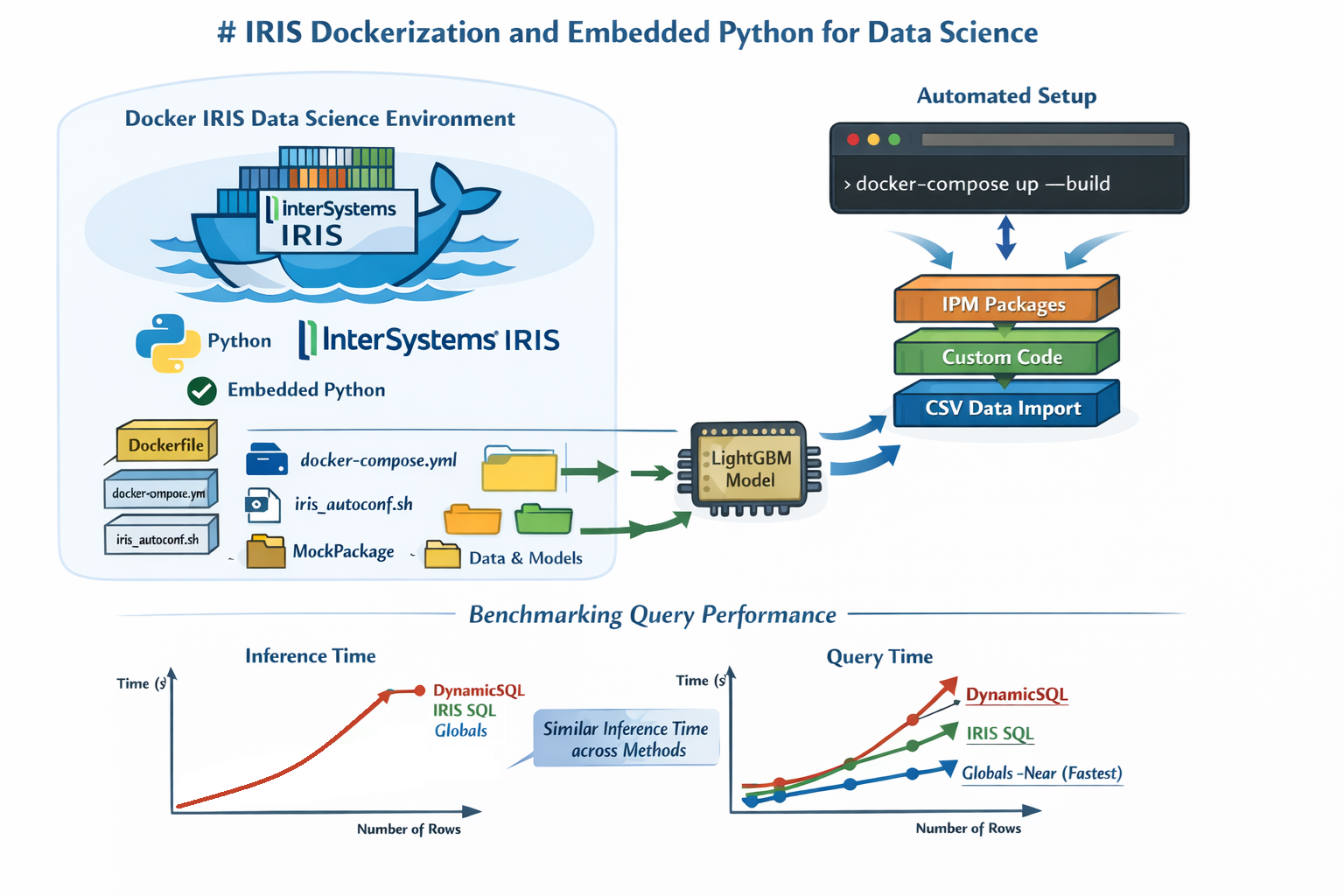
I am documenting a demo of InterSystems IRIS featuring Embedded Python and Jupyter Notebook deployed on the same container, and an Embedded Python application developed on that Jupyter Notebook IDE.
I have used the Docker container created by @Bob Kuszewski as a development environment to demonstrate how Embedded Python app can be developed in such a setting to push and retrieve data to and from InterSystems IRIS. The benefit of using this container as the development environment is that it is a virtual environment with Jupyter IDE and IRIS connected and running side by side.
Hi Community,
Are you a Python developer? If so, you can already start building apps with InterSystems IRIS without learning a new programming language!
👨💻Try this exercise to get started quickly with using Python's familiar DB-API interface to connect to an InterSystems IRIS database and run SQL queries.
💬What was your experience with the exercise? Let me know in the comments!
Hi all,
It's me again 😁. In the pervious article Writing a REST api service for exporting the generated FHIR bundle in JSON, we actually generated a resource DocumentReference, with the content data encoded in Base64
.png)
Question!! Is it possible to write a REST service for decoding it? Because I am very curious what is the message data talking about🤔🤔🤔
OK, Let's start!
1. Create a new utility class datagen.utli.decodefhirjson.cls for decoding the data inside the DocumentReference
Class datagen.utli.decodefhirjson Extends %RegisteredObject
{
}2. Write a Python function decodebase64docref to
a
I am trying to add Plotly Bar graph in a div to a CSPpage. I am working in IRIS 2022.1. I created persistent class.
I copied relevant code into github repo:
oliverwilms/iris-python-plotly
iris-python-plotly/csp/otwPlotly.csp at master · oliverwilms/iris-python-plotly
ClassMethod PlotlyDiv(pTrnYear = 2025, pTrnMonth = 8) As %String
{
Set importlib = ##class(%SYS.Python).Import("importlib")
Set plotdiv = ##class(%SYS.Python).Import("plotdiv")
Do importlib.reload(plotdiv)
Set div = plotdiv.
We are happy to present the bonuses page for the applications submitted to the InterSystems .Net, Java, Python, and JavaScript Contest!
See the results below.

| Project |
XEP
|
Native SDK
|
PEX
|
Java Persister
|
ADONET & . |
Hi,
It's me again😁, recently I am working on generating some fake patient data for testing purpose with the help of Chat-GPT by using Python. And, at the same time I would like to share my learning curve.😑
1st of all for building a custom REST api service is easy by extending the %CSP.REST
Creating a REST Service Manually
Let's Start !😂
1. Create a class datagen.restservice which extends %CSP.REST
Class datagen.restservice Extends %CSP.REST
{
Parameter CONTENTTYPE = "application/json";
}
2.
In my previous article, I introduced the FHIR Data Explorer, a proof-of-concept application that connects InterSystems IRIS, Python, and Ollama to enable semantic search and visualization over healthcare data in FHIR format, a project currently participating in the InterSystems External Language Contest.
In this follow-up, we’ll see how I integrated Ollama for generating patient history summaries directly from structured FHIR data stored in IRIS, using lightweight local language models (LLMs) such as Llama 3.2:1B or Gemma 2:2B.
The goal was to build a completely local AI pipeline that can extract, format, and narrate patient histories while keeping data private and under full control.
All patient data used in this demo comes from FHIR bundles, which were parsed and loaded into IRIS via the IRIStool module. This approach makes it straightforward to query, transform, and vectorize healthcare data using familiar pandas operations in Python. If you’re curious about how I built this integration, check out my previous article Building a FHIR Vector Repository with InterSystems IRIS and Python through the IRIStool module.
Both IRIStool and FHIR Data Explorer are available on the InterSystems Open Exchange — and part of my contest submissions. If you find them useful, please consider voting for them!
In a previous article, I presented the IRIStool module, which seamlessly integrates the pandas Python library with the IRIS database. Now, I'm explaining how we can use IRIStool to leverage InterSystems IRIS as a foundation for intelligent, semantic search over healthcare data in FHIR format.
This article covers what I did to create the database for another of my projects, the FHIR Data Explorer. Both projects are candidates in the current InterSystems contest, so please vote for them if you find them useful.
You can find them at the Open Exchange:
In this article we'll cover:
I’m excited to share the project I’ve submitted to the current InterSystems .Net, Java, Python, and JavaScript Contest — it’s called FHIR Data Explorer with Hybrid Search and AI Summaries, and you can find it on the InterSystems Open Exchange and on my GitHub page.
Hi everyone! 👋
I’m excited to share the project I’ve submitted to the current InterSystems .Net, Java, Python, and JavaScript Contest — it’s called IRIStool and Data Manager, and you can find it on the InterSystems Open Exchange and on my GitHub page.
It's about an example for the External Languages Contest 2025
You get almost any information about your databases in IRIS using
the System Management Portal. After passing several levels, you often
get a wide list of items, but the interesting ones are hard to find.
Hi Developers!
Here are the technology bonuses for the InterSystems .Net, Java, Python, and JavaScript Contest that will give you extra points in the voting:
While working with external languages for IRIS (such as Python and Node.js), one of the first things you must accomplish is making a connection to an IRIS instance.
For instance, to make a connection in python (from https://pypi.org/project/intersystems-irispython/):
import iris
# Open a connection to the server
args = {
'hostname':'127.0.0.1',
'port': 1972,
'namespace':'USER',
'username':'username',
'password':'password'
}
conn = iris.connect(**args)
# Create an iris object
irispy = iris.createIRIS(conn)
# Create a global array in the USER namespace on the server
irispy.Hi Developers,
We are happy to announce the new InterSystems online programming contest:
🏆 InterSystems .Net, Java, Python, and JavaScript Contest 🏆
Duration: September 22 - October 12, 2025
Prize pool: $12,000
(2).jpg)
Hey Community!
We're happy to share a new video from our InterSystems Developers YouTube:
I’ve been exploring options for connecting Google Cloud Pub/Sub with InterSystems IRIS/HealthShare, but I noticed that IRIS doesn’t seem to ship with any native inbound/outbound adapters for Pub/Sub. Out of the box, IRIS offers adapters for technologies like Kafka, HTTP, FTP, and JDBC, which are great for many use cases, but Pub/Sub appears to be missing from the list.
Has anyone here implemented such an integration successfully?
For example:
.png)
.png)
Along this OMOP Journey, from the OHDSI book to Achilles, you can begin to understand the power of the OMOP Common Data Model when you see the mix of well written R and SQL deriving results for large scale analytics that are shareable across organizations. I however do not have a third normal form brain and about a month ago on the Journey we employed Databricks Genie to generate sql for us utilizing InterSystems OMOP and Python interoperability.
These are the strategic plans of my example for the External Languages Contest 2025
In the previous article, we saw how to build a customer service AI agent with smolagents and InterSystems IRIS, combining SQL, RAG with vector search, and interoperability.
In that case, we used cloud models (OpenAI) for the LLM and embeddings.
This time, we’ll take it one step further: running the same agent, but with local models thanks to Ollama.
Customer support questions span structured data (orders, products 🗃️), unstructured knowledge (docs/FAQs 📚), and live systems (shipping updates 🚚). In this post we’ll ship a compact AI agent that handles all three—using:
Interoperability on Python (IoP) is a proof-of-concept project designed to showcase the power of the InterSystems IRIS Interoperability Framework when combined with a Python-first approach.IoP leverages Embedded Python (a feature of InterSystems IRIS) to enable developers to write interoperability components in Python, which can seamlessly integrate with the robust IRIS platform. This guide has been crafted for beginners and provides a comprehensive introduction to IoP, its setup, and practical steps to create your first interoperability component. By the end of this article, you will get a clear understanding of how to use IoP to build scalable, Python-based interoperability solutions.
Or can I change namespaces within one connection object?
This article is a continuation of the IRIS JSON project and features additional methods and insights.
Let's continue with the instance methods
This instance method is used to determine the JSON data type of the %DynamicObject or %DynamicArray.
It returns one of the following strings:
|
|
USER>Set array = [1,"test",true,12.I have a custom Buffer class which is designed to capture written/printed statements to the device, to be able to transform the captured text to string or stream type. I have used this in ObjectScript to capture ObjectScript write statements and return a string. I would like to try to use this with a [ Language = python ] method as follows. This class will be called by a scheduled task.
/// ObjectScript code which initializes buffer to capture statements written in nested method call
ClassMethod CollectStringFromBuffer()
{
set buffer = ##class(CustomClass.Buffer).%New()
do buffer.Reviewing my published packages, I identified a nasty bug in IRIS Native API

This article will introduce you to the concept of virtual environments in Python, which are essential for managing dependencies and isolating project from the OS.
A virtual environment is a folder that contains :
Virtual environments will help you to isolate your project from the OS Python installation and from other projects.
I am brand new to using AI. I downloaded some medical visit progress notes from my Patient Portal. I extracted text from PDF files. I found a YouTube video that showed how to extract metadata using an OpenAI query / prompt such as this one:
ollama-ai-iris/data/prompts/medical_progress_notes_prompt.txt at main · oliverwilms/ollama-ai-iris
I combined @Rodolfo Pscheidt Jr https://github.com/RodolfoPscheidtJr/ollama-ai-iris with some files from @Guillaume Rongier https://openexchange.intersystems.com/package/iris-rag-demo.
I attempted to run
python3 query_data.

In this section, we will explore how to use Python as the primary language in IRIS, allowing you to write your application logic in Python while still leveraging the power of IRIS.