Hi Community,
Please welcome the new video on InterSystems Developers YouTube:
⏯ Build HL7 Interfaces in a Flash
.png)
InterSystems IRIS for Health™ is the world’s first and only data platform engineered specifically for the rapid development of healthcare applications to manage the world’s most critical data. It includes powerful out-of-the-box features: transaction processing and analytics, an extensible healthcare data model, FHIR-based solution development, support for healthcare interoperability standards, and more. All enabling developers to realize value and build breakthrough applications, fast. Learn more.
Hi Community,
Please welcome the new video on InterSystems Developers YouTube:
⏯ Build HL7 Interfaces in a Flash
Hi Everyone,
I've been working on deploying an IRIS for Health environment in EKS. There is a video session in the InterSystems learning portal about this feature but I have not succeeded in finding the proper documentation and resources to use this in my Kubernetes cluster.
Has this been deprecated/discontinued? Any idea where can I find the resources? Should I stick to StatefulSets instead of using the IrisCluster resource type provided by this operator?
Loading your IRIS Data to your Google Cloud Big Query Data Warehouse and keeping it current can be a hassle with bulky Commercial Third Party Off The Shelf ETL platforms, but made dead simple using the iris2bq utility.
Let's say IRIS is contributing to workload for a Hospital system, routing DICOM images, ingesting HL7 messages, posting FHIR resources, or pushing CCDA's to next provider in a transition of care. Natively, IRIS persists these objects in various stages of the pipeline via the nature of the business processes and anything you included along the way. Lets send that up to Google Big Query to augment and compliment the rest of our Data Warehouse data and ETL (Extract Transform Load) or ELT (Extract Load Transform) to our hearts desire.
A reference architecture diagram may be worth a thousand words, but 3 bullet points may work out a little bit better:
.avro to keep the schema along the data: this will avoid to specify/create the BigQuery table schema beforehands..avro into the respective BigQuery tables you specify.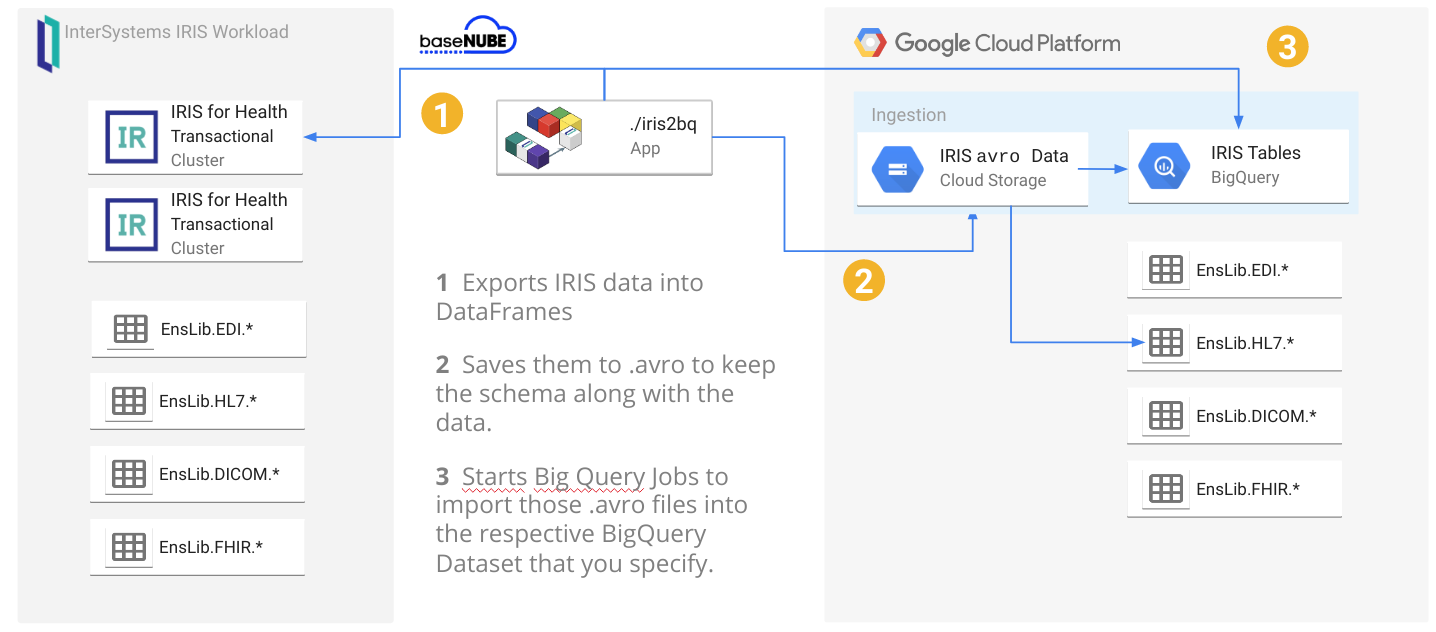
While I can query the HL7 message class EnsLib.HL7.Message (EnsLib_HL7.Message for SQL) to my heart's content in the SQL Shell or the Management Portal's SQL page, I can't seem to SELECT anything other than ID/%Id from an ADO/ODBC client. Properties such as TimeCreated, Name, MessageTypeCategory, etc. all seem to prevent the query from ever completing EXCEPT when I provide the ID as part of the WHERE criteria.
This works fine in the Management Portal and Shell:
SELECT head.ID As HeadId, body.ID As BodyId, body.Name as BodyName
FROM Ens.MessageHeader head
INNER JOIN EnsLib_HL7.InterSystems and Intel recently conducted a series of benchmarks combining InterSystems IRIS with 2nd Generation Intel® Xeon® Scalable Processors, also known as “Cascade Lake”, and Intel® Optane™ DC Persistent Memory (DCPMM). The goals of these benchmarks are to demonstrate the performance and scalability capabilities of InterSystems IRIS with Intel’s latest server technologies in various workload settings and server configurations. Along with various benchmark results, three different use-cases of Intel DCPMM with InterSystems IRIS are provided in this report.
Hi,
I created a BS with a SQL Inbound Adapter.
Query = "SELECT rowid, fname ,lname,datesent
FROM labs
WHERE datesent IS NOT NULL"
DeleteQuery = " update labs set datesent = Getdate() where rowid = ?"
KeyFieldName = "rowid"
i am getting the following errors.
"NOT assuming network disconnect error based on: Gateway failed: DropStatement."
"Skipping previously errored row '235'"
"Assuming network disconnect error based on: SQLState: (HY000) NativeError: [0] Message: [Microsoft][SQL Server Native Client 11.
Hi,
I have a production with a BS calling a BP calling another BP and so on and finally a BO. All calls are made using SendRequestSync.
The initial request is passed by value. The response is passed by ref and I allocate memory for it in the BO, hoping that it will go back to the initial caller in the BS, but it does not.
It looks like the following:
// In BS, do not allocate response, call BP1
Set tSC = SendRequestSync(request, .response)
// In BP1, call BP2. Now I don't know if .response is a reference to a reference
Set tSC = SendRequestSync(request, .response)
// In BP2, call BP3.
Dear Community,
In advance of the upcoming release of InterSystems IRIS 2020.1 and InterSystems IRIS for Health 2020.1, we're pleased to invite you to the “Office Hours: InterSystems IRIS 2020.1 Preview” webinars. These Q&A sessions will provide a forum for you to ask questions and learn about the latest product features in the upcoming releases.
The webinar will feature members of InterSystems product management team who will answer questions and provide additional information about the new features and enhancements.
We will be hosting two sessions on Thursday, February 20, 2020. Reserve your spot by clicking one of the buttons below for the appropriate time slot.
Hello,
I've always worked with typical web applications (a bunch of code files that sit in a server that connects to an RDS). Now our team is responsible for different IRIS for Health environments. We are currently working to set up the local dev environment and this is the current scenario:
* IRIS for Health local development server is running in a container
* Developers are using VSCode with the objectScript plugin
* GitHub as a version control system for the code and configuration.
Our goal is to be able to keep track of the entire code and configuration of the IRIS instance.
Hi Developers!
Another way to start using InterSystems ObjectScript Package Manager is to use prebuilt container images of InterSystems IRIS Community Edition and InterSystems IRIS for Health Community Edition.
We deploy this IRIS images on DockerHub and you can run it with the following command:
docker run --rm -p 52773:52773 --init --name my-iris -d intersystemsdc/iris-community:2019.4.0.383.0-zpm
Launch a terminal with:
docker exec -it my-iris iris session IRIS
And install zpm-module as:
USER>zpm

zpm: USER>install objectscript-math

[objectscript-math] Reload START

[objectscript-math] Reload SUCCESS

[objectscript-math] Module object refreshed.

[objectscript-math] Validate START

[objectscript-math] Validate SUCCESS

[objectscript-math] Compile START

[objectscript-math] Compile SUCCESS

[objectscript-math] Activate START

[objectscript-math] Configure START

[objectscript-math] Configure SUCCESS

[objectscript-math] Activate SUCCESS

zpm: USER>
And use same commands for InterSystems IRIS for Health using the tag: intersystemsdc/irishealth-community:2019.4.0.383.0-zpm
The images are being published on IRIS Community Edition and IRIS Community Edition for Health repositories of Docker Hub.
We will update tags with every new release of IRIS and ZPM.
Happy coding!
I was searching for the most simple way to connect from visual studio code to my local instance via terminal without having to change any window.
I know this can also be achieved via telnet but seems a bit overhead if you're in your local machine.
For me the simplest sollution is to open a terminal window in VS Code, navigate to the /bin folder of your instance installation and run .\csession.
Hi,
I need to set the label of a custom setting in the portal instead of the name of the associated property, eg.:
Class SomeClass Extends (Ens.BusinessService, %ZEN.Portal.Hi,
i have a DTL with generic source request (Inbound TCP).
i have added a parameter in the request class and compiled.
how do i now refresh or resync the DTL so that i see the new added field in the source.
Thanks
Hi Community,
Please welcome the new video on InterSystems Developers YouTube, recorded by @Patrick Jamieson:
⏯ A Healthcare Data Management Solution - What Kinds of Data
Preview releases are now available for the 2020.1 version of InterSystems IRIS and IRIS for Health!
Kits and Container images are available via the WRC's preview download site.
The build number for these releases is 2020.1.0.199.0. (Note: first release was build 197, updated to 199 on 2/12/20)
InterSystems IRIS Data Platform 2020.
InterSystems has corrected a defect that can result in skipping a transaction rollback. This can only occur after activation or addition of a mirrored database on a primary mirror member.
This problem exists for:
The conditions necessary for this defect to be triggered are quite specific. All of the following must apply:
Hi guys,
I thought I test the InterSystems IRIS for Health 2020.1, the Docker image. but for some reason, the container only lives for about 10 seconds and I can see from the message.log file that as soon as IRIS starts it then performs shutdown thus ending also container. Anyone else seen this?
here is the message.log part
*** Recovery started at Fri Feb 7 14:37:02 2020
Current default directory: /durable/iris-config/mgr
Log file directory: /durable/iris-config/mgr/
WIJ file spec: /durable/iris-config/mgr/IRIS.WIJ
Recovering local (/durable/iris-config/mgr/IRIS.
Hi Community,
The new video is available on InterSystems Developers YouTube Channel:
⏯ Collecting Healthcare Data with Alexa
Hi All - I want to share with the community a project I recently posted in OpenExchange, that extends on the Business Activity Monitoring features available with InterSystems IRIS’s integration framework. I have called this REST Business Activity Monitoring, and is implemented via a set of zaux.rBAM.* classes.
Hi everyone,
I am very pleased to announce that the Readmission Demo has been released as open source. Many thanks to the Solution Factory team that worked hard on making this possible.
Here are the changes:
Hi all,
I'm having issues with mounting custom database on top of IRISHealth 2019.1 docker container. Data gets mounted only in Read-only mode. This means read operations are successful but I couldn't make the image with databases mounted in Read/write, both modes. Is anyone having similar issue?
When reading %GlobalBinaryStream into a %String I am aware therte is a size limit of 3,6MB.
My question is since %Binary is underlying a %String is there a limit on this as well?
Can I safely read any size %GlobalBinaryStream into a %Binary?
Hi I am getting this message for some databases but not for others: This database is mounted as read-only due to 'Failed to access iris.lck file'! and not for others on Google Cloud community non-health edition.
For example this default database displays the message: Name IRISLIB Directory /usr/irissys/mgr/irislib/
But this default database does not: Name IRISSYS Directory /ISC/dur/mgr/
I have loaded IHS FOIA RPMS and am getting the message and <PROTECT> errors when running programs. Permissions on disk look ok to me, changed to the same as the default databases.
Updated 1/30/2020
*** The affected product versions have changed ***
*** The affected versions are Caché and Ensemble beginning with 2016.2.0. ***
*** Caché and Ensemble 2016.1.0 is not at risk for this defect ***
InterSystems has corrected a defect that can cause database degradation in extremely rare circumstances. Associated problems may include, but are not limited to, incorrect or missing application data and system hangs.
This defect affects:
hi,
Product:
| IRIS for Windows (x86-64) 2019.1.1 (Build 612U) Mon Oct 28 2019 11:29:24 EDT [HealthConnect:1.1.2] |
i am using a TCP Inbound Adapter with call interval set to 5.
To my understanding this means that the adapter check to see if there any connections to the port every 5 seconds.
But i am getting error "No Connection made on port 12123 within interval 5"
The sending application connections to the port happen at no specific interval, what are the recommended setting for call interval?.
Thanks
Hi Developers!
Recently we published on Docker Hub images for InterSystems IRIS Community Edition and InterSystems IRIS Community for Health containers.
What is that?
There is a repository that publishes it, and in fact, it is the same container IRIS Community Edition containers you have on official InterSystems listing which have the pre-loaded ObjectScript Package Manager (ZPM) client.
So if you run this container with IRIS CE or IRIC CE for Health you can immediately start using ZPM and install packages from Community Registry or any others.
What does this mean for you?
It means, that anyone can deploy any of your InterSystems ObjectScript application in 3 commands:
It is safe, fast and cross-platform.
It's really handy if you want to test a new interesting ZPM package and not harm any of your systems.
Suppose, you have docker-desktop installed. You can run the image, which wiil pull the latest container if you don't have it locally:
Hi Developers!
Many of you are looking for samples on how to work with InterSystems IRIS Analytics, formerly known as DeepSee.
There is a Samples BI module with Patients and Holefoods examples which is available on Github with source code. The installation steps are clear but take time.
Recently we added the option to run IRIS Community Edition containers with ObjectScript Package Manager (ZPM) on board. This simplifies the installation to the "run-one-command" step for the modules submitted to ZPM Community Registry. And thus we can benefit the Samples BI installation with ZPM.
And here is how you can run it on your laptop. Let's go!
Hello,
I have a record map and batch class being passed to an EnsLib.RecordMap.Operation.BatchFileOperation.
They are designated as INFORMATION.FPL.Record and INFORMATION.FPL.Header
After reaching the operation it errors out with this message : ERROR <Ens>ErrGeneral: Quitting with error on Message body 5@INFORMATION.FPL.Record / 54 because Status 'ERROR <EnsRecordMap>ErrNoBatchParent: Record with class 'INFORMATION.FPL.Record' and Id '54' doesn't belong to a batch' matched ReplyCodeAction 1 : 'E=F' resulting in Action code F
Some screen grabs are attached of my configuration.
I'm currently working with a developer to add IRIS/Caché functionality to his HL7 analysis tool that would allow its users to extract messages directly from the Ensemble message store. IRIS for Health Community Edition has been a great aid in debugging this, but I keep banging into the 5 connection license limit with Studio, the Management Portal, an IRIS terminal session and a client database connection using either ODBC or ADO.NET.
Hi,
My customer is implementing HL7 validation using EnsLib.HL7.Util.Validator.Validate in an HL7 production.
They set validation spec "dmr-z" because they want to allow unrecognized Z-segments and verify the presence of required fields.
Despite using "-z", Z-segments are not allowed and the following error occurs:
<Ens> ErrGeneral: Cannot validate segment schemas without a category.Unable to validate segment 8: ZPR.
Aside to that, when the verification spec is “dm-z”, the Z-segment is allowed as expected.
Can 't "r" and "-z" be used together?
Is there any other way to implement both validations?