#Deployment

3 Followers · 205 Posts

Software deployment is all of the activities that make a software system available for use. The general deployment process consists of several interrelated activities with possible transitions between them. 

Article Murray Oldfield · Jan 12, 2017 19m read

Hi, this post was initially written for Caché. In June 2023, I finally updated it for IRIS. If you are revisiting the post since then, the only real change is substituting Caché for IRIS! I also updated the links for IRIS documentation and fixed a few typos and grammatical errors. Enjoy :)


In this post, I show strategies for backing up InterSystems IRIS using External Backup with examples of integrating with snapshot-based solutions. Most solutions I see today are deployed on Linux on VMware, so a lot of the post shows how solutions integrate VMware snapshot technology as examples.

29
9 12215
Article Eduard Lebedyuk · Mar 1, 2018 6m read

Everybody has a testing environment.

Some people are lucky enough to have a totally separate environment to run production in.

-- Unknown

.

In this series of articles, I'd like to present and discuss several possible approaches toward software development with InterSystems technologies and GitLab. I will cover such topics as:

  • Git 101
  • Git flow (development process)
  • GitLab installation
  • GitLab WorkFlow
  • GitLab CI/CD
  • CI/CD with containers

This first part deals with the cornerstone of modern software development - Git version control system and various Git flows.
1
5 5023
Article Pietro Di Leo · Sep 24, 2025 23m read

Table of Contents

  1. Purpose of the article
  2. What containers are and why they make sense with IRIS
     2.1 Containers and images in a nutshell
     2.2 Why containers are useful for developers
     2.3 Why IRIS works well with Docker
  3. Prerequisites
  4. Installing the InterSystems IRIS image
     4.1 Using Docker Hub
     4.2 Pulling the image
  5. Running the InterSystems IRIS image
     5.1 Starting an IRIS container
     5.2 Checking container status
     5.3 Executing code in the container terminal
     5.4 Accessing the IRIS Management Portal
     5.5 Connecting the container to VS Code
     5.6 Stopping or removing the container
     5.7 Setting a specific password with a bind mount
     5.8 Using durable %SYS volumes
      5.8.1 What gets stored with durable %SYS
      5.8.2 How to enable durable %SYS
  6. Using Docker Compose
     6.1 Docker Compose example
     6.2 Running Docker Compose
  7. Using a Dockerfile to run custom source code
     7.1 Dockerfile example
     7.2 Docker Compose example
     7.3 Understanding layers, image tagging and build vs. run time
     7.4 Source code and init script
     7.5 Building the image with Dockerfile
     7.6 Running instructions in the containerized IRIS terminal
  8. Conclusion and what’s next
9
11 611
Article Eduard Lebedyuk · Feb 19, 2016 12m read

Suppose you have developed your own app with InterSystems technologies stack and now want to perform multiple deployments on the customers' side. During the development process you've composed a detailed installation guide for your application, because you need to not only import classes, but also fine-tune the environment according to your needs.
To address this specific task, InterSystems has created a special tool called %Installer. Read on to find out how to use it.

9
4 4704
Announcement Evgeny Shvarov · Nov 18, 2020

Hooray! 

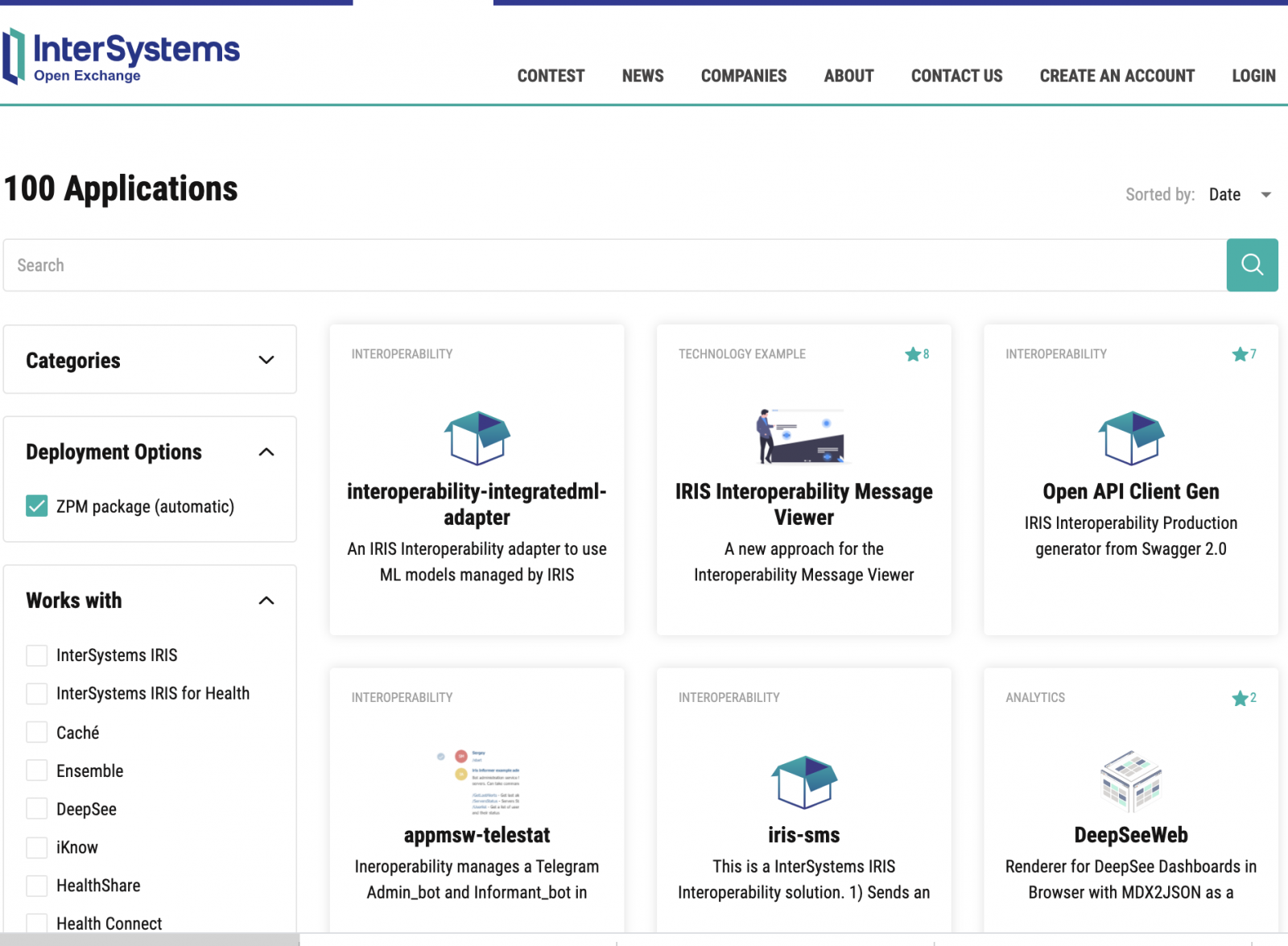
I'm pleased to announce that 100 ZPM modules are available in the public InterSystems IRIS zpm-repository! Now!

Thank you, developers! This is great that you adopt ZPM Package manager that fast and share your open source add-on libraries for InterSystems IRIS in a form of ZPM packages which means that each of them could be installed as:

USER>zpm "install module-name"

Wish to see the next milestone of 1,000 modules soon in 2021!

Thank you!

4
1 308
Article Nigel Salm · Aug 21, 2021 106m read

How to develop an interoperability solution in one code base and then use it to generate many individual interfaces

Overview

In 2009 I wrote the first of several Interfaces for LabTrak. The Interfaces allowed existing National Health Laboratory Services (NHLS) clients to send Patient Demographics and Orders to LabTrak. LabTrak would, in turn, send the results of those tests back to the client. I wrote 3 or 4 at the time and an Interface that fed data from LabTrak into the NHLS Corporate Data Warehouse.

2
0 799
Article Ariel Glikman · Mar 2, 2024 4m read

The IKO documentation is robust. A single web page, that consists of about 50 actual pages of documentation. For beginners that can be a bit overwhelming. As the saying goes: how do you eat an elephant? One bite at a time. Let's start with the first bite: helm.

What is Helm?

Helm is to Kubernetes what the InterSystems Package Manager (IPM, formerly ObjectScript Package Manager - ZPM) is to IRIS.

It facilitates the installation of applications on the platform - in a fashion suitable for Kubernetes.

2
5 711
Article Bob Binstock · May 16, 2018 6m read

InterSystems supports use of the InterSystems IRIS Docker images it provides on Linux only. Rather than executing containers as native processes, as on Linux platforms, Docker for Windows creates a Linux VM running under Hyper-V, the Windows virtualizer, to host containers. These additional layers add complexity that prevents InterSystems from supporting Docker for Windows at this time.

We understand, however, that for testing and other specific purposes, you may want to run InterSystems IRIS-based containers from InterSystems under Docker for Windows.

12
6 4528
Article Patrick Jamieson · Jul 19, 2025 10m read

Optimizing Performance of Apache Web Server and Web Gateway

By Patrick Jamieson, M.D., Product Technical Manager, InterSystems IRIS for Health

When working with InterSystems IRIS or IRIS for Health, an external web server like Apache2 or NGINX is essential for managing HTTP workloads, especially for FHIR servers Starting with version 2023.3, the private Apache server was removed from the installation kit (except for Community Editions and Health Connect).

1
4 334
Article Luca Ravazzolo · Sep 21, 2017 7m read

Last week saw the launch of the InterSystems IRIS Data Platform in sunny California.

For the engaging eXPerience Labs (XP-Labs) training sessions, my first customer and favourite department (Learning Services), was working hard assisting and supporting us all behind the scene.

Before the event, Learning Services set up the most complicated part of public cloud :) "credentials-for-free" for a smooth and fast experience for all our customers at the summit.

3
0 1109
Article T Wolfe · Jan 30, 2017 10m read

Quality of Service Mirroring Timeout Configuration

           The Quality of Service (QoS) timeout determines how long a Mirror configuration of Caché will tolerate a loss of connectivity between its members. However, the exact method by which it does this and what that means for someone looking to configure this setting on their own system is not entirely obvious.

2
5 2912
Article Ariel Glikman · Feb 11, 2025 5m read

The Istio Service Mesh is commonly used to monitor communication between services in applications. The "battle-tested" sidecar mode is its most common implementation. It will add a sidecar container to each pod you have in your namespace that has Istio sidecar injection enabled.

It's quite easy to get started with, just put the istioctl executable in your PATH, and label your namespace such that it tells Istio to acitvate side car injection there.

3
2 373
Article Ariel Glikman · Mar 8, 2024 3m read

The IKO will dynamically provision storage in the form of persistent volumes and pods will claim them via persistent volume claims.

But storage can come in different shapes and sizes. The blueprint to the details about the persistent volumes comes in the form of the storage class.

This raises the question: we've deployed the IrisCluster, and haven't specified a storage class yet. So what's going on?

You'll notice that with a simple

kubectl get storageclass

you'll find the storage classes that exist in your cluster.

1
1 457
Announcement John Murray · Sep 21, 2018

If you are attending Global Summit 2018 please be sure to say hello to George James Software in the Partner Pavilion.
You are also invited to the informal lunchtime meeting we're hosting at Global Summit on Tuesday 2nd October from 1pm in Indian Paintbrush, a meeting room at the conference venue. We will be previewing the next versions of Deltanji, our integrated source code management solution, and Serenji, our editor and debugger.

0
0 407
Article Ariel Glikman · Apr 15, 2025 4m read

If you look at the values.yaml of the IKO's Helm chart you'll find:

useIrisFsGroup: false 

Let's break down what it is and in what situations you may want to set it to true.

FsGroup refers to the file system group.

By default, Kubernetes volumes are owned by root, but we need IRIS to own its files (IRIS in containers is installed under irisowner user). To get around this we employ one of two methods:

1) initContainers

The initContainers run before app containers (like IRIS) in a pod. They generally set up the environment for the application and then run to completion/terminate.

0
0 230
Article Ariel Glikman · Nov 10, 2024 3m read

IAM - InterSystems API Manager is a great tool for monitoring your traffic. If you are trying to use it in your Kubernetes cluster you may have tried doing a deployment similar to this one:

apiVersion: intersystems.com/v1alpha1
kind: IrisCluster
metadata:
  name: iris
spec:
  licenseKeySecret:
    name: iris-key-secret
  configSource:
    name: iris-cpf
  imagePullSecrets:
    - name: intersystems-pull-secret
  topology:
    data:
      image: containers.intersystems.com/intersystems/iris-arm64:2024.1
      compatibilityVersion: "2024.1.
2
1 333
Article Ariel Glikman · Mar 4, 2024 4m read

We now get to make use of the IKO.

Below we define the environment we will be creating via a Custom Resource Definition (CRD). It lets us define something outside the realm of what the Kubernetes standard knows (this is objects such as your pods, services, persistent volumes (and claims), configmaps, secrets, and lots more). We are building a new kind of object, an IrisCluster object.

apiVersion: intersystems.
1
2 665
Article Anton Umnikov · Feb 11, 2020 19m read

InterSystems IRIS Deployment Guide for AWS using CloudFormation template

Please note: following this guide, especially the prerequisites section requires Intermediate to Advanced level of knowledge of AWS. You'll need to create and manage S3 buckets, IAM roles for EC2 instances, VPCs and Subnets. You'll also need access to InterSystems binaries (usually downloaded via WRC site) as well as IRIS license key.
 

Aug 12, 2020
Anton Umnikov

Templates Source code is available here: https://github.com/antonum/AWSIRISDeployment

Table of Contents

InterSystems IRIS Deployment Guide – AWS Partner Network

1
1 1869
Article Eduard Lebedyuk · Mar 7, 2018 7m read

In this series of articles, I'd like to present and discuss several possible approaches toward software development with InterSystems technologies and GitLab. I will cover such topics as:

  • Git 101
  • Git flow (development process)
  • GitLab installation
  • GitLab Workflow
  • Continuous Delivery
  • GitLab installation and configuration
  • GitLab CI/CD

In the previous article, we covered Git basics, why a high-level understanding of Git concepts is important for modern software development, and how Git can be used to develop software. Still, our focus was on the implementation part of software development, but this part presents:

  • GitLab Workflow - a complete software life cycle process - from idea to user feedback
  • Continuous Delivery - software engineering approach in which teams produce software in short cycles, ensuring that the software can be reliably released at any time. It aims at building, testing, and releasing software faster and more frequently.
1
4 3506
Article Ariel Glikman · Feb 2, 2025 3m read

All pods are assigned a Quality of Service (QoS). These are 3 levels of priority pods are assigned within a node.

The levels are as following:

1) Guaranteed: High Priority

2) Burstable: Medium Priority

3) BestEffort: Low Priority

It is a way of telling the kubelet what your priorities are on a certain node if resources need to be reclaimed. This great GIF below by Anvesh Muppeda explains it.

If resources need to be freed, firstly pods with Best Effort QoS will be evicted, then those with Burstable, and finally those with Guaranteed.

0
2 407
Article Muhammad Waseem · Mar 25, 2024 7m read

In this article, we will cover below topics:

  • What is Kubernetes?
  • Main Kubernetes (K8s) Components


What is Kubernetes?

Kubernetes is an open-source container orchestration framework developed by Google. In essence, it controls container speed and helps you manage applications consisting of multiple containers. Additionally, it allows you to operate them in different environments, e.g., physical machines, virtual machines, Cloud environments, or even hybrid deployment environments.


What problems does it solve?

0
3 448
Article Lorenzo Scalese · Nov 10, 2022 8m read

REST API for Security Package

Hi community,

In this article, we will learn how to set up a REST API for the IRIS Security Package. We will be able to create users, roles, add applications, etc... by simple HTTP requests as well as generate a client application in ObjectScript.

Requirements

We need :

  1. An IRIS instance (installation kit or docker).
  2. ObjectScript package manager (ZPM).
  3. (Optional) A second IRIS instance to generate an ObjectScript client.

We will use a set of existing applications and libraries on OpenExchange.

1
0 831
Article Mihoko Iijima · Nov 2, 2023 3m read

InterSystems FAQ rubric

For routines (*.mac)

You can hide the source by exporting/importing only the *.obj that is generated after compiling the source program.

The command execution example specifies EX1Sample.obj and EX2Sample.obj, which are generated by compiling EX1Sample.mac and EX2Sample.mac, as export targets and exports them to the second argument file.

After moving to another namespace, I am using the exported XML file to perform the import.

USER>do $system.OBJ.Export("EX1Sample.obj,EX2Sample.obj","D:\routine.
1
0 677
Article Andrew Sklyarov · Nov 2, 2025 7m read

Over time, while I was working with Interoperability on the IRIS Data Platform, I developed rules for organizing a project code into packages and classes. That is what is called a Naming Convention, usually. In this topic, I want to organize and share these rules. I hope it can be helpful for somebody.

Disclaimer: This guide is a good fit for Interoperability projects. When you have integrations, data flows, when you use IRIS for ETL processes, etc. Overall, when your code is combined with Productions.

4
4 213
Article Lorenzo Scalese · Apr 15, 2021 6m read

Hi Developers,

Writing a script for the application deployment can be very interesting to ensure rapid deployment without forgetting anything. config-api is a library to help developers to write configuration scripts based on a JSON document.

Implemented features :

  • Set system settings.
  • Set security settings.
  • Enable services.
  • Configure namespaces, databases, mapping.
  • Export existing configuration.
  • All features are exposed with a RESTful API.

This library is focused on IRIS configuration to help applications deployment.

19
0 1044
Article Ariel Glikman · Mar 6, 2024 3m read

The IKO allows for sidecars. The idea behind them is to have direct access to a specific instance of IRIS. If we have mirrored data nodes, the web gateway will (correctly) only give us access to the primary node. But perhaps we need access to a specific instance. The sidecar is the solution.

Building on the example from the previous article, we introduce the sidecar by using a mirrored data node and of course arbiter.

apiVersion: intersystems.
1
1 473
Article Anton Umnikov · May 31, 2021 6m read

All source code to the article is available at: https://github.com/antonum/ha-iris-k8s 

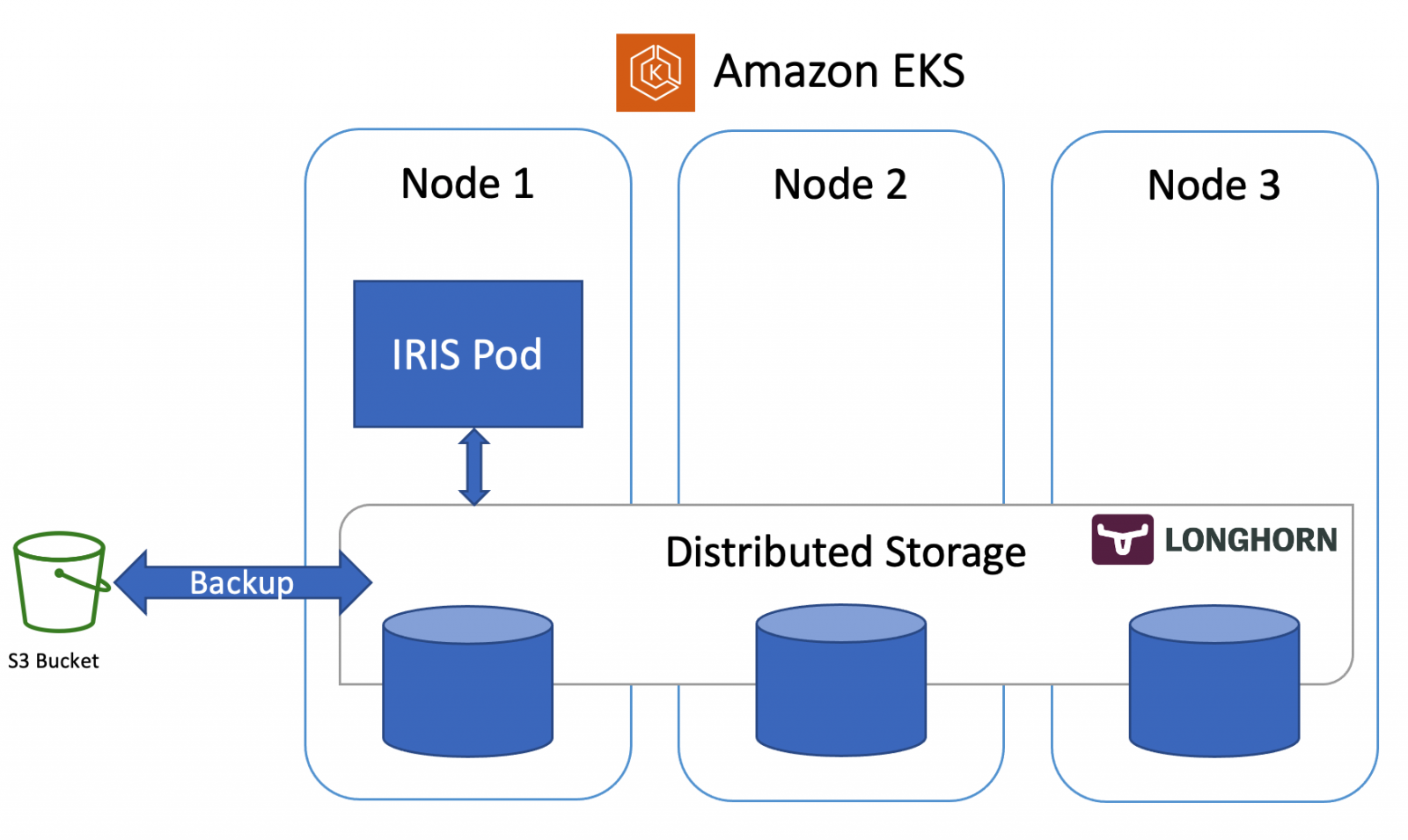
In the previous article, we discussed how to set up IRIS on k8s cluster with high availability, based on the distributed storage, instead of traditional mirroring. As an example, that article used the Azure AKS cluster. In this one, we'll continue to explore highly available configurations on k8s. This time, based on Amazon EKS (AWS managed Kubernetes service) and would include an option for doing database backup and restore, based on Kubernetes Snapshot.

Installation

Let's get right to business.

2
0 1606
Article Derek Gervais · Sep 8, 2025 3m read

Hey folks! Having recently onboarded to InterSystems, I realized that despite having a totally free and awesome Community Edition, it's not super clear how to get it. I decided to write up a guide highlighting all the different ways you can access the Community Edition of InterSystems IRIS:

Get InterSystems IRIS Community Edition as a Container

Working with a containerized instance of the Community Edition is the recommended approach for folks who are new to developing on InterSystems IRIS, and in my opinion it's the most straightforward. InterSystems IRIS Community Edition can be found on DockerHub; if you have an InterSystems SSO account, you can also find it in the InterSystems Container Registry.

In either case, you'll want to pull the image you want using the docker CLI:

docker pull intersystems/iris-community:latest-em
// or
docker pull containers.intersystems.com/intersystems/iris-community:latest-em

Next, you'll need to start the container: In order to interact with IRIS from outside the container (for example, to use the management portal) you'll need to publish some ports. The following command will run the IRIS Community Edition container with the superserver and web server ports published; note that you can't have anything else running that depends on ports 1972 or 52773!

docker run --name iris -d --publish 1972:1972 --publish 52773:52773 intersystems/iris-community:latest-em
0
2 529