
#Deployment

3 Followers · 205 Posts

Software deployment is all of the activities that make a software system available for use. The general deployment process consists of several interrelated activities with possible transitions between them. 

Question Brian Chen · Jan 27, 2019

Hello,

I am trying to copy an xml file generated on an Apache server into the Jenkins workspace post-build. I was thinking to use a 'send files over ssh' post-build script, but have not done this before and do not know how to refer to the file location on Apache server vs on Jenkins.

For example, if I want to copy from Apache's location of: "classes/UnitTest/Results.xml" into Jenkin's workspace: "/ReportFiles/Results.xml",

How does the script differentiate between whether the location address refers to the Apache server or Jenkins workspace?

Or is there a better alternative way to do this?
 

2
0 21791
Article Murray Oldfield · Jan 12, 2017 19m read

Hi, this post was initially written for Caché. In June 2023, I finally updated it for IRIS. If you are revisiting the post since then, the only real change is substituting Caché for IRIS! I also updated the links for IRIS documentation and fixed a few typos and grammatical errors. Enjoy :)


In this post, I show strategies for backing up InterSystems IRIS using External Backup with examples of integrating with snapshot-based solutions. Most solutions I see today are deployed on Linux on VMware, so a lot of the post shows how solutions integrate VMware snapshot technology as examples.

29
9 12204
Article Murray Oldfield · Jun 6, 2017 20m read

I am often asked by customers, vendors or internal teams to explain CPU capacity planning for large production databases running on VMware vSphere.


This post was originally written in 2017, I am updating the post in February 2026. For context I have kept the original post, but highlighted changes. This post was originally written for ESXi 6.0. The core principles remain valid for vSphere 7.x and 8.x, though there have been improvements to vNUMA handling, CPU scheduling (particularly for AMD EPYC), and CPU Hot Add compatibility with vNUMA in vSphere 8.

7
0 6759
Article Tete Zhang · May 17, 2017 5m read

Configuring an Ensemble production can be a challenging task involving a thorough understanding of the system and production functionality and a detailed understanding towards each configuration item. After successfully configured an Ensemble production, you might need to set up an identical production on the mirror environment, or deploy the production on a development system to a live system, or send a copy for diagnostic/debug purposes. Other times you might have spent some time designing a BPL/DTL and some other productions can use the same logic.

0
0 5346
Article Eduard Lebedyuk · Mar 1, 2018 6m read

Everybody has a testing environment.

Some people are lucky enough to have a totally separate environment to run production in.

-- Unknown

.

In this series of articles, I'd like to present and discuss several possible approaches toward software development with InterSystems technologies and GitLab. I will cover such topics as:

  • Git 101
  • Git flow (development process)
  • GitLab installation
  • GitLab WorkFlow
  • GitLab CI/CD
  • CI/CD with containers

This first part deals with the cornerstone of modern software development - Git version control system and various Git flows.

1
5 5017
Article Murray Oldfield · May 22, 2018 9m read

This post provides useful links and an overview of best practice configuration for low latency storage IO by creating LVM Physical Extent (PE) stripes for database disks on InterSystems Data Platforms; InterSystems IRIS, Caché, and Ensemble.

Consistent low latency storage is key to getting the best database application performance. For applications running on Linux, Logical Volume Manager (LVM) is often used for database disks, for example, because of the ability to grow volumes and filesystems or create snapshots for online backups.

4
1 4951
Article Eduard Lebedyuk · Feb 19, 2016 12m read

Suppose you have developed your own app with InterSystems technologies stack and now want to perform multiple deployments on the customers' side. During the development process you've composed a detailed installation guide for your application, because you need to not only import classes, but also fine-tune the environment according to your needs.
To address this specific task, InterSystems has created a special tool called %Installer. Read on to find out how to use it.
9
4 4700
Article Bob Binstock · May 16, 2018 6m read

InterSystems supports use of the InterSystems IRIS Docker images it provides on Linux only. Rather than executing containers as native processes, as on Linux platforms, Docker for Windows creates a Linux VM running under Hyper-V, the Windows virtualizer, to host containers. These additional layers add complexity that prevents InterSystems from supporting Docker for Windows at this time.

We understand, however, that for testing and other specific purposes, you may want to run InterSystems IRIS-based containers from InterSystems under Docker for Windows.

12
6 4526
Question Russell Knight · Aug 31, 2017

Greetings,

Is it possible to save Cache code into a file and then run it via command line?  

IE:  csession [ini] -U [ini] /path/cacheCodeFile.?

What I need to do is run a Cache script from the Linux command line.  The script will navigate data to produce a file and then it will exit back to the command line.

Thanks in advance for everyone's time.

2
0 3742
Article Mark Bolinsky · Jul 10, 2018 4m read

Often InterSystems technology architect team is asked about recommended storage arrays or storage technologies.  To provide this information to a wider audience as reference, a new series is started to provide some of the results we have encountered with various storage technologies.  As a general recommendation, all-flash storage is highly recommended with all InterSystems products to provide the lowest latency and predictable IOPS capabilities.

The first in the series was the most recently tested Netapp AFF A300 storage array.  This is middle-tier type storage array with several higher models above it.  This specific A300 model is capable of supporting a minimal configuration of only a few drives to hundreds of drives per HA pair, and also capable of being clustered with multiple controller pairs for tens of PB's of disk capacity and hundreds of thousands of IOPS or higher. 

0
0 3555
Article Eduard Lebedyuk · Mar 7, 2018 7m read

In this series of articles, I'd like to present and discuss several possible approaches toward software development with InterSystems technologies and GitLab. I will cover such topics as:

  • Git 101
  • Git flow (development process)
  • GitLab installation
  • GitLab Workflow
  • Continuous Delivery
  • GitLab installation and configuration
  • GitLab CI/CD

In the previous article, we covered Git basics, why a high-level understanding of Git concepts is important for modern software development, and how Git can be used to develop software. Still, our focus was on the implementation part of software development, but this part presents:

  • GitLab Workflow - a complete software life cycle process - from idea to user feedback
  • Continuous Delivery - software engineering approach in which teams produce software in short cycles, ensuring that the software can be reliably released at any time. It aims at building, testing, and releasing software faster and more frequently.
1
4 3503
Article Eduard Lebedyuk · Mar 20, 2018 8m read

In this series of articles, I'd like to present and discuss several possible approaches toward software development with InterSystems technologies and GitLab. I will cover such topics as:

  • Git 101
  • Git flow (development process)
  • GitLab installation
  • GitLab Workflow
  • Continuous Delivery
  • GitLab installation and configuration
  • GitLab CI/CD

In the first article, we covered Git basics, why a high-level understanding of Git concepts is important for modern software development, and how Git can be used to develop software.

8
3 3301
Article T Wolfe · Jan 30, 2017 10m read

Quality of Service Mirroring Timeout Configuration

           The Quality of Service (QoS) timeout determines how long a Mirror configuration of Caché will tolerate a loss of connectivity between its members. However, the exact method by which it does this and what that means for someone looking to configure this setting on their own system is not entirely obvious.

2
5 2911
Article Murray Oldfield · Nov 10, 2022 7m read

Overview

Predictable storage IO performance with low latency is vital to provide scalability and reliability for your applications. This set of benchmarks is to inform users of IRIS considering deploying applications in AWS about EBS gp3 volume performance.

Summary

  • An LVM stripe can increase IOPS and throughput beyond single EBS volume performance limits.
  • An LVM stripe lowers read latency.
1
0 2740
Article Luca Ravazzolo · Feb 2, 2018 4m read

Container Images

In this second post on containers fundamentals, we take a look at what container images are.

What is a container image?

A container image is merely a binary representation of a container.

A running container or simply a container is the runtime state of the related container image.

Please see the first post that explains what a container is.

Container images consist of a basic OS substratum and all the software we need to run our service. I use the term service for a given "container solution" as a generic description of a software solution wrapped in a container.

1
0 2531
Question Rosti Zacharias · Oct 24, 2018

Hi,

I would like to know if anyone has had some experience in building systems for multiple end-users. 

To keep things simple, in a hypothetical example, say an Event Booking System, where a Venue could sign up to use such a system and define it's Venue, costs, calendars, etc.. and then invite their customers to book the Venue on different days/times. 

If I wish to offer such a system to many

6
0 2412
Article Eduard Lebedyuk · Mar 13, 2018 4m read

In this series of articles, I'd like to present and discuss several possible approaches toward software development with InterSystems technologies and GitLab. I will cover such topics as:

  • Git 101
  • Git flow (development process)
  • GitLab installation
  • GitLab Workflow
  • Continuous Delivery
  • GitLab installation and configuration
  • GitLab CI/CD

In the first article, we covered Git basics, why a high-level understanding of Git concepts is important for modern software development, and how Git can be used to develop software.

In the second article, we covered GitLab Workflow - a complete software life cycle process and Continuous Delivery.

I this article we'll discuss:

  • GitLab installation and configuration
  • Connecting your environments to GitLab
2
2 2213
Announcement RB Omo · May 21, 2018

This document describes considerations around SDDC and HCI solutions for InterSystems Clients.

Software Defined Data Centers (SDDC) and Hyper-Converged Infrastructure (HCI) – Important Considerations for InterSystems Clients

A growing number of IT organizations are exploring the potential use of SDDC and HCI solutions. These solutions appear attractive and are marketed as simplification of IT management and potential cost reductions across heterogeneous data centers and cloud infrastructure options.

0
0 2107
Question Rich Taylor · May 9, 2018

I am working with a client to try and export a set of tasks defined in the Task Manager from one system to another.  I am not seeing any API for this.  I can query this information in SQL.  So I tried to use the Data Export Wizard from the System Management portal in the SQL window.  Export was fine.  Importing failed with a "can't insert into read only field" error.  Looking at the class definition does not help since the implementation details are not visible.

So how would one accomplish this?  Export scheduled tasks from one system to another?

25
0 1942
Article Nikita Savchenko · May 6, 2016 8m read

Greetings! This article describes yet another simple way of creating installers for the solutions based on InterSystems Caché. The topic covers applications, which can be installed or completely removed from Caché with one action only. If you are still documenting installation instructions that have more than one step to do to install your application — it’s high time you automated this process. 

14
0 1883
Article Anton Umnikov · Feb 11, 2020 19m read

InterSystems IRIS Deployment Guide for AWS using CloudFormation template

Please note: following this guide, especially the prerequisites section requires Intermediate to Advanced level of knowledge of AWS. You'll need to create and manage S3 buckets, IAM roles for EC2 instances, VPCs and Subnets. You'll also need access to InterSystems binaries (usually downloaded via WRC site) as well as IRIS license key.
 

Aug 12, 2020
Anton Umnikov

Templates Source code is available here: https://github.com/antonum/AWSIRISDeployment

Table of Contents

InterSystems IRIS Deployment Guide – AWS Partner Network

1
1 1864
Question Greg Arnold · Feb 6, 2017

I am looking for a way to deploy production changes (code and/or production configs) via script or some other systematic way other than the Ensemble/Deploy page in the Management Portal. My goal is to store these configurations in Subversion, then have a piece that can pull the XML from source control and deploy it to a given server. Is there some kind of script that I can run on a given server to perform this deployment? If so, I can tie it up with Subversion using another tool that I have access to.

If it helps, we are running Cache 2016.1 (HealthShare 15.01) on Red Hat Enterprise Linux 7.

6
0 1746
Question Andrew Harris · Dec 8, 2016

How suitable is Docker for standalone deployment of an Ensemble version and Ensemble application together?

The context is deployment by an application partner of an integration application and the supporting Ensemble version as a single package (single file ideally), to multiple environments and to multiple customer sites.

I don't have experience with Ensemble on Docker so I'm wondering what gaps and pitfalls may exist.

8
0 1684
Article Anton Umnikov · May 31, 2021 6m read

All source code to the article is available at: https://github.com/antonum/ha-iris-k8s 

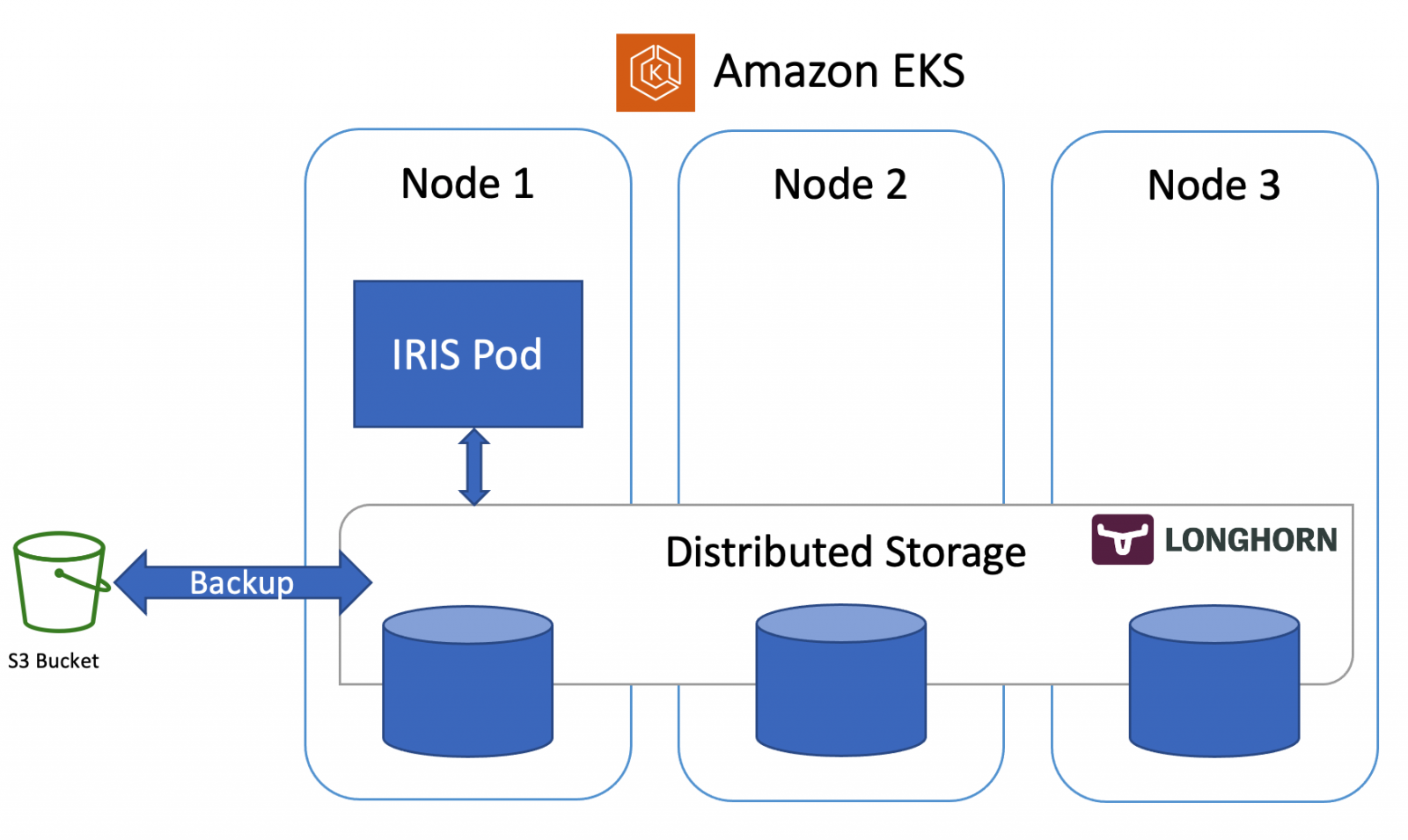
In the previous article, we discussed how to set up IRIS on k8s cluster with high availability, based on the distributed storage, instead of traditional mirroring. As an example, that article used the Azure AKS cluster. In this one, we'll continue to explore highly available configurations on k8s. This time, based on Amazon EKS (AWS managed Kubernetes service) and would include an option for doing database backup and restore, based on Kubernetes Snapshot.

Installation

Let's get right to business.

2
0 1602
Article Timur Safin · Feb 2, 2017 19m read

This is the second part of my long post about package managers in operating systems and language distributions. Now, hopefully, we have managed to convince you that convenient package manager and rich 3rd party code repository is one key factor in establishing of a vibrant and fast growing ecosystem. (Another possible reason for ecosystem success is the consistent language design, but it will be topic for another day.)

In this second part we plan to discuss the practical aspects of creating a package manager in general and their projection to the Caché database environment.

23
1 1503
Article Andreas Schneider · Mar 28, 2021 4m read

This small tutorial described how to „register“ the ADO.NET Database Provider (Driver) for InterSystems IRIS and InterSystems Caché on a Windows machine.

Before we start: Why need the ADO.NET Database Provider to be registered?

ADO.NET provides factory classes standardize the way programmer will create a provider-specific Connection. This simplifies the way programmers create provider specific instances in a generic data access API. Details about that can be found here: https://docs.microsoft.

0
0 1339