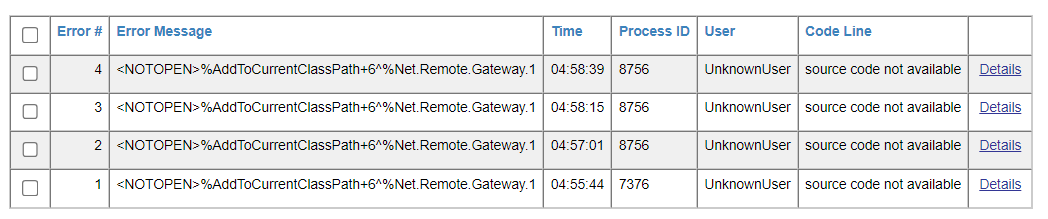
An exception occurs randomly.
I expect the value of ^TEST to be 20, but it's not.
Did i miss something like closing, flush the stream or locking the global?
This applies to embedded and dynamic SQL queries in Caché ObjectScript. If I attempt to terminate the process via Management Portal, nothing happens. Neither does Ctrl C nor closing the terminal window in which my program is running, nor setting a stop flag in a global which is read by the program on each loop iteration. The only way to stop the query appears to be restarting the Caché server (which is running locally on my PC).
I'm dealing with a situation that leaves in doubt what I understand about CACHE.WIJ (C:\Roche\CobasInfinity\HealthShare\mgr).. Journal files store records already written to the base.. and CACHE.WIJ records not yet written to the base.. theoretically, the data contained in CACHE.WIJ is temporary... until the record is written to the base (consequently generating journal).
We have several clients in different productions all accessing a web-service. We are trying to add another client in a new production, and its not working. The messages between the relevant Process and the SOAP web-client Operation are the same in the working and the non-working productions. But the web-service is reporting an XML parsing error to the non-working production. Here's the error as reported in the SOAP web-client Operation...
ObjectScript allows you to pass any number of arguments using arrays. Do it by adding ... after the argument name.
An example is as follows. In the example statement, the argument information is set in a global variable (a variable stored in the database) so that it can be easily checked after the method is executed.
AWS requires REST clients to call their APIs using Signature Version 4 which in case you don't know what I am talking about is a pain in the neck. Here comes the question:
Has anybody, by any chance implemented the v4 signing alg. in COS? If yes, would she or he have the kind heart to share?
In the sample below, an image file is encoded into a Base64 string in a class property, saved, decoded again with Base64, and restored to another file.
【Usage class】
Class User.test Extends %Persistent
{
Property pics As %GlobalBinaryStream;
}
Is it possible to have a single MUMPS variable representing all subscripts for a global? For example, if I have an ^ABC global and the ^ABC(1,2) node exist, is it possible to have a variable TEMP so that ^ABC(TEMP) would represent ^ABC(1,2)? TEMP="1,2" obviously does not work since it is interpreted as a single subscript, not two subscripts.
Developing a Full-Stack JavaScript web app with Caché requires you to bring together the right building blocks. In the previous part, we created a basic front-end React application. In the second part of this article series I will show how to choose the right back-end technology for your application. You will see Caché allows you to use many different approaches to link your front-end to your Caché server, depending on your application's needs. In this part we will set up a back-end with Node.js/QEWD and CSP/REST. In the next part we will enhance our basic web app and connect it to Caché using these technologies.
We are retiring a hosted application for an electronic health care records (EHR) system which stored the data on Cache for UNIX (Red Hat Enterprise Linux for x86-64) 2017.2.2 (Build 867_4_20245) Thu Oct 8 2020 16:58:40 EDT. The hosting company is providing me with a single CBK file. I need to install a database system to restore the database and provide occasional SQL access for reports when necessary. I'll need to maintain access to the data for an approximately 10 year retention period. Not sure how to approach restoring this old of a database and eventually upgrading it to a newer re
I need to ensure that the task created/scheduled, by system user, is created in the routine database and not remotely in the ECP to which it is connected. How can I guarantee the creation/scheduling of this task?
Here is a suggestion for creating the routine in both environments:
I'm trying to configure a specific process which dynamically sends messages to different endpoints based on datalookup keys, I've configured this aspect. What I'd like is to be able to visually see these connections without hardcoding them so is there a way to dynamically link them, i'll share what I tried below.
I am dealing with a very old code base (some routines date back to 1985 and were running on a M system 😉). It is rather huge and currently contains around 5000 compilable *.int routines.
My goal is to export all routine code as *.int UDL files and setup a git repository containing all routines.
I hope you are all doing well. I am currently facing an issue while trying to set up the SNMP subagent functionality for my InterSystems Cache installation.
I am using InterSystems Cache for Windows (AMD64) version 5.2.4 (Build 809_0_9006U). The SNMP subagent functionality requires the iscsnmp.dll dynamic library, which I have been unable to locate in my installation directory.
Currently, the SQL privileges (SELECT, INSERT, UPDATE, DELETE) are managed at the tables level, which can be very tedious when you have to administer many roles in an organization, and need to keep them sync with a constantly evolving data models. By managing privileges at the schemas level, will allow to give SELECT and other DML privileges to *all* or *several schemas* to a role|user, fixing the need to manually synchronize the new tables|views to the roles.
We often get questions about recent and upcoming changes to the list of platforms and frameworks that are supported by the InterSystems IRIS data platform. This update aims to share recent changes as well as our best current knowledge on upcoming changes, but predicting the future is tricky business and this shouldn’t be considered a committed roadmap.