A question that quickly arises when configuring IAM (aka Kong Gateway) is how many routes should be created to reach all the business objects in an IRIS API.

A common mistake is to create one route per business object, unnecessarily multiplying the number of routes.

Let's take the example of the Supply Chain Orchestrator Data Model API:

2 0
0 8

This article is intended as a beginner level article for people that want to learn how to use OAuth2 in their web applications natively.

There is an accompanying video/demo that may be helpful here:

https://www.youtube.com/embed/4mfWQwcKcMI
[This is an embedded link, but you cannot view embedded content directly on the site because you have declined the cookies necessary to access it. To view embedded content, you would need to accept all cookies in your Cookies Settings]

and you can reproduce this locally with the Open Exchange application attached.

8 0
1 42

There are numerous excellent tools available for testing your REST APIs, especially when they are live. Postman, various web browser extensions, and even custom ObjectScript written with %Net.HttpRequest objects can get the job done. However, it is often difficult to test just the REST API without inadvertently involving the authentication scheme, the web application configuration, or even network connectivity. Those are a lot of hoops to jump through just to test the code within your dispatch class. The good news is that if we take our time to understand the inner workings of the %CSP.REST class, we will find an alternative option suited for testing only the contents of the dispatch class. We can set up the request and response objects to invoke the methods directly.

9 5
7 235
Article
· Dec 11, 2025 8m read
Supply Chain Orchestration for dummies

Supply Chain refers to a set of processes and activities performed by the company's business areas and its suppliers and partners (stakeholders), from the acquisition of raw materials, through production, to delivery to the end consumer. It can be better managed using SCM solutions with the orchestration of the InterSystems IRIS:

7 0
5 166

The previous article introduced IrisOASTestGen, a tool designed to generate REST API test code for InterSystems IRIS based on OpenAPI 2.0 specifications. It demonstrated how to scaffold test cases using the default templates bundled with OpenAPI Generator.

This follow-up focuses on the next natural step: customizing the generated test code.
By extending the code generation logic with Mustache templates, it becomes possible to express richer semantics, implement CRUD-aware tests, and create more meaningful test suites.

0 0
0 59

How to set up RAG for OpenAI agents using IRIS Vector DB in Python

In this article, I’ll walk you through an example of using InterSystems IRIS Vector DB to store embeddings and integrate them with an OpenAI agent.

5 0
0 57

Project Overview / Introduction

Developing and testing REST APIs in InterSystems IRIS often requires a significant amount of boilerplate code. While ObjectScript provides powerful tools for building APIs, writing consistent and repeatable tests can be time‑consuming. This is where IrisOASTestGen comes in.

4 2
0 101

Hola amigo! 😊 Cómo estás hoy,

I would like to share a small part of my learnings from my first ever official project: POS/EDC machine integration with our billing system. This was an exciting challenge where I got hands-on experience working with APIs and vendors.

How does a Payment Machine actually work?

It's simple, start by initiating/creating a transaction, then retrieve its payment status.

Here, initiate/create refers to POST method and Retrieve refers to GET.

1 0
2 115

Why This Matters

Managing IAM can be tedious when done manually — especially when your APIs are already well-documented using OpenAPI (Swagger) specs. Wouldn't it be great if you could automatically generate Kong services and routes directly from your OpenAPI spec?

That's exactly what this ObjectScript method does: it reads an OpenAPI 2.0 spec stored in the XData block of your spec class and generates a decK-compatible YAML file that can be used to sync your IAM configuration.

2 0
2 90

Securing IRIS Integrations with Mutual TLS (mTLS): A Practical Guide

In today’s enterprise environments, secure communication between systems is not optional—it’s essential. Whether you're integrating InterSystems IRIS with cloud APIs, internal microservices, or third-party platforms, Mutual TLS (mTLS) offers a powerful way to ensure both ends of the connection are authenticated and encrypted.

This post walks through how to configure IRIS for mTLS and how to validate your certificates to avoid common pitfalls.

5 0
1 192
Article
· Sep 16, 2025 14m read
High Availability IAM

One of the recommendations when deploying InterSystems Technologies for production is to set up High Availability. The recommended API Manager for these InterSystems Technologies is the InterSystems API Manager (IAM). IAM (essentially Kong Gateway) has multiple deployment topologies.

8 2
3 205

FHIR Server

A FHIR Server is a software application that implements the FHIR (Fast Healthcare Interoperability Resources) standard, enabling healthcare systems to store, access, exchange, and manage healthcare data in a standardized manner.

Intersystems IRIS can store and retrieve the following FHIR resources:

  • Resource Repository – IRIS Native FHIR server can effortlessly store the FHIR bundles/resources directly in the FHIR repository.
  • FHIR Facade - the FHIR facade layer is a software architecture pattern used to expose a FHIR-compliant API on top of an existing one (often non-FHIR). It also streamlines the healthcare data system, including an electronic health record (EHR), legacy database, or HL7 v2 message store, without requiring the migration of all data into a FHIR-native system.

What is FHIR?

Fast Healthcare Interoperability Resources (FHIR) is a standardized framework created by HL7 International to facilitate the exchange of healthcare data in a flexible, developer-friendly, and modern way. It leverages contemporary web technologies to ensure seamless integration and communication across various healthcare systems.

4 0
3 346
Article
· Jul 10, 2025 16m read
The Zen Angle

Dear community, I have a confession to make. I have not gotten over Zen yet. Alas, all good things must come to an EOF, so I am currently learning about Angular. I am working on proving to myself that with the right back end and Angular components, I can deliver to myself and my team a very Zen-like experience in this environment.

8 7
1 266

Introduction

InterSystems IRIS allows you to build REST APIs using ObjectScript classes and the %CSP.REST framework. This enables the development of modern services to expose data for web apps, mobile apps, or system integrations.

In this article, you'll learn how to create a basic REST API in InterSystems IRIS, including:

4 3
3 229

IRIS supports CCDA and FHIR transformations out-of-the-box, yet the ability to access and view those features requires considerable setup time and product knowledge. The IRIS Interop DevTools application was designed to bridge that gap, allowing implementers to immediately jump in and view the built-in transformation capabilities of the product.

In addition to the IRIS XML, XPath, and CCDA Transformation environment, the Interop DevTools package now provides:

3 0
1 160
Article
· May 29, 2025 8m read
Integrate with Google Forms

Google Forms is the most popular solution on the market for collecting data, answering questionnaires and quizzes. So, it is the ideal solution for collecting patient data and responses in a practical way, without the need to expand or develop systems. In this article, I will detail how to create an account on Google Cloud, register the application that will consume the Google Forms API, generate the service user necessary to consume the API and finally perform actions to create new forms and collect data filled in them in an automated way in embedded Python and IRIS.

5 2
2 256


Hi Community,

In this article, I will introduce my application iris-fhir-bridge

IRIS-FHIR-Bridge is a robust interoperability engine built on InterSystems IRIS for Health, designed to transform healthcare data across multiple formats into FHIR and vice versa. It leverages the InterSystems FHIR Object Model (HS.FHIRModel.R4.*) to enable smooth data standardization and exchange across modern and legacy healthcare systems.

5 2
1 284

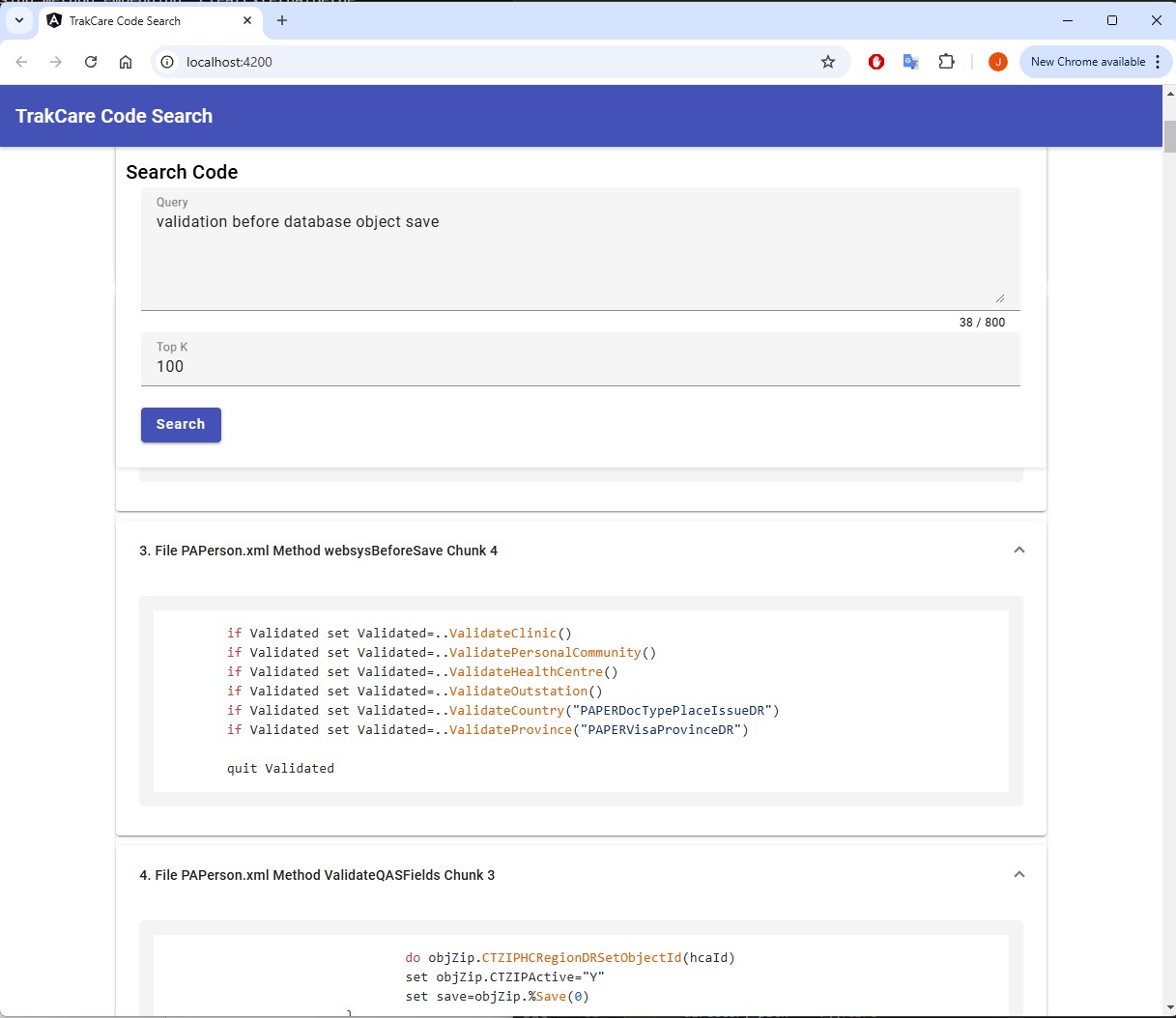
This article presents a potential solution for semantic code search in TrakCare using IRIS Vector Search.

Here's a brief overview of results from the TrakCare Semantic code search for the query: "Validation before database object save".

  • Code Embedding model

There are numerous embedding models designed for sentences and paragraphs, but they are not ideal for code specific embeddings.

6 0
1 303
Article
· Apr 1, 2025 1m read
How to get server/instance info

Hi all,

As part of the development an API to know what is the instance of IRIS is connected, I've found some methods to know information about the server that can help you.

Get the server name: $SYSTEM.INetInfo.LocalHostName()

Get the server IP: $SYSTEM.INetInfo.HostNameToAddr($SYSTEM.INetInfo.LocalHostName())

Get the instance name: $PIECE($SYSTEM,":",2)

6 2
0 346
Article
· Apr 1, 2025 1m read
IRIS-Intelligent Butler

# IRIS-Intelligent Butler
IRIS Intelligent Butler is an AI intelligent butler system built on the InterSystems IRIS data platform, aimed at providing users with comprehensive intelligent life and work assistance through data intelligence, automated decision-making, and natural interaction.
## Application scenarios
adding services, initializing configurations, etc. are currently being enriched
## Intelligent Butler

4 1
1 213

Introduction

As AI-driven automation becomes an essential part of modern information systems, integrating AI capabilities into existing platforms should be seamless and efficient. The IRIS Agent project showcases how generative AI can work effortlessly with InterSystems IRIS, leveraging its powerful interoperability framework—without the need to learn Python or build separate AI workflows from scratch.

16 10
3 579
Article
· Mar 17, 2025 2m read
Ollama AI with IRIS

In this article I will be discussing the use of an alternative LLM for generative IA. OpenIA is commonly used, in this article I will show you how to use it and the advantages of using Ollama

In the generative AI usage model that we are used to, we have the following flow:

9 2
2 373