Hello and welcome to the April 2026 Developer Community YouTube Recap.
Every great community is enriched by those who work tirelessly behind the scenes, crafting the knowledge and resources that help others grow. In the InterSystems Developer Community, one such person is @Derek Robinson — a dedicated educator, whose passion for teaching has helped shape how developers everywhere learn to work with InterSystems technologies.
👏 Let's take a closer look at Derek's journey in the InterSystems ecosystem.

Hey Community!
We know not everyone could join our live stream from the READY 2026, so we’re happy to share that you can now watch our session online.
👉 Streamlining Development Workflow with InterSystems Developer Community and Ecosystem
I am working on setting up OAUTH with FHIR and Microsoft Entra. I have configured the Client and configured it in the FHIR Server successfully. However, I get 401 when authenticating with a token. Looking at ^ISCLOG I see:
^ISCLOG("Data",9,0)="accessToken=<jwt token>, scope=, aud="
^ISCLOG("Data",10)=$lb(3,"OAuth2","[OAuth2.ServerDefinition:ValidateJWT]","171430","%SYS","2026-04-28 17:41:25.305549397","OAuth2.ServerDefinition.1","","zwKKakZZZx2")
^ISCLOG("Data",10,0)="JWT valid? sc=1"
^ISCLOG("Data",11)=$lb(3,"HSFHIRServer","[HS.FHIRServer.
In v2026.2 (currently available as a Developer Preview), we are adding a feature that can help in a FHIR Endpoint SMART/OAuth authorization - more out-of-the-box flexibility in audience value validation.
Hello and welcome to the April 2026 Open Exchange Recap.
General Stats:
✓ 10 new apps in April
✓ 386 downloads in April
✓ 1,227 applications all time
✓ 46,787 downloads all time
✓ 3,666 developers joined
When I build docker containers my build log usually looks like this:
#924.94Is there any way to record commands? Currently I need to add:
But it would be way better if I could just see what's being executed.
Hello and welcome to the April 2026 Developer Community Recap.
General Stats
✓ 108 new posts published in April:
– 36 new articles
– 44 new announcements
– 25 new questions
– 3 new discussions
✓ 294 new members joined in April
✓ 16,266 posts published all time
✓ 21,589 members joined all time
We have a large, existing production taking a feed from a single up-stream system and sending to a wide-variety of downstream systems. One of the downstream systems has been decommissioned, and we have deleted the classes that implemented the routing/transformations from the namespace, and deleted the components from the production (Wardview and WV Out in the diagram below). We now want to delete the messages associated with those components without deleting the messages associated with any other components.
READY 2026 has come to an end and we’re sure it brought a lot of great moments along the way 🚀 🚀
What stood out to you the most?
It could be a session, a conversation, an idea or just a moment that made you think “this is why I came”.
Share your experience in a few lines 👇
We’d love to hear what you’ve discovered and feel free to explore other replies and like the ones you relate to 💙

Ever since I started using IRIS, I have wondered if we could create agents on IRIS. It seemed obvious: we have an Interoperability GUI that can trace messages, we have an underlying object database that can store SQL, Vectors and even Base64 images. We currently have a Python SDK that allows us to interface with the platform using Python, but not particularly optimized for developing agentic workflows. This was my attempt to create a Python SDK that can leverage several parts of IRIS to support development of agentic systems.
One of the recommendations when deploying InterSystems Technologies for production is to set up High Availability. The recommended API Manager for these InterSystems Technologies is the InterSystems API Manager (IAM). IAM (essentially Kong Gateway) has multiple deployment topologies.
If you are looking for high availability you could use:
a) Kong Traditional Mode: Multiple Node Clusters
b) Hybrid Mode
c) DB-less Mode
Before we break them down let's first understand the out of the box deployment that is provided by InterSystems: Installing IAM Version 3.10.
Hi, Community!
Are you gathering data for clinical research? See how InterSystems OMOP can help streamline your data preparation:
- HealthShare Unified Care Record Overview – Virtual May 19-20, 2026
- Overview of HealthShare Unified Care Record® architecture, data flows, consent, and notifications
- This 2-day course provides an overview of HealthShare Unified Care Record®. It focuses on architecture, data flows, consent, alerts, user management and terminology.
- This non-technical course provides an introduction to the product for those who do not need the detail provided in the 5-day HealthShare Unified Care Record Fundamentals class.
Hi Community,
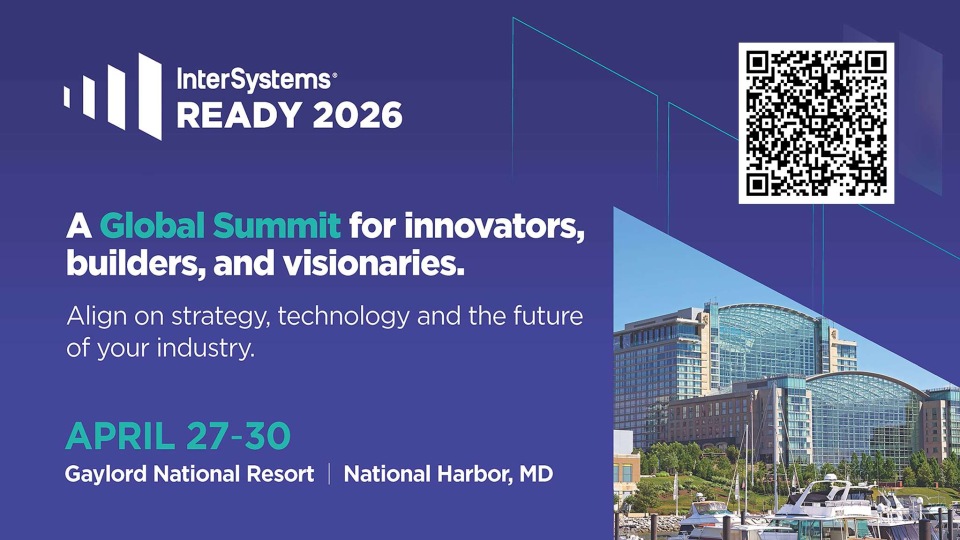
Can't make it to the National Harbor in person? You can still be part of READY 2026 — two streams will be going live during the event.
Hi everyone,
I’ve been diving into the new IRIS 2026.1 features this week, specifically trying out the opt-in modernized Interoperability UI and the new DTL Explainer, but I’ve recently hit a persistent technical snag where the Management Portal becomes incredibly sluggish and my Terminal sessions start to experience significant input latency.
I am currently using a community setup to handle some automated local logging and script-based data scrubbing for my production archives in the background while I work.
Hi Community,
Enjoy the new video on InterSystems Developers YouTube:
⏯ Whats Going On - Monitoring and Observability of InterSystems IRIS @ Ready 2025
InterSystems has released IAM 3.10.0.9, which is a maintenance release of IAM 3.10 that includes significant fixes, including fixes for security vulnerabilities.
For those of you running older versions of IAM, we encourage you to start planning your upgrade. Customers upgrading from versions of IAM earlier than 3.10 must get a new IRIS license key to use IAM 3.10.
IAM is an API gateway between your InterSystems IRIS servers and applications, providing tools to effectively monitor, control, and govern HTTP-based traffic at scale.
Hello,
can someone confirm to me if image for docker deployment of IRIS are ready for production? Also what about Healtshare products?
Thank you.
. . . you are not alone.
Help is available.
This took me a while to figure out, and I assume there may be others struggling too. I made my way through all the Entra stuff to set up a client credentials workflow to send email through a Microsoft 365 account. I was able to successfully retrieve my token, but I couldn't ever get it to authenticate with the SMTP server using the %Net.SMTP class. There were two parts to fixing this.
First, the authenticator's access token needs to be more than JUST the access token. It has to be formatted as:
set smtp.authenticator.AccessToken = "user="_emailaddress_$C(1)_"auth=Bearer "_token_$C(1,1)READY is right around the corner, and this year the Application Services team from InterSystems will be hosting a Embedded Git Users GroupMeeting during the conference!This will be held Thursday, April 30th during breakfast from 7:30 – 8:30 (breakfast will be served at the meeting room starting at 7:00am).
READY is right around the corner, and this year the Application Services team from InterSystems will be hosting a IPM Users GroupMeeting during the conference!This will be held Wednesday, April 29th during lunch from 12:30 – 1:30 (lunch will be served at the meeting room).
We are very excited to launch a new AI powered CCR feature which should help our users save time and prevent calls to Support. Today we are introducing the new CCR Transport Log Analyst (or CTLA) AI-Generated summary. The goal of CTLA is to provide an analysis of errors that have occurred in the Transport Log for a specific CCR, and advise the user as to what steps could be taken to correct the situation, as well as what might have been done to prevent it in the first place. When there is an issue with integrating or deploying a CCR, all of the details are captured in the Transport Log.
- InterSystems EMPI (formerly HealthShare Patient Index) – Virtual May 12-14, 2026
- Configure, tune, and work with InterSystems EMPI, an Enterprise Master Person Index
- This 3-day course teaches the installation, configuration, and use of InterSystems EMPI™ (formerly HealthShare® Patient Index). Starting with version 2025.1, HealthShare Patient Index has been renamed to InterSystems EMPI, but the core functionality remains the same.
- The first half of the class focuses on person identification issues and the tools for reviewing records and record matches.
Hey Community,
Yeah, I know we have a lot of tips & tricks articles - we even have a special tag for it, right? But I can not share my own collection. In this collection, you can find snippets for beginners, as well as some everyday ObjectScript constructions. In fact, it's also a way to learn something new about my favorite programming language. So, if you guys have anything to add, you are welcome!
Hi Community,
Enjoy the new video on InterSystems Developers YouTube:
⏯ Data Pipelines in Diagnostic Medicine - Architecting for Performance and Governance @ Ready 2025
A very important feature for HL7 FHIR has been introduced with the release of v2026.1 - the support for SMART on FHIR v2 fine-grained granular Scopes.
This enables you to be much stricter and more accurate in the access you provide to the data in your FHIR repository.
Part of this new support is to refuse requests that don't match the scopes, but an even more interesting ability is to filter the results according to the provided scopes.
The article was motivated by the 2025 September Article Bounty
The principle of Docker is just convincing to me.
- Get a sandbox where you play and try whatever you want/need to do
- Once done. You drop it without leaving traces in your working environment
This was the technical base for me to run about 700 reviews in OEX
with almost no side effects (except those caused by myself).
For beginners, I'll start with straight pure IRIS, no *health, *ML, *whatever
First, you need a Docker installation. It's available on almost any platform.
If one of your packages on OEX receives a review, you get notified by OEX only of YOUR own package.
The rating reflects the experience of the reviewer with the status found at the time of review.
It is kind of a snapshot and might have changed meanwhile.
Reviews by other members of the community are marked by * in the last column.
| # | Package | Review | Stars | IPM | Docker | * |
|---|---|---|---|---|---|---|
| 1 | ms-iris-credit-risk | another 6* top experience | 6.0 | . | y | . |
| 2 | Free DBsize with Swagger | great remote access | 5.0 | . | . | * |
| 3 | iris-configuration-manager-extension | Me popupou muito tempo. | 5.0 | . | . | * |
| 4 | docbook-markdown-extension | Convenient | 5. |
I am regularly contacted by customers about memory sizing when they get alerts that free memory is below a threshold, or they observe that free memory has dropped suddenly. Is there a problem? Will their application stop working because it has run out of memory for running system and application processes? Nearly always, the answer is no, there is nothing to worry about. But that simple answer is usually not enough. What's going on?
Consider the chart below. It is showing the output of the free metric in vmstat