I get the following error when I am trying to create a linked server connection via MS OLE DB Provider for ODBC Drivers in MS SQL Server Management Studio. The message I get is:
The OLE DB provider "MSDASQL" for linked server "IRIS" reported an error. The provider did not give any information about the error. Cannot initialize the data source object of OLE DB provider "MSDASQL" for linked server "IRIS". (Framework Microsoft SqlClient Data Provider)
Good morning. Can someone provide some advice? We know it is no longer supported or in development but it worked for the testing we were doing. We have several new people who need a copy. Does someone have a link to Iris Studio downloads?
If it's not available here are there other ways to test mumps code? Links? thank you!
I have an IRIS installation that is using 8-bit charset encoding (set to deu8 / Latin 1). I would like to convert everything (database and system) to Unicode
Charset encoding is something asked during installation, is it possible to change this on the fly ? The installer clearly say that Unicode systems cannot be converted. What about 8 bit ?
Same for database : is there possible conversion ?
I'm trying to use JWT authentication on a REST application in IRIS. The login API are correctly "injected" into the application. Login works fine with Postman and other REST clients, and subsequent calls to my REST API using the bearer token work fine (correctly authenticated). So far, so good.
I have an Interoperability Enabled namespace, however, when I try to configure it for production, the Production Configuration page freezes, and, it does not show a listing of my Interoperability Enabled namespaces-
Is there a way to search for a string or use of a function in all namespaces in one go.
Studio option "Search in files"/Ctrl+shift+F search all files in the current namespace. We have 13 namespaces and wanted to know if there is an easy way to search in all namespaces in one go.
Recently, I have noticed Scott Roth's mission to resolve issues with Orphaned messages with a lot of focus on prevention, and I envy that level of dedication.
So i want to use the INSERT OR UPDATE command so i can update a COUNTER for a given name:
INSERT OR UPDATE myTable SET name='Omer', counter = counter + 1;
as you can see with the above code - if the row is non-existent then we get an error because COUNTER is NULL! I tried the following to fix this but all have failed:
We are planning to move our system from windows to Linux and I never used Linux before and all I know that is another operating system, so the new server has Linux which looks like just terminal session like Dos and as I ran "uname -r" command to check for the version in it shows some like "6.1.112-124.190.amzn2023.x86_64".
So for the available IRIS distribution and can only found versions for Ubuntu and Red Heat, so do I have to either install one of them to be able to install & run IRIS?
We are in the process of migrating from Ensemble to IRIS.
After the migration I would like to find all usages of deprecated classes and methods in all of our code. This is to align with the changes in package like %SYSTEM.SQL for example.
Is there an easy way to do this, or maybe a tool that can assist?
Hi, I'm working on a large extraction from a database and need to parallelize the processes during the extraction.
Here's what happens:
The user starts the extraction from.
Several jobs are started using the Job <Method> instruction.
At the end, the user expects to find a document containing the results of all the extractions. What I'd like to do is start a new job that checks whether the previously started jobs have finished or are still working and consequently produce the document.
I'm attempting to streamline a process for renaming PDF documents received from multiple vendors to conform to a specification provided by an EMR vendor for ingestion. Things like Document ID, Document Type, Date of Service, Account Number, MRN, etc. all must be included in the filename at defined offsets and lengths. Most of the required values can be extracted from the inbound file's name and the few remaining are static values that would be the same (or handled via a lookup table based on source) for all documents.
I just installed the IRIS 2024 version 2 and it doesn't have Cache Studio. Doesn't anyone know how to add Cache Studio in the IRIS 2024 version 2 or did I install the wrong one? Thank you for your help in advance.
Since version 1.93 of VS Code, the “import and compile” process has been very slow (more than an hour). Have you encountered this issue and do you know how to resolve it?
Is there any mechanism already implemented in IRIS to prevent XSS exploits ?
This case happen when user input html/javascript content into fields and submit the page. If saved content is rendered as is, it's going to be executed by anyone visiting the page.
We have installed IRIS on a separate server that we access remotely and copied all code and data to it so we can test IRIS before we do the move.We develop directly on the server.
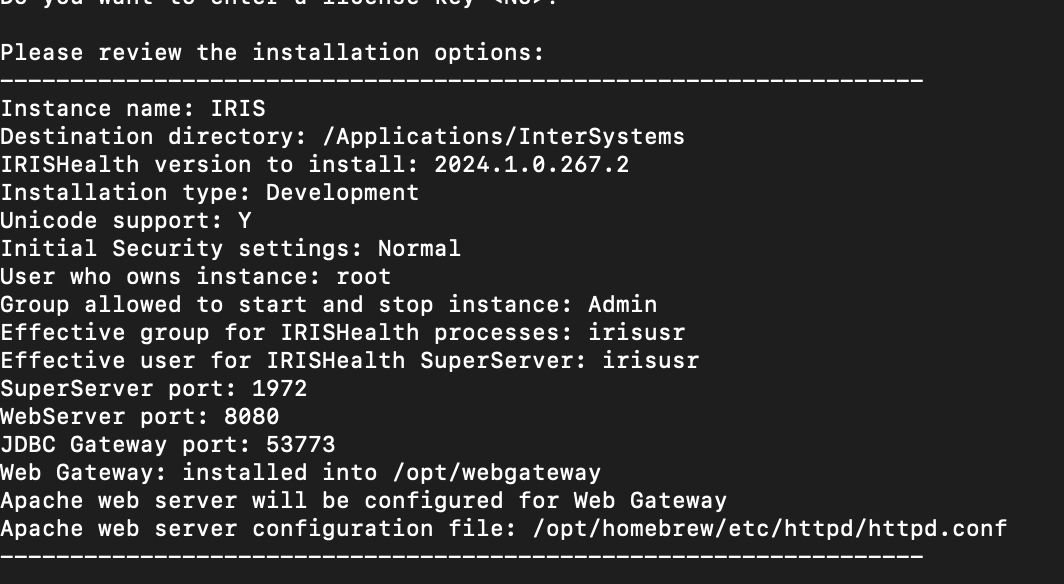
I don't know why I can't get into management portal. I saw something related to permission issue of group allowed to start and stop and have already changed to root and Admin but still doesn't work.
I have installed the latest version of IRIS (without a web server) to replace my community version with a embeded web server. I tried to connect Visual Studio Code to my namespace, but I am unable to do so. I keep receiving the message "Not found." Here is my configuration:
Hello, I try to develop a REST interface where I need to interact with legacy MUMPS routines. How can I pass in input to a Read without modifying the legacy code?
I think in linux I can execute command < inputfile to read from file, but how does it work in ObjectScript?
 Year
Year
.png)
.png)
.png)