Hi
I'm using %XML.Writer to write XML files from a database source, and I see that it is not encoding carriage return or line feed as 
 and 
 respectively, and is instead leaving them unencode.
What can I do to have them encoded?
Andy
Hi
I'm using %XML.Writer to write XML files from a database source, and I see that it is not encoding carriage return or line feed as 
 and 
 respectively, and is instead leaving them unencode.
What can I do to have them encoded?
Andy
Hi All,
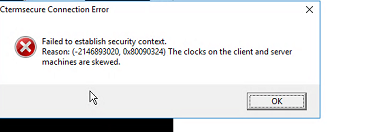
I am registered as an InterSystems Developer but when trying to login to the registry I get the following error
Hi,
Management Portal SQL Interface
ERROR #5540: SQLCODE: -104 Message: Field 'QT.Fehlermeldung.parameter' (value '<params wert=\"\" feldName=\"Modul.name:...') failed validation
I've checked the syntax with some public tools with adjusted Tablename "Fehlermeldung" -> `Fehlermeldung`. It seems to be valid, but cache does not accept it.
INSERT INTO "Fehlermeldung" VALUES (1001021,'qsDataFieldOutOfRange','10','Der Wert ''<wert>'' des Datenfeldes <feldName> \"<feldBezeichnung>\" ist <artDerAbweichung> als <feldBound>.','<params wert=\"\" feldName=\"Modul.name:Bogen.name:Feld.name\" feldBezeichnung=\"Feld.bezeichnung\" artDerAbweichung=\"Ein Wert aus [größer, kleiner]\" feldBound=\"Minimal- oder Maximalwert des Feldes je nach Wert in artDerAbweichung\" />','','Leistungserbringer','','','Leistungserbringer','Als Template-Meldung kann diese auch auf modifizierte Daten der DAS zutreffen.','')
If anybody could give me some insight on creating the %All Namespace programmatically I would appreciate it. There are quite a few posts I found that reference its creation using the UI, but I cant seem to get passed some validations with any form of the below:
Set Properties("Globals")="%DBDEFAULT"
//Set Properties("Library")="IRISLIB"
Set Properties("Routines")="%DBDEFAULT"
//Set Properties("SysGlobals")="IRISSYS"
//Set Properties("SysRoutines")="IRISSYS"
Set Properties("TempGlobals")="IRISTEMP"
Set tSC=##class(Config.Namespaces).Create("%All",.Properties)
The documentation for Config.
Hello,
We have recently received the two following errors as part of a PDF extraction process and I am trying to figure what the difference is between the two errors?
1. ERROR <Ens>ErrException: <MAXSTRING>zGetReferralDocFromStream+30^UCLH.SIP.Operation.PBT.HTTP.V1.RefDocRequest.1 -- logged as '-' number - @' set file=object.%Get(i).file'
2. ERROR <Ens>ErrException: <STRINGSTACK>zGetReferralDocFromStream+30^UCLH.SIP.Operation.PBT.HTTP.V1.RefDocRequest.1 -- logged as '-' number - @' set file=object.%Get(i).file'
Can someone please explain what the difference is?
Thanks!
Dear Comminuty,
Can you provide learning path recommendations to start on "InterSystems IRIS for Health"?
Hey Developers,
Thank you so much for being with InterSystems Developer Community for yet another year!
Day by day our team is trying to make it better and more useful for InterSystems developers. More than 10K+ members are already registered in our Community!
We'd like to know how helpful the Developer Community is for you today. Please take a few questions to let us know what do you think and what could be improved.
👉🏼 InterSystems Developer Community Annual Survey 2021 👈🏼
Note: The survey will take less than 5 minutes to complete.
Hello CCR Community,
InterSystems Certification is developing a certification exam for CCR and, if you match the exam candidate description given below, we would like you to beta test the exam. We anticipate the exam being available for beta testing on February 7, 2022, but interested beta testers should sign up now by emailing certification@intersystems.com. The beta testing must be completed by March 31, 2022.
What are my responsibilities as a beta tester?
You will be assigned the exam and will need to take it within a month of the beta release.
You will receive a string of comma-separated integers whose elements have both a negative and a positive value, except for one integer that is either only negative or only positive, our challenge will be to find that integer. As usual shortest solution wins.
##Input
"1,-1,2,-2,3"
##Output
3
3has no matching negative appearance
##Note
Class CodeGolf.PairedOpposites
{

ClassMethod Solve(o As %String) As %Integer
{
}

}
InterSystems has corrected a defect that can result in an SQL query returning incorrect results.
This defect exists only in the 2021.2 (Continuous Delivery) version of:
InterSystems IRIS Data Platform
InterSystems IRIS for Health
HealthShare Health Connect
InterSystems has replaced existing distributions of these products with new builds that correct the defect. The corrected distributions can be identified by the build number (651) and are available via normal means. Ad Hoc corrections are not available for Continuous Delivery (CD) distributions.
The MONITOR process (also called the Caché Monitor) scans the messages in your cconsole.log file and sends you emails based on the severity of those messages. The MONITOR is configured using the ^MONMGR utility in terminal.
The MONITOR should not be confused with the similarly named System Monitor, which checks a variety of system health and performance metrics and can log messages regarding them to the cconsole.log, where they can then be scanned by the MONITOR.
The process begins automatically at Caché startup and scans your cconsole.
This package was triggered by the extra bonus points in the contest for writing the example
in embedded Python only. Therefore PURE
This concept may be known to some, but I just found it very useful and I would like to share as it may help someone else.
If you are working with CSP or Zen you sometimes come across the need to use embedded JavaScript. Suppose you are working with some loops, which use < or > as shown in example below:
&js<
var test = document.getElementById('seTest');
for (var i = 0; i < test.options.length; i++) {
// Do Something here with my test.options[i].
Hello guys! I need some assistance with these problems I have.
The first one is that I need to execute a Python file, which is at /XY path. This PY is supposed to read an excel file and create a CSV version in /XZ path.
I am quite sure that the PY file is correct, but when using this function I get nothing but this error:
SET tSC = $ZF(-100,"/ASYNC /SHELL ", "python", "/data/InterSystems/IRIS/mgr/TEST01CODE/ExcelReading/ExcelToCSV.py")
ConfigItem 'FJ EXCEL READING' (FJ.BS.ExcelReading) started in job 3164
ERROR #00: (sin descripción de error)
Any ideas or suggestions?
What is the best way to add an en-uk.json or an en-za.json file to the custum folder, since the default is en-us.json?
<hspc-home>/base/ui-custom-app/assets/i18n/en-za.json
Where can I get the json files for UK and Za ?
Is there a straightforward workflow in VS Code for moving a class from one namespace to another on the same server? With Caché/IRIS Studio, it was a (sort of) simple export/change namespace in file menu/import operation. But in VS Code it's not obvious (to me, at least).
I can add multiple namespaces to a workspace, but when using isfs:// paths I see only a "Download" option and no "Upload" or "Import/Compile." When I'm navigating the local file tree, I see Import options, but no way to select the namespace into which I want to import.
Could be enabled a service as "%service_telnet" from cmd? I need to open a cache terminal from cmd but without this service enabled it is not possible, I mean avoiding the use of manage portal of course.
I will give you some additional information on my first embedded Python package.
it is written as a mix of python and ObjectScript to take the best of both worlds.
Hey Developers,
New video is already on InterSystems Developers YouTube channel:
InterSystems has been using a two-stream release cadence with InterSystems IRIS since 2018 (see the original announcement from when we started). We provide:
I was wondering if there was a certain procedure or documentation on securing (Https://) the Web Portal into IRIS/Ensemble?
Currently we are using LDAP Delegated Authentication to access the Web Portal using LDAP. However as more and more emphasis is put on securing applications within networks, I can see Management/Security asking us to make sure that the web portal is more secure.
Maybe I am not looking at the right place for documentation, but is there a Best Practice guide, set of instructions, or Online learning that can help guide me in trying to make our environment more secure?
EnsLib.File.PassthroughService replaces spaces with underscores in filenames.
Example:
File name of GWUH_9999_GWUHMRN_9999_99999_Chart Note_999999.pdf lands in receiving folder as GWUH_9999_GWUHMRN_9999_99999_Chart_Note_999999.pdf.
The same behavior is occurring when the file is saved to the archive folder.
Has anyone encountered this issue and devised a fix or workaround?
 Hi Community:
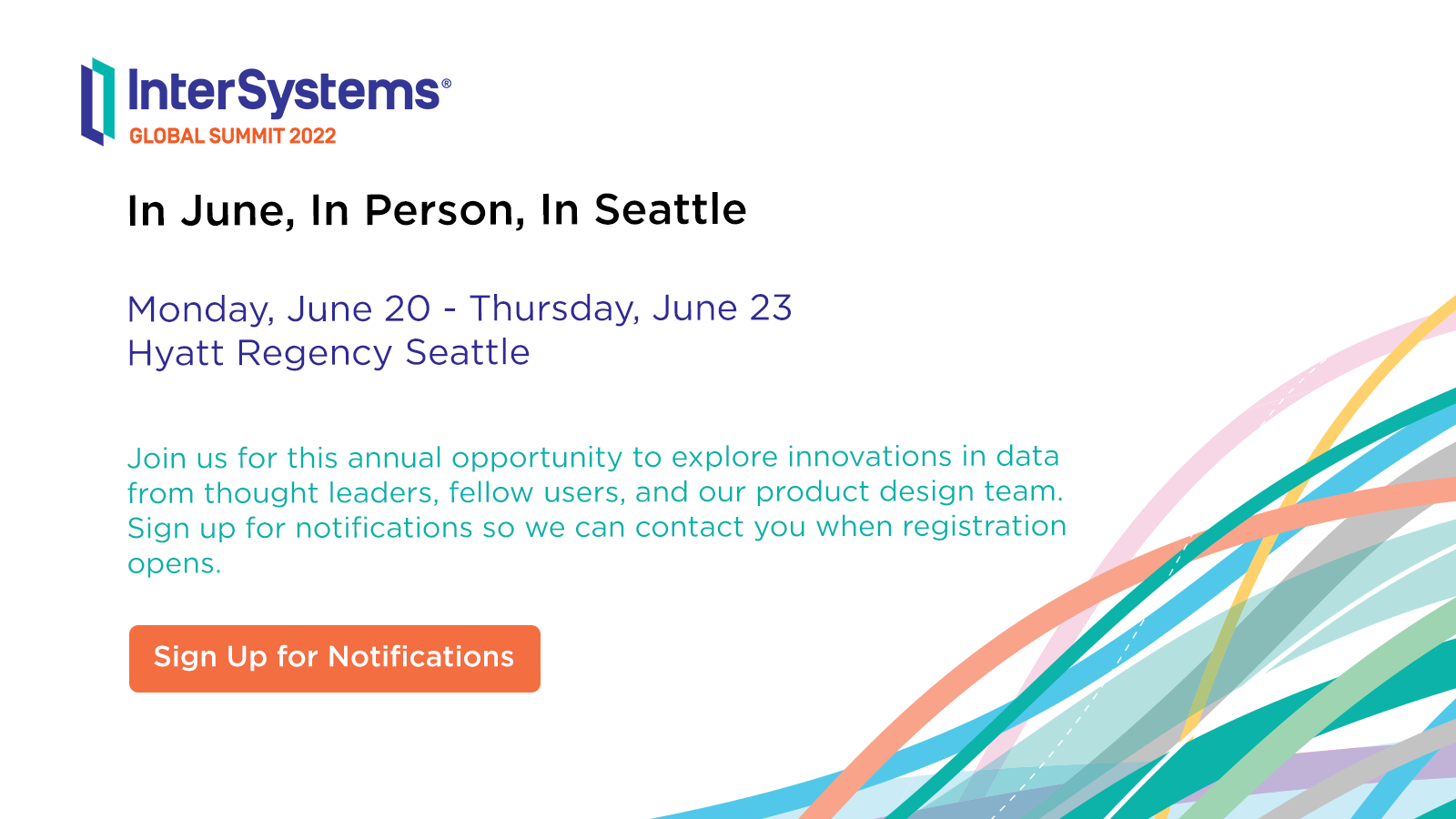
Mark your calendars for June. I'll update you all regularly with posts about our agenda, speakers, and events. And yes, we'll be live this year in Seattle. Sign up for notifications.
Hi guys, just a quick question on how get the sql statement that has been executed in a %ResultSet?
so basically after the execute command I would like to save the SQL statement generated in a eg, a global and check sql statement?
Set rset1 = ##class(%ResultSet).%New()
Set sc = rset1.Prepare("Select statment ")
Set:+sc sc = rset1.Execute(parm1,parm2)
Maybe something like s ^sql=rset1.Getstatment !?
Thanks
Seeking opportunities either remote or local to Massachusetts for an experienced HealthConnect developer.
Have experience in transaction HL7 messages, mostly ADT and Results. Developing rules, transforms and message schemas.
I have created a Class method to list employees that are subordinated to a certain boss. But I don´t know how to relate the data in the way it was given to me.
For Example:
^Employee(1) = "Jessica"
^Funcionario(10) = "Rose"
^HistEmployee(10, 64628) = "3500^Secretary^1"
So, based on this seetings, Jessica is Rose's boss. But I don't know how I can make a relation between that string and the subscript. Can someone help me?
It's time to announce the Winners for January 2022! Please welcome our awesome Global Masters Heroes!
The storm of applause goes to these developers and their great contribution to DC in January 2022:
🥇 @Robert Cemper, ex Senior Sales Engineer from InterSystems, Austria
🥈 @Muhammad Waseem, HIS Team Lead, International Medical Center, Jeddah, Saudi Arabia
🥉 @Prashanth Ponugoti, Technical Architect, Optimus IT Infra Ltd, London, United Kingdom
 Learn more about the competition and our awesome winners below.
Hey Community,
Here is a digest of the Developer Community videos on InterSystems Developers YouTube Channel in January 2022:
Hi Community,
We are pleased to invite all the developers to the upcoming InterSystems Python Contest Kick-off Webinar! The topic of this webinar is dedicated to the Python contest.
In this webinar, we’ll present two templates to start working with Embedded Python :
As always, our experts will answer the questions on how to develop, build, and deploy Python solutions using InterSystems IRIS.
Date & Time: Monday, February 7 – 12:00 PM EDT
Speakers:
🗣 @Guillaume Rongier, InterSystems Sales Engineer
🗣 @Bob Kuszewski, InterSystems Product Manager
🗣 @Evgeny Shvarov, InterSystems Developer Ecosystem Manager