I have created a global say ^myglobal and entered some data. I am storing the name of global in databases and fetching the name based on some criteria. I am getting "^myglobal" in return from databases but i am not able to fetch the data I stored in the global.
I tried set var = result.global which gives me "^myglobal" in var. Doing WRITE var will return "^myglobal" and not the data i stored in this global.
As it says in documentation %ZEN.Auxiliary.jsonProvider been deprecated. We been using it's functions like %ConvertJSONToObject, WriteJSONFromObject etc. Is there any replacement?
A customer wants to create an IRIS for Health business rule via the graphical editor, and then to execute that rule in ObjectScript without the context of an interoperability production. Is this possible, and if so, how?
It can sometimes be useful to list or export all of the subclasses that are derived, directly or indirectly, from a given class. In Studio, the Class -> Derived Classes menu option will show such a list, but I'm not aware of a built-in API for programmatically exporting their source code.
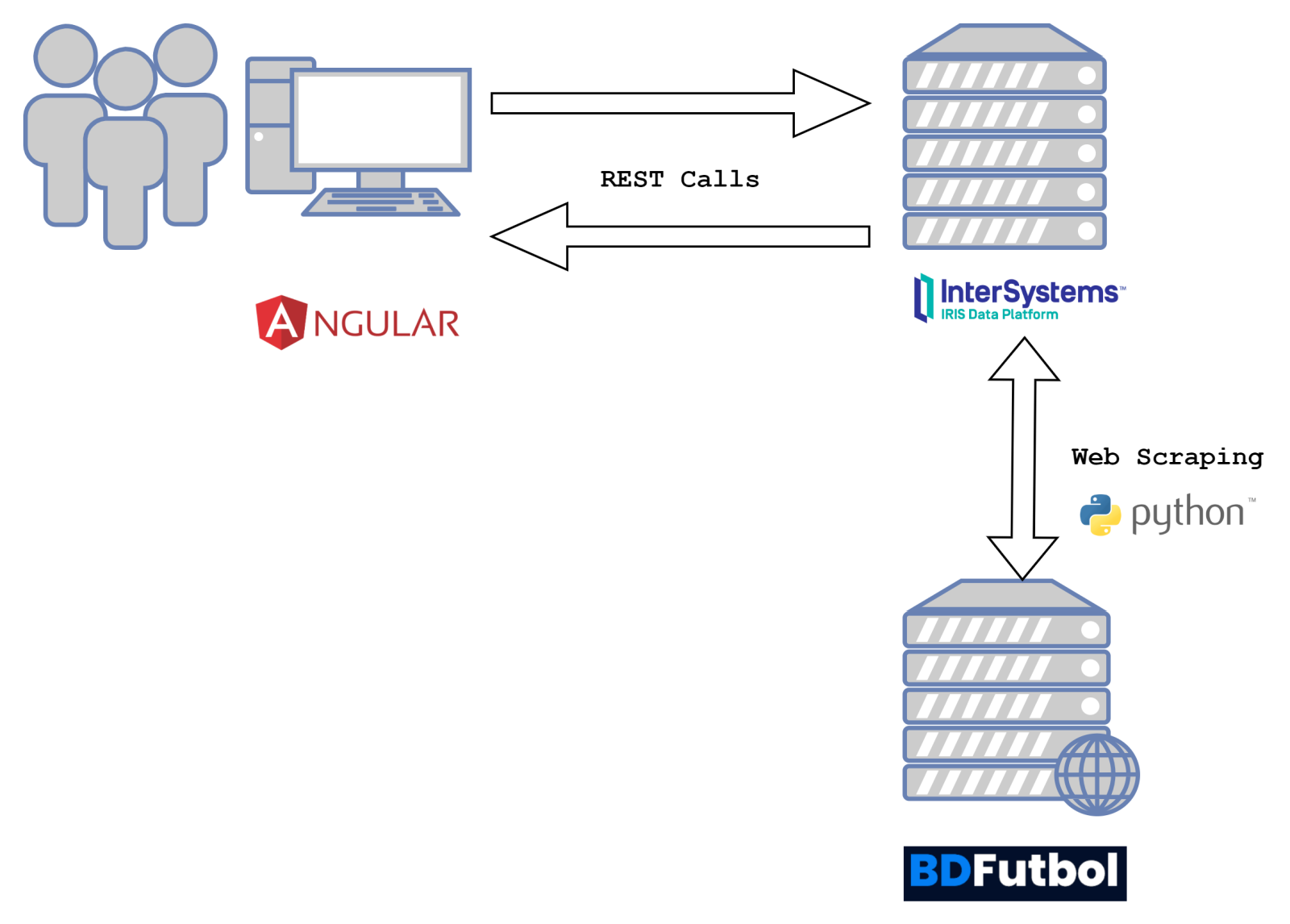
In our previous article we saw how to configure our EMPI to receive FHIR messages. To do this we installed the FHIR Adapter that InterSystems made available to us that configured a REST endpoint to which we could send our FHIR message. We would then get the message and transform it to a %String that we would send via TCP to the output of our EMPI configured in our HSPIDATA namespace.
Alright, it's time to see how we retrieve the message, transform it back to a %DynamicObject and parse it to the class used by the EMPI to store the information.
Strong technical experience with InterSystems Cache Objects, XSLT is a must for this position. Experience in CACHE/MUMPS technology. Experience in IHE XCA, XDS.b profiles, CCDA exchange. Experience in HL7 v2 messaging. This position is good thru 2023 and very good possibility of extension if budget gets approved. This position is for Pacific time hours.
As previously announced at Global Summit 2022, InterSystems will discontinue shipping or installing an Apache-based web server (often referred to as the private web server or PWS); this change is currently planned for InterSystems IRIS 2023.2.
https://www.youtube.com/embed/IM2Qm7cOuuk [This is an embedded link, but you cannot view embedded content directly on the site because you have declined the cookies necessary to access it. To view embedded content, you would need to accept all cookies in your Cookies Settings]
I want to fetch value from a global without being limited by the namespace. Is there any way of referencing the values from a global to a different namespace?
Is your InterSystems Certification expiring soon? Have you thought about why you should renew your certification? Are you curious about our recertification process?
Starting in version 2021.1, InterSystems IRIS began shipping with a python runtime in the engine's kernel. However, there was no way to install packages from within the instance. The main draw of python is its enormous package ecosystem. With that in mind, I introduce my side project zpip, a pip wrapper that is callable from the iris terminal.
We are doing a SQL server upgrade to SQL server v.15 from a legacy server which had v.10 . I have our Cache server as a linked server int order to pull data from our system. When building out the ROWSPEC, I have my fields typed as %String with various lengths with one field having a max length of 15000. The SQL server is trying to interpret this as a text data type instead of varchar(n). Text is a depracated data type since SQL server 2008. The error below is produced when trying to query from this view
https://www.youtube.com/embed/3pao-TwPHkc [This is an embedded link, but you cannot view embedded content directly on the site because you have declined the cookies necessary to access it. To view embedded content, you would need to accept all cookies in your Cookies Settings]
Hi Community,
I'm pleased to announce DEVBOX, the code anywhere IDE for IRIS.
Please watch the video and let me know what you think. Would you use it?
Suppose you have routine ^A loaded in your partition in programmer mode and you call routine ^B. Routine ^B finds the value of $ZU(96,9) which should be the calling routine.
But $ZU(96,9) now returns null, as does $SYSTEM.Process.CallingRoutine()
Works on 2018.1.7 but not 2018.1.8
$ROLES= %All on both systems
More precisely I have line label ZZPP in ^%ZLANGC00 which needs to identify the original routine in the partition and do some work on it. When I type ZZPP I get nothing on the later version. Here's the line of code:
Now the Classes/Rutines/DeepSee files will be automatically exported to the working directory after saving or compiling and files will be automatically deleted .
https://www.youtube.com/embed/B1pmqAQqd4M [This is an embedded link, but you cannot view embedded content directly on the site because you have declined the cookies necessary to access it. To view embedded content, you would need to accept all cookies in your Cookies Settings]
Installation
To install isc-dev , you just need to download and import the file isc-dev.xml from last release.
Some ways to import isc-dev .xml file:
Go to Management Portal -> System Explorer -> Classes -> Import and select the XML file.
Date & Time: Thursday, July 13, 11 am EDT | 5 pm CEST
https://www.youtube.com/embed/_HMZhdiLhrA [This is an embedded link, but you cannot view embedded content directly on the site because you have declined the cookies necessary to access it. To view embedded content, you would need to accept all cookies in your Cookies Settings]
I have a question about how to modify a XData Block programmatically . Assume i have a impl.cls and there is a XData Block (like XData OpenAPI [ MimeType = application/json ]) in the impl.cls. In other class, can i write a fucntion to modify the context in the XData Block?
Ps: The document already show how to read the XData blcok, if i want to insert something into the block and save it back, how can i do this programmatically (eg write a method and read the block from other class, write something into the block and save it ) ??
Hi all! Wanted to share a recent video we created with InterSystems FHIR expert, Russ Leftwich, covering some of the most frequently asked questions with FHIR. Let us know if you have more questions for a future iteration of this!
https://www.youtube.com/embed/tH2sWhVa8MU [This is an embedded link, but you cannot view embedded content directly on the site because you have declined the cookies necessary to access it. To view embedded content, you would need to accept all cookies in your Cookies Settings]
With rapid evolution of Generative AI, to embrace it and help us improve productivity is a must. Let's discuss and embrace the ideas of how we can leverage Generative AI to improve our routine work.
I'm trying to figure out why I'm unable to iterate through a dynamic array and access the nested objects.
Using the NHS PDS FHIR API in the NHS sandbox environment, I'm querying the PDS endpoint using a sample NHS Number to retrieve a patient's demographics. My Business Operation reads the response data and passes it back to my Business Process where I intend on iterating through certain nested objects. The data present in these nested objects will decide what happens next in the process.
Is it possible to hide certain properties in a class from displaying in the BPL visual editor, if you want to prevent drag and drop from accessing them or otherwise controlling or restricting their behavior?
Virtual document messages, such as EnsLib.HL7.Message, have hidden fields, such as Source, that do not show, presumably since the field list is rebuilt from the document schema. Setting the flag Internal, or XMLPROJECTION = "NONE" doesn't do it. Trying to follow the Virtual Document precedent to rebuild or edit the field list seems like a heavy list.
The extended maintenance releases of InterSystems IRIS, InterSystems IRIS for Health, and HealthShare Health Connect 2023.1.1 are now available. This release provides bug fixes for the previous 2023.1.0 releases.
You can find the detailed change lists / upgrade checklists on these pages:
https://www.youtube.com/embed/FnSPT1U9u9A [This is an embedded link, but you cannot view embedded content directly on the site because you have declined the cookies necessary to access it. To view embedded content, you would need to accept all cookies in your Cookies Settings]
I have several 1GB journals from a LIVE server that I would like to inspect (eg: check which globals have been updated over the time).
Is there a simple way to view those journals using another IRIS instance ? (eg: local installation).
I have been tempted to put those files directly into the journal folder of my local installation and restart the system, however I am concerned that the transactions they contains will be restored and will corrupt the local database.