What is JWT?

JWT (JSON Web Token) is an open standard (RFC 7519) that offers a lightweight, compact, and self-contained method for securely transmitting information between two parties. It is commonly used in web applications for authentication, authorization, and information exchange.

A JWT is typically composed of three parts:

1. JOSE (JSON Object Signing and Encryption) Header
2. Payload
3. Signature

13 4
9 541
Article
· Feb 14, 2025 5m read
HTTP and HTTPS with REST API

HTTP and HTTPS with REST API

Hello

The HTTP protocol allows you to obtain resources, such as HTML documents. It is the basis of any data exchange on the Web and a client-server protocol, meaning that requests are initiated by the recipient, usually a Web browser.

REST APIs take advantage of this protocol to exchange messages between client and server. This makes REST APIs fast, lightweight, and flexible. REST APIs use the HTTP verbs GET, POST, PUT, DELETE, and others to indicate the actions they want to perform.

When we make a call to a RESt API, what actually happens is an HTTP call. The API receives this call and according to the requested verb and path, the API performs the desired action. In the case of the Iris implementation we can see this clearly in the URLMap definition area:

12 1
3 467

Background:

This guideline provides an overview of how to design and implement a REST API interface for querying patient demographic data from an Electronic Patient Record (EPR) system using HealthConnect. The process involves sending a query request with the patient's identification number, retrieving the response from the EPR system, extracting the required patient demographic data from the HL7 message, and sending it as a JSON response to the supplier. The high-level process diagram is shown below (Screenshot 1).

7 5
2 334

Hi developers!

Observing the avalanche of AI-driven and vibe-coding developer tools that have been appearing lately almost every month with more and more exciting dev features, I was puzzled whether it is possible to leverage it with InterSystems IRIS. At least to build a frontend. And the answer - yes! At least with the approach I followed.

Here is my recipe to prompt the UI vs InterSystems IRIS Backend:

  1. Have the REST API on the IRIS side, which reflects some Open API (swagger) spec.
  2. Generate the UI with any vibe-coding tool (e.g., Lovable) and point the UI to the REST API endpoint.
  3. Profit!

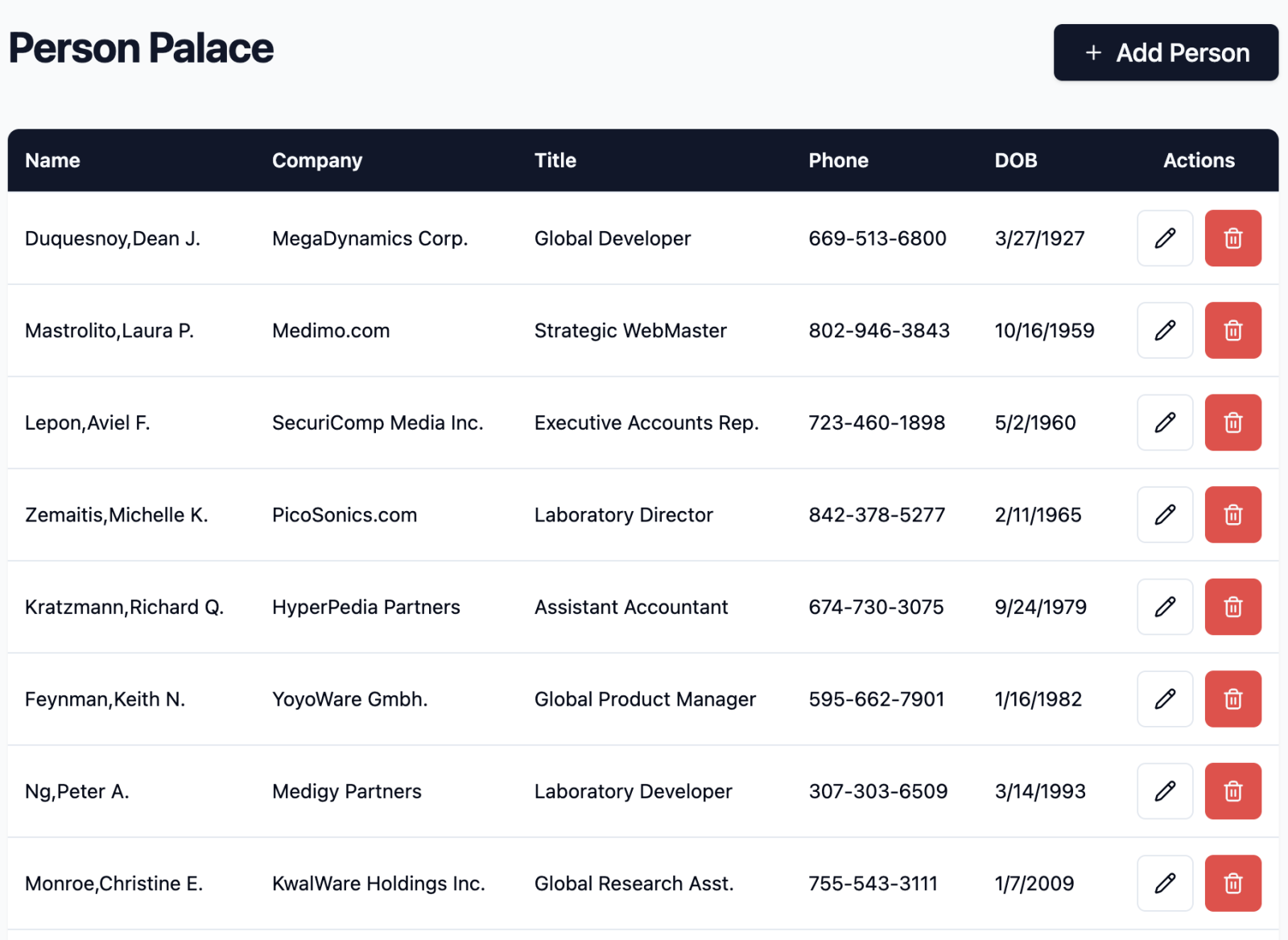
Here is the result of my own exercise - a 100% prompted UI vs IRIS REST API that allows to list, create, update delete entries of a persistent class (Open Exchange, frontend source, video):

What is the recipe in detail?

8 5
2 331
Article
· Jul 10, 2025 16m read
The Zen Angle

Dear community, I have a confession to make. I have not gotten over Zen yet. Alas, all good things must come to an EOF, so I am currently learning about Angular. I am working on proving to myself that with the right back end and Angular components, I can deliver to myself and my team a very Zen-like experience in this environment.

8 7
1 266

REST API with Swagger in InterSystems IRIS

Hello

The HTTP protocol allows you to obtain resources, such as HTML documents. It is the basis of any data exchange on the Web and a client-server protocol, meaning that requests are initiated by the recipient, usually a Web browser.

REST APIs take advantage of this protocol to exchange messages between client and server. This makes REST APIs fast, lightweight, and flexible. REST APIs use the HTTP verbs GET, POST, PUT, DELETE, and others to indicate the actions they want to perform.

6 0
4 404

FHIR Server

A FHIR Server is a software application that implements the FHIR (Fast Healthcare Interoperability Resources) standard, enabling healthcare systems to store, access, exchange, and manage healthcare data in a standardized manner.

Intersystems IRIS can store and retrieve the following FHIR resources:

  • Resource Repository – IRIS Native FHIR server can effortlessly store the FHIR bundles/resources directly in the FHIR repository.
  • FHIR Facade - the FHIR facade layer is a software architecture pattern used to expose a FHIR-compliant API on top of an existing one (often non-FHIR). It also streamlines the healthcare data system, including an electronic health record (EHR), legacy database, or HL7 v2 message store, without requiring the migration of all data into a FHIR-native system.

What is FHIR?

Fast Healthcare Interoperability Resources (FHIR) is a standardized framework created by HL7 International to facilitate the exchange of healthcare data in a flexible, developer-friendly, and modern way. It leverages contemporary web technologies to ensure seamless integration and communication across various healthcare systems.

4 0
3 337

There are numerous excellent tools available for testing your REST APIs, especially when they are live. Postman, various web browser extensions, and even custom ObjectScript written with %Net.HttpRequest objects can get the job done. However, it is often difficult to test just the REST API without inadvertently involving the authentication scheme, the web application configuration, or even network connectivity. Those are a lot of hoops to jump through just to test the code within your dispatch class. The good news is that if we take our time to understand the inner workings of the %CSP.REST class, we will find an alternative option suited for testing only the contents of the dispatch class. We can set up the request and response objects to invoke the methods directly.

9 5
7 222

Hi Community,

Watch this short exercise in writing basic code snippets in InterSystems ObjectScript using Copilot in VSCode and the GPT-4.0 engine. This screencast covers "Hello, World," global manipulation, class creation, and building a simple REST API application.

>> Coding InterSystems ObjectScript with Copilot <<

🗣 Presenter: @Evgeny Shvarov, Senior Manager of Developer and Startup Programs, InterSystems

📌 The related code can be found here: objectscript-copilot-demo.

https://www.youtube.com/embed/CanxHvMZyLY
[This is an embedded link, but you cannot view embedded content directly on the site because you have declined the cookies necessary to access it. To view embedded content, you would need to accept all cookies in your Cookies Settings]

5 0
0 292

Introduction

InterSystems IRIS allows you to build REST APIs using ObjectScript classes and the %CSP.REST framework. This enables the development of modern services to expose data for web apps, mobile apps, or system integrations.

In this article, you'll learn how to create a basic REST API in InterSystems IRIS, including:

4 3
3 223

Hi all,

Let's do some more work about the testing data generation and export the result by REST API.😁

Here, I would like to reuse the datagen.restservice class which built in the pervious article Writing a REST api service for exporting the generated patient data in .csv

This time, we are planning to generate a FHIR bundle include multiple resources for testing the FHIR repository.

3 6
0 155

Hi folks!

I'm building a very simple REST API.

But before testing it via a Web Server what I want to make sure that REST API methods work in principle.

Is it an easy way to "fake" the web-server request and get a result e.g. of the method with signature like that?

ClassMethod GetAllRecords(pRequest As %CSP.Request, pResponse As %CSP.Response) As %Status

e.g. calling it in Terminal?

0 6
0 251

I am trying to help another group within our organization access a SQL Table that I have created to populate Epic Department Data within our environment and came across the ability to use SQL Seach REST Interface using iKnow.

However, I am having issues trying to get it to work via POSTMAN before I hand off the solution...

the POST URL... https://<servername>/api/iKnow/latest/TESTCLIN/table/osuwmc_Epic_Clarity.DepartmentMaster/search

where osuwmc_Epic_Clarity.DepartmentMaster is the table

In the body...

2 15
1 231

Some languages ​​have the concept of a garbage collector for automatic memory management. I'd like to know if something like this exists in InterSystems Caché in the context of routines, %CSP.REST, or %CSP.Page.

The question arises from the %Close() method of the %RegisteredObject class. This indicates that I need to manually clear the object from memory if it's no longer in use, or in the web context, if the request has completed. Is this correct? Or am I completely wrong?

Thank you!

2 8
0 227

Using Flask, REST API, and IAM with InterSystems IRIS

Part 1 - REST API

Hello

In this article we will see the implementation of a REST API to perform the maintenance of a CRUD, using Flask and IAM.

In this first part of the article we will see the construction and publication of the REST API in Iris.

First, let's create our persistent class to store the data. To do this, we go to Iris and create our class:

3 0
0 232

Hi,

It's me again😁, recently I am working on generating some fake patient data for testing purpose with the help of Chat-GPT by using Python. And, at the same time I would like to share my learning curve.😑

1st of all for building a custom REST api service is easy by extending the %CSP.REST

Creating a REST Service Manually

Let's Start !😂

3 3
1 122

I have a scenario where I send a GET request to a broker and receive a FHIR response. When I attempted to use the built-in InterSystems functions to convert this FHIR response into SDA, the transformation failed—likely because it is not a standard FHIR request.

How should I handle this situation? Is there a recommended approach to processing FHIR responses in this context?

0 3
0 175

Using SQL Gateway with Python, Vector Search, and Interoperability in InterSystems Iris

Part 1 - SQL Gateway

Hello

In this article we will look at the use of SQL Gateway in Iris. SQL Gateway allows Iris to have access to tables from other (external) database via ODBC or JDBC. We can access Tables or Views from various databases, such as Oracle, PostgreSQL, SQL Server, MySQL and others.

4 0
0 172

Hi:

I see a lot of cool REST apps and i'm trying to host something in the TIE using REST/Axios with VITE.

At the moment i will probably host the application in web applications in Intersytems.

For authorisation and getting the logged in user and password to any app, is there a standard people are doing?

I.e. for axios you might have this from the app

0 8
0 157

Hello everyone!

I have set up an EnsLib.REST.GenericService with an EnsLib.HTTP.InboundAdapter which forwards the http requests received by a web app to my Business Process.

I would like to parse HTTP multipart/form messages I am receving and be able to iterate over the various fields within the request body, accessing its content type and the content itself.

As far as I understand I should use the %Net.MIMEReader class which should return a list of %Net.MIMEPart, one for each field within the request. However if I do :

0 4
0 154

Using SQL Gateway with Python, Vector Search, and Interoperability in InterSystems Iris

Part 3 – REST and Interoperability

Now that we have finished the configuration of the SQL Gateway and we have been able to access the data from the external database via python, and we have set up our vectorized base, we can perform some queries. For this in this part of the article we will use an application developed with CSP, HTML and Javascript that will access an integration in Iris, which then performs the search for data similarity, sends it to LLM and finally returns the generated SQL. The CSP page calls an API in Iris that receives the data to be used in the query, calling the integration. For more information about REST in the Iris see the documentation available at https://docs.intersystems.com/irislatest/csp/docbook/DocBook.UI.Page.cls...

8 1
0 135