There are numerous excellent tools available for testing your REST APIs, especially when they are live. Postman, various web browser extensions, and even custom ObjectScript written with %Net.HttpRequest objects can get the job done. However, it is often difficult to test just the REST API without inadvertently involving the authentication scheme, the web application configuration, or even network connectivity. Those are a lot of hoops to jump through just to test the code within your dispatch class. The good news is that if we take our time to understand the inner workings of the %CSP.REST class, we will find an alternative option suited for testing only the contents of the dispatch class. We can set up the request and response objects to invoke the methods directly.

6 4
5 131
Article
· Dec 24, 2025 2m read
"The Hidden HTTP Errors" (Behind IIS)

You send an HTTP request and get back an HTTP error but with an HTML error page which you didn't expect... what's happening?... 🤔

Specifically for example, perhaps you tried to READ a FHIR Resource (e.g. /Patient/123) and you get back a 404 error page, even though with other Patient IDs, you get back the Resource payload, so "the page" definitely does exist... why should you be getting a 404 error page? 🙄

6 0
0 61

The previous article introduced IrisOASTestGen, a tool designed to generate REST API test code for InterSystems IRIS based on OpenAPI 2.0 specifications. It demonstrated how to scaffold test cases using the default templates bundled with OpenAPI Generator.

This follow-up focuses on the next natural step: customizing the generated test code.
By extending the code generation logic with Mustache templates, it becomes possible to express richer semantics, implement CRUD-aware tests, and create more meaningful test suites.

0 0
0 44

Project Overview / Introduction

Developing and testing REST APIs in InterSystems IRIS often requires a significant amount of boilerplate code. While ObjectScript provides powerful tools for building APIs, writing consistent and repeatable tests can be time‑consuming. This is where IrisOASTestGen comes in.

4 2
0 86

Hola amigo! 😊 Cómo estás hoy,

I would like to share a small part of my learnings from my first ever official project: POS/EDC machine integration with our billing system. This was an exciting challenge where I got hands-on experience working with APIs and vendors.

How does a Payment Machine actually work?

It's simple, start by initiating/creating a transaction, then retrieve its payment status.

Here, initiate/create refers to POST method and Retrieve refers to GET.

1 0
2 95

FastJsonSchema: High-Performance JSON Validation in IRIS

Validating JSON data against JSON Schema is a common requirement for modern applications. FastJsonSchema brings this capability natively to InterSystems IRIS, combining speed, simplicity, and full schema compliance.

Unlike traditional validation approaches, FastJsonSchema generates native ObjectScript code from your JSON Schemas and compiles it directly to iris object code, enabling idiomatic performance without relying on external libraries or runtimes.

1 1
0 60

As a developer who uses Cache as DB for a couple of projects, I'm using REST API's every time, knowing how to consume a resource from REST API, in my opinion, it's crucial to know how to consume external REST Api's using %Net.HttpRequest because it enables integration with modern web applications and services, and it's a crucial skill for a backend developer who loves and uses Cache as a DB.

What and who is %Net.HttpRequest

3 0
1 86

Hi all,

Let's do some more work about the testing data generation and export the result by REST API.😁

Here, I would like to reuse the datagen.restservice class which built in the pervious article Writing a REST api service for exporting the generated patient data in .csv

This time, we are planning to generate a FHIR bundle include multiple resources for testing the FHIR repository.

3 6
0 141

Hi,

It's me again😁, recently I am working on generating some fake patient data for testing purpose with the help of Chat-GPT by using Python. And, at the same time I would like to share my learning curve.😑

1st of all for building a custom REST api service is easy by extending the %CSP.REST

Creating a REST Service Manually

Let's Start !😂

3 3
1 108

FHIR Server

A FHIR Server is a software application that implements the FHIR (Fast Healthcare Interoperability Resources) standard, enabling healthcare systems to store, access, exchange, and manage healthcare data in a standardized manner.

Intersystems IRIS can store and retrieve the following FHIR resources:

  • Resource Repository – IRIS Native FHIR server can effortlessly store the FHIR bundles/resources directly in the FHIR repository.
  • FHIR Facade - the FHIR facade layer is a software architecture pattern used to expose a FHIR-compliant API on top of an existing one (often non-FHIR). It also streamlines the healthcare data system, including an electronic health record (EHR), legacy database, or HL7 v2 message store, without requiring the migration of all data into a FHIR-native system.

What is FHIR?

Fast Healthcare Interoperability Resources (FHIR) is a standardized framework created by HL7 International to facilitate the exchange of healthcare data in a flexible, developer-friendly, and modern way. It leverages contemporary web technologies to ensure seamless integration and communication across various healthcare systems.

4 0
3 307
Article
· Jul 10, 2025 16m read
The Zen Angle

Dear community, I have a confession to make. I have not gotten over Zen yet. Alas, all good things must come to an EOF, so I am currently learning about Angular. I am working on proving to myself that with the right back end and Angular components, I can deliver to myself and my team a very Zen-like experience in this environment.

8 7
1 252

Introduction

InterSystems IRIS allows you to build REST APIs using ObjectScript classes and the %CSP.REST framework. This enables the development of modern services to expose data for web apps, mobile apps, or system integrations.

In this article, you'll learn how to create a basic REST API in InterSystems IRIS, including:

4 3
3 203

Hi developers!

Observing the avalanche of AI-driven and vibe-coding developer tools that have been appearing lately almost every month with more and more exciting dev features, I was puzzled whether it is possible to leverage it with InterSystems IRIS. At least to build a frontend. And the answer - yes! At least with the approach I followed.

Here is my recipe to prompt the UI vs InterSystems IRIS Backend:

  1. Have the REST API on the IRIS side, which reflects some Open API (swagger) spec.
  2. Generate the UI with any vibe-coding tool (e.g., Lovable) and point the UI to the REST API endpoint.
  3. Profit!

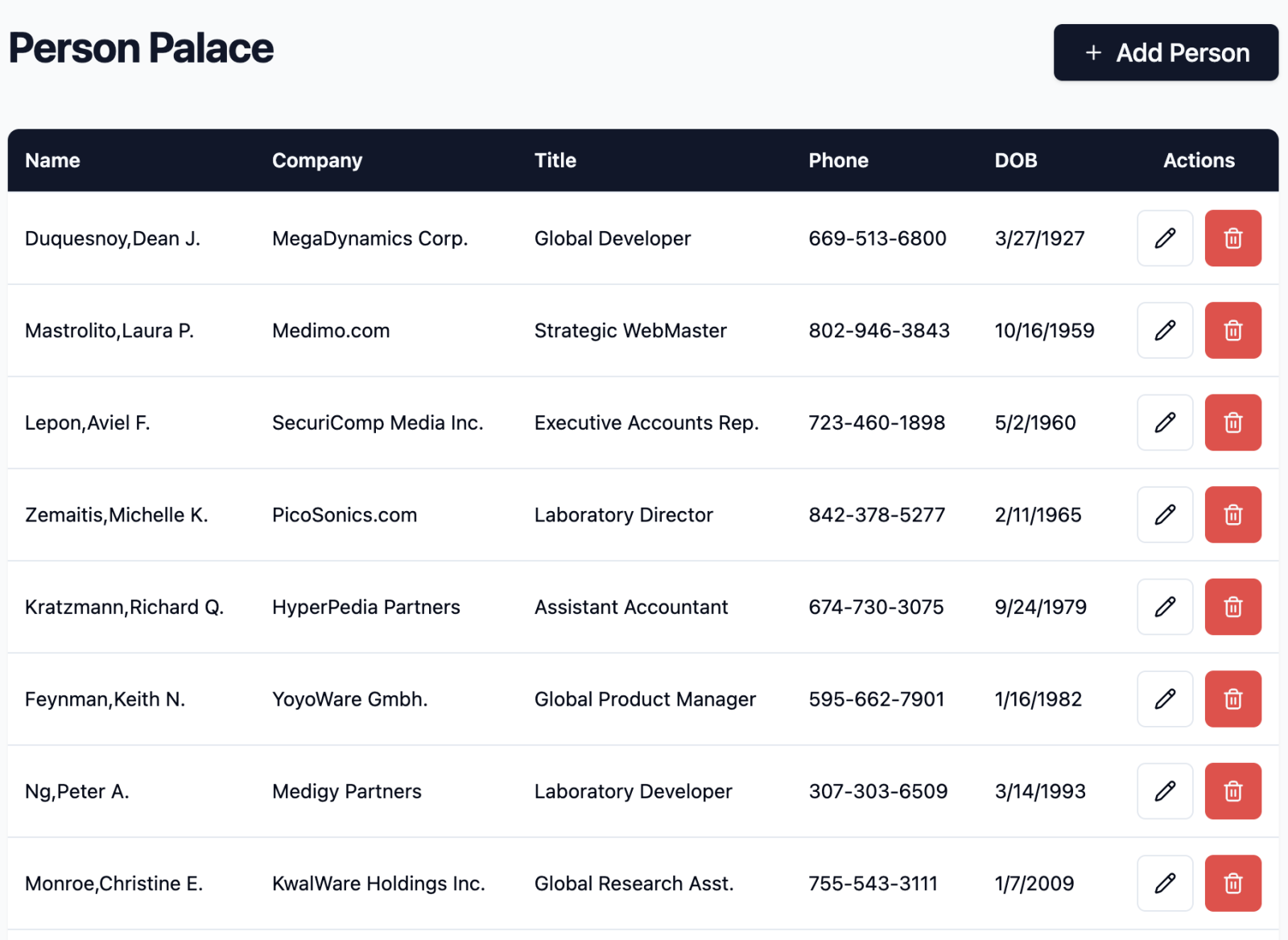
Here is the result of my own exercise - a 100% prompted UI vs IRIS REST API that allows to list, create, update delete entries of a persistent class (Open Exchange, frontend source, video):

What is the recipe in detail?

7 5
1 258

Background:

This guideline provides an overview of how to design and implement a REST API interface for querying patient demographic data from an Electronic Patient Record (EPR) system using HealthConnect. The process involves sending a query request with the patient's identification number, retrieving the response from the EPR system, extracting the required patient demographic data from the HL7 message, and sending it as a JSON response to the supplier. The high-level process diagram is shown below (Screenshot 1).

7 5
2 319

REST API with Swagger in InterSystems IRIS

Hello

The HTTP protocol allows you to obtain resources, such as HTML documents. It is the basis of any data exchange on the Web and a client-server protocol, meaning that requests are initiated by the recipient, usually a Web browser.

REST APIs take advantage of this protocol to exchange messages between client and server. This makes REST APIs fast, lightweight, and flexible. REST APIs use the HTTP verbs GET, POST, PUT, DELETE, and others to indicate the actions they want to perform.

6 0
4 386

What is JWT?

JWT (JSON Web Token) is an open standard (RFC 7519) that offers a lightweight, compact, and self-contained method for securely transmitting information between two parties. It is commonly used in web applications for authentication, authorization, and information exchange.

A JWT is typically composed of three parts:

1. JOSE (JSON Object Signing and Encryption) Header
2. Payload
3. Signature

13 3
9 500
Article
· Feb 14, 2025 5m read
HTTP and HTTPS with REST API

HTTP and HTTPS with REST API

Hello

The HTTP protocol allows you to obtain resources, such as HTML documents. It is the basis of any data exchange on the Web and a client-server protocol, meaning that requests are initiated by the recipient, usually a Web browser.

REST APIs take advantage of this protocol to exchange messages between client and server. This makes REST APIs fast, lightweight, and flexible. REST APIs use the HTTP verbs GET, POST, PUT, DELETE, and others to indicate the actions they want to perform.

When we make a call to a RESt API, what actually happens is an HTTP call. The API receives this call and according to the requested verb and path, the API performs the desired action. In the case of the Iris implementation we can see this clearly in the URLMap definition area:

12 1
3 443

Using Flask, REST API, and IAM with InterSystems IRIS

Part 2 – Flask App

Flask is a web development microframework written in Python. It is known for being simple, flexible, and enabling rapid application development.

Installing Flask is very simple. Once you have python installed correctly on your operating system, we need to install the flask library with the pip command. For REST API consumption, it is advisable to use the requests library. The following link provides a guide to installing flask: https://flask.palletsprojects.com/en/stable/installation/

2 0
0 129

Using Flask, REST API, and IAM with InterSystems IRIS

Part 1 - REST API

Hello

In this article we will see the implementation of a REST API to perform the maintenance of a CRUD, using Flask and IAM.

In this first part of the article we will see the construction and publication of the REST API in Iris.

First, let's create our persistent class to store the data. To do this, we go to Iris and create our class:

3 0
0 223

Using SQL Gateway with Python, Vector Search, and Interoperability in InterSystems Iris

Part 3 – REST and Interoperability

Now that we have finished the configuration of the SQL Gateway and we have been able to access the data from the external database via python, and we have set up our vectorized base, we can perform some queries. For this in this part of the article we will use an application developed with CSP, HTML and Javascript that will access an integration in Iris, which then performs the search for data similarity, sends it to LLM and finally returns the generated SQL. The CSP page calls an API in Iris that receives the data to be used in the query, calling the integration. For more information about REST in the Iris see the documentation available at https://docs.intersystems.com/irislatest/csp/docbook/DocBook.UI.Page.cls...

8 1
0 130

Using SQL Gateway with Python, Vector Search, and Interoperability in InterSystems Iris

Part 2 – Python and Vector Search

Since we have access to the data from our external table, we can use everything that Iris has to offer with this data. Let's, for example, read the data from our external table and generate a polynomial regression with it.

For more information on using python with Iris, see the documentation available at https://docs.intersystems.com/irislatest/csp/docbook/DocBook.UI.Page.cls?KEY=AFL_epython

Let's now consume the data from the external database to calculate a polynomial regression. To do this, we will use a python code to run a SQL that will read our MySQL table and turn it into a pandas dataframe:

4 0
0 143