As mentioned in the previous article, it is possible to configure the way you wish your collections to be stored and queried in SQL.
.png)
To set this up, you will need to use the following field parameters and settings:

InterSystems IRIS is a Complete Data Platform
InterSystems IRIS gives you everything you need to capture, share, understand, and act upon your organization’s most valuable asset – your data.
As a complete platform, InterSystems IRIS eliminates the need to integrate multiple development technologies. Applications require less code, fewer system resources, and less maintenance.
As mentioned in the previous article, it is possible to configure the way you wish your collections to be stored and queried in SQL.
To set this up, you will need to use the following field parameters and settings:
In InterSystems IRIS, when you compile a persistent class, you automatically get a SQL table. Sometimes, there are situations that require having a slightly (or not so slightly) different names/options in SQL compared to Object model. Here are some of the settings that you can change to make it happen.
They define the "Face" of your class when it appears as a table in the SQL catalog.
SqlTableName allows you to change the name of SQL table that holds objects from your class. This is especially useful, when your class name uses reserved SQL words in a name, e.g. Group.
This is the second part of an article pair where I walk you through:
As mentioned the goal is to give you a smooth “first run” experience.

Hi folks!
Is there any way to know the text of the SQL queries executed against the IRIS server?
My case: I have an SQL class query with a few parameters and and some combination of values causes unexpected results.
It'd be great if I could just copy the query from some log of queries done vs my IRIS the server. Cannot find it easily, though. Any advice?
We are hiring! 100% Remote W2 Contract | 3-6+ Months (numerous extensions likely)
Two Roles:
🔹InterSystems Engineer
🔹Epic Bridges Certified/InterSystems Engineer
Having solid experience with the below:
Hi folks!
How can we handle JSON boolean types in IRIS?
I'm having a UI sending me a JSON payload as:
{

  "id": 1,
  "strprop": "string",
  "boolprop": true

}
The class is
MyPackage.MyClass Extends (%Persistent, %JSON.Adaptor)

{

strprop as %String;

boolprop as %Boolean;

}
And I'm trying to update an instance of a MyPackage.MyClass and I'm getting a datatype-related error, something like %JSONImportInternal+269...
How am I supposed to deal with booleans in JSON with IRIS and ObjectScript? Any best practice advices?
There are numerous excellent tools available for testing your REST APIs, especially when they are live. Postman, various web browser extensions, and even custom ObjectScript written with %Net.HttpRequest objects can get the job done. However, it is often difficult to test just the REST API without inadvertently involving the authentication scheme, the web application configuration, or even network connectivity. Those are a lot of hoops to jump through just to test the code within your dispatch class. The good news is that if we take our time to understand the inner workings of the %CSP.REST class, we will find an alternative option suited for testing only the contents of the dispatch class. We can set up the request and response objects to invoke the methods directly.
Hi, now I would like to continuous on the topic that we talk about previously
Using Postman for testing the OAuth2.0 of the InterSystems FHIR repository - Part1
.png)
Question 1: Where is my client_id and client_secret come form?
Short answer: Authentication Server.
If you don't have an Authentication Server, you may set up one as following
.png)
Provide the hostname (the host must support Https), at least 1 grand type (we choose client credential here), and SSL/TSL configuration
.png)
Input the scopes (here we input user/*.read and user/*.
Sometimes customers need a small IRIS instance to do something in the cloud and shut it down, or they need hundreds of containers (i.e. one per end user or one per interface) with small workloads. This exercise came about to see how small an IRIS instance could be. For this exercise we focused on what is the smallest amount of memory we can configure for an IRIS instance. Do you know all the parameters that affect the memory allocated by IRIS ?
What is JWT?
JWT (JSON Web Token) is an open standard (RFC 7519) that offers a lightweight, compact, and self-contained method for securely transmitting information between two parties. It is commonly used in web applications for authentication, authorization, and information exchange.
A JWT is typically composed of three parts:
1. JOSE (JSON Object Signing and Encryption) Header
2. Payload
3. Signature
These parts are encoded in Base64Url format and concatenated with dots (.) separating them.
trying importing classDefinition to Iris via LoadStream() fails with
Code is here; use any valid exported ClassDefinition as File to test that:
    public static void loadClassFromStream(this IRIS iris, string txt)
    {

        // IRISObject globalCharStr = IrisStreamExtensions.FromTxt(iris, text);
        var fp = @"C:\tmp\TestClass.xml";
        txt = File.ReadAllText(fp);

        var stream = new MemoryStream();
var bytes = Encoding.Hi developers!
There is a very neat variable in IPM ${ipmdir} that lets packages be installed on a particular IRIS server and ensures that the data and resources they bring don't mess around as ${ipmdir} variable during the installation transforms into:
iris installation dir/ipm/package_name/version/whatever_you_install_here
It is very convenient, e.g., to bring some data and resource files that can be useful during the installation setup, e.g., via FILECOPY. Indeed, suppose you bring some csv_file, e.g. titanic.csv via FILECOPY as:
<FileCopy Name="data/titanic.csv" Target="${ipmdir}data/titanic.csv"/>or even the whole folder of data in the source code repo into the package:
<FileCopy Name="data/" Target="${ipmdir}data/"/>And in the case of Iris in Docker it resides in:
/usr/irissys/ipm/package_name/1.0.0/data/titanic.csv
This is all great, but is there any way for the installed code to determine the location of the data files? It'd be neat to let the installed app know somehow where is the data that came with it? Could it be the method in the IPM client that will resolve ${ipmdir} for the app?
Hi, Community!
Do you need a way to securely manage your passwords, API keys, and other credentials? See how the Secure Wallet in InterSystems IRIS® data platform can help:
We are a group of interface analysts in a healthcare setting, running IRIS for Health 2024, having upgraded over time from an old ENSEMBLE environment. We have been working on a wish list of development goals, but are having trouble finding the correct, best practice method/path for getting to what we envision.
Current state: We run IRIS for Health on a Redhat 8 virtual machine. We run Interoperability productions (IE.cls) out of 6 namespaces. We have a dev/test box and a production box.
If you want to generate JWT from x509 cert/key, any operation (including reading) on %SYS.X509Credentials requires U on %Admin_Secure resource.%Admin_Secure is required because %SYS.X509Credentials is persistent, and it's implemented this way to prevent all users from accessing private keys.
If %Admin_Secure resource is not available at runtime, you can use the following workaround.
Upon reviewing the code for JWT generation, I discovered that the JWT code utilizes %SYS.X509Credentials solely as a source of runtime data for PrivateKey, PrivateKeyPassword, and Certificate
SETassigns value to the variable at RUNTIME.
#DIM declare the variable and it's Data Type at COMPILE TIME.
SET |
#DIM |
| Makes the variables Dynamic. | Improves Readability. |
| No Data Type Declaration. | Enables IDE auto-completion. |
| Runtime | Useful for Object references. |
#DIM name As %String
Set name = "Micheal Scott"
#DIM age As %Numeric
Set age = 36
#DIM employer As App.Employer               ; compile time
Set employer = ##class(App.Employer).%New() ; runtime SETor #DIM? Your design, your rules.
I’m working on XML Digital Signature in InterSystems IRIS using %XML.Security.Signature
I start with an XML document that is created by parsing an input XML string, and I want to digitally sign this document using an X509 certificate.
Set x509 = ##class(%SYS.X509Credentials).GetByAlias(credAlias)
Set signature = ##class(%XML.Security.Signature).CreateX509(x509,$$$SOAPWSIncludeNone ,$$$KeyInfoX509Certificate)

Set signature.Id = "SIG1"
DO signature.SetSignatureMethod($$$SOAPWSrsasha1)
DO signature.SetDigestMethod($$$SOAPWSsha1)
Set signature.SignedInfo.CanonicalizationMethod.Hey Community,
Enjoy the new video on InterSystems Developers YouTube:
⏯ Advancing Healthcare Interoperability - Strategy and Vision @ Ready 2025
I have a business service that actively reads data from a remote Postgres database. OnProcessInput opens a XDBC (actually JDBC) connection, executes an SQL query, fetches several thousand rows, iterates the resultset, and closes the connection. On each iteration I also need to update each source row in the remote database using PreparedStatement.
In other words, in every OnProcessInput call I have a long running SELECT statement and several thousands small UPDATE statements.
InterSystems IRIS is built on an architecture that separates the logical organization of data (namespaces) from its physical storage location (databases). Understanding this separation and the distinction between Namespaces and Databases is crucial for effective data management, security, and especially, high-performance data sharing.
In this article, I will discuss these foundational components and provide a practical guide on leveraging global mappings to share native data structures (globals) across different logical environments.
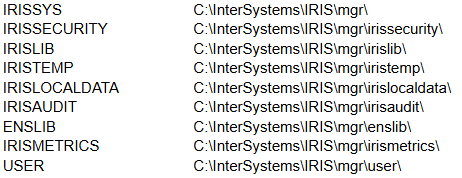
A database represents the physical reality of where the data is stored on the disk. First and foremost, it’s a file in a file system called IRIS.dat (e.g., <Install folder>\mgr\user\IRIS.DAT). The maximum size of this file is 32TB. It is the container for all the actual data and the code. Databases are managed by the IRIS kernel, which handles caching, journaling, and transaction logging at the physical file level.
When you install InterSystems IRIS DBMS, the following databases are installed automatically:
I have a new project to store information from REST responses into an IRIS database. I’ll need to sync information from at least two dozen separate REST endpoints, which means creating nearly that many ObjectScript classes to store the results from those endpoints.
Could I use ChatGPT to get a headstart on creating these classes? The answer is “Yes”, which is great since this is my first attempt at using generative AI for something useful. Generating pictures of giraffes eating soup was getting kind of old….
Sometimes it is more convenient, more efficient, and more secure, to limit FHIR Searches per pre-defined "Lists" of Resources.
Since v2025.1 we support several List-related features in our FHIR Server.
I will highlight these here, and provide some samples.
I have see this discussed on the community but I'm not quite finding an answer.
I have a method that is called in the OnPreHttp() method of a CSP page. That method returns a dynamic object and a set a new variable to the %ToJSON method of the object so I can use it in my JavaScript code later to init a table of data (using the #(variable)# syntax). This creates a MAXSTRING error. So I changed it to return a %Stream.TmpCharacter. But if I call Read($$$MaxStringLenght) I only get part of the data.
I have a Photo that is stored as an VARBINARY within MS SQL. I would like to Select the data into a EnsLib.SQL.Snapshot, is that possible? I would take it out of the Snapshot and send it to a %Stream so it can be written out to a file.
Developing Custom Components for Integrations – In Person (Boston, MA) February 10-12, 2026
Hi, Community!
Ready to strengthen your deployment of InterSystems IRIS® data platform?
👨💻See how to configure a mirrored pair to preserve the integrity of your data:
I was trying to see if we could connect to another Server, we use to execute external scripts using %Net.SSH.Session.
TESTCLIN>set sshSession = ##class(%Net.SSH.Session).%New()

TESTCLIN>set user = <omitted>

TESTCLIN>set host = <omitted>

TESTCLIN>set privateKey = "/nfs/data/ssh/<omitted>"
TESTCLIN>set publicKey = "/nfs/data/ssh/<omitted>.pub"
TESTCLIN>Set statusConnection = sshSession.Connect(host)

TESTCLIN>set statusAuth = sshSession.Hey Community,
Enjoy the new video on InterSystems Developers YouTube:
Hi Developers!
Sometimes we need to deal with classes/tables where the primary key and the IdKey are something that is maintained by yourself.
What is the proper way to generate a new ID in case where ID is a %BigInt?
Property id As %Library.BigInt
Are there any system methods to provide it?
There is data already imported via SQL, so there is no last ID stored in ^myclassD, so I cannot do $I(^myclassD).
Thinking of:
set newid=$O(^myclassD(""),-1),newid=$I(newid)What do you think?