Dear All ,
Good Day ,
I want to learn the Trackcare Technical Track , is anyone have helping material? Please share with me .
Regards ,
Zulqarnain

InterSystems IRIS is a Complete Data Platform
InterSystems IRIS gives you everything you need to capture, share, understand, and act upon your organization’s most valuable asset – your data.
As a complete platform, InterSystems IRIS eliminates the need to integrate multiple development technologies. Applications require less code, fewer system resources, and less maintenance.
Dear All ,
Good Day ,
I want to learn the Trackcare Technical Track , is anyone have helping material? Please share with me .
Regards ,
Zulqarnain
ISC Developers, I 👑 you.

Looking to get started with generative AI? Try two brand-new learning paths. In Getting Started with Generative AI (2h 45m), learn the basics of interacting with GenAI. Then, try Developing Generative AI Applications (2h) to start developing your own GenAI application. Plus, earn badges for completing each path!
Hi,
We are developing a .NET6 application using Iris database. We would like to use ORM for easier code maintenance.
I saw a doc about Entity Framework: https://docs.intersystems.com/iris20231/csp/docbook/DocBook.UI.Page.cls?KEY=BNET_eframe, but even it's newest Iris version, the Entity Framework is very old .NET Framework (2013) and not supported by Microsoft anymore. Are there any plans to support Entity Framework Core?
Hi All,
I am working on SQL based KPI in IRIS BI. I want to remove below highlighted search text box in "auto" filter type.
We cannot use other type like only dropdown etc. Is there a way we can do this ?
One way I can see is writing own control instead of using default control but I am not aware how to do this. I didn't find any sample code for this.
Is there any sample code available for writing custom control which I can refer.
Please assist
.png)
Hi everybody, I am trying to connect with an IRIS database where to retrieve data and import them to SQL server but the access gets denied. I would appreciate your help, Thank you, Jeb
import pyodbc
connection_string = ( "DRIVER={InterSystems IRIS ODBC35};" "SERVER=;" "PORT=;" "DATABASE=________;" "TrustServerCertificate=yes;" )
try: conn = pyodbc.connect(connection_string) print("Connection successful") except pyodbc.Error as ex: sqlstate = ex.
This is the sequel to Data Collection. If you have not had a chance to go through and install that you should first do that.
What is provided here is the analysis for the collection of that data that was collected earlier.
In much the same way as was done in that repository you will need to import the xml that makes up this repository.
Starting at the topmost level there is a task:
This task will allow us to set parameters that we will be monitoring. They are as follows:
GrowthPercentageWarning: What percentage growth is 'acceptable' for a global to grow.
Here we will document how you can get the results of your Data Collection to be displayed graphically. The output of your project will look like this:
Note that I am working on a local machine. If you are doing this on a server then be aware to use the correct IP address.
First, we will import the three classes from the that we are going to need (note that we will edit them later):
You can take the xml and import it to your system.
The spec will actually create the dispatch class and implementation template.
Hi,
I almost managed to connect myself from nodejs to IRIS via intersystems-iris-native, but the connection failed.
> const irisnative = require('./intersystems-iris-native')
It finished with ERROR_8BIT_SERVER. I would like to ask you whether it is possible to connect to IRIS from javascript, in order to execute Mumps commands from nodejs.
Kind regards,
Alin C Soare.
Columnar storage is one of the newer offers provided by InterSystems IRIS. Unlike traditional row-based storage, it optimizes query processing by storing data in columns rather than rows, enabling faster access and retrieval of relevant information.
.png)
A couple of articles have been written on when it should be used to give a system the biggest boost, how to create tables like that using SQL
CREATE TABLE table (column1 type1, column2 type2, column3 type3) WITH STORAGETYPE = COLUMNAR  -- ex 1
CREATE TABLE table (column1 type1, column2 type2, column3 type3 WITH STORAGETYPE = COLUMNAR)  -- ex 2
and even the performance tests.
As we all know, InterSystems IRIS is a multi-model DBMS and it gives seamless access to the same data using relational and object access. So the former is covered in other articles, but what about the latter?
Translated from the Spanish Community Article Contest.
Following the latest programming contest on OEX I had some surprising observation.
There were almost exclusive applications based on AI in combination with pre-cooked Py modules.
But digging deeper, all examples used the same technical pieces of IRIS.
Seen from point of view of IRIS it was pretty much the same whether searching for text
or searching for images or other pattern. It ended in almost exchangeable methods.
This reminds me my private situation at home.
Hi all!
How can I get the ODBC drivers for IRIS 2024.1 if I am only using IRIS 2024.1 Community Edition?
This page gives you the information: "The official location for customers to download the latest released and fully supported InterSystems IRIS driver packages is the WRC download site." My first thought on this is: Why does Intersystems make it so difficult for users to use their database? Why is the ‘official’ driver package hidden behind a login wall? Shouldn't Intersystems be happy if someone wants to work with their database, wants to connect?
Hi there,
I am interested to execute ObjectScript commands from external language. I saw that IRIS provides the irisnative library for this.
I am using Windows and 8-bit IRIS server (due to compatibility with old software I need to use 8-bit instead of Unicode).
I tried to execute irisnative for Javascript and for python, without success, as I explained in my previous questions.
I would like to ask you whether Intersystems provides an API to execute commands from external scripts (the same as Visual Studio Code does when I execute commands like "Import and Compile", etc.).
It's the QUIZ time today!
Here you can test your knowledge and try to solve the quiz.
Choose the right answer below.
Author: @Robert Barbiaux
The poll is active for one week, after which we reveal the correct answer along with a link to the documentation.
Hi Community
In this article, I will introduce my application irisChatGPT which is built on LangChain Framework.
First of all, let us have a brief overview of the framework.
The entire world is talking about ChatGPT and how Large Language Models(LLMs) have become so powerful and has been performing beyond expectations, giving human-like conversations. This is just the beginning of how this can be applied to every enterprise and every domain!
Beginning with the release of InterSystems IRIS® data platform 2022.3, InterSystems corrected the license enforcement mechanism to include REST and SOAP requests. Due to this change, environments with non-core-based licenses that use REST or SOAP may experience greater license utilization after upgrading. To determine if this advisory applies to your InterSystems license, follow the instructions in the FAQ linked below.
This table summarizes the enforcement:
|
Product |
REST & SOAP requests included in license enforcement? |
To disable the timeout, set the query timeout to disabled in the DSN settings:
Windows Control Panel > Administrative Tools > Data Sources (ODBC) > System DSN configuration
If you check Disable query timeout, the timeout will be disabled.
If you want to change it on the application side, you can set it at the ODBC API level.
Set the SQL_ATTR_QUERY_TIMEOUT attribute when calling the ODBC SQLSetStmtAttr function before connecting to the data source.
Hi,
I am using Windows 10 and I cannot find an installation source for the irisnative python library. I tried to install the wheel file provided by intersystems on github (https://github.com/intersystems/quickstarts-python/).
c:\wc\quickstarts-python\Solutions\nativeAPI_wheel>pip install irisnative-1.0.0-cp34.cp35.cp36.cp37.cp38.cp39-none-win_amd64.whl
Is irisnative supported on Windows 10 ? The purpose is to execute ObjectScript command from external python code.
Kind regards,
Alin C Soare.
It's Friday and a long weekend is upon us, so let's have a round of code golf!
Nowadays, it's rare to find a text message without at least one emoji. 😃😄😎🙂😊😀😁😆😂
But back in the day, people had to be creative to express their emotions in text. They would use emoticons, which are symbols made up of keyboard characters :^) =] ) B).
Our challenge for today is to create a function that receives a string as argument and returns the total number of smiling faces or happy faces.
Each smiley face must have one smiling mouth, which should be marked with ), ], }, D or >.
A smiley face can have a pair of eyes but it does not have to. Valid characters for eyes are :, ;, 8, B or =.
A nose is optional, and can be represented these characters: -, ^, c, o and ~.
Valid smiley face examples:
    :) :D ;-D :~) :‑) :-] =)
    :] :-> :> 8-) :D 8‑D )
    8) :-} :} :o) :c) :^) =]
    :‑D 8D =D B^D
"count how many smiley faces are here :)"
1
Hi,
In my Iris Installation I cannot use python. When I try to install external libraries I get no OPENSSL_Applink:
$ pwd
/cygdrive/c/InterSystems/IRIS2/bin
$ ./irispip install --target ../Mgr/python/ pandas
OPENSSL_Uplink(00007FFBEC2F7068,08): no OPENSSL_Applink
I get the same error when I try to install a wheel file:
$ ../../bin/irispip install ./intersystems_irispython-3.2.0-py3-none-any.whl
Processing c:\intersystems\iris2\dev\python\intersystems_irispython-3.2.0-py3-none-any.whl
Installing collected packages: intersystems-irispython
Successfully installed intersystems-irispython-3.2.0
OPENSSL_Uplink(00007FFBCBE37068,08): no OPENSSL_Applink
I am attempting to make a FHIR call against the Epic Repository through Intersystems. I have setup a Service client per Create FHIR REST Client | InterSystems Developer Community | Business
but I have set it up using OAuth and HTTPS.
.png)
I have verified that the OAuth works by executing it manually via a Terminal to verify I get a response. Of course, when I do it is writing to the ISCLOG
I am trying to now test making the FHIR call by initiating the test of HS.FHIRServer.Interop.HTTPOperation, however I keep getting mixed results with first a 404 not found error, and now a 401 unauthorized error.
Hi,
I have over 36 years of experience developing solutions with MUMPS and Cache. Additionally, I also develop in Python and HTML.
I have no experience in Vista or PSL, but I would be very happy to have the opportunity to learn it. I'm looking for a job opportunity.
Best,
Carlos
Good morning, 🙂
I would like to ask a question, which has to do with how to manage %GlobalCharacterStream representing JSONS.
Thank you for reading this question, thank you for your help, and thank you for your time and attention.
Specifically, in a certain Process, we were querying 2 Operations, whose response we were converting to a Property called "informesAutorizadosRangoFechas" (reportsAuthorizedInRangeDates) which is %GlobalCharacterStream whose content is a JSON with the same structure.
Trying to pass pdf to save to custom file using default Trying to pass pdf to save to custom file and %f. but oriignal filename didn't send (it does in terminal). What is missing from setting filename from stream? can the file passthrough not out of box use outputfilename or has wrong default one been sent.
set"ThisHasBeenChanged.pdf"Set.png)
We have a yummy dataset with recipes written by multiple Reddit users, however most of the information is free text as the title or description of a post. Let's find out how we can very easily load the dataset, extract some features and analyze it using features from OpenAI large language model within Embedded Python and the Langchain framework.
First things first, we need to load the dataset or can we just connect to it?
Hi
I've started seeing the following alerts in the message log of my Primary HealthConnect server
05/23/24-11:20:09:718 (6732) 2 [Utility.Event] Process 7248 generated 3 alerts in 10 seconds. Suspending alert notifications for this process.
Process 6732 corresponds to
| EXECUTION DETAILS | |||
|
| Last Global Reference: | ||ISC.BackupDBArray("USER") |
| Routine: | SYS.VSSWriter.1 |
| Location: | VSS Writer |
| Source Location: | +33^SYS.VSSWriter. |
The TIMESTAMP type corresponds to the %Library.TimeStamp data type (=%TimeStamp) in InterSystems products, and the format is YYYY-MM-DD HH:MM:SS.nnnnnnnnn.
If you want to change the precision after the decimal point, set it using the following method.
1) Set system-wide
Management Portal: [System Administration] > [Configuration] > [SQL and Object Settings] > [General SQL Settings]
Default time precision for GETDATE(), CURRENT_TIME, CURRENT_TIMESTAMP. You can specify the number of digits in the range 0 to 9.
For a few latest versions, I noticed that Web Applications got some support for JWT Authentication
.png)
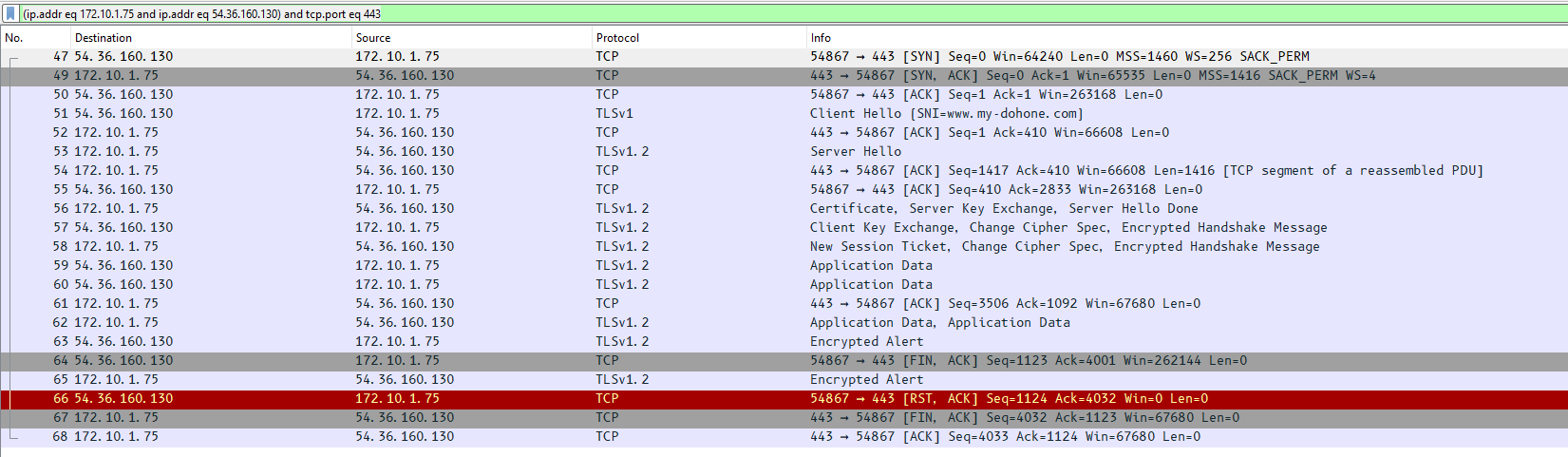
Hi guys,
I need to check my HTTPS POST REQUEST, in order to do this I try to catch it by using wireshark.
I can't see anything because of the encryption.
I try unsuccefully to use the SSLKEYLOGFILE key (windows 11), but the generated file did not increase when I trigger my code OR postman, it grows only by the action of the web browser.
My question is so simple :
1°) How have a clear view of the HTTPS request from IRIS code in wireshark
2°) Why the keylog file did not increase when trigger the code from IRIS ?
Hello,
I need a way to securely store credentials in IRIS that are used to access third-party APIs. These credentials include different clientId/secret pairs that I don't want to expose. While I know that it's possible to define Production Credentials in Ens.Config.Credentials, I understand that they are stored in plain text.
Does anyone have an idea of how to securely store credentials in IRIS? For your information, I am using IRIS with docker-compose and I am wondering if using HashiCorp Vault together with IRIS could be the solution. Has anyone used Vault before with their IRIS installations?
