Hi Community!
We are pleased to invite you to a new webinar in Spanish: ‘Facial recognition applied to application login using JavaScript+IRIS’, on Thursday 26th September, at 4:00 PM (CEST).
InterSystems IRIS is a Complete Data Platform
InterSystems IRIS gives you everything you need to capture, share, understand, and act upon your organization’s most valuable asset – your data.
As a complete platform, InterSystems IRIS eliminates the need to integrate multiple development technologies. Applications require less code, fewer system resources, and less maintenance.
Hi Community!
We are pleased to invite you to a new webinar in Spanish: ‘Facial recognition applied to application login using JavaScript+IRIS’, on Thursday 26th September, at 4:00 PM (CEST).
.png)
I attended Cloud Native Security Con in Seattle with full intention of crushing OTEL day, then perusing the subject of security applied to Cloud Native workloads the following days leading up to CTF as a professional excercise. This was happily upended by a new understanding of eBPF, which got my screens, career, workloads, and atitude a much needed upgrade with new approaches to solving workload problems.
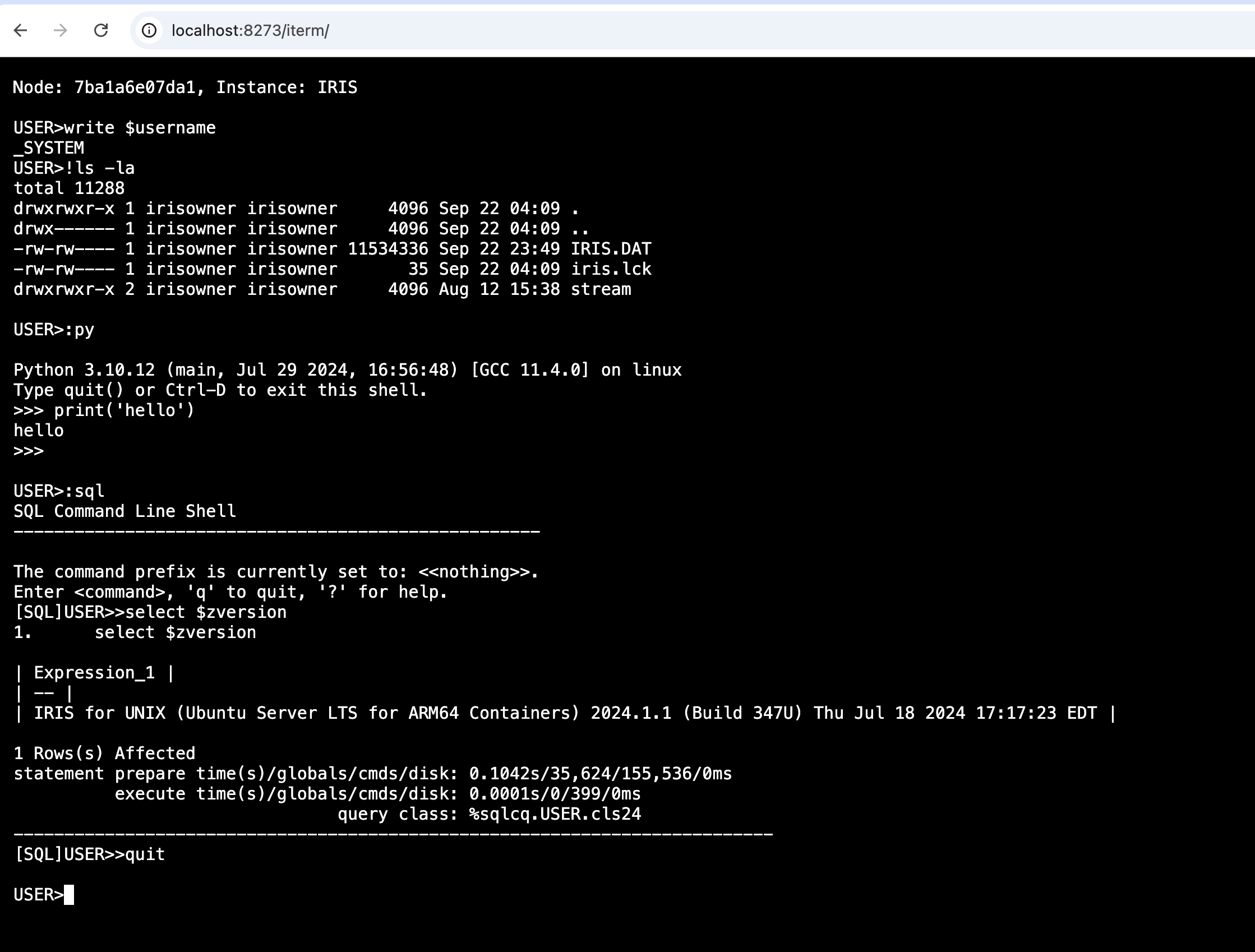
So I made it to the eBPF party and have been attending clinic after clinic on the subject ever since, here I would like to "unbox" eBPF as a technical solution, mapped directly to what we do in practice (even if its a bit off), and step through eBPF through my experimentation on supporting InterSystems IRIS Workloads, particularly on Kubernetes, but not necessarily void on standalone workloads.
.png)
An IRIS.DAT file was removed, as it was not needed anymore. But the database was mirrored, so it still shows up in the mirror monitor and database list. How can this be fixed? There is no backup of the .DAT file so it cannot be restored.
w ##class(SYS.Mirror).RemoveMirroredDatabase("/mydir/")throws a protect error.
(everything else works fine and this is not a production system, it only is annoying in the mirror monitor and database list)
In today's data landscape, businesses encounter a number of different challenges. One of them is to do analytics on top of unified and harmonized data layer available to all the consumers. A layer that can deliver the same answers to the same questions irrelative to the dialect or tool being used. InterSystems IRIS Data Platform answers that with and add-on of Adaptive Analytics that can deliver this unified semantic layer. There are a lot of articles in DevCommunity about using it via BI tools.
In SQL, NULL data and the empty string ('') are different data. The method for setting and checking each is as follows.
(1) NULL data
[SQL]
insert into test(a) values(NULL)
select * from test where a IS NULL[InterSystems ObjectScript]
set x=##class(User.test).%New()
set x.a=""(2) Empty string ('')
[SQL]
insert into test(a) values('')
select * from test where a = ''[InterSystems ObjectScript]
set x=##class(User.test).%New()
set x.a=$C(0)For more information, please refer to the following documents:
When I was searching for the ideas to migrate IRIS DB to Oracle, I could find a tool called "ESF Data Migration tools" over internet with easy steps.
Can we use them to migrate?
Link for your reference
https://www.dbsofts.com/articles/cache_to_oracle/
Thanks in advance
I need to know if given package exists or not.
Currently found two solution - one doesn't work, another works but I don't like it.
Solution 1.
I started, of course, with %Dictionary package - it has PackageDefinition class after all.
However, %ExistsId returned 0 on packages that clearly do exist, so I went to %LoadData, it uses this macro to determine if the package exist:
#define PACKAGE(%package) ^oddPKG($zcvt(%package,"u"))And zw ^oddPKG showed the root cause - ^oddPKG global only contains data for packages with tables (or something along these lines).
Solution 2.
For those of you who still use the Studio IDE for ObjectScript programming and are going through the process of migrating to VS Code, did you know there's a section in the VS Code documentation just for you? Have a look at the Migrating from Studio chapter. It covers:
And now there's a new section, Keyboard Shortcuts, that shows you the VS Code equivalent for shortcuts you may be used to, so your hands never have to leave the keyboard.
I'm trying to convert date - 2023-09-28T20:35:41Z to BST/GMT format. I tried with $ZDT($ZDTH("2023-09-28T20:35:41Z",-2),8,1) but it's giving the output as '19700101 01:33:43' and looks link the date format in $ZDTH specified is wrong. Any inputs or solution would be appreciated.
Hello,
I've recently updated the python version of a linux server running Red Hat Enterprise Linux 8.10 (Ootpa). We have an instance 2023.1 running there, and whenever I run the $System.Pyhthon.Shell() I can see it's still pointing to the old version. From within linux, it runs the latest one (we've change all the links to the new 3.11, so no scripts are broken).
So I guess the problem comes from the fact irispython is still compiled using old python version. So, how can I do to force IRIS to use the current version on the server, or update the irispython file?
Thanks!
I encountered an unexpected behavior while working with the $ZTIMEH and $ZTIME functions, specifically with times between 12:00 and 13:00. Here's what I observed:
W $ZTIMEH("08:50:38.975411826")
Output: 31838
W $ZTIME(31838,1)
Output: 08:50:38
This behavior is correct as $ZTIME returns the expected time of 08:50:38.
However, with the following example:
W $ZTIMEH("12:05:38.975411826")
Output: 338
W $ZTIME(338,1)
Output: 00:05:38
This seems incorrect to me. $ZTIME should have returned 12:05:38, but instead it returns 00:05:38.
Hi,
I'm getting an unexpected behavior when using pandas function to_sql(), which uses sqlalchemy-iris. After the first execution, a transaction seems to be opened and all rows inserted are lost after closing the connection:
engine = create_engine(f"iris://{args['username']}:{args['password']}@{args['hostname']}:{args['port']}/{args['namespace']}")
conn = engine.connect()
# rows are kept after close connection
train_df.to_sql(name='table1', con=conn, if_exists='replace', index=False)
# rows **aren't** kept after close connection
train_df.Hey Community,
Watch this video to learn how InterSystems can help you access, understand, and use your data quickly and easily:
⏯ Unleash the Power of Your Data with InterSystems @ Global Summit 2024
Currently we are exploring how we can allocate additional disk space to our current environment as we have seen a significant increase in growth of our Database files. Currently we have 3 namespaces, all with 1 IRIS.dat each that contains both the Global and Routines.
Since we have started down the route of everything within a single IRIS.dat file for each namespace, is it logical as we see growth to be able to split the current IRIS.dat for each namespace into a separate IRIS.dat for global and a IRIS.dat with for routines for each namespace in a Mirror environment?
In the preceding section, we explored the installation process and initiated the writing of the IRIS in native Python. We will now proceed to examine global traversal and engage with IRIS class objects.
get: this function is used to get values from the traversal node.
def traversal_firstlevel_subscript():
"""
^mygbl(235)="test66,62" and ^mygbl(912)="test118,78"
"""
for i in irispy.node('^mygbl'):
print(i, gbl_node.Hello developers!
Last year, for the first time, we held the Technical Article Contest on Japan's InterSystems Developer Community, and 📣 we are holding it again this year!📣
The topics are the same as last year, and you can submit any content related to InterSystems IRIS/InterSystems IRIS for Health.
🖋 InterSystems Japan Technical Article Contest – 2024: Articles related to IRIS 🖋
🎁 Participation prize:Everyone who submits a post will receive our👚Developer Community’s original T-shirt👕!!
🏆 Special Prize:Authors of three selected works will receive special prizes.
Updated on 30/8: Prize information added!Please check it out!👇
Hi community members!
I'm testing some functionalities about Foreign Tables and it works smoothly with PostgreSQL database, but I found out an issue with MySQL database, I followed the documentation:
.png)
CREATE FOREIGN SERVER Test.MySQLDB FOREIGN DATA WRAPPER JDBC CONNECTION 'MySQL'
CREATE FOREIGN TABLE Test.PatientMySQL SERVER Test.MySQLDB TABLE 'patient'
Say I want to uninstall the IKO - all I need to do is:
> helm uninstall intersystemsWhat happens behind the scenes is that helm will uninstall what was installed when you ran :
> helm install intersystems <relative/path/to/iris-operator>In some sense - this is symmetric to when we ran install - however with a different image.
You'll notice that when you install, it knows what image to take from:
operator:
registry: containers.intersystems.com
repository: intersystems/iris-operator-amd
tag: 3.713.Hello, I want to create PDF from HTML source. I found pandoc. I installed pandoc on IRIS container image. I created Interoperability production. I have setup REST service to receive HTML file in request body. I call pandoc command pandoc -o output.pdf input.html from a BPL process. I copy output.pdf file stream into response body. I save the response at the source. I get a file named output.pdf but it does not load in Acrobat. I suspect I am doing something wrong with headers (accept-encoding?) or maybe do I need to base64 encode the pdf file to transfer it via REST?
Hello all,
On one of my team's systems, we utilize a business operation with the EnsLib.SQL.OutboundAdapter to make SQL queries to another IRIS system using JDBC. To authenticate the connection, we utilize a user account on the target system.
We recently had a failure where this user account expired due to inactivity, causing all queries to error until the account was reactivated on the target system.
Hi Community,
Play the new video on InterSystems Developers YouTube:
⏯ High-Speed Ingestion Using InterSystems IRIS Persister with Java @ Global Summit 2023
Recently I got into a situation where a user had some roles, which granted additional roles, and so on.
As I did not understand where a particular permission came from, I wrote this code which gets an initial set of roles and unwraps them recursively, accounting for any repeats.
Hello,
I'm working on building some .NET Scripts/CLI tools and starting to use the .NET external language server.
I've been able to connect using the .NET SDK, but trying to understand a little how to make a call that has a output parameter. I've read that you should use IRISReference, but haven't been able to get that to work. Here is what I'm trying to do
I'm trying to make a call to the %SYS.Namespace.ListAll() method but as you will note, the first param for the method is an output param (https://docs.intersystems.com/irisforhealthlatest/csp/documatic/%25CSP…?
I'm posting this for the benefit of WebTerminal users who have upgraded to the recently-released IRIS 2024.2 -- (Build 247U) Tue Jul 16 2024 09:52:30 EDT -- or are considering doing so.
That version of 2024.2 contains a change (DP-432503) which requires that the user under which the Web Gateway initially connects to IRIS (usually CSPSystem) must have READ permission on the database hosting the dispatch class of the REST web application.
For cases where that is not true an error is raised, but this returns an HTTP 404 status to the caller instead of the expected HTTP 401.
Hi Community,
Watch this video to learn about the latest developments and what to look forward to in InterSystems IRIS:
When trying the Iris Nodejs Quickstart I do get the following message in the source code:
the necessary npm modules are installed.
Or other way round: Can Test Coverage Tool to be used with other unit testing frameworks than %UnitTest ?
Test Coverage Tool: https://openexchange.intersystems.com/package/Test-Coverage-Tool
InterSystems IRIS UnitTest framework: https://docs.intersystems.com/irislatest/csp/documatic/%25CSP.Documatic…
Hi, Community!
We're happy to introduce a new learning path created by the Online Learning team:
I have this code and I need to send
Set tRequest= ##class(Testing.Messages.GatewayCreateFacilityRequest).%New()
Set tRequest.facilityCode ="VINUSE"
Set tResponse = ##class(Testing.Messages.GatewayCreateFacilityResponse).%New()
need to send a request to a new server:
Server: ECR10
Namespace: ECR
Business Service: Healthix.Common.Verato.Gateway.Service.HubQueryService
set tResponse = ##class(Testing.Gateway.Service.HubQueryService).%New().CreateFacility(tRequest)
How do I add code to send it to the ECR10 server?
FOREIGN TABLES is a rather fresh feature in IRIS (2023.?)
So I was motivated to try something new by own hands.
Documentation of Foreign Table from File is a good starting point.
Also the related promotional video is fine to start with.