#InterSystems IRIS

19 Followers · 5.6K Posts

InterSystems IRIS is a Complete Data Platform
InterSystems IRIS gives you everything you need to capture, share, understand, and act upon your organization’s most valuable asset – your data.
As a complete platform, InterSystems IRIS eliminates the need to integrate multiple development technologies. Applications require less code, fewer system resources, and less maintenance.

Article Eduard Lebedyuk · Jul 6, 2018 9m read

In this series of articles, I'd like to present and discuss several possible approaches toward software development with InterSystems technologies and GitLab. I will cover such topics as:

  • Git 101
  • Git flow (development process)
  • GitLab installation
  • GitLab Workflow
  • Continuous Delivery
  • GitLab installation and configuration
  • GitLab CI/CD
  • Why containers?
  • Containers infrastructure
  • CD using containers
  • CD using ICM

In this article, we'll build Continuous Delivery with InterSystems Cloud Manager. ICM is a cloud provisioning and deployment solution for applications based on InterSystems IRIS. It allows you to define the desired deployment configuration and ICM would provision it automatically. For more information take a look at First Look: ICM.
0
2 1467
Question Jasenko Donlagic · Jul 3, 2018

Hi everyone,

I am still learning the platform for a student project and have to do some streaming and data analysis next. Since for my case I have no "live api" I wanted to just stream json files and output the data as it comes in from the files. (basically to emulate a incoming data scenario)

So thanks to the documentation and community posts I have figured how to create a stream and read data from a JSON but since I'm also new to JSON I have some parsing problems. I don't know how to access subarrays/sub-objects via objectscript.

2
1 2951
Question Eduard Lebedyuk · Jun 18, 2018

Let's say I have a user-generated document template with placeholders and I want to replace them with actual values.

Values could be:

  • scalars
  • tables
  • ...?

So far I wrote a simple find/replace tool that works with RTF format (because it's not a binary format), here's how it works:

set template = "D:\Cache\RTF\template.rtf"
set var("%title") = "Hello"
set var("%table") = $lb("Utils.RTF", "TestFunc")
set result = "D:\Cache\RTF\out.rtf"
set sc = ##class(Utils.RTF).
2
0 446
Announcement Michelle Spisak · Apr 30, 2018

When you hear people talk about moving their applications to the cloud, are you unsure of what exactly they mean? Do you want a solution for migrating your local, physical servers to a flexible, efficient cloud infrastructure? 

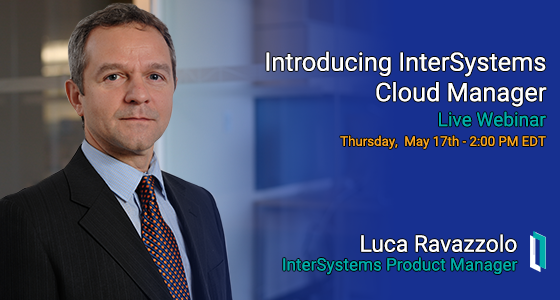
Join Luca Ravazzolo for Introducing InterSystems Cloud Manager, (May 17th, 2:00 p.m. EDT). In this webinar, Luca — Product Manager for InterSystems Cloud Manager — will explain cloud technology and how you can move your InterSystems IRIS infrastructure to the cloud in an operationally agile fashion.

3
0 554
Announcement RB Omo · May 21, 2018

This document describes considerations around SDDC and HCI solutions for InterSystems Clients.

Software Defined Data Centers (SDDC) and Hyper-Converged Infrastructure (HCI) – Important Considerations for InterSystems Clients

A growing number of IT organizations are exploring the potential use of SDDC and HCI solutions. These solutions appear attractive and are marketed as simplification of IT management and potential cost reductions across heterogeneous data centers and cloud infrastructure options.

0
0 2100
Announcement Simon Player · Sep 12, 2017

Modern businesses need new kinds of applications — ones that are smarter, faster, and can scale more quickly and cost-effectively to accommodate larger data sets, greater workloads, and more users.

With this in mind, we have unveiled InterSystems IRIS Data Platform™, a complete, unified solution that provides a comprehensive and consistent set of capabilities spanning data management, interoperability, transaction processing, and analytics. It redefines high performance for application developers, systems integrators, and end-user organizations who develop and deploy data-rich and mission-critical solutions.

 ​

2
0 1797
Article Benjamin De Boe · Jan 31, 2018 4m read

With the release of InterSystems IRIS, we're also making available a nifty bit of software that allows you to get the best out of your InterSystems IRIS cluster when working with Apache Spark for data processing, machine learning and other data-heavy fun. Let's take a closer look at how we're making your life as a Data Scientist easier, as you're probably already facing tough big data challenges already, just from the influx of job offers in your inbox!

2
0 1833
InterSystems Official Steve Brunner · Jan 31, 2018

InterSystems is pleased to announce that InterSystems IRIS Data Platform 2018.1.0 is now released.

This press release was issued this morning.

InterSystems IRIS is a complete, unified data platform that makes it faster and easier to build real-time, data-rich applications.  It mirrors our design philosophy that software should be interoperable, reliable, intuitive, and scalable.

For information about InterSystems IRIS, please visit our website here.

14
0 2300
Article Nikolay Solovyev · Apr 25, 2018 4m read

"Telegram" is a well-known instant messenger, which provides an API for creating bots. The features of this API allow you to create bots with a wide range of functionality including receiving payments. 
With the help of the telegram bot, I solved a simple task - sending Alerts from Ensemble to Telegram.

Advantages: Alerts come to the mobile phone, a notification appears, so there is no need to install any additional applications (in contrast to the solution https://community.intersystems.com/post/sending-alerts-mobile-phone-using-pushover- httpoutboundadapter).

The bot can be extended by adding new commands, for example, for managing the Production or for solving other tasks in Iris, Ensemble or Cache.

 
0
5 1489
Question Peter Steiwer · Apr 6, 2018

I am using Atelier + EGit plugins for a project. Is it possible to turn the storage definition off in Atelier so this does not get copied to Git when I make changes? While developing on different versions of the code on different systems, it may cause conflicts and excess noise in the source control history

6
0 494
Article Murray Oldfield · Mar 11, 2016 8m read

In the last post we scheduled 24-hour collections of performance metrics using pButtons. In this post we are going to be looking at a few of the key metrics that are being collected and how they relate to the underlying system hardware. We will also start to explore the relationship between Caché (or any of the InterSystems Data Platforms) metrics and system metrics. And how you can use these metrics to understand the daily beat rate of your systems and diagnose performance problems.

10
2 4292
Article Robert Cemper · Feb 16, 2018 2m read

The base class Bmap.Person defines persons within an organization distributed
by various countries. All records are indexed by (Country, PersonalId).
this structure doesn't allow use of bitmaps.

So a wrapper class Bmap.PersonQ around the data eliminates the top level of
the index (Country) and isolates the PersonalId (%Integer, MINVAL=1).
We are ready to use a Bitmap index.

A few performance figures on 300010 generated records.
You see that Relative Cost are sometimes quite misleading.

base

  select count(*) from Bmap.
0
1 983
Article Luca Ravazzolo · Feb 2, 2018 4m read

Container Images

In this second post on containers fundamentals, we take a look at what container images are.

What is a container image?

A container image is merely a binary representation of a container.

A running container or simply a container is the runtime state of the related container image.

Please see the first post that explains what a container is.

Container images consist of a basic OS substratum and all the software we need to run our service. I use the term service for a given "container solution" as a generic description of a software solution wrapped in a container.

1
0 2505
Article Benjamin De Boe · Sep 19, 2017 4m read

Last week, we announced the InterSystems IRIS Data Platform, our new and comprehensive platform for all your data endeavours, whether transactional, analytics or both. We've included many of the features our customers know and loved from Caché and Ensemble, but in this article we'll shed a little more light on one of the new capabilities of the platform: SQL Sharding, a powerful new feature in our scalability story.

11
2 1826
Article Luca Ravazzolo · Sep 21, 2017 7m read

Last week saw the launch of the InterSystems IRIS Data Platform in sunny California.

For the engaging eXPerience Labs (XP-Labs) training sessions, my first customer and favourite department (Learning Services), was working hard assisting and supporting us all behind the scene.

Before the event, Learning Services set up the most complicated part of public cloud :) "credentials-for-free" for a smooth and fast experience for all our customers at the summit.

3
0 1102
Article Robert Cemper · Nov 11, 2017 3m read

This should be an overview over a subject that pops up over several places in online documentation mostly as remarks and never as dedicated chapter.

Once upon a time ...  No it's not a fairy tale.
In the beginning of Caché (and before) you had your partition to run your code. Part of that partition was a space with all your local variables nicely sorted by %,A,..Z,a,...z

And whatever values or information you had to store locally was there and visible and available to any piece of code running  in your

3
1 1206
Announcement Michelle Spisak · Oct 17, 2017

Learning Services Live Webinars are back! 

At this year’s Global Summit, InterSystems debuted InterSystems IRIS Data Platform™, a single, comprehensive product that provides capabilities spanning data management, interoperability, transaction processing, and analytics. InterSystems IRIS sets a new level of performance for the rapid development and deployment of data-rich and mission-critical applications. Now is your chance to learn more!

1
0 651
Article Robert Cemper · Oct 15, 2017 3m read

As I mentioned in an early post the roots of COS were laid in the late 60ies of the 20th century.

Close to that time, BLISS was designed at Carnegie-Mellon University (January 15, 1970)
https://en.wikipedia.org/wiki/BLISS
Similarly in 1972 C language was written at Bell Labs.
https://www.bell-labs.com/usr/dmr/www/chist.html

Both were designed to overcome the portability limits of code written in assembly language.
While BLISS was running on DEC machines and vanished with Digital Equipment Corporation
C language and later C++ expanded on almost any processor technology until today.

2
0 993