Hello Everyone,
I want to Know Caché or IRIS has some way to communicate with DDE or RTD from Excel?
Att. Flávio.

InterSystems IRIS is a Complete Data Platform
InterSystems IRIS gives you everything you need to capture, share, understand, and act upon your organization’s most valuable asset – your data.
As a complete platform, InterSystems IRIS eliminates the need to integrate multiple development technologies. Applications require less code, fewer system resources, and less maintenance.
Hello Everyone,
I want to Know Caché or IRIS has some way to communicate with DDE or RTD from Excel?
Att. Flávio.
Since version 2019.2, InterSystems IRIS has provided their Native API for Python as a high-performance data access method. The Native API allows you to directly interact with the native IRIS data structure.
Preview kits are now published via the WRC's preview download site for:
The build number for these releases is 2019.1.1.608.0.
This is a maintenance release and includes changes in a number of areas, as described in the online documentation here.
It also includes three new features, described in the online documentation here:
Code golf is a type of recreational computer programming competition in which participants strive to achieve the shortest possible source code that implements a certain algorithm.
Here's a list of Code Golf competitions we had on Developers Community.
And some interesting challenges:
Did I miss something? Add more challenges in comments.
Just wanted to share my Zabbix template for monitoring InterSystems IRIS on Linux servers.
It monitors irisusr (configurable) memory consumption:
How to use:
Is there a way to set null in dynamic object without using %Set methods?
I have this method and I need to set NULL as, well, null and not string.
ClassMethod node(name) [ CodeMode = expression ]
{
{
    "name":(name),
    "content":($case(##class(%Dictionary.ClassDefinition).%ExistsId(name), $$$YES:"mycontent", $$$NO:"NULL"))
}
}Hi Community,
Our latest issues of Developments and Developments Healthcare Edition have been posted to the Developments Archive site, where you'll also find other previous issues. Learn about InterSystems API Manager, preview releases of InterSystem IRIS and IRIS for Health, and live webinars this month about how you can easily move your Ensemble or Caché applications to InterSystems IRIS.
Optimize your investment in InterSystems technology by subscribing to these and other InterSystems publications.
Hi,
I want to do ordering dynamically in Query. I mean to say that order by value will not be hard coded in query, it will be passed in parameter.
I have tried to it following way, but it is not working for me. Can you please advise me how can I achieve it?
In below code, Order by :objSearch.SortingField is not working.
Class Query.ExternalUsers Extends %Library.RegisteredObject [ ClassType = "", DdlAllowed, Owner = {_SYSTEM}, Not ProcedureBlock ]

{


Query Search(objSearch As LISSystem.ModelView.We've just published an update to the Serenji extension for VS Code. Starting with this version (3.0.7) you can now debug the code that implements your REST services. Here's a taster:
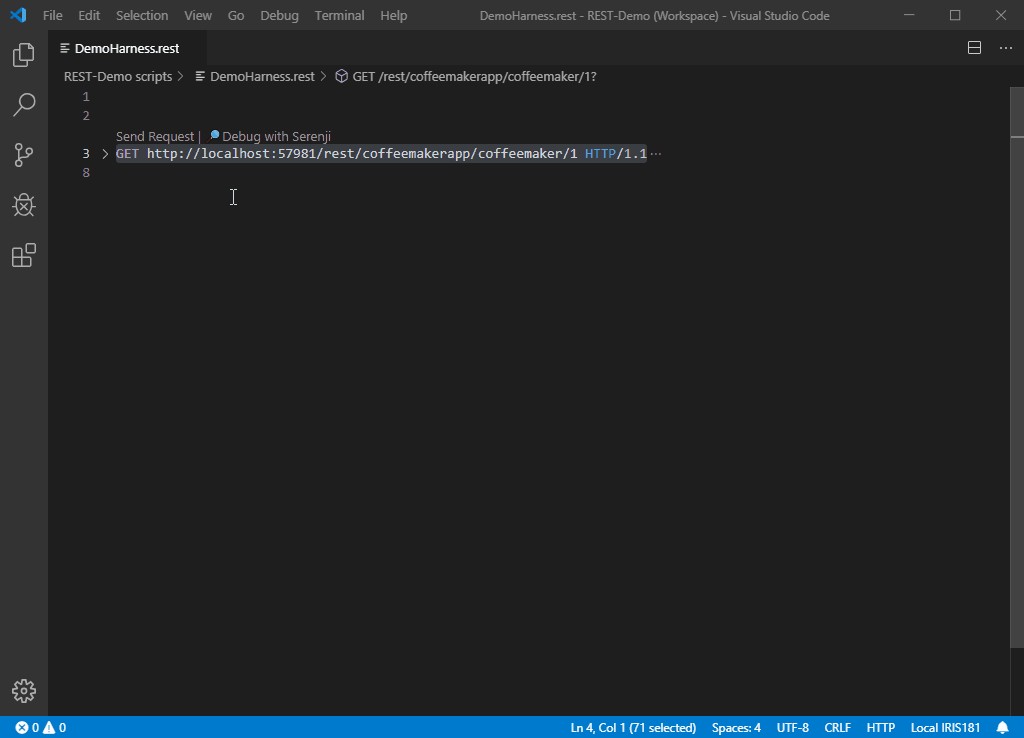
Read more about Serenji on Open Exchange.
Hi Community!
Enjoy watching the new video on InterSystems Developers YouTube, recorded by @Thomas Carroll, Cloud Market Technical Specialist at InterSystems.
How Are Containers Different From Virtual Machines?
Hi Developers!
Suppose I have a project where I want to build an IRIS container with two different dockerfiles depending on goals. How can I make it?
The issue is that docker-compose is looking for the file with name 'dockerfile'
Are there any #IF constrations in a dockerfile syntax?
Commenting works but sometimes it's more than one line.
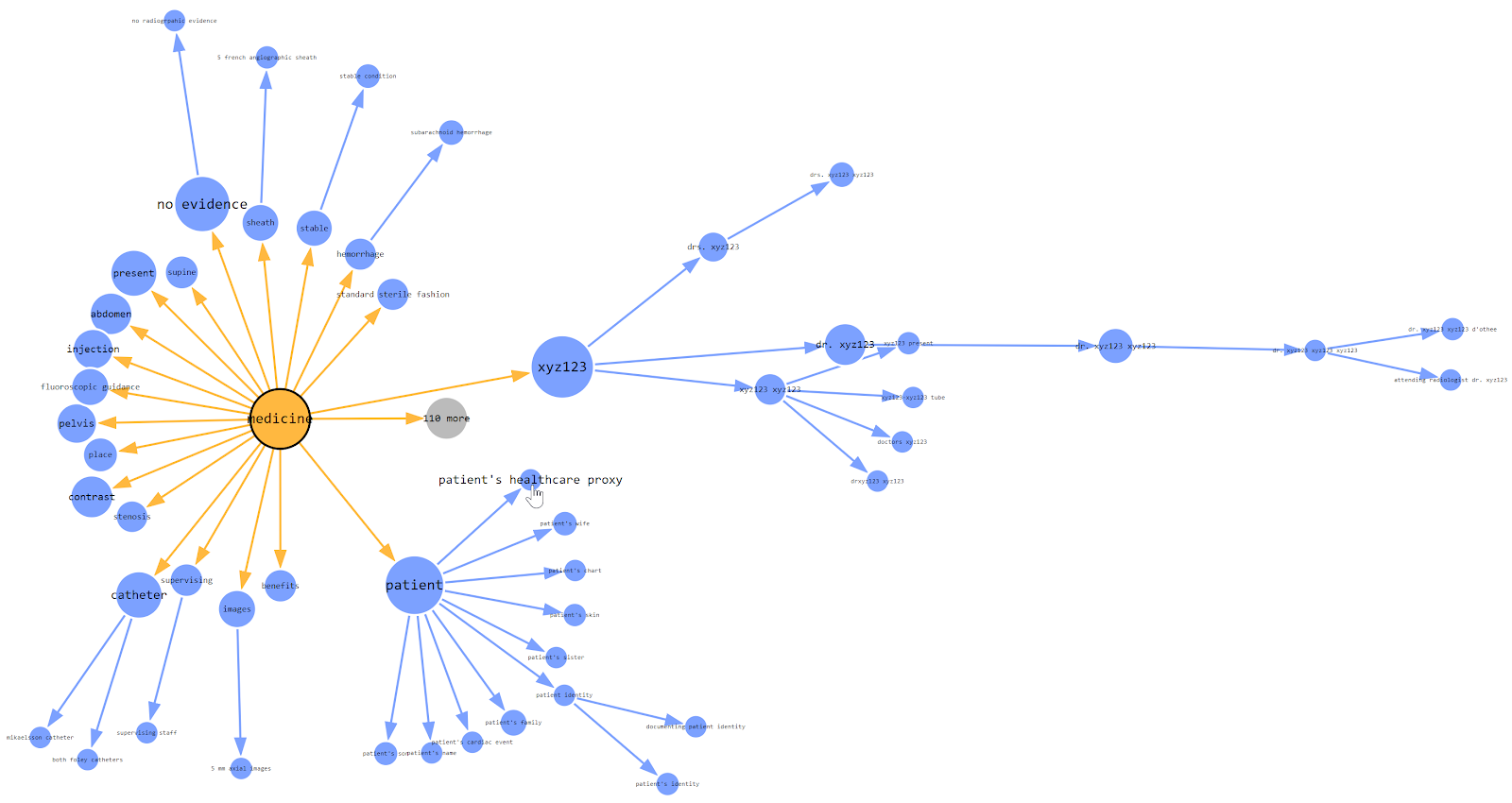
This article introduces InterSystems iKnow Entity Browser, a web application which allows to visualize extracted and organized text data mined from a large number of texts, powered by InterSystems iKnow technology, which is also known as InterSystems Text Analytics in InterSystems IRIS. Feel free to play with the demo of this tool or learn more about it on InterSystems Open Exchange.
I started the development of this project in late 2016. From now on, my iKnow Entity Browser is used around the world by those who use InterSystems technology in their stack and those who do text mining.
Hey Developers!
We are pleased to invite you to the upcoming webinar "InterSystems MLToolkit: AI Robotization" on 18th of September at 10:00 (GMT+3)!

Hi Community!
New video is already on InterSystems Developers YouTube Channel:
OAuth server to be deployed on the IRIS learning cloud platform. Clients - one on the other instance of the learning IRIS server, the other client locally on my computer in the container docker.
Both clients get a seemingly correct link (through ##class(%SYS.OAuth2.Authorization).GetAuthorizationCodeEndpoint()) to the login request form:
https://52773b-62955584.labs.learning.intersystems.com/oauth2/authorize?response_type=code&client_id=nHCv5A-u_5T1YAwk_tJ7xpi1ky-s2AnRQMaL6YHsUgU&redirect_uri=https%3A//52773b-99792125.labs.learning.intersystems.com/csp/sys/oauth2/OAuth2.Response.
Hi,
I'm sure I'm not the only one who's already assembling matching pairs of socks for this year's Global Summit in Boston later this month  . In case you haven't registered yet or are still looking for the right justification to get the eventual approval to attend, here's a quick overview of all the sessions around Data Management and Analytics:
Hello everyone,
After some work with IRIS we want to share our ToolBox-4-Iris with you.
What is this about?
The ToolBox-4-Iris is an API for IRIS with a collection of handy and useful tools - features that are not available in IRIS, but greatly simplify application development. To save time and effort on the "typical tools" that every developer needs. This includes additional classes, individual methods or even more efficient macros, which are described in the respective packages.
Content
Macros
General ObjectScript macros, Status macros, National Language Support macros, and JavaScript macros.
I want to assign below query result into my Person class which have Name,DOB properties, and then convert into JSON.
SELECT Name,DOB FROM Sample.Person
I got below error when passing Date in timestamp format.
I am using %JSON.Adaptor. Please refer screen 2
.png)
.png)
.png)
Some time ago, InterSystems introduced the concept of %DynamicObjects.
This feature is a powerful tool that makes it very easy to convert any string of JSON text to objects and vice versa.
However, in the work that J2 Interactive is doing for our customers, there are a couple of things that "need some tweaking".
Very often, we create REST services for our customers. Those services have a payload (in JSON format) that contains information that our customer expects in the form of an object that is proprietary to them.
Hello everyone!
Hi Team,
I am using %JSON.Adaptor class for Json validation.
Using below statement I got only one required field validation.(refer below screen)
SET stat = objExternalUser.%JSONImport(%request.Content)
I need summary of all required field.
.png)
.png)
Hi Everyone!
New video, recorded by @Benjamin De Boe, is already on InterSystems Developers YouTube:
Scaling Fluidly with InterSystems IRIS
I need RowId of inserted record.
I have used below logic to get max row id,
but it will not give desired result when multiple people enter record in the table at the same time.
.png)
Hi Community!
Sometimes I meet a method which accepts 10+ parameters.
And often I need only the 8th parameter to pass. And I call the method something like:
do ##class(Some.Feature).Method(,,,,,,,"flag")And I don't like this method when I call it like this cause, you know, often I just miss the number of commas and raise some other flag I wanted.
How do you avoid this situations?
If you meet such a code, how do you call it and sure that you didn't miss the number of ","?
What is a good number of parameters in a method and f you need to pass more parameters in a method what do you do?
Can you please provide steps to debug in VS code using serenji and how to put break point in VS code, I have tried using F9 but it is not working.
I want to debug API code using postman.
Hello, I have a task created in my task manager, calling my Business Service class, and it's working fine.
But I need to know the ID of the task, I searched within the class %SYS.Task.Definition and found nothing related.
 Class Example.Tasks Extends %SYS.Task.Definition
{

Property BusinessService As %String [ InitialExpression = "Example" ];


Method OnTask() As %Status
{
  SET tSC = $$$OK
  TRY {

  SET tSC = ##Class(Ens.Director).CreateBusinessService(..BusinessService,.tBS)
  SET tRequest = ##class(Ens.Request).%New()
  SET tSC = tBS.OnProcessInput(tRequest
Our team is reworking an application to use REST services that use the same database as our current ZEN application. One of the new REST endpoints uses a query that ran very slowly when first implemented. After some analysis, we found that an index on one of the fields in the table greatly improved performance (a query that took 35 seconds was now taking a fraction of a second).
We saw this improvement on our development system and our test system. However, when we moved the code to the production system, the query still took “forever”. What went wrong?
Hi Community!
Enjoy watching the new video on InterSystems Developers YouTube, recorded by @Joel Solon, InterSystems Senior Technical Trainer:
I have created store procedure using management portal.
how to alter or modify SP using SQL in management portal.
Please refer below screen.
.png)